Category: ARTIFICIAL-INTELLIGENCE

  • The Semiconductor AI Will Design The Silicon It Needs

    Photo by Google DeepMind on Unsplash


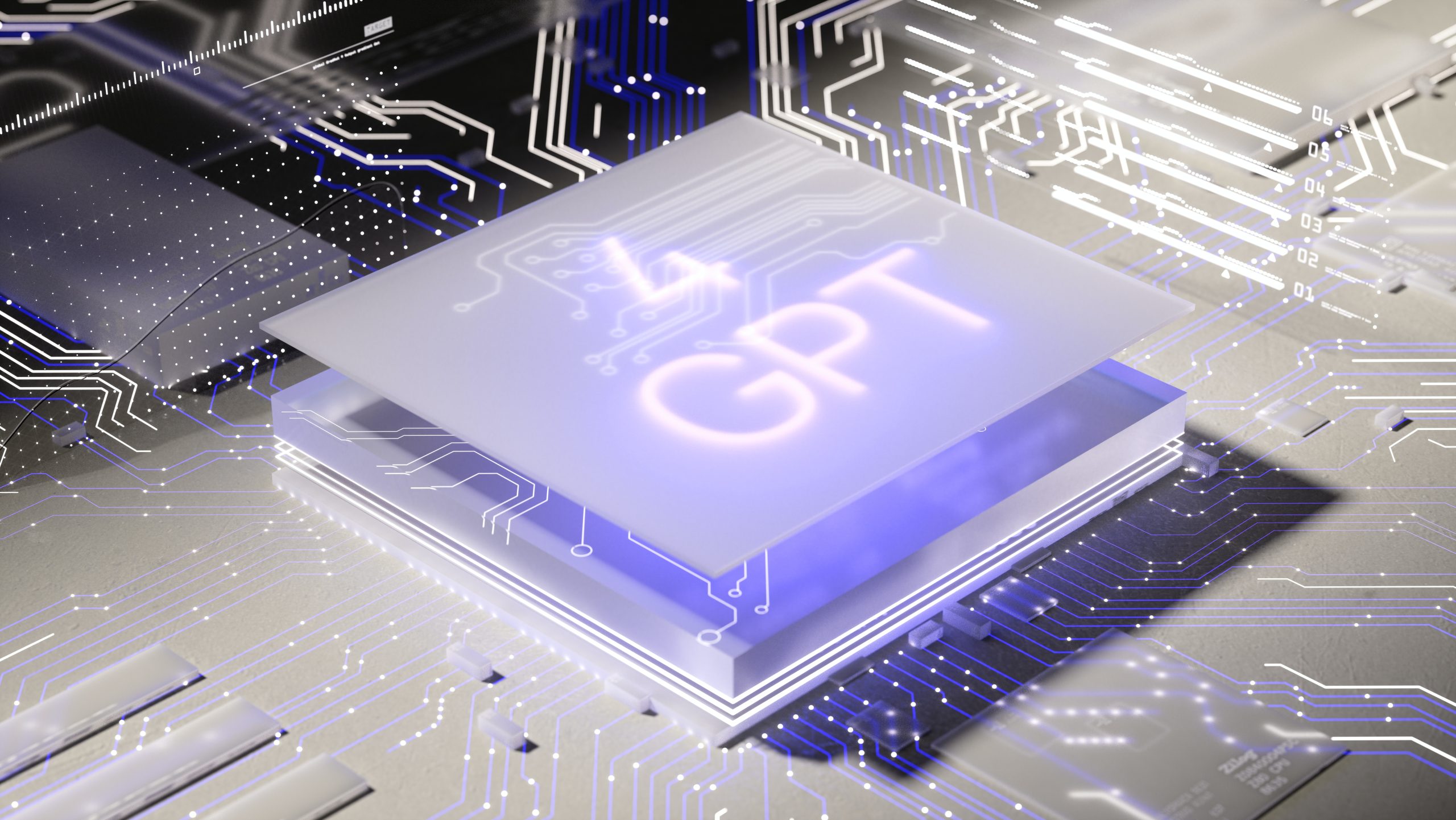
    Artificial General Intelligence (AGI) is a hypothetical type of artificial intelligence that can understand or learn any intellectual task a human can. AGI is still a long way off, but if achieved, it could profoundly impact several technological areas, including the design of silicon chips used for AI applications.

    One of the biggest challenges in designing silicon chips is balancing performance with power consumption, apart from enabling a set of blocks to process and manage the workload without slowing down the system. As chips become more powerful, they also become more power-hungry. AGI could solve this problem by identifying the bottlenecks in current silicon chip designs across numerous fragments and their workloads. AGI could then use this information to develop unique design architectures that are more efficient and power-friendly.

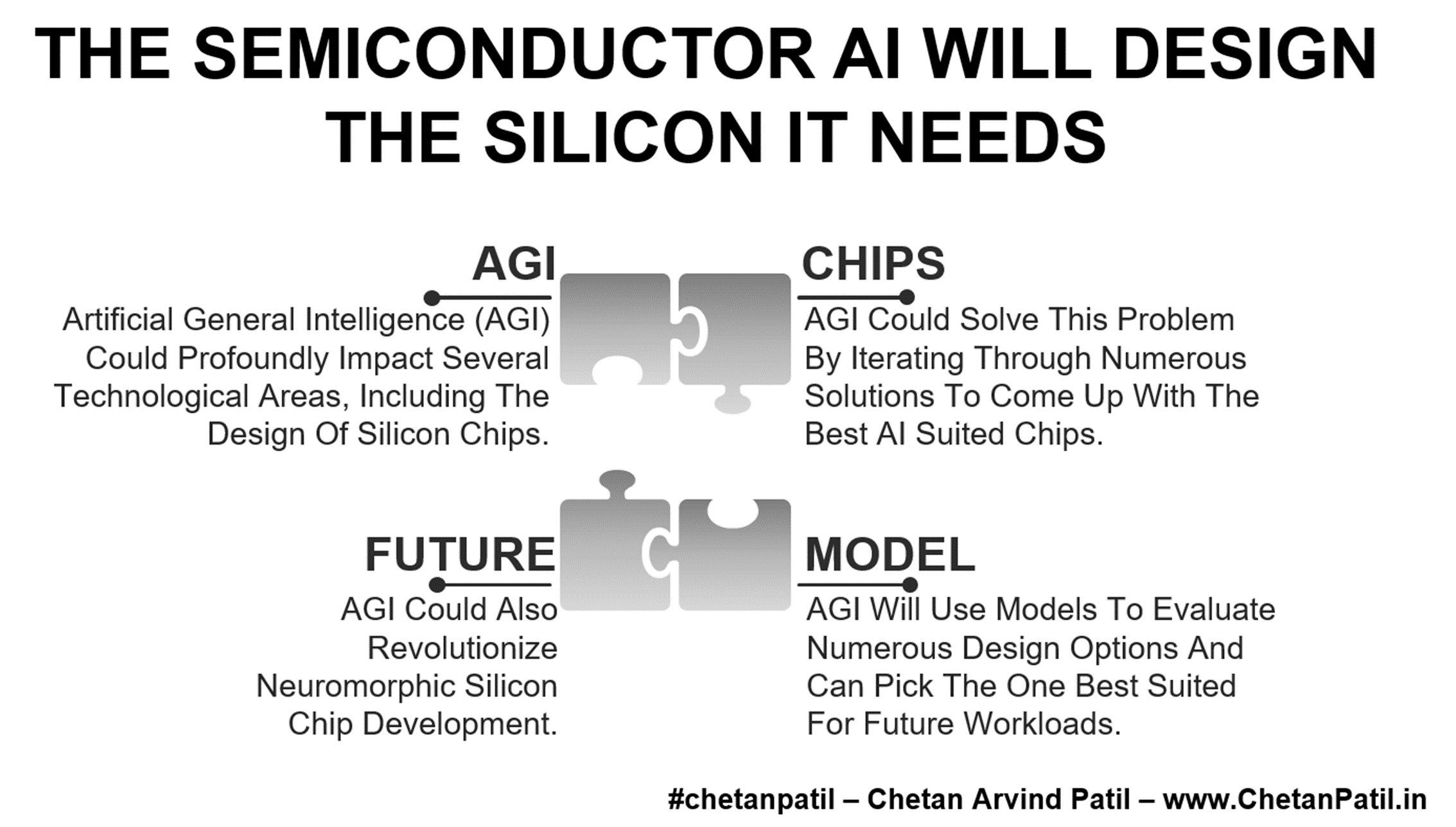
    AGI: Artificial General Intelligence (AGI) Is Still A Long Way Off. If Achieved, It Could Profoundly Impact Several Technological Areas, Including The Design Of Silicon Chips.

    Chips: AGI Could Solve This Problem By Iterating Through Numerous Solutions To Come Up With The Best AI Suited Chips.

    In addition to improving performance and power efficiency, AGI could also help design silicon chips tailored explicitly for AI applications. For example, AGI could design chips better at processing large amounts of data or more efficient at learning new patterns. It will be able to do so due to capturing the ins and outs of how different workloads have performed. Currently, this task is very manual, and with AGI, it is possible to speed up the analysis flow tremendously.

    Another example: AGI might identify that the chip’s memory bandwidth is a bottleneck. It means the chip cannot access its memory fast enough (compared to the expectation) to meet the application’s demands. AGI would then use this information to develop a new design architecture that improves the chip’s memory bandwidth.

    Picture By Chetan Arvind Patil

    AGI will use data and modeling to design next-gen AI silicon chips in several ways. First, AGI will capture data from numerous existing chips to identify the commonality in lack of performance. This data will include information about the types of AI applications, the amount of data these applications need to process, and the available power budget.

    Second, AGI will use models to predict the performance of different chip architectures. These models will be per the AGI’s data from current chips. AGI will use these models to evaluate other design options and choose the one most likely to meet the performance requirements of future chips.

    Model: AGI Will Use Models To Evaluate Numerous Design Options And Can Pick The One Best Suited For Future Workloads.

    Future: AGI Could Also Revolutionize Neuromorphic Silicon Chip Development.

    Finally, AGI will combine data and models to optimize the design of next-gen AI silicon chips. This optimization will include factors such as the chip’s architecture, the size of its transistors, and the materials used to build it. AGI will also use its knowledge of physics and chemistry to optimize the chip’s design for performance, power efficiency, and scalability.

    The development of AGI for silicon chips is still in its early stages, with few examples of designing chips on its own. However, it has the potential to revolutionize the way that we design and build silicon chips. By working together, AGI and neuromorphic silicon chips could create a new generation that is more powerful, efficient, and scalable than possible.
  • The Semiconductor AI Dependency

    The Semiconductor AI Dependency

    Photo by Bill Fairs on Unsplash


    Artificial Intelligence (AI) is a rapidly growing field revolutionizing many industries. However, AI highly depends on semiconductors, the electronic components that power computers and other devices.

    Semiconductors are essential for AI because they provide the processing power and memory needed to run AI algorithms. For example, AI algorithms for image recognition require a lot of processing power to analyze large images. AI algorithms for natural language processing require a lot of memory to store and process large amounts of text data.

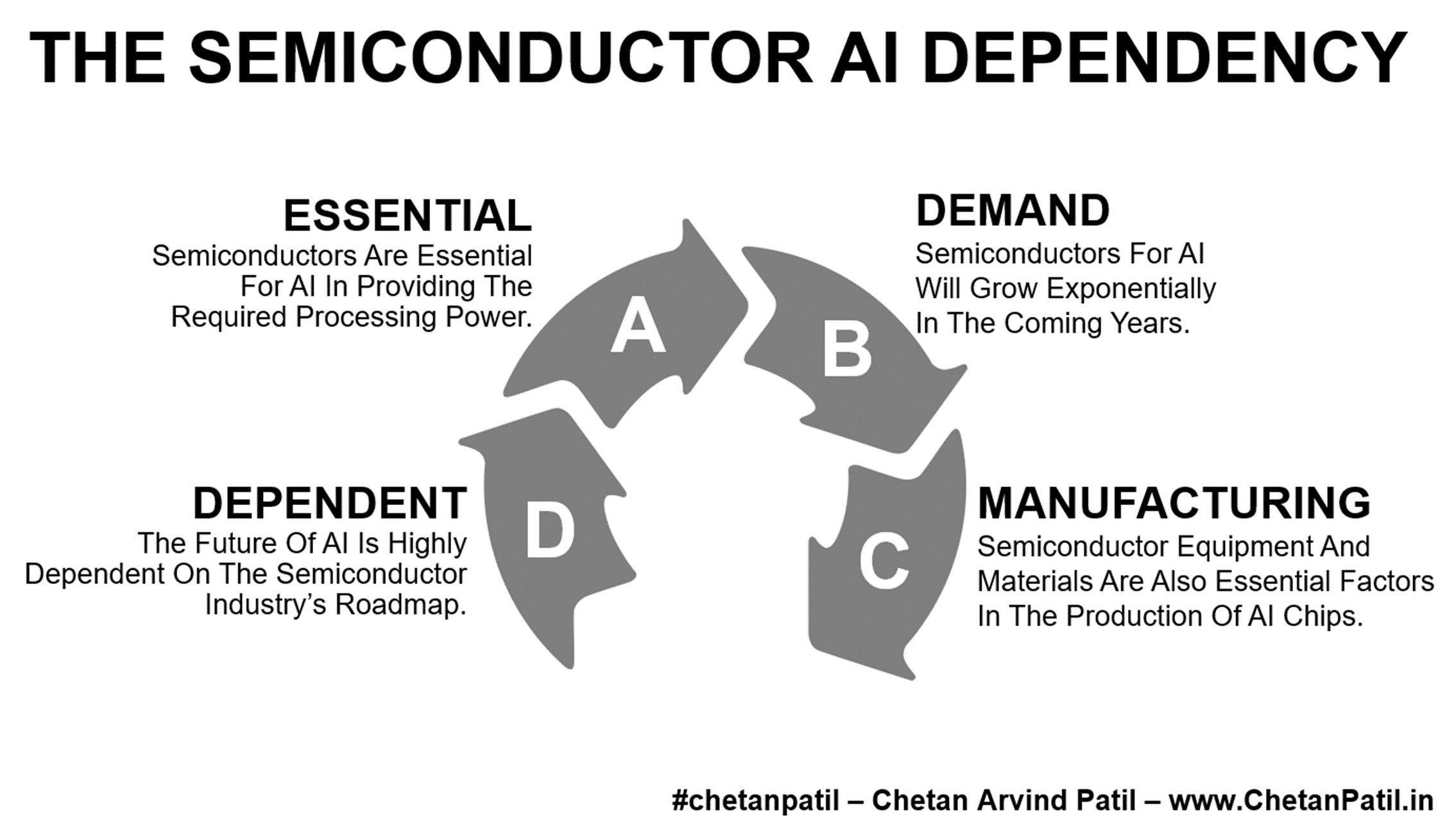
    Essential: Semiconductors Are Essential For AI In Providing The Required Processing Power.

    Demand: Semiconductors For AI Will Grow Exponentially In The Coming Years.

    The demand for semiconductors for AI will grow exponentially in the coming years. It is because AI is getting deployed in more and more applications, such as self-driving cars, healthcare, and manufacturing.

    The growth of AI also drives innovation in semiconductor design and manufacturing. For example, advanced semiconductor materials provide the performance and power efficiency needed for AI applications.


    Picture By Chetan Arvind Patil

    Semiconductor design is also critical to AI chips’ performance and efficiency. As AI algorithms become more complex, semiconductor designers will need to develop new ways to optimize the performance of AI chips. For example, semiconductor designers will need to find ways to reduce the power consumption of AI silicon while still maintaining high performance.

    Semiconductor manufacturing is also a critical factor in the performance and cost of AI chips. As the demand for AI chips grows, semiconductor manufacturers will need to find ways to increase the production capacity of AI chips. In addition, semiconductor manufacturers will need to find ways to reduce the cost of AI chips while still maintaining high quality.

    Manufacturing: Semiconductor Equipment And Materials Are Also Essential Factors In The Production Of AI Chips.

    Dependent: The Future Of AI Is Highly Dependent On The Semiconductor Industry’s Roadmap.

    Semiconductor equipment and materials are also essential factors in the production of AI chips. As the demand for AI chips grows, semiconductor equipment and materials suppliers will need to develop new technologies that can meet the needs of AI chip manufacturers.

    The future of AI is highly dependent on the semiconductor industry’s roadmap. As AI continues to grow, the demand for semiconductors will also increase. It will drive semiconductor design, manufacturing, equipment, and materials innovation. Developing new semiconductor technologies will help make AI more powerful, efficient, and affordable – an existing time for both the AI and semiconductor industry.


  • The Semiconductor AI Chip Stack

    The Semiconductor AI Chip Stack

    Photo by D koi on Unsplash


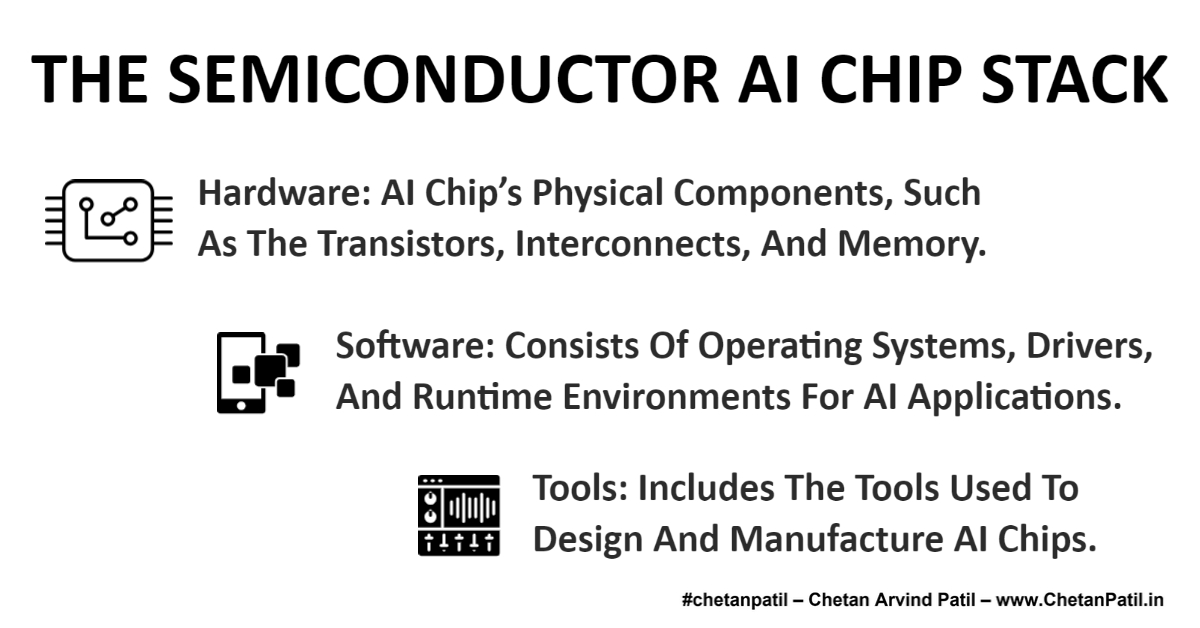
    Artificial intelligence (AI) is rapidly evolving as a critical application enabler. However, the high computational requirements of AI algorithms pose a challenge for semiconductor design and manufacturing. It is where the AI chip stack comes into the picture and will undoubtedly change AI-focused hardware, software, and tools development.

    AI Chip Stack: The AI chip stack is a layered approach to designing and manufacturing AI chips. It consists of three layers:

    Hardware: AI chip’s physical components, such as the transistors, interconnects, and memory.

    Software: Consists of operating systems, drivers, and runtime environments for AI applications.

    Tools: Includes the tools used to design and manufacture AI chips.

    These three layers of the AI chip stack also require IPs. These IPs provide access to the hardware and software components of the chip stack and enable developers to design and manufacture AI chips tailored to their applications’ specific requirements. It will be more relevant to the chiplet way of silicon development.

    These AI chip stack IPs also require software APIs like EDA tools. These tools provide a Graphical User Interface (GUI) for designing and manufacturing AI chips. They also offer a range of features that make creating and manufacturing AI chips easier, such as automated place and route, verification, and timing analysis.


    Picture By Chetan Arvind Patil

    Unfortunately, the AI chip stack is a complex and rapidly evolving field today. However, it offers a promising solution to the challenge of meeting the high computational requirements of AI algorithms. Providing access to the hardware and software components of the chip stack, semiconductor design, and manufacturing APIs enable developers to design and manufacture AI chips tailored to their applications’ specific requirements.

    Some of the benefits offered by AI chip stack flow:

    Increased Performance: The AI chip stack can deliver significantly higher performance than traditional CPU and GPU architectures. It is because the AI chip stack is specifically for the high computational requirements of AI algorithms.

    Reduced Power Consumption: The AI chip stack can consume significantly less than traditional CPU and GPU architectures.

    Increased Flexibility: The AI chip stack can be customized to meet the specific requirements of different AI applications. This flexibility allows developers to create optimized AI applications for their particular needs.

    Challenges faced by the AI chip stack flow:

    High Cost: The AI chip stack is typically more expensive than traditional CPU and GPU architectures. The AI chip stack is a newer technology, and there is less competition in the market.

    Long Development Time: The AI chip stack can take longer to develop than traditional CPU and GPU architectures. It is because the AI chip stack is a more complex technology.

    Limited Availability: The AI chip stack has yet to be widely available. It is because the technology is still in its early stages of development.

    The AI chip stack is a good design process that has the potential to revolutionize the way AI silicon and applications are developed and deployed. As the technology matures and AI chip stack costs decrease, the semiconductor industry can expect to see more AI applications powered by AI chips.


  • The Ways In Which Software Has Used Semiconductor To Be AI Ready

    Photo by DeepMind on Unsplash


    The semiconductor industry has significantly contributed to the development of Artificial Intelligence (AI). Semiconductors have enabled software developers to create AI-ready applications by providing the necessary hardware components.

    It has allowed for faster and more efficient processing of data, as well as improved accuracy in decision-making. In addition, semiconductors have enabled software developers to create more robust algorithms that can perform various tasks, such as image recognition and natural language processing.

    AI-Ready: Semiconductors And Software Go Hand In Hand In Creating AI-Ready Solutions.

    Silicon: Underlying Silicon Architecture Is Critical In Ensuring The End AI Product Meets User Experience.

    As a result, AI-ready software is readily available in many industries, including healthcare, finance, and retail. On top of all this, with the help of semiconductor technology, AI-ready tools are increasingly being deployed to automate processes and make decisions with greater accuracy than ever before.

    One key differentiator of how good a semiconductor product is for the AI application is the type of semiconductor technology used. Primarily, semiconductor technologies that reduce power consumption and latency while improving performance are preferred.


    Picture By Chetan Arvind Patil

    All AI-ready software companies have one common trait. They have used semiconductor solutions to their advantage, first by deploying at a larger scale and then using them to come up with initial AI-focused models and then improving the underlining silicon architecture by creating custom silicon that can accelerate the AI applications.

    It has been a common trend that several of the AI giants have followed. It also shows how well these companies have utilized semiconductors to develop next-gen software solutions. It has required a lot of planning and investment and a roadmap that has now started to show results.

    Custom: Opting For Custom Silicon Architecture Is Far Better Thant Adopting Generic Silicon.

    Technology: Internal Silicon Technology Is Also Crucial In Providing Long-Term Benefits To AI Workload.

    To keep driving the AI-ready software, the process node used in semiconductor technology will also play a key role as it allows for more data to be processed at once (based on the technology generation), thus resulting in faster processing speeds and improved throughput, a must-have for AI solutions.

    Overall, the semiconductor industry will play an essential role in AI-ready applications. However, it also requires a greater understanding of how the internals of any XPU architecture works, and then aligning the features with them can provide benefits in the long term.


  • The Impact Of AI On Semiconductor Manufacturing

    The Impact Of AI On Semiconductor Manufacturing

    Photo by DeepMind on Unsplash


    Artificial Intelligence (AI) plays an increasingly important role in semiconductor fabrication. AI is being used to automate the semiconductor process of designing and manufacturing semiconductors and optimize the process for maximum efficiency.

    Additionally, AI detects and diagnoses problems in the fabrication process, allowing for faster resolution. However, deploying AI in this sector comes with a price. Irrespective, AI can help reduce overall operational costs, increase productivity, and improve product quality.

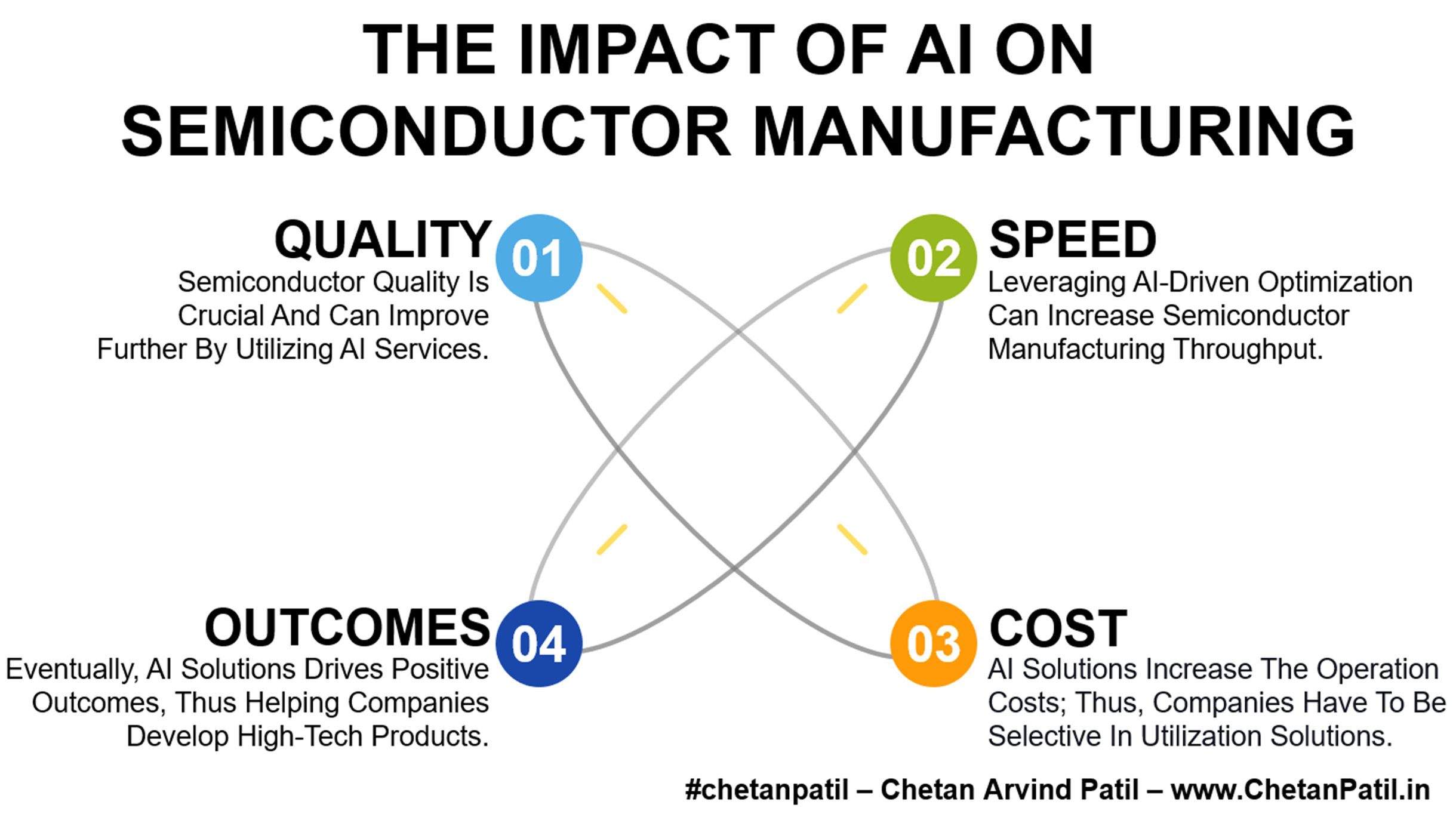
    Quality: Semiconductor Quality Is Crucial And Can Improve Further By Utilizing AI Services.

    Speed: Leveraging AI-Driven Optimization Can Increase Semiconductor Manufacturing Throughput.

    AI-driven automation can also help streamline the manufacturing process from design to delivery by analyzing the fabrication process data, identifying defects, and optimizing procedures. AI can automate several aspects of the fabrication process, allowing for faster production times and improved quality control.

    However, deploying AI in semiconductor manufacturing can take time and effort. It requires significant resources to develop AI applications’ algorithms, hardware, and software. On top, the cost of training and maintaining the AI system is also high.


    Picture By Chetan Arvind Patil

    Several factors drive the cost of AI in semiconductor manufacturing. Such as the complexity of the application, the size of data sets used for training, and the number of resources required to maintain it. Furthermore, additional costs are associated with integrating existing systems with new AI solutions. These factors increase the cost of deploying AI in the semiconductor industry.

    Nevertheless, the future of AI in a semiconductor is encouraging. With the help of AI, semiconductor companies can develop more efficient and cost-effective solutions for their customers. Several design and manufacturing process steps currently rely on AI solutions to speed up analysis and thus help speedy production output.

    Cost: AI Solutions Increase The Operation Costs; Thus, Companies Have To Be Selective In Utilization Solutions.

    Outcomes: Eventually, AI Solutions Drives Positive Outcomes, Thus Helping Companies Develop High-Tech Products.

    One of the better use cases of AI in semiconductor manufacturing is to predict future trends in the industry, which can help develop new products and services tailored to market needs. As a result, semiconductor companies will be able to stay competitive in the market and provide better products and services for their customers.

    AI is revolutionizing the semiconductor industry by providing a range of benefits. AI-enabled semiconductors can perform complex tasks with greater accuracy and speed than ever before. With all such advantages, it is no wonder that AI is becoming an increasingly important part of the semiconductor industry.


  • The AI Semiconductor Stack

    The AI Semiconductor Stack

    Photo by Jelleke Vanooteghem on Unsplash


    The use cases of Artificial Intelligence are increasing year after year. To deliver the much-required performance, the silicon technology platform is critical. The computing industry has developed different types of AI-inspired applications and is now looking for a perfect silicon architecture that can cater to different application scenarios.

    In this process, the semiconductor industry has provided the silicon platforms like GPUs, TPUs, NPUs, and AIUs. The common trait across these silicon platforms has been the internals on how different data processing occurs. Eventually, the AI applications require high throughput to ensure the time taken to perform inference and training is the smallest possible.

    Memory Management: AI Semiconductor Stack Demands Speedy And Error-Free Data Movement Via Memory Stacks.

    Data Storage: Enabling On-The-Go Analysis Requires Silicon AI Semiconductor Stack That Can Provide Ample Amount Of Data Storage.

    The internals of AI Stack for semiconductor solutions requires near-perfect memory management. The key to handling a large data set is memory. The silicon architecture has to ensure that the AI application is not running into memory bottlenecks. If they do, the silicon architecture will slow down the AI application and eventually harms the customer experience.

    Silicon architecture also has to ensure that data management is not a bottleneck. It requires an interaction between the upper-level memories (caches) with the lower-level (disk)memories. The penalty of slow processing across these two levels is on processing time, which is a critical component of AI applications.


    Picture By Chetan Arvind Patil

    As the application of AI grows further, the computing power will have to also increase with it. Thus, on top of the memory management and data movement, the two other critical components are data logic and network-on-a-chip.

    Data logic ensures the processing aspect is error-free, thus no bottlenecks when interacting with different sub-blocks. It is a critical requirement of high-performance processors and an area that academic and industry researchers have continuously worked to enhance.

    Data Logic: Underlying Data Pipeline Needs Logic Blocks That Can Ensure There Are No Processing Bottlenecks.

    Network Of Chips: Single Die Is Not Doing To Work For AI Semiconductor Stack. It Is Where Networks Of Multi-Die Is Needed.

    Apart from all the technical considerations, the last part of the AI Semiconductor Stack is cost. Eventually, the silicon solution deployed to handle the AI applications should be cost-friendly. It means the cost of processing per bit does not negatively impact the business side of the AI use case.

    The computing industry will keep launching novel uses cases for AI applications. Today, it is ChatGPT. Tomorrow it will be something else. Eventually, the underlying silicon architecture will have to cater to all the changing requirements and thus will have to ensure all the AI Semiconductor Stacks are technically robust and business-wise budget-friendly.


  • The Semiconductor Push For Artificial Intelligence Unit

    The Semiconductor Push For Artificial Intelligence Unit

    Photo by DeepMind on Unsplash


    System-On-A-Chip (SoC) has been in the market for decades. The core-level features have provided the much-needed processing capabilities to drive data-driven applications.

    However, the capabilities provided by the underlying architecture of SoC are not suitable for applications that are always crunching and training the data. For such applications, a faster processing capability is a must. Which the traditional SoCs are not capable of providing.

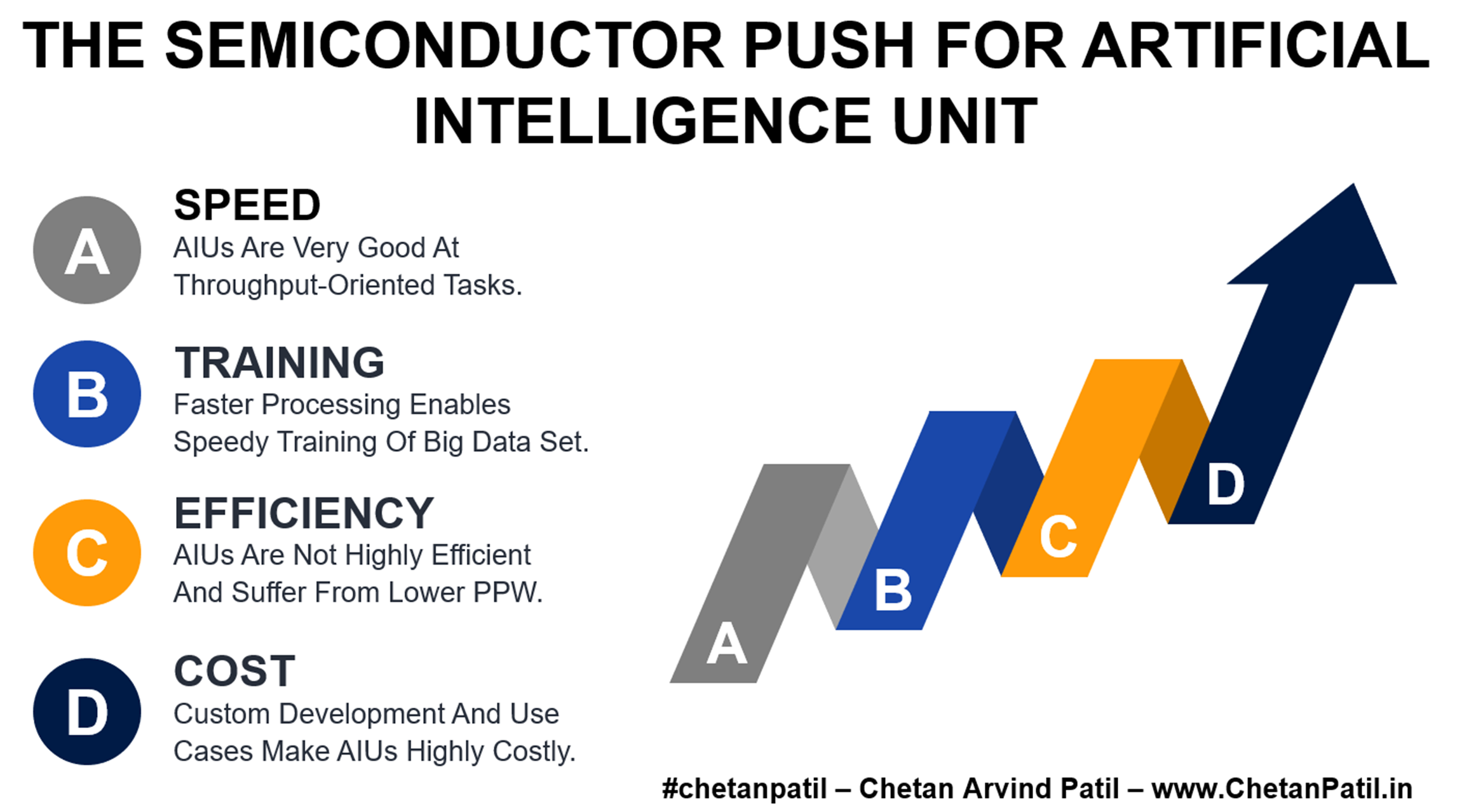
    Speed: AIUs Are Very Good At Throughput-Oriented Tasks.

    Training: Faster Processing Enables Speedy Training Of Big Data Set.

    It is where a new set of computer architecture comes into play. These are Artificial Intelligence Units (AIUs), which cater to the training demand of new-age applications. Given the purpose of AIUs is data throughput, the inference and training part of the data engineering is highly efficient compared to the traditional CPUs.

    The core reason for such high efficiency of training is math operations. AIUs can provide the required architecture and memory organization that makes the math operation near-bottleneck-free compared to any other processing unit.


    Picture By Chetan Arvind Patil

    AIUs architectures can reduce the time to train a data set drastically. At the same time, the power requirement (at the gain of performance) makes them inefficient. This efficiency is due to the power and cooling needs.

    Not just AIUs, the widely used GPUs (for data training) face this issue. So far, the semiconductor industry has not been able to derive a long-term solution to ensure that complex architectures like GPUs and AIUs are low-power while not compromising performance.

    Efficiency: AIUs Are Not Highly Efficient And Suffer From Lower PPW.

    Cost: Custom Development And Use Cases Make AIUs Highly Costly.

    AIUs are for highly specialized and specific tasks. Thus, the use case of AIUs is very niche and not a mass-market solution. The impact of such use cases is on the cost. It also raises questions on how long AIUs can be relevant if the use cases are limited.

    Nevertheless, the semiconductor industry cannot rely on traditional cores to process adaptive applications. Thus, developing solutions like AIUs is the correct course of action, and now it is up to the computing industry to make the most of such solutions.


  • The Semiconductor Requirements For AI Chip

    The Semiconductor Requirements For AI Chip

    Photo by Markus Spiske on Unsplash


    The design and development of an AI Chip is not an easy process. More so when the cost is high while the use cases are limited. It thus makes the process of selecting requirements for an AI Chip a critical one.

    These requirements for AI Chip should be a balance of both software and hardware. On the software side, it is more about ensuring the correct set of tools and libraries are available to make the most of the underlying hardware architecture. From the hardware aspect, it is specifically about ensuring the semiconductor-driven processes used eventually can create the correct hardware for the specific application.

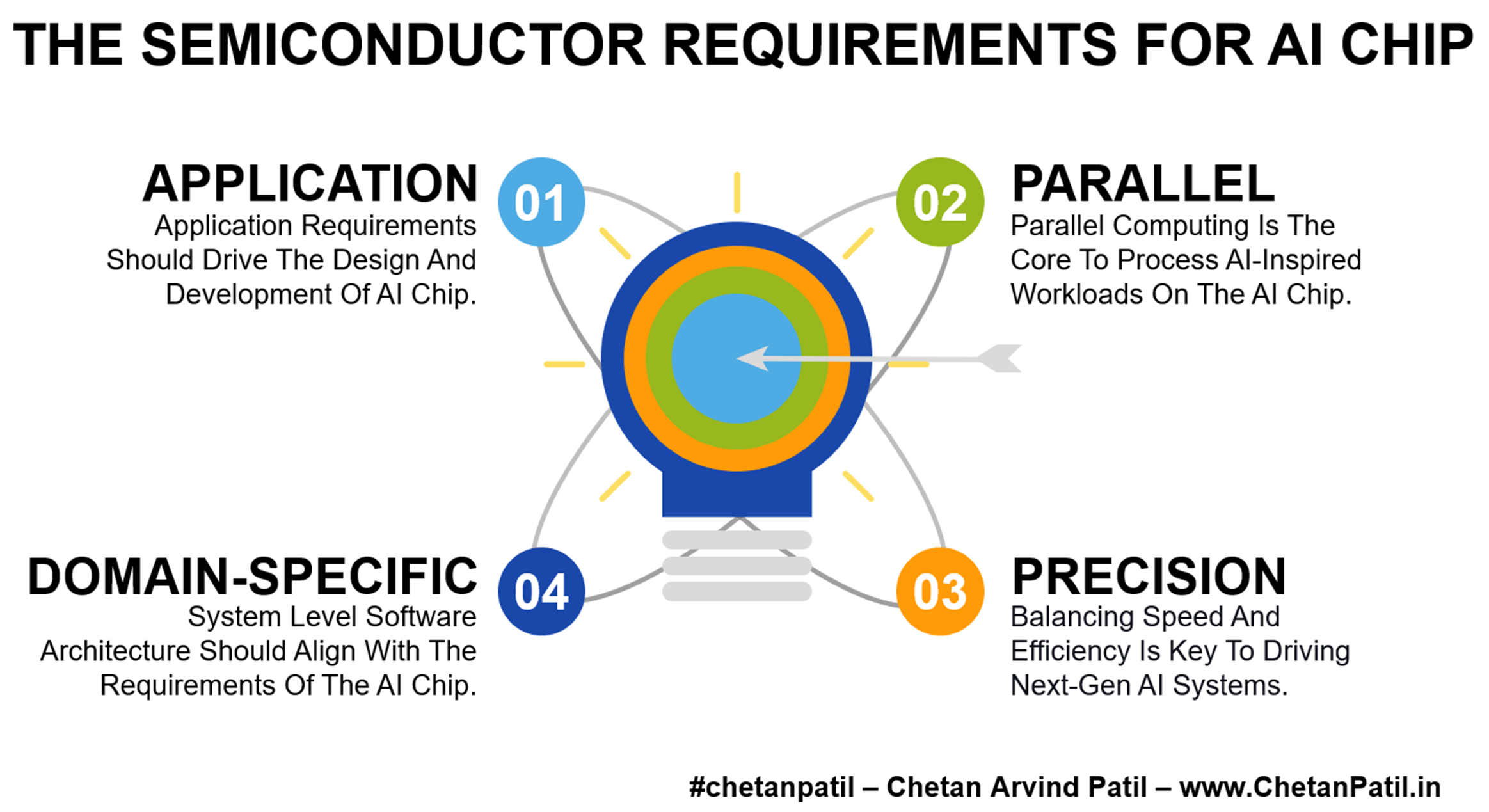
    Application: Application Requirements Should Drive The Design And Development Of AI Chip.

    Parallel: Parallel Computing Is The Core To Process AI-Inspired Workloads On The AI Chip.

    Application requirement is one of the core requirements of AI Chip. The primary reason is the cost. The application using the chip with AI-specific features should be able to make the case of ROI. Otherwise, the cost to develop, procure and use AI Chip will outweigh the gains.

    From the core technology point of view, AI Chip has to have the capability to drive parallel processing. Parallel computing has been around for decades and is de facto for any XPU. However, the premise falls short for AI applications due to the amount of data processing required while not adding latency. The data also keeps changing with the growing use case of AI.


    Picture By Chetan Arvind Patil

    Application and parallel computing certainly provide a way for AI Chip architects to select the right semiconductor design and manufacturing solutions. The chip architects of the AI Chip have to consider the precision and domain-specific requirements.

    For AI Chips, precision is about balancing speed and efficiency. The definition of speed and efficiency has changed as the application area has grown. However, the core concept is to ensure the user experience is not compromised. Otherwise, the AI system developed will be bottleneck driven.

    Precision: Balancing Speed And Efficiency Is Key To Driving Next-Gen AI Systems.

    Domain-Specific: System Level Software Architecture Should Align With The Requirements Of The AI Chip.

    Another aspect from a technical point of view is the domain-specific functionality. Utilizing parallel and precision computing also requires system-level software. It means it should be a domain-specific solution that allows software architecture to make the most of the silicon-level architectures.

    The race to develop different standalone and hybrid AI Chips will keep growing. Eventually, companies that balance cost and requirements will drive profitable AI Chip businesses.


  • The Semiconductor AI-XPU Adoption Race

    Photo by Markus Spiske on Unsplash


    Lately, several AI-driven silicon chip solutions have showcased the benefits of utilizing the semiconductor chips designed and manufactured for the AI application. It is also evident based on the several new XPUs being AI-compatible, which is possible only by combining the best features of CPUs, GPUs, FPGAs, and ASICs.

    AI-XPU: Silicon Chips Are Designed By Incorporating The Best Computing (CPU And FPGA) And Memory (GPU And ASIC) Technologies And Are Specialized For AI.

    Incorporating the best of CPUs, GPUs, FPGAs, and ASICs has thus given rise to AI-XPUs, which have features that can accelerate the processing of AI algorithms by incorporating the right set of compute-to-memory level features. Several processor-focused companies have already shown the benefits of such design and have created an adoption race for AI-XPU.

    AI Chip: Market For Chips That Are Adaptive And Can Efficiently Process Data Is On The Rise.

    Demand: AI-Driven Products Are Increasingly Demanding Better And Smarter Chip Solutions.

    Both the enterprise and consumer are utilizing AI-powered silicon. However, the use cases have been limited and have to evolve. Otherwise, the lower adoption rate will not enable new features for the AI-XPU.


    Picture By Chetan Arvind Patil

    The cost and time to design and manufacture AI-XPU are higher than the traditional general-purpose computing chips. The reason is the adoption rate. Unless AI-XPUs are mass-produced, they will be niche and capital-intensive. The market is demanding AI-powered silicon. However, it will be crucial to ensure the use cases of such applications are vetted. Otherwise, the cost and time spent will not provide the expected dividends.

    AI-XPU: AI-XPU Has Thus Become An Important Part Of The Race To Adopt Better Adaptive Solutions.

    Use Cases: Customers Will Have To Ensure The AI-XPUs Are Used For The Right Use Cases, Or Else Cost Will Rise.

    AI-XPU chips also face similar technical (memory, scaling, interconnect, etc.) hurdles as the traditional XPU chips. On the positive side, the advent of advanced packaging solutions and the growing use case of chiplets could be positive news for AI-XPU. Such new semiconductor design and manufacturing solutions can speed up the adoption of AI-XPUs.

    Computing demand will never go down. On the server side, the requirement to process data without adding latency will always grow. Thus, AI-XPU is a perfect fit for such use cases. Hence, faster adoption is crucial to make AI-XPU affordable.


  • The Semiconductor And AI Adoption

    The Semiconductor And AI Adoption

    Photo by Jason Leung on Unsplash


    Artificial Intelligence (AI) driven by Machine Learning (ML) and Deep Learning (DL) has found its way into several industrial and consumer products. There is not a single high-tech solution that is not getting pitched as being AI-powered.

    AI also requires a silicon platform that can enable the training of a vast set of data apart to form accurate predictions using models. It will not be wrong to say that AI adoption is dependent on how efficient and error-free the silicon platform is.

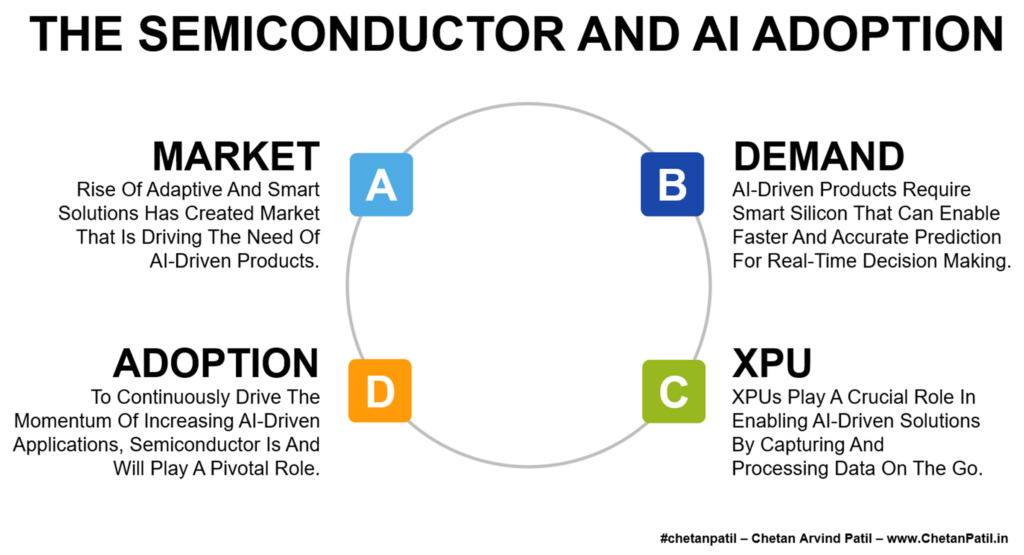
    Market: AI-focused market is growing consistently and demands silicon that can enable faster decision making.

    Demand: AI-driven solutions create the need for silicon that require advanced semiconductor technologies.

    In 2022, there are already several AI-driven solutions utilizing the semiconductor capability to capture the market. Intel and AMD already have AI-focused XPUs that have enabled the computing industry to bring unique AI applications and services. Data-focused companies like Google, Amazon, and Microsoft have also spent years developing AI to help them understand consumer behavior faster than ever.

    The AI-driven market and the demand for silicon that can power such a solution will keep growing, this, in turn, will drive the need for more efficient XPUs.


    Picture By Chetan Arvind Patil

    Several emerging companies are focused on providing specialized XPU that can enable adaptive decision-making on the go. AlphaICs, Alphawave, Cambricon Technologies, Graphcore, and Groq are some examples. All of these are focused on creating a unique silicon platform to speed up the adoption of AI.

    Both enterprise and consumer markets demand AI-powered silicon that can cut down the cost and time to bring a new application to the market. As more consumers come online, the need for AI silicon will increase, and companies with the most bottleneck-free XPU solution will win the race.

    XPU: The demand for AI applications requires a silicon platform that can drive bottleneck data processing.

    Adoption: Smart silicon has already changed the AI race. As more elegant XPU silicon comes out, the adoption of AI-powered solutions will grow further.

    The semiconductor industry is already marching with advanced technology nodes and chiplets-driven advanced package technologies. Such advanced manufacturing solutions are perfect for powering next-gen AI chips. However, the cost and capital required to enable such a solution are very high. Thus the strategy to bring up the manufacturing capacity of advanced nodes for the AI world should be more robust than ever.

    The computing and semiconductor industries go hand in hand. As the need for consumer and enterprise-level AI-powered solutions grows, the adoption of AI chips will too, and semiconductors will (already are) play a pivotal role in decades to come.