Category: AUTOMOTIVE

  • The Automotive Semiconductor Will Be Powered By These Next-Gen Automakers

    Image Generated Using 4o


    Automotive Semiconductor

    Over the last two decades, the global automotive industry has undergone a fundamental transformation. A new class of automakers, established in the context of accelerating electrification, autonomy, and software-defined mobility, has emerged to challenge long-standing paradigms in vehicle design, manufacturing, and systems integration.

    Unlike their legacy counterparts rooted in internal combustion and mechanical engineering, these companies were founded when semiconductors had become central to the vehicle’s core functionality.

    From powertrain electrification and real-time sensor fusion to functional safety systems and edge computing for autonomous decision-making, modern cars have evolved into highly integrated, compute-intensive platforms.

    This shift places semiconductors at the center of vehicle architecture, governing performance, user experience, system reliability, and over-the-air serviceability. In this new automotive landscape, chip architectures, embedded software, and electronic subsystems are now as critical to competitive differentiation as the engine or chassis once were.


    Why Focus On New-Age Automakers?

    Traditional carmakers are adapting to EVs and autonomy, but newer players are born-native to software, electric powertrains, and platform thinking. Many of these companies began with the core assumption that:

    • Cars will be electric (or will use alternate fuel)
    • Driving will be assisted or autonomous
    • User experience will be digitally driven
    • Supply chains will increasingly revolve around silicon

    Their clean-sheet approach often puts them ahead on integration, over-the-air (OTA) updates, and leveraging high-performance chips. All while increasing the user experience.


    New-Age Automakers Since 2005

    In the past two decades, numerous new automotive manufacturers have emerged worldwide. Below is a comprehensive summary of these “new-age” automakers founded in 2005, covering passenger cars, commercial vehicles, and niche manufacturers. Each entry lists the company’s name, founding year, country of origin, market size (latest production volumes or valuation), target market segment, and vehicle type (EV, hybrid, etc.).


    North America (United States And Canada)

    The North American automotive sector has seen a wave of new companies born into the era of electrification, autonomy, and software-defined vehicles. These firms are redefining vehicle architecture and accelerating semiconductor integration across segments from luxury EVs to commercial platforms.

    NameFoundedCountryMarket Size (Latest Production / Valuation)Target MarketVehicle Type
    Lucid Motors2007 (as Atieva)USA~8,428 vehicles produced in 2023; ~6,000 delivered in 2023, market cap ≈ $7.7 B.Luxury sedans (Lucid Air); upcoming SUV (Gravity).EV (Battery Electric)
    Rivian2009USA57,000 EVs produced / 50,000+ delivered in 2023; market cap ~$12 B.Pickup trucks (R1T), SUVs (R1S), and delivery vans.EV (Battery Electric)
    Fisker Inc.2016USA~65,000 reservations; production began in 2023. Magna plant capacity ~120k/yr.Premium SUVs (Ocean), compact EV (PEAR).EV (Battery Electric)
    Nikola Motor2014USA209 electric trucks delivered by end of 2023; market cap <$1 B.Heavy-duty trucks (Tre semi tractor).Hydrogen Fuel-Cell & Battery EV
    Canoo2017USANo mass production yet; Walmart ~4,500 vans ordered. Market cap ~$0.3 B.Delivery vans, lifestyle vans, pickup trucks.EV (Battery Electric)
    Faraday Future2014USAFF 91 deliveries began in 2023. Valuation declined from $3.4 B via SPAC.Ultra-luxury SUVs (FF 91); future FF 81, FF 71.EV (Battery Electric)
    Bollinger Motors2014USAPre-production stage; acquired by Mullen Automotive in 2022.Off-road trucks and commercial truck chassis.EV (Battery Electric)
    Aptera Motors2006 (revived 2019)USAThousands of reservations for solar EV; no products delivered yet.Solar-powered three-wheeler commuter vehicle.EV (Battery Electric + Solar)
    Workhorse Group2007 (as AMP)USADelivered electric vans by 2020; low-scale operations ongoing.Delivery vans and utility drones.EV (Battery Electric)
    Lion Electric2008Canada~550+ electric buses/trucks as of 2022; listed with ~$1.4 B valuation (2021).Electric school buses and medium-duty trucks.EV (Battery Electric)
    Karma Automotive2014USAEstimated revenue of $213.3M as of 2025.Ultra-luxury sedans, coupes, and touring vehicles.EREV & EV (Battery Electric)

    Sources: Information was compiled from a range of credible industry and news outlets, including Electrek, Lucid Motors Investor Relations, Companies Market Cap, Wikipedia, Electric Drives, Rivian Stories, Futurride, Reuters, Magna, CleanTechnica, Bloomberg, PR Newswire, Enterprise League, Driving Vision News, Faraday Future’s Medium blog, Techpoint Africa, TechCrunch, and Medium.


    Europe

    Europe has emerged as a hub for next-generation automotive startups, with companies targeting electric hypercars, solar mobility, and urban transport. These firms are advancing new powertrain architectures, modular manufacturing, and software-driven design across diverse market segments.

    NameFoundedCountryMarket Size (Latest Production / Valuation)Target MarketVehicle Type
    Rimac Automobili2009Croatia~150 Nevera hypercars; valuation ~$2B post Porsche investment (2022).Hypercars; EV powertrains for OEMs.EV (Battery Electric)
    Arrival2015UKIPO valuation ~$13B (2021), dropped to <$10M (2023); assets sold to Canoo.Urban vans and buses via modular microfactories.EV (Battery Electric)
    Polestar2017Sweden / China~51,500 EVs delivered in 2022; ~$6–10 B market cap (SPAC 2022).Premium sedans, SUVs.EV (Battery Electric, PHEV)
    Automobili Pininfarina2018Italy~150 Battista hypercars planned; backed by Mahindra & Mahindra.Luxury electric hypercars.EV (Battery Electric)
    Lightyear2016NetherlandsBuilt Lightyear 0 prototype; insolvency in 2023; rebooting Lightyear 2.Solar-assisted long-range sedans.EV (Battery Electric + Solar)
    Sono Motors2016GermanyDeveloped Sion solar EV; project canceled in 2023, pivoted to retrofits.Compact solar family cars (discontinued).EV (Battery Electric)
    Volta Trucks2019UK / SwedenPre-production of 16-ton electric trucks; funding and production hurdles.Medium-duty logistics trucks.EV (Battery Electric)
    Microlino (Micro)2015Switzerland~150+ units delivered (2022–23); small-scale production in Italy.City microcars (2-seater bubble cars).EV (Battery Electric)

    Sources: Data compiled from Just Auto, Volvo Cars, Electronomous, TechCrunch, TechXplore, and MarkLines.


    Asia – China

    China has rapidly become a global epicenter for electric vehicle innovation, driven by a wave of startups founded in the last decade. These companies prioritize smart features, autonomous driving capabilities, and localized supply chains. Several have already reached significant production scale and are expanding globally, positioning China as a leader in next generation mobility.

    NameFoundedCountryMarket Size (Production / Valuation)Target MarketVehicle Type
    NIO Inc.2014China160,000 EVs delivered in 2023; ~450k total by end of 2023.Premium SUVs and sedans; focus on tech and battery swapping.EV (Battery Electric)
    Xpeng Motors2014China120,757 EVs in 2022; ~66k in 2023 (dip); rebound expected in 2024.Smart sedans and SUVs; focus on in-house ADAS (XPILOT).EV (Battery Electric)
    Li Auto2015China376,000 vehicles delivered in 2023; fastest-growing Chinese EV startup.Extended-range electric SUVs (EREV); family focused.EREV (Extended-Range EV)
    Weltmeister (WM)2015China~100k total units by 2022; entered bankruptcy in 2023.Affordable crossovers and sedans for mass market.EV (Battery Electric)
    Leapmotor2015China~111,000 EVs in 2022; entering European markets in 2023.Budget EVs including city cars, coupes, and mid-size sedans.EV (Battery Electric)
    Hozon Auto (Nezha)2014China~152,000 units in 2022; continued growth in ASEAN region.Entry-level and mid-range EVs with good value proposition.EV (Battery Electric)
    Human Horizons2017ChinaThousands of HiPhi X units sold since 2020; priced ~$100k+.Tech-heavy luxury EVs; competing with premium global brands.EV (Battery Electric)
    Byton (defunct)2016ChinaRaised ~$1.2B; never launched. Ceased operations in 2021.Smart luxury SUVs and sedans; failed to commercialize.EV (Battery Electric)
    BYD Auto2003ChinaOver 3 million vehicles sold in 2023; market cap > $80B.Full spectrum: passenger cars, luxury, buses, commercial.EV (Battery Electric), PHEV
    MG Motor (SAIC)2007 (SAIC acquisition)ChinaOver 800,000 vehicles sold in 2023 globally.Affordable EVs and hybrids for global markets.EV (Battery Electric), Hybrid
    Aion (GAC Group)2017China480,000+ vehicles sold in 2023.Mid-range and premium EVs (Aion Y, Aion LX, Hyper GT).EV (Battery Electric)
    Zeekr (Geely Group)2021ChinaOver 160,000 vehicles sold in 2023.Premium performance EVs (Zeekr 001, Zeekr X, 009 MPV).EV (Battery Electric)
    Avatr (Changan + CATL + Huawei)2021ChinaEarly stage; deliveries ramping in 2023.High-end smart EVs with Huawei tech integration.EV (Battery Electric)
    IM Motors (SAIC + Alibaba)2020ChinaLow volume; deliveries began in 2022.Tech-driven luxury EVs (IM L7, LS7).EV (Battery Electric)
    Rising Auto (SAIC)2021ChinaRebranded from SAIC’s Roewe line; early growth phase.Smart electric sedans and crossovers.EV (Battery Electric)
    Seres (AITO, Huawei JV)2016ChinaPartnered with Huawei; launched M5 and M7 models.Hybrid and EV SUVs integrated with Huawei ecosystem.EV (Battery Electric), EREV

    Sources: Data from CNEVPost, CarNewsChina, Technode, Reuters, TechCrunch, XPeng, and company investor portals.


    Asia – Other Regions (India, Southeast Asia, Middle East, Africa)

    Across India, Southeast Asia, the Middle East, and Africa, new automotive companies have emerged, addressing local market needs with electric mobility, affordability, and regional manufacturing. These companies range from high-volume e-scooter producers and electric bus makers to ultra-luxury and government-backed initiatives. Together, they represent a critical extension of the global shift toward sustainable and localized automotive innovation.

    NameFoundedCountryMarket Size (Production / Valuation)Target MarketVehicle Type
    VinFast2017Vietnam~35,000 vehicles sold in 2023; market cap dropped from $85B to ~$6B.Mass-market EVs (VF8, VF9); global expansion plans.EV (Battery Electric)
    Togg2018Turkey28,000 orders in first sales day (2023); scaling to 100k/year by 2025.Electric SUVs and upcoming sedan/hatchback models.EV (Battery Electric)
    Ola Electric2017India~150,000 e-scooters sold (2022–23); electric car in pipeline.Two-wheelers and future budget EV hatch for India.EV (Battery Electric)
    Pravaig Dynamics2011IndiaPrototype sedan launched; SUV under development for 2024.Luxury EVs for Indian market; premium focus.EV (Battery Electric)
    Mobius Motors2010KenyaDozens of Mobius II SUVs built since 2015; halted in 2023.Low-cost rugged SUVs for African roads.Gasoline (ICE)
    Kiira Motors2014UgandaBuilding electric buses; scaling to 1,000+ units/year.City buses and hybrids for East Africa.EV & Hybrid
    Innoson Vehicle Mfg2007NigeriaAssembles a few thousand vehicles yearly; Nigerian govt support.Low-cost cars, buses, pickups for West Africa.Gasoline (ICE)
    Ceer2022Saudi ArabiaFirst EVs expected in 2025; JV with Foxconn; BMW platform licensed.EV sedans and SUVs for GCC and Middle East.EV (Battery Electric)
    W Motors2012UAE/LebanonLimited-run hypercars; expanding into electric/autonomous prototypes.Ultra-luxury sports cars; now exploring EV-based law enforcement vehicles.Gasoline (ICE), EV planned

    Sources: Data from Just Auto, Reuters, Techxplore, Medium, MarkLines, Dailysabah, Tribune PK, Wikipedia, and official company releases.


    What This New-Age Automakers Mean For The Automotive Semiconductor Industry

    This new generation of automakers is not merely a business disruption. A structural shift intensifies the demand for semiconductors across the automotive stack. A modern vehicle today, integrates more than 100 different types of silicon solutions, and this number is set to grow as autonomy, connectivity, and software-defined features expand.

    What matters is not just chip volume but compute density and architectural dependency. ADAS, infotainment, and battery systems now rely on advanced SoCs and specialized silicon with performance levels approaching data centers.

    Key implications for the semiconductor industry:

    • Co-development is becoming standard as automakers involve chipmakers early in the design process
    • Domain-specific architectures are evolving faster by leveraging innovations from AI, mobile, and high-performance computing
    • Power electronics, safety systems, and battery management require integrated, real-time, capable solutions
    • Regional supply chains and custom silicon initiatives are gaining momentum in strategic market

    As new automakers scale, semiconductor companies must align closely with their timelines, architectures, and localized production strategies. Success will depend on delivering optimized computing and resilient system design.

    Thus, semiconductors are no longer peripheral to vehicles. They are now the foundation of performance, safety, and product differentiation.



  • The Automotive And The Increasing Use Of Semiconductor XPU

    Photo by Vasilis Chatzopoulos on Unsplash


    The automotive industry is increasingly using semiconductor XPUs to power advanced driver assistance systems (ADAS) and autonomous driving features. XPUs perform specific tasks, such as image processing, object detection, and machine learning, much faster than traditional CPUs. Making them ideal for use in ADAS and autonomous driving systems, which require real-time processing of large amounts of data.

    The XPU types include CPU, GPU, and APU. CPU is the most widely used type of XPU in the automotive market. GPU is gaining traction in the market due to its high performance and energy efficiency. APU is a new type of XPU specifically designed for machine learning applications. The choice of which XPU to use in an automotive application depends on several factors, covering the application requirements, the budget, and the desired performance.

    Central Processing Unit (CPU): It executes the instructions that control various vehicle functions. The CPU controls the engine, transmission, braking system, and other electronic systems. The CPU in automotive applications is supposed to be high-speed, low-power, and highly reliable. It is responsible for executing complex algorithms and communicating with other systems in the vehicle. The CPU is a critical component in the vehicle’s electronic system, as it controls the overall performance and safety of the car.

    Graphics Processing Unit (GPU): The GPU is responsible for handling the graphical processing tasks in the vehicle’s infotainment system. The GPU is responsible for rendering 3D graphics, video decoding, and image processing. It also plays a crucial role in ADAS systems and is commonly used for object detection, lane departure warnings, and other visual recognition tasks. The GPU is for parallel processing, which allows it to handle multiple tasks simultaneously. It is an ideal solution for managing complex graphic and visual processing tasks in automotive applications. In automotive applications, power consumption is a crucial factor. That’s why the GPU should get designed to be power-efficient, ensuring its effectiveness.

    Accelerated Processing Unit (APU): The APU is a mix of CPU and GPU in a single chip. The APU provides high-performance computing capabilities while consuming less power. The APU is an ideal solution for automotive applications with limited space and energy. The APU finds applications in various automotive applications, including infotainment systems, ADAS systems, and autonomous driving systems.

    The global automotive XPU market size was valued at USD 1.5 billion in 2021 and will reach USD 10 billion by 2028, growing at a CAGR of 19.2% from 2022 to 2028. The increasing demand for autonomous features in cars is driving the growth of the XPU market, which is crucial in providing real-time processing of large amounts of data, such as sensors, maps, and weather data.


    Picture By Chetan Arvind Patil

    The automotive XPU market by region is segmented into North America, Europe, Asia Pacific, and the Rest of the World. North America is the largest market for automotive XPUs. Europe is the second largest market for automotive XPUs. Asia Pacific is the fastest-growing market for automotive XPUs.

    Several top semiconductor companies invest heavily in research and development to develop new and innovative XPUs. Some details about semiconductor automotive XPU investment for research and development and new product launch:

    Nvidia: In 2022, Nvidia announced a $10 billion investment in automotive over the next four years. This investment will bring new XPUs, software, and services to the automotive industry. Nvidia also plans to launch a new automotive platform called the DRIVE Hyperion 9 in 2025. The DRIVE Hyperion 9 will be a fully integrated platform that includes everything from sensors to software to computing.

    Intel: In 2021, Intel announced a $20 billion investment in self-driving technology over the next decade. This investment will enable the development of new XPUs, software, and sensors for self-driving cars. Intel also plans to launch a new self-driving car platform called the Mobileye EyeQ5 in 2023. The EyeQ5 will be a powerful XPU that can handle the complex computing requirements of self-driving cars.

    Qualcomm: In 2022, Qualcomm announced a $10 billion investment in automotive over the next five years. It is to develop new XPUs, software, and services for the automotive industry. Qualcomm also plans to launch a new automotive platform called the Snapdragon Ride in 2024. The Snapdragon Ride will be a fully integrated platform that includes everything from sensors to software to computing.

    Samsung: In 2021, Samsung announced a $17 billion investment in semiconductor manufacturing over the next three years. This investment will bring new semiconductor factories to fabricate new semiconductor technologies. Samsung also plans to launch a new automotive XPU called the Exynos Auto V10 in 2025. The Exynos Auto V10 will be a powerful XPU that can handle the complex computing requirements of autonomous cars.

    Renesas: In 2022, Renesas announced a $2 billion investment in automotive over the next five years. Such an investment will bring new XPUs, software, and services to the automotive industry. Renesas also plans to launch a new automotive platform called the R-Car V4H in 2024. The R-Car V4H will be a powerful XPU that can handle the complex computing requirements of autonomous cars.

    As the automotive industry continues to evolve and innovate, the demand for processing solutions will only grow. It presents an exciting opportunity for developers and engineers to create new and innovative solutions that will shape the future of the automotive industry.


  • The Ever-Increasing Share Of Semiconductor In Automotive

    The Ever-Increasing Share Of Semiconductor In Automotive

    Photo by Chris Liverani on Unsplash


    Automotive has always been an integral part of day-to-day life. Worldwide, billions of people drive vehicles, and the goal is the same: reaching the next destination safely and on time. Achieving this goal is only possible due to the different features and components that come together to enable an end product that can zoom safely.

    A lot of effort goes behind the scenes to meet customer demand and automotive safety requirements. Any given vehicle demands thousands of tiny parts procured (or manufactured) from different vendors. Eventually, all these components need to work synchronously to provide the safest ride possible.

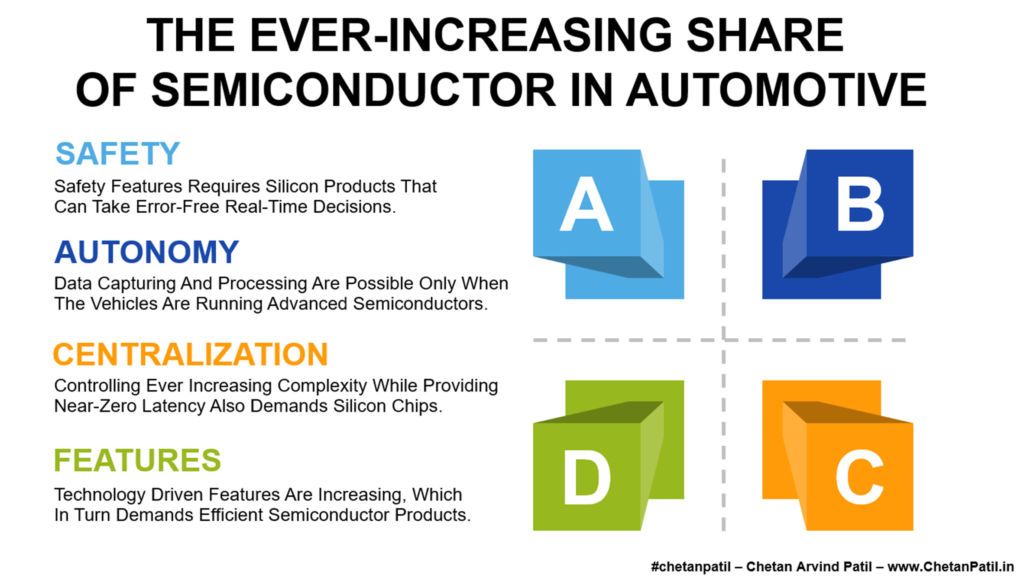
    Safety: Silicon products enable real-time decision-making, a must-have feature for maintaining the standard of automotive safety.

    Autonomy: Autonomy focuses on assisting safe rides, and it requires error-free silicon products that can work in any conditions.

    In this line, one of the vital part, whose share in automotive products have increased steadily year on year, is a semiconductor. Semiconductors are part of every vehicle out on the road. These tiny devices (packaged as silicon chips) enable different features.

    In the last decade alone, the number of semiconductor products in modern vehicles has increased by 10x. Such a drastic increase in demand is majorly due to new features apart from the need to make every ride a safe and enjoyable one. It is also evident from the growing demand for automotive-focused semiconductor solutions, which will increase further with the adoption of more alternate-fuel solutions that will increase the share of semiconductors in next-gen vehicles.


    Picture By Chetan Arvind Patil

    One of the drastic changes in the automotive industry is the centralization approach. CAN-based solutions were already available for decades. However, the availability of more reliable XPU based solutions has pushed the centralization towards a new era and is transforming automotive into a computer on the wheels. Thus, opening up the market for companies that never focused on automotive segments.

    It also implies that the thermodynamics of automotive products is changing and slowly becoming semi-dynamics. In the semi-dynamics world, the decision is driven by silicon products while also working alongside the traditional thermodynamic system. Such reliance will grow further, already has, with alternate-fuel, hybrid, and electric approaches.

    Centralization: Automotive products are getting loaded with high-performance computer chips, which are more centralized than ever before.

    Features: New features require new silicon products that focus on improving customer experience by enabling highly reliable products.

    Even though automotive semiconductor demand is increasing, it will not be easy for emerging companies to make the most of the growing market. The reason is the safety, quality, and reliability standards that automotive products demand. It is not only time-sensitive but also capital intensive. Still, there are promising upcoming automotive semiconductor-focused emerging companies making the mark in the market. However, such companies will face stiff competition from the existing established players.

    The next decade will be an exciting one for automotive semiconductor companies. The focus will be on highly dynamic, safe, and reliable semiconductor-driven products that will enable a new ear of transforming mobility.


  • The Semiconductor Recipe For Automotive Industry

    The Semiconductor Recipe For Automotive Industry

    Photo by Lenny Kuhne on Unsplash


    THE IMPACT OF SEMICONDUCTOR SHORTAGE ON AUTOMOTIVE INDUSTRY

    Automotive is one of the several industries that heavily rely on semiconductor products to provide different features. These features range from infotainment to sensors to wireless communication. Over the last few decades, the need to drive such advanced features has increased the share of semiconductor products in automotive manufacturing.

    Due to the heavy dependence on automotive semiconductor products, the automotive industry has also been impacted because of the semiconductor shortage. The non-availability of the automotive semiconductor product has certainly brought several challenges for the automakers (and OEMs) and worldwide automakers are now struggling to keep their production line up and running.

    In the end, automakers also have to rely on OEMs to provide the sub-systems that their production line uses. The delay is more because the OEMs are not able to procure the silicon chips (from OSATs and FABs) required to provide the end systems that automakers use to assemble different vehicles. Eventually, the impact is felt on the end product (vehicles) and this is why the focus has shifted more on automakers than the OEMs.

    Below are the major impacts of the automotive semiconductor shortages on the automotive industry:

    Delay: Semiconductor capacity crunch has lead to a shortage of critical automotive semiconductor products. Automakers are not able to ship or sell vehicles without these vital silicon chips. This has lead to a backlog of orders and slowly causing leading to the halt of several automotive production lines. Given how strict the quality and reliability requirements of automotive semiconductors are, it is difficult to switch the FABs and OSATs where the capacity might be available. All this is impacting automakers with severe delay in providing the last piece of silicon automakers need.

    Revenue: Automaker’s OEM vendors are not able to procure the required number of silicon chips to design automotive systems that are needed by different vehicles. This has caused a supply chain gap and has impacted the revenue (slow production line) of the majority of the automakers even though the demand is high.

    Human Resource: Due to the slow or halted production lines, the automotive manufacturers are taking tough decisions to lower the loss caused by the semiconductor shortage. One such decision is layoffs and unfortunately, it is leading to job losses.

    Planning: Automakers worldwide launch new models and trims every year. Due to the semiconductor shortage, automakers are not able to plan out their future product launches. This is severally impacting their long-term planning and more so when it comes to launching alternate-fuel technologies to drive next-gen vehicles.

    Cost: As it happens in any other industry, the slow production has to lead to a supply crunch and this is leading to a rise in the cost of vehicles. On top of this, the cost to develop new products and solutions has also gone up mainly due to the impact on timeline and schedule caused by the semiconductor shortage.

    The severe impact of the automotive semiconductor shortage has prompted the automotive industry to take a serious look at the importance and share of semiconductors in automotive manufacturing.

    As the world moves towards alternate-fuel technologies to drive next-gen automotive products, the share of automotive electronics (developed by the semiconductor industry) will keep increasing. This implies that any semiconductor shortage in the future will also keep impacting the automotive industry.

    The corrective actions (based on semiconductor shortage) will take years of planning and investment, and it is about time that the automakers (more than the OEMs) start preparing themselves for future implications today.


    Picture By Chetan Arvind Patil

    Picture By Chetan Arvind Patil

    THE RECIPE TO MERGE SEMICONDUCTOR INTO AUTOMOTIVE MANUFACTURING

    Every industry that has been impacted by the semiconductor shortage has started preparing backup plans for the future. This is mainly true for the OEMs who could not procure the semiconductor chips required to develop their system so that their customers can use and ship the end product out of the manufacturing facilities.

    When any other manufacturing industry is compared with automotive manufacturing, the major difference that stands out is the amount of investment and big plants that are required to keep assembling the new vehicles. On a positive note, the experience of handling large manufacturing facilities provides the automotive industry an edge mainly due to the vast experience in building complex machines. If planned well, there is no question that the automotive industry can easily adapt and embrace non-automotive (semiconductor) manufacturing facilities.

    Automotive manufacturing is indeed heavily dependent on OEMs. More so for systems that are built using semiconductor chips and end up getting plugged during the automotive assembly process. This dependence has grown with the growing importance of semiconductor products that are required to build a more advanced automotive solution than its predecessors.

    Semiconductor Design -> FAB -> OSAT -> OEM -> Automotive Manufacturing

    For automotive manufacturing, if there is one important question that comes out of the semiconductor shortage saga, then it is about how to mitigate future semiconductor shortages. To answer this question, several automotive manufacturers have already started preparing plans to make themselves self-sufficient for future semiconductor needs. In reality, it will take a lot of time and effort, but such push by the automotive industry is inevitable.

    Irrespective of the path taken by different automakers, the below recipe can be used to understand how to merge semiconductor manufacturing into the automotive manufacturing process:

    Cluster: Setting up semiconductor manufacturing (mainly FABs and OSATs) is a big investment. It requires years of planning and then billions of dollars to execute and thereafter millions to keep the facilities active. It is a risk that few key players have taken. What the automotive industry should focus on is a cluster-based approach wherein different automakers pool money and resources to create a network of automotive-focused FAB and OSAT facilities. This can be a multi-tier JV that can drive the manufacturing of critical automotive semiconductor products. These cluster facilities can also balance out the semiconductor manufacturing capacity worldwide.

    In-House Capacity: Apart from the cluster semiconductor manufacturing approach, automakers can also find avenues to build semiconductor manufacturing capacity in-house. This is certainly not easy to execute and there are only a handful of automakers that will have the kind of investment required to drive FABs and OSATs. But this is certainly the way to go because the importance of semiconductors in providing new technology features will keep increasing.

    Team: Irrespective of whether the automotive manufacturers end up building their semiconductor manufacturing facilities or not, there should be a push to create a network (within and outside) of semiconductor teams that can provide insights into the design and manufacturing of next-gen semiconductor products. This can help automakers understand which target features can be optimized using a different set of available semiconductor features. This can also be a way to make automakers self-sufficient when it comes to the automotive semiconductor.

    Acquisition: Automakers should start acquiring emerging companies that provide automotive semiconductor solutions. They can do so by focusing on critical automotive features like LIDAR, RADAR, CMOS cameras, sensor-based tech, and even centralized XPUs for future autonomous vehicles. In the end, these strategic acquisitions will help automotive companies drive in-house semiconductor design operations, which can slowly kickstart the need to move towards the manufacturing aspect of semiconductors, which can also be executed by acquiring small FABs and OSATs.

    Investment: Even if automakers are not able to acquire semiconductor-focused emerging companies, they should start investing in semiconductor companies that can add value to their portfolio. This investment can be equally distributed towards both the design and the manufacturing aspects of the semiconductor.

    When the world comes out of the semiconductor shortage (which can take anywhere from months to years), there are certainly going to be new players entering the semiconductor industry to take control of the different aspects of the semiconductor supply chain that affected their business.

    One such industry will be automotive, and there is certainly going to be a push by automakers to make themselves self-sufficient to ensure that any future semiconductor shortage does not impact their production line.

    The recipe to merge semiconductor manufacturing (and even design) with automotive manufacturing is readily available and the only missing links are the actions by the automakers.


  • The Semiconductor Industry Is Driving The Automotive Industry

    The Semiconductor Industry Is Driving The Automotive Industry

    Photo by Vlad Tchompalov on Unsplash


    THE NEED FOR SEMICONDUCTORS IN AUTOMOTIVE

    The automotive industry is going through a significant transformation. Countries all over the world are pressing for greener and eco-friendly vehicles. Government policies are getting stricter and demand vehicular technologies that require smarter software and hardware.

    The de-facto transformation is towards electric vehicles. However, other vehicular technologies (hybrid, autonomous, and alternate-fuel) are also driving the change in the automotive industry, and all this is pushing automotive companies to innovate. To keep up with the smart and safe automotive features, the share of software and hardware in automotive is increasing tremendously, thus leading to new automotive technology companies are also emerging. The emerging automotive companies work in collaboration with the established automotive companies or are launching their own smarter electric, hybrid, autonomous, and alternate-fuel automotive products.

    One of the pieces to make electrichybridautonomous and alternate-fuel vehicles are semiconductor products, as it forms the base for the hardware required to run the software. In 2021, automotive production may be impacted due to the shortage of semiconductor chips, and it shows the dependency the automotive industry has on the semiconductor industry.

    The Semiconductor Industry And Products Are Key To Developing Smarter Hardware To Drive The Automotive Industry Using Smarter Software

    The need for semiconductor solutions in automotive is also pushing the innovation and development of smarter automotive chips to drive vehicles safely. The increasing need to develop error-prone software that runs on efficient hardware is vital and is driving the automotive industry to re-invent automotive solutions from a semiconductor point of view.

    It is not that semiconductor products started getting used by the automotive industry in 2020. The automotive industry has relied on semiconductor products for decades. From airbags to infotainment and many other solutions have always required defect-free semiconductor products. However, the landscape of semiconductors in automotive is changing from individual silicon components to more centralized silicon systems. The semiconductor products work excellent for solo operations. 

    However, when the goal is to connect the system for level 5 autonomy or increasing hybrid efficiency, a centralized automotive-specific system-on-a-chip (SoC) is required. The centralized automotive semiconductor-based solution still relies on individual semiconductor components and is leading to innovative work from both the established automotive firms and the new semiconductor FAB-LESS companies looking to eat into the automotive and semiconductor market.

    A centralized silicon system needs to cater to the following uses cases for autonomous automotive solution:

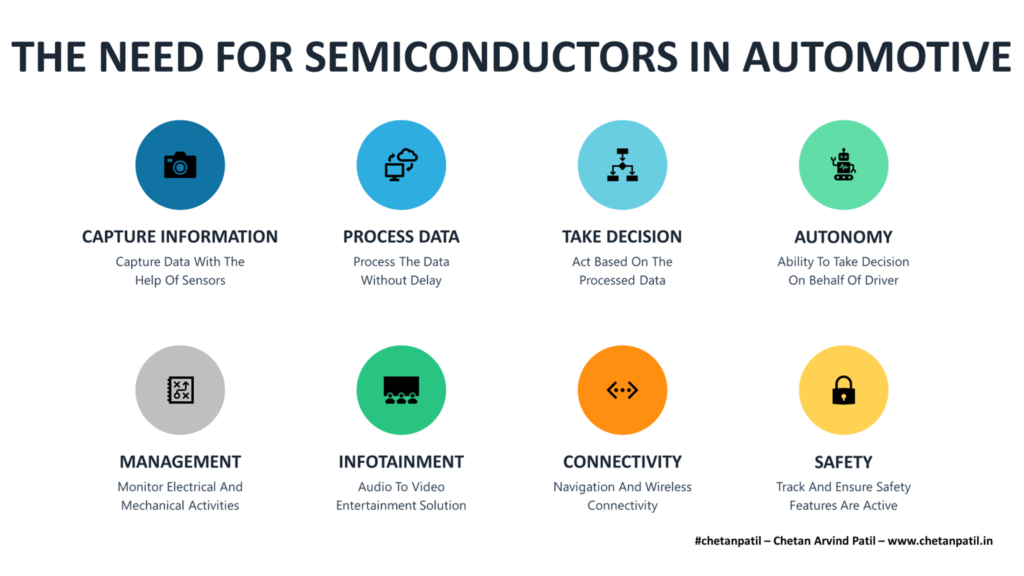
    Capture Information: Ability to capture information with the help of monitoring sensors, LIDAR, and RADAR

    Process Data: Information captured should is processed without delay

    Take Decision: The processed data is used to take accurate actions

    Autonomy: Decide on behalf of the driver to enable a safer experience

    Management: Track electrical and mechanical activities to provide vehicle health

    Infotainment: Display, audio, and video system for entertainment

    Connectivity: On-the-go navigation, Bluetooth, 5G, and WiFi connectivity

    Safety: Ensure critical components and features are working and alert when maintenance is required

    The above use cases of semiconductors are valid for any kind of two/three/four automotive solution, including passenger, commercial, motorcycles, and industrial automobiles.

    Developing semiconductor solutions for automotive requires strong collaboration with the semiconductor design and manufacturing industry. In some cases, the semiconductor solutions are also being developed in-house by automotive companies. It is why the automakers are investing or building R&D facilities to come up with a high precision silicon need for future vehicles.


    Picture By Chetan Arvind Patil

    THE DEVELOPMENT OF SEMICODUCTORS IN AUTOMOTIVE

    It is critical to make use of a high-level intelligence system to make automotive products smarter. The growing share of technology-powered features in modern vehicles is prompting the automotive industry to invest in software and hardware capabilities in-house. In many cases, automotive companies are also collaborating and investing by out-sourcing many of the vital semiconductor solutions from silicon chips to sensors systems.

    Automotive giants and the silicon chip:

    BMW: To remove its dependency on outsourced power semiconductor products, BMW has invested in GaN semiconductor startup. In parallel, BMW has also collaborated with Intel to drive its fully autonomous vehicle project.

    BOSCH: Like DENSO, BOSCH has been the provider and one of the leaders of automotive components. Given the growth of alternate fuel technology and the dependency on semiconductor products, BOSCH has upped its ante and in-course grabbed billions of vehicle computer orders. BOSCH is also one of the rare automotive companies to also own semiconductor FABs, and this puts BOSCH in a unique position to not only design in-house but also manufacture. Recently, BOSCH also launched a new chip that promises to be a game-changer navigation technology.

    DENSO: While DENSO is party owned by Toyota, it still does a lot of work on its own to power future automotive technologies. In line with its ambitions to power EVs, DENSO has invested in startups focusing on semiconductor solutions to manage power and performance. On other hand, DENSO has also taken equity in Infineon Technologies to enhance its semiconductor portfolio. It has also formed a new semiconductor called MIRISE Technologies in-collaboration with Toyota, to develop next-generation in-vehicle semiconductors.

    Daimler: To compete with Tesla and other automotive companies, Daimler has partnered with Nvidia to speed up its use of next-generation silicon chips. Apart from this, Daimler has also increased investment in battery manufacturing. An interesting fact – In 1997 Daimler-Benz AG sold its semiconductor business unit TEMIC Telefunken Microelectronic GmbH to Vishay Intertechnology and now it is going back to the same business area to survive the growing semiconductor in the automotive products.

    Ford: To cater to its elective vehicle and autonomous technologies, Ford is working with Mobileye and Intel to drive its semiconductor needs.

    Hyundai: Hyundai has a long-term plan to remove the dependency on automotive products. In line with its vision, Hyundai has launched a semiconductor lab to develop semiconductor products for electric/hybrid vehicle powertrain controllers.

    Honda: Honda a decade ago invested in Shindengen Electric Manufacturing. Given how big Honda is in the two-wheeler segment and the growing electric vehicles market, Honday can reap the benefits of the strategic investment made in Shindengen Electric.

    Nissan: Nissan has collaborated with Renesas for its innovative semiconductor needs.

    NXP: NXP Semiconductor is one of the leaders in automotive solutions. Apart from a strong portfolio and design capabilities, NXP has an advantage in its manufacturing expertise in automotive products. The growing line of products for automotive will certainly make NXP stand out in the market.

    Toyota: Since 2014, Toyota has been using innovative semiconductor technologies to enable higher-fuel efficiency. Last year, Toyota formed JV with DENSO to focus on in-house silicon chip development due to the exploding cost of semiconductors in automotive.

    Tata Motors: Tata is one of the leaders in passenger and commercial vehicles in India. Its semiconductor arm Tata ELXSI is capable of providing all the required semiconductor solutions for its need apart from its decade-long collaboration with other automotive semiconductor product providers.

    Volkswagen: A few years ago, Volkswagen formed a deep partnership with Infineon Technologies to drive its TRANSFORM 2025+ strategy in line with semiconductors in automotive.

    There are numerous examples of big automotive giants already owning or investing in semiconductor chip development. Given the decreasing cost of developing an automotive solution using advanced intelligence techniques, several startups and newcomers are also shaking the automotive market by providing semiconductor solutions.

    New comers in automotive silicon chip:

    Autotalks: A FAB-LESS startup providing semiconductor solutions for vehicle-to-everything (V2X) communications for the automotive industry.

    Apple: Not official yet, but there are numerous reports of Apple’s electric car. If that happens, it is for sure going to be an in-house development.

    Argo AI: Developing its software to hardware self-driving technology, Argo AI is another startup getting into automotive semiconductors. It also got recently merged with Audi’s AI center.

    GEO Semiconductor: A FAB-LESS semiconductor startup that is providing integrated circuits (ICs) for video and geometry processing.

    indie semiconductor: indie Semiconductor makes SoCs for the automotive industry. It has changed its portfolio in the last few years but has certainly got a front foot in the connected car and infotainment business.

    NIO: NIO is a China-based EV maker that has decided to go big for in-house silicon chip development to fulfill its need for semiconductors.

    NIKOLA: NIKOLA is another promising automotive company. It has been focusing on designing and manufacturing electrical components for greener vehicles. So far, NIKOLA has focused on semi and soon plans to venture into the passenger segment.

    SLD Laser: Started in 2013, SLD Laser is pushing the development of laser-based sensor solutions for the automotive industry.

    Silicon Mobility: Founded in 2015, Silicon Mobility is providing a semiconductor-based mobility solution to make EV more efficient.

    Tesla: While Tesla is not new to the automotive market, its silicon solution is certainly is. It aims to provide a silicon sandbox that is going to make any vehicle an autonomous one. Tesla AI chip is still under in-house use, but will certainly open up the market if sold separately.

    Waymo: Owned by Google, Waymo, for now, is using Intel’s technology but in-house is also planning to develop its silicon chip.

    Zoox: Amazon bought Zoox early this year and also unveiled its self-driving car. With Amazon’s experience in developing hardware via Amazon Lab126, Zoox automotive hardware solution will be innovative.

    The list of newcomers and startups in automotive semiconductors is going to increase. It will be interesting to see how the semiconductors market adapts to the solutions from the smaller companies.

    It is for sure going to increase the importance of semiconductor design and development. However, there are still major challenges to overcome before automotive companies can make it big in the semiconductor industry.


    Picture By Chetan Arvind Patil

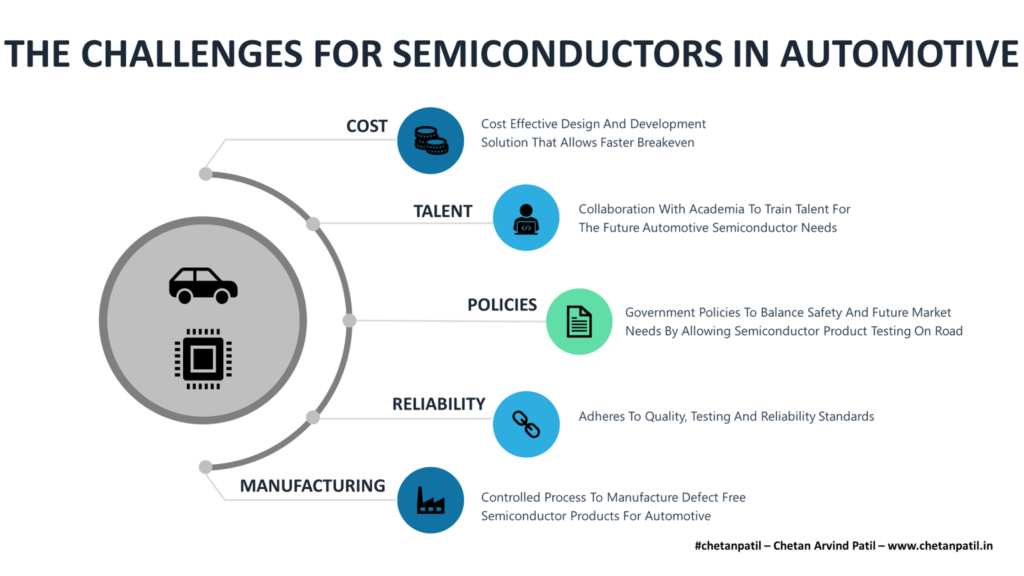
    THE CHALLENGES FOR SEMICONDUCTORS IN AUTOMOTIVE

    Automotive companies which have been in the industry can establish the semiconductor business unit to meet its need. The challenges arise for newcomers wanting to cater to the automotive industry.

    Five major challenges might hinder the progress of newcomers from providing elegant automotive semiconductor solutions:

    Cost: Even though the share of semiconductor cost in new vehicles is on the rise, the challenge remains on optimizing the development and manufacturing cost to reach the breakeven point. Optimizing the process to make a low-cost product for large scale consumption is still a challenge. On top of it, proving the smarter semiconductor driven solution to the market is getting tougher. Autonomous (not specifically self-driving) technologies take years to test on the road before they can be used by the mass market. All this adds to the cost.

    Talent: Acquiring relevant software and hardware talent to bring silicon solutions to bring innovation to the market is another challenge. Automotive companies getting into self-driving, electric vehicles, and alternate-fuel solutions are doing all they can to form the best team. In some cases, the practice is not as per everyone’s liking. Bringing new talents on-board and training them takes years too. Challenges also remain with universities to launch programs that cater to the new-age automotive and semiconductor market that requires different skills and demands. An interdisciplinary study that combines mechanical, computer, electrical, and semiconductor engineering is the need of the hour. 

    Policies: The lives of many on the road are at stake, and Government policies play a crucial role in the automotive industry. Not all countries or states enable the framework to test autonomous solutions out on the road. Dedicated infrastructure is required to test solutions like lane guidance and autonomous driving. It is difficult for states to grant permission to test the solution on public roads due to dangerous un-known consequences. Only a few examples of how state policy can strike the balance of technological progress and road safety. Arizona is one such example. The policy has to lead Chalder in Arizona to become the hub for self-driving design and development. Waymo to Uber to Cruise are all testing their solutions out on the road. It shows the growing need to make policies that strike the balance of safety and future market needs.

    The Semiconductor Automotive Product Development Demands Talent Pool Trained With Interdisciplinary Curriculum Covering Mechanical, Computer, Electrical And Semiconductor Engineering.

    Reliability: Semiconductor automotive products have to go through stringent qualification, testing, and reliability criteria. Automotive Electronics Council (AEC) and a few other standards provide the guidelines for qualifying the semiconductor products. The guidelines require the temperature to reliability stress testing. All these require resources, time, cost, and talent to execute. A chip not functioning during a crash can lead to fatality. Making automotive semiconductor product reliable is a key concern.

    Manufacturing: Automotive semiconductor products eventually have to get manufactured in the same arena where smartphone semiconductor products get manufactured. A semiconductor FAB and OSAT have to ensure strict control over the process to ensure zero variation between lots of the same product. Controlling such requirement demands strong industry flow that enables defect-free products. FAB-LESS companies developing semiconductor products for the automotive industry have to engage and invest with semiconductor manufacturing teams.

    The challenges are many, but so are the opportunities. Companies have to increase focus on semiconductor products in the automotive industry at the chip level. The automotive industry has leverage semiconductor solutions for decades.

    The next decade is going to be a game-changer. The share of semiconductor products and costs in automotive is only going to quadruple. All this will open tremendous opportunities both for the semiconductor and the automotive industry.


  • Indian Automotive Industry Can Drive Semiconductor Manufacturing In India

    Photo by Amin Khorsand on Unsplash

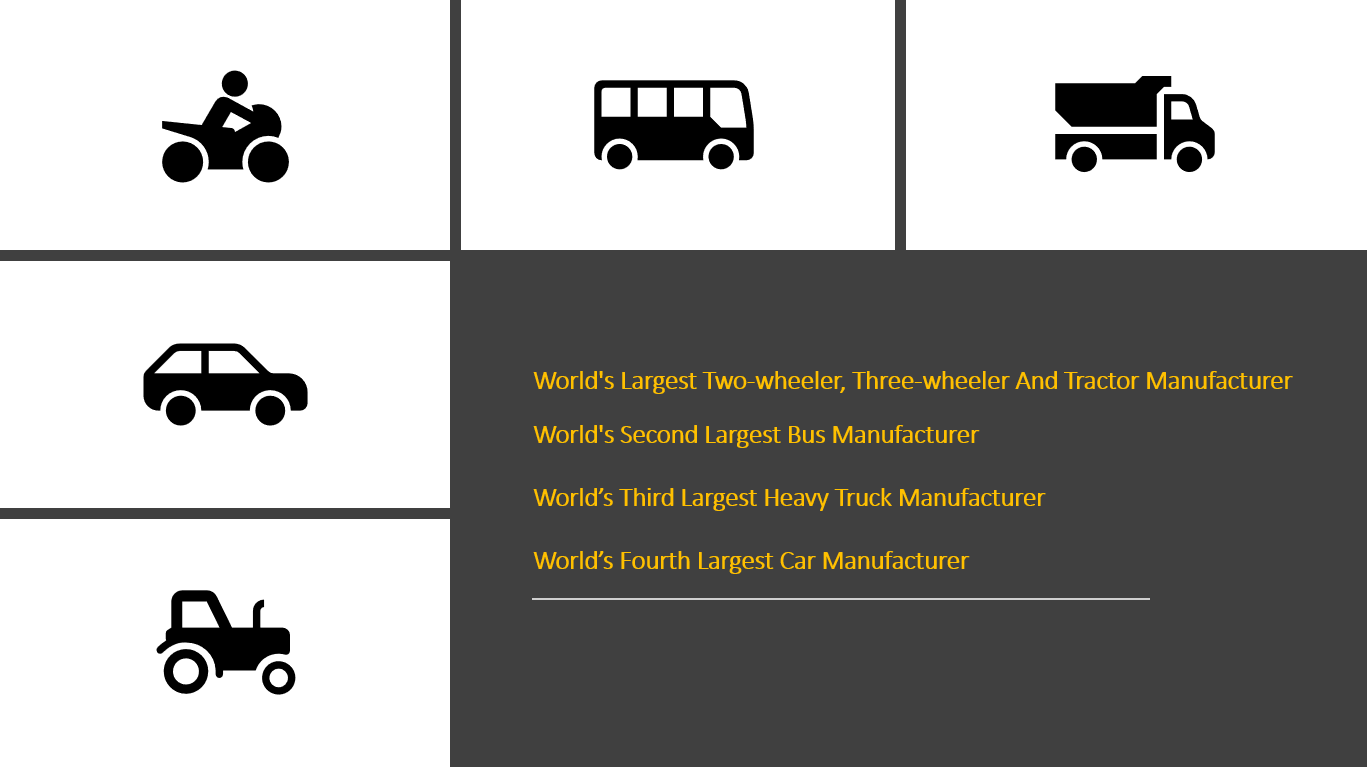
    India’s automotive industry is the world’s largest two-wheeler, three-wheeler, and tractor manufacturer. It is also the world’s second-largest bus manufacturer, third-largest heavy truck manufacturer, and fourth-largest car manufacturer.

    With the advancement in automotive solutions that will enable sensor-based safe assisted driving, the demand for smart Electronic Component Units (ECUs) will grow for every car, tractors, trucks, buses, and motorcycles that will come out of India’s production unit. Smart semiconductor products have started to change the automotive industry for good.

    Picture By Chetan Arvind Patil

    With the growing demand for automotive vehicles in India and the ability to export it in different regions, isn’t it time to ensure that the semiconductor products that are drivers of smart capabilities are also manufactured in India?

    The fairly old and well established automotive industry can surely enable semiconductor manufacturing growth given the increasing demand for smart solutions from infotainment to radar to collision avoidance.

    It is being anticipated that in 2030, 80% of the cars driving capability will be based on smart ECUs. Rest 20% will depend on the rules and regulation around level 5 is autonomy.


    AUTOMOTIVE INDUSTRY IN INDIA

    India has set an ambitious goal to move to alternate-fuels for automotive. First step is 100% electric cars only by 2030. This also means increased demand for semiconductor products that make up the smart ECUs to enable efficient driving.

    With each new car having more feature than the last one and all of these features relying on semiconductor solutions, raises the question of how automotive industry can drive semiconductor manufacturing in India.

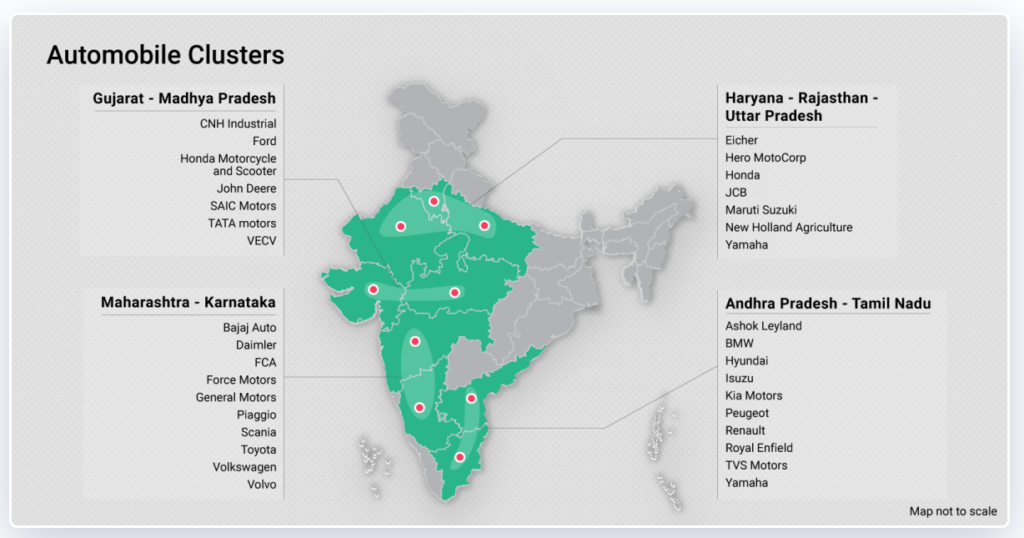
    A very crucial and vital role will be played by the Original Equipment Manufacturers (OEMs). India is already home to all of the top automobile manufacturers that are evenly spread across different clusters and states.

    India Will Be The World’s Third-Largest Automobile Manufacturer With A Market Size of $300 Billion By 2026.

    Picture By Chetan Arvind Patil

    Designing of automotive ECUs is actively done in many of the R&D offices by the semiconductor companies in India. However, the majority of these smart solutions are manufactured overseas and then imported by automotive customers back in India.

    If all the activities from design to manufacturing of semiconductor products for the auto industry is done in house in India, then the benefits in terms of employment and business are huge.

    Any advanced car that is manufactured in 2020, has around 100 million lines of software code that has to meet automotive regulation. The established software industry in India can then provide over the top (OTT) solutions that will quadruple the amount of safety features on top of the smart mobility solution provided by the semiconductor solutions.


    LEADERS IN SEMICONDUCTOR AUTOMOTIVE SOLUTIONS

    Currently, the leaders in semiconductor manufacturing for the auto industry are all based in the Americas, EU, or East Asia. India certainly is home to all these semiconductor giants but only from designing and R&D point of view, which in itself is a great advantage.

    The automobile industry’s growing demand for smart semiconductor solutions in India should be an attractive opportunity. Establishing semiconductor manufacturing units in India not only allows semiconductor design companies to have access to the automobile industry but can also enable the growth of other sectors that they are catering to apart from the auto industry in India.

    Having an end-to-end design to manufacturing solutions in India will also help companies innovate faster and enable cost savings without compromising on security and quality.

    Another important factor is India’s open market that already has a talent pool to drive innovation. Many companies already heavily invested in R&D activities that can then quickly be tested using the automotive infrastructure.


    SEMICONDUCTOR AUTOMOTIVE OPPORTUNITIES

    As per Deloitte, the cost contribution of automotive electronics in 2007 was 20% and in 2017 it increases to 40%, and by 2030 it is expected to be 50%. With the way smart mobility is changing the auto industry, it is fair to say that the trend is only going to go up. Alternate fuel will demand more smart semiconductor solutions and many of these are already in use.

    From infotainment to lane assistance, all require ECUs that are not manufactured from start to end in India. This has lead to an increase in the cost of semiconductor components.

    Picture By Chetan Arvind Patil

    With the increasing use of electronics in automobiles along with exploding automobile industry, India needs to re-think the policies such that they not only cater to the automotive industry but also enable semiconductor manufacturing.

    Having policies that provide more financial and profits based incentives is going to attract foreign direct investment in semiconductor manufacturing much faster than a scheme that only caters to one domain that needs to be started from scratch in India.


    AUTOMOTIVE AND SEMICONDUCTOR MANUFACTURING COLLABORATION

    India cannot afford to be 100% importer of these electronic semiconductor solutions if it has to be the leader in the automobile industry in the smart mobility world.

    The automotive industry in most cases doesn’t require the lowest semiconductor technology node possible. That can be one take away where semiconductor fabrication can be set up for higher technology nodes, which are cost-effective and affordable given India’s history with semiconductor manufacturing. Apart from automobiles, higher technology node can also cater to other segments like smart devices, smartphones, and smart infrastructures.

    Picture By Chetan Arvind Patil

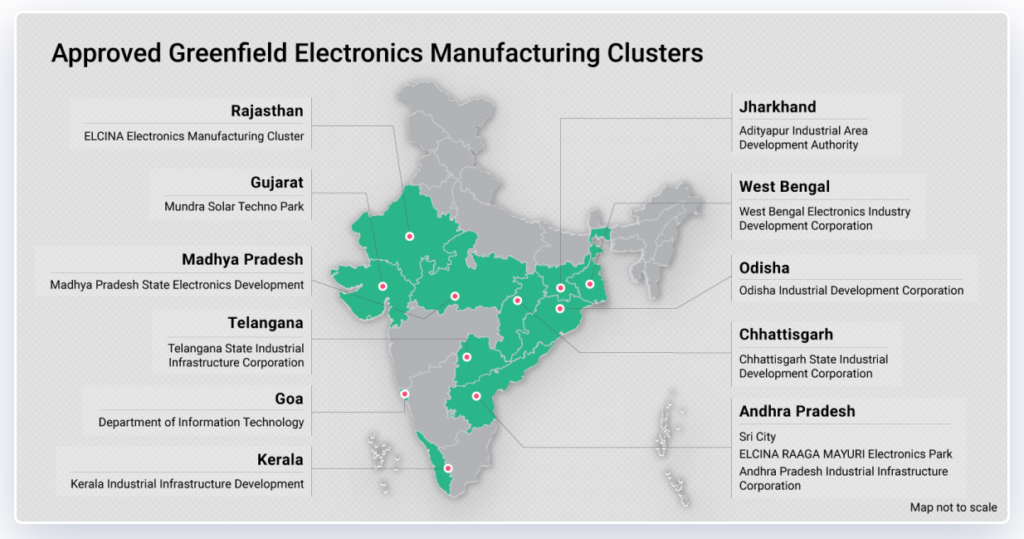
    There are already many greenfield electronics manufacturing clusters that are in the region where automotive companies already have manufacturing units. Collaboration between the automotive and semiconductor industry in India needs to be explored to drive semiconductor automotive manufacturing.

    Automotive Electronics Account For 8% of Electronic In India

    The sensor market for automotive itself is going to be worth $5 billion by 2022. This is just one of the many segments that automotive in semiconductor solutions for. Adding AI to semiconductor solutions for smart mobility is going to increase the market demand tenfold. Having all such solutions in the house is critical for long term financial and innovation growth.

    Picture By Chetan Arvind Patil

    Designing of advanced automotive semiconductor chips already happens in India. The only hurdle is manufacturing and testing at large scale. The government of India is already looking to expand the local manufacturing of automobile equipment and it is about time to enable the same for semiconductor manufacturing from automobile use.

    The success of automobile semiconductor manufacturing in India will surely enable the growth of end-to-end semiconductor manufacturing for different domains.


    PSA

    NXP is a leader in advance autonomous semiconductor solutions from design to manufacturing and below videos show a glimpse of how they do it.


  • V2X – Vehicle To Everything

    V2X – Vehicle To Everything

    Photo by chuttersnap on Unsplash

    Over the last half-century, vehicles have played an important role in everyone’s life. It has enabled point-to-point commute a faster and an efficient process. Whether one is traveling on a public bus or a private car, each of these vehicle types play a very crucial role in enabling ease of living.

    The last decade saw a drastic change in how the automotive industry manufactures vehicles. Vehicles of all forms are now much more fuel-efficient. Alternate fuel technologies are being used on a large scale. Features are provided that make vehicles safer and more aware. Enhanced digital experience by making most of the auto software tools built on top of the Android Auto and Apple CayPlay ecosystem.

    The next big change in vehicles is going to be on the data and communication technologies.

    On the data front, there are already many interesting hardware-based solutions that can capture the data generated by the vehicle. Then present it to the consumers and businesses to understand vehicle behavior and/or to track the vehicle usage. This is possible due to the standardization of the On-Board Diagnostics (OBD) and Controller Area Network (CAN). Data is also critical for the automotive industry to manufacture the products with zero defects.

    There are still many unexplored opportunities in the data domain due to the lack of continuous high speed internet access inside the vehicle. With 5G communication networks even vehicles can be equipped with the high speed internet. This will also allow many over the top service and will enable data driven innovation.

    The next decade is going to change how data is accessed within a vehicle due to the 5G expansion. Due to the different frequency bands 5G can run on, it makes it a perfect solution to enable real-time information access.

    While data and communication will play a major role in the automotive industry, it is also critical to understand the specifics of how this foundation will be laid.


    VEHICLE TO FUTURE

    The answer of how to make use of data and communication in automotive industry lies in the solutions provided under Vehicle To Everything (V2X).

    V2X holds big promises. All the sensors and the data points when combined ensure that vehicles are more secure and aware than ever.

    V2X already enables on the go real-time entertainment, but in the future with 5G and other network infrastructure, on-demand information and entertainment will go hand in hand.

    Picture By Chetan Arvind Patil

    The developments around V2X will provide second by second tracking of the logistics and will prealert any possible issues with traffic, vehicle, and any important information that may lead to shipment delays.

    V2X will also enable different levels of vehicle autonomy apart from securing pedestrians and bicyclists from colliding on vehicles. V2X will also increase the number of small cell networks by converting the vehicle itself as a cellular point of access.

    It is important to understand how V2X does so with the help of different technology domains within V2X.


    VEHICLE TO EVERYTHING

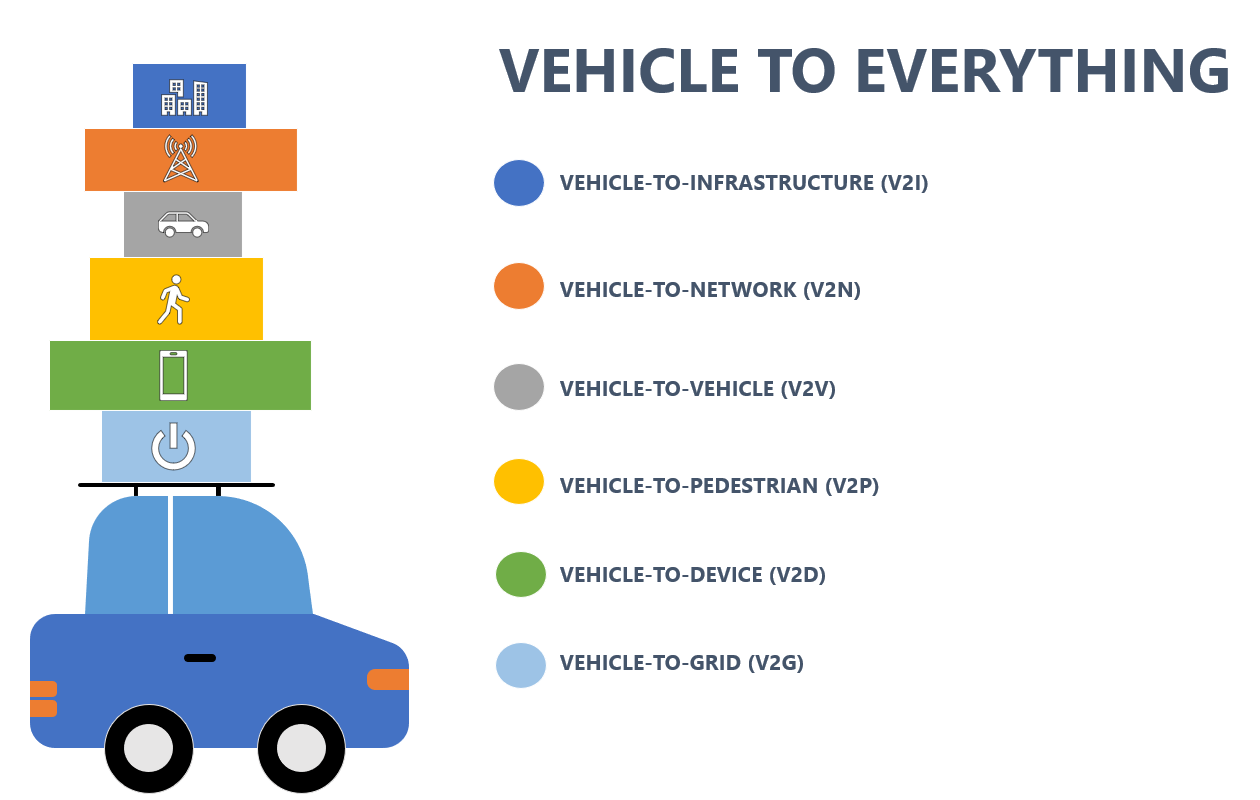
    Vehicle-To-Everything (V2X) is all about how vehicles are able to send the data out and get the data in with the help of advanced communication technologies. With 5G, there is going to be a rapid increase in V2X implementation. Every new vehicle in the market will then act as a data point, router, and network in itself.

    The X in V2X stands for the different technology domain a vehicle has started being part of.

    Vehicle-To-Network (V2N) – V2N is the foundation of V2X. With the help of widely deployed communication network within and outside the vehicle, high speed data transfer can occur. The important use of V2N is voice and data communication for real-time navigation and entertainment apart from the critical emergency roadside assistance. Internet access using hotspots also comes under V2N.

    Any other V2X technology domain is fully dependent on V2N as without a communication network (specially wireless), none of the other V2X implementations can work.

    Vehicle-To-Infrastructure (V2I) – V2I is critical for level 5 automation where along with LIDAR and other self-driving sensors the data based approximation also is useful. This way vehicles can distinguish between road and obstacles much better than just a single data point coming from the use of vehicle’s own hardware. This is done so by feeding the vehicle with live view of surrounding by communicating directly with near by internet and data nodes. This continuous data feed helps in decision making. Apart from self-driving, V2I can also communicate with the traffic control network directly. Using this information vehicle can adjust/advice speed to ensure that the traffic block miles away does not get more congested.

    Vehicle-To-Vehicle (V2V) – V2V takes the help of V2N along with V2I to capture information from vehicles in close proximity. With V2V, Vehicles can communicate about traffic, speed, collision, and distance. All these data points will enable much safer driving compared to the past decade. A self-driving vehicle is heavily dependent on its sensors to capture, decode, and react to the real time situation. If the same self-driving vehicle gets accurate input that makes the driving safer, then it will also increase the adoption and take safety to the next level. This is where V2V is important and helps drive zero accident occurrence.

    Picture By Chetan Arvind Patil

    Vehicle-To-Pedestrian (V2P) – V2P takes the approach of ensuring that the vehicle is always able to detect and take action in case a pedestrian or bicyclist comes in the way. V2P relies on V2N and V2I data points and then combines it with its data to ensure that any critical scenario like a pedestrian or bicyclist coming in front of the vehicle, is handled without comprising on the safety of the pedestrian or bicyclist and even the passengers. Most of the systems in the vehicle today are already equipped with processing capability to alert the driver for different collision scenarios, but with V2P the data point will allow another layer of security and ensures 100% accurate collision alerts by considering 360 degree view .

    Vehicle-To-Device (V2D) – V2D is already in use in most of the vehicles out in the market. With the help of Bluetooth communication any device can connect with the vehicle and do many tasks from answering calls to playing music to logging data via OBD. The next step in V2D will be to allow smart devices to make use of small cell 5G networks that every vehicle will come equipped with. This will allow vehicles to act as hotspots. V2D will also enable advanced secure keyless vehicle entry along with remote startup, locking, and tracking.

    Vehicle-To-Grid (V2G) – V2G is all about electric vehicles plugging into the electric grids. These grids can be in a parking lot, home, or a roadside charging station. V2G allows real-time tracking of nearby grids that can be used to charge the vehicles. The same grids can also perform a diagnostic check to ensure that the safety of the vehicle is not compromised and the battery to internal electrical networks is intact. Performing such smart checks with V2G will provide more safety than mile based servicing currently followed by the manufacturers. The data points gathered with V2G every time an electric vehicle is charged then can be sent to the central servers to process and understand usage of energy along with other data insights.

    V2X provide unlimited opportunity not only to the automotive industry but also to the hardware and software businesses. The consumers are also going to see rapid increase in the feature list. It will be interesting to see how automotive industry provides V2X features without making it too costly for the consumers. Otherwise, wide adoption of V2X will not be possible.


    Bloomberg technology has an interesting video on 5G and the Future of Connected Vehicles showcasing the importance of having a universal data and communication standard to enable growth of V2X.


  • The Challenges For Electric Vehicles In India

    The Challenges For Electric Vehicles In India

    Photo by CHUTTERSNAP on Unsplash


    ELECTRIC VEHICLES IN INDIA

    India has set an ambitious goal of 30% electric vehicle (EV) adoption by 2030. The adoption is expected to be driven majorly by two/three-wheelers and commercial vehicles. This is a daunting task and there are many challenges on way to ensuring faster EV adoption.

    EV adoption requires a three-way handshake and the same is true for the Indian automotive market:

    • First: Automotive manufacturers need to provide an EV alternate to every non-EV model in production
    • Second: Consumers should be able to afford the EV model
    • Third: Infrastructure required to ensure end-to-end EV support

    The majority of automotive manufacturers around the world have already started working on plans to launch a wide range of EV vehicles for consumers. Some are also working on an alternate EV model for every alternate fuel model in production. The more manufacturers join such initiative, the better it will be for a new market like India.

    From the consumer point of view, the major concern is still about the range and the cost. Over the last 5 years, several startups in India have focused on EV solutions to capture the two/three-wheeler market. Some have been very successful in doing so. There are still concerns around the cost and range, as these two/three wheelers still take on an average of 5 hours to get fully charged to provide a range of about 150-200 KM (93-125 Miles).

    Infrastructure is another key to the wider adoption of EV. Countries that have a well-developed market for EV (the USA, EU, etc.) have ensured that the policies are suitable for faster EV adoption including incentives for both manufacturers and consumers.

    India though has taken a step in all the three points discussed above, there are still challenges on the EV 2030 roadmap.


    EV CHALLENGES IN INDIA

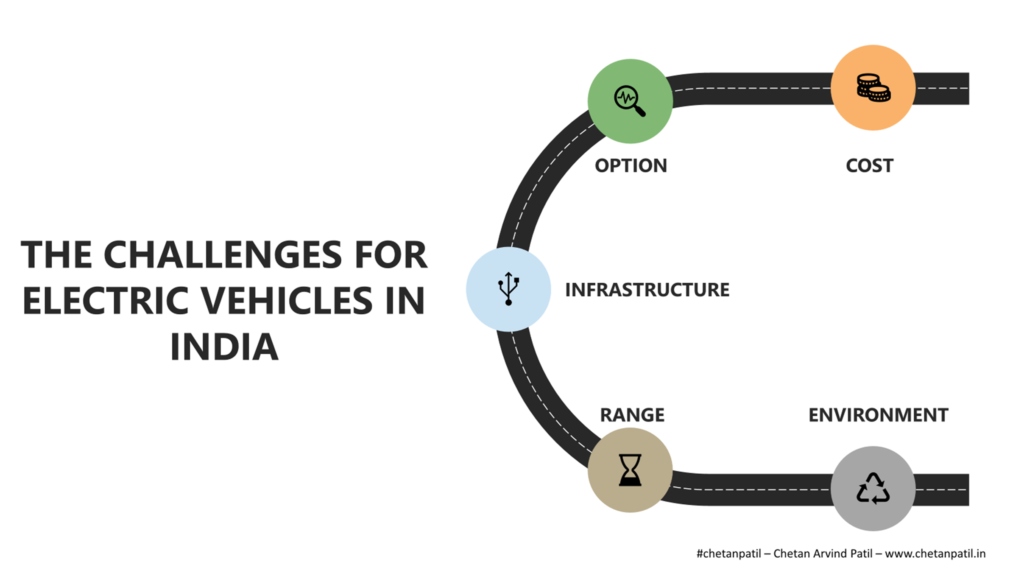
    EV growth in India is depended on overcoming the following challenges:

    • Cost
    • Range
    • Option
    • Environment
    • Infrastructure

    Cost: Given the technology required to develop an efficient EV is fairly new, the cost is becoming the major hurdle in wider adoption. The majority of India’s automotive buyers focus on vehicles that are compact and provide long-term reliability and cost benefits. This choice has driven automotive manufacturers in India to keep churning out new models that are not only compact and reliable, but are low cost too. Any new EV passenger vehicle will have to not only beat the entry-level fuel-powered models but will also need to ensure that there is no compromise on the features.

    Range: India is still a fuel-powered automotive market. Users have adapted to the fact that they need not worry about waiting to re-fuel the vehicle. Not all the cities and towns have the EV electric charging infrastructure. On the go charging requires time and that doesn’t help EV adoption. This is a turn off for the EV market. On top, the planning and implementation of such EV charging network is yet to be defined clearly for the Indian market.

    Picture By Chetan Arvind Patil

    Option: In 2020, Indian automotive manufacturers are not providing more than two or three EV model options. This limits the EV options for the consumer. While commercial vehicles by default are slowly getting more EV models, the major market (~70%) is still in the passenger vehicles which is far behind in terms of EV models. Unless automotive manufactures come up with a wide range of options, consumers will still get attracted to fuel-powered vehicles.

    Environment: There is still no clear roadmap in India about how the battery charging infrastructure is going to be. Whether it will be re-charging the EV batteries at the charging stations or the battery swapping is going to be an economically viable option. In both cases, the environmental challenges still exist. Taking fossil fuel out of the vehicles still does not mean that the EV is 100% environment friendly. Disposing of the battery after long usage is still a big concern. On top, the raw materials required to develop batteries are not fully environment friendly.

    Infrastructure: EV requires a network of charging stations. The developed market already have policies and partners who have worked on creating a network of infrastructure that allows anyone with an EV model to get their EV charged at an affordable cost. The same infrastructure is now being extended to provide EV servicing, in case of breakdowns. India needs a clear policy and partners to ensure that the infrastructure is in place before ramping up the EV production.


    EV FUTURE IN INDIA

    The future of EV is promising in India. It does come up with challenges. There are already established EV markets to learn from and take the best possible route possible to increase the wider adoption of passenger and commercial EV.

    The commercial EV market is growing mainly due to state government policies. The same needs to be applied to passenger vehicles. Two/three-wheelers have already started adopting to the EV business model. If the cost goes down further with an increase in range, the speed of adoption can be faster.

    EV market also provides opportunity to the semiconductor companies which can provide electronic based solution to make EV ecosystem smarter.

    The mass mobility transition for 1.3+ Billion people is not an easy task. It is an opportunity for all the manufactures that are driving the EV market around the globe. Will be exciting to see how the world helps India drive into the EV world.