Category: BUSINESS

  • The Hurdles And Opportunities For The Shrinking Semiconductor Roadmap

    The Hurdles And Opportunities For The Shrinking Semiconductor Roadmap

    Photo by Matt Duncan on Unsplash


    THE HURDLES FOR THE SHRINKING SEMICONDUCTOR ROADMAP

    Several roadmaps get initiated by different semiconductor companies and also semiconductor technical bodies. These roadmaps provided a path of where semiconductor technologies were, where it is today and where it will be tomorrow. In many cases, roadmaps also allow a way to understand how the product development phase will be for any given domain within the semiconductor industry or company.

    These roadmaps are based on the capabilities of any given company to drive semiconductor technological innovation. These innovations then eventually push the industry towards the next-gen of solutions that set the path for future research and development. For example, the mass production of 2nm is heavily dependent on EUV technology, and when such a solution is used at a large scale then enables the development of more die-to-device-level optimization and research.

    However, the continuous push to innovate and provide more balanced power and performance has now brought the semiconductor industry to a point where there are several challenges that companies (and the industry at large) need to overcome. These challenges will eventually enable new opportunities that will move the semiconductor product innovation ahead.

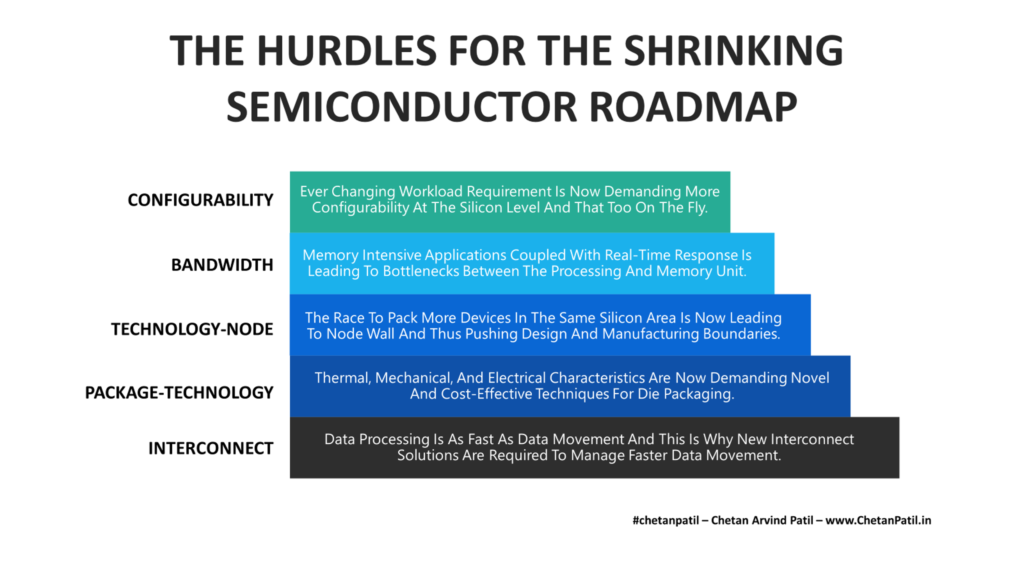
    Configurability: The computing workloads in the 1990s were far less complex than the workloads today’s computing architectures are running today in the 2020s. For lighter workloads, a rigid IC (mainly XPUs) is perfect. Today, the workloads are changing due to the new data that gets generated faster than ever. That demands configurability from the lower level architecture to drive away any architectural bottlenecks. Configurability at the silicon level is all about adapting internal features based on the workload type. Configurability is hard to validate (apart from making it hack-proof), and the mass production of high-level configurable architecture remains a distant dream and a big challenge.

    Bandwidth: Memory-intensive applications often require XPUs to read and write data to/from memory at a fast speed and that too at a high rate. Such continuous data movement is possible only if the memory bandwidth is large enough to drive faster data throughput. Theoretical maximum memory bandwidth overall has been increasing. It is mainly due to new XPUs that utilize memory interfaces via a high-bandwidth memory controller. There are applications (on the server-side) that require much larger bandwidth for faster GB/second to keep up with the read/write request from the processing unit. It is a challenge for semiconductor memory companies, as they gear up for the 5G+ and Edge computing world where every data point will have to get processed on the go.

    Technology-Node: Research-driven design and development have enabled the shrinking of transistors. Today billions of transistors get fabricated in silicon chips to provide the highest performance possible. However, the race to pack more devices is now leading to a device scaling bottleneck. On top of that, device scaling is also pushing the boundaries of science (physics, chemistry, and math). The semiconductor industry is still marching ahead and is ready to touch the 1nm technology-node and then move to the angstrom era. The design and manufacturing challenges brought with the new device scaling era will be endless. The semiconductor industry will have to move beyond just focusing on the shrinking of the technology-node.

    Package-Technology: The shrinking transistor size is not only affecting semiconductor manufacturing but also has impacted package-technology. The semiconductor industry has already found solutions by utilizing 2.5D/3D techniques as an avenue to drive next-gen package-technology. There are still thermal, mechanical, and electrical challenges that are not easy to solve with every growing silicon density. Today, disintegrated packaging solutions are being used to integrated different components to balance the device characteristics.

    Interconnect: Any given silicon product has different blocks interconnected via different network topologies. Interconnect allows data movement and transfer between multiple processing units. The speed of the processing units itself drives the application response time. As the number of processing units has increased in XPU, managing the data traffic is becoming a challenge. The electrical interconnect is also leading to higher power consumption as the data traffic is increasing. Thus putting the semiconductor solutions to adopt for alternate techniques to drive next-gen interconnect. Optimizing other alternate interconnect (photonics) solutions is going to be a big challenge for XPU designers.

    The semiconductor industry has followed the roadmap approach for a very long time. Such a continuous outlook has pushed the boundaries of semiconductor design and manufacturing. The roadmap is also the reason why several innovative semiconductor-powered solutions are coming out in the market. There are certainly challenges due to Moore’s law scaling down. However, these challenges are creating new opportunities and driving the semiconductor industry towards the More-Than-Moore era.
    Picture By Chetan Arvind Patil

    Picture By Chetan Arvind Patil

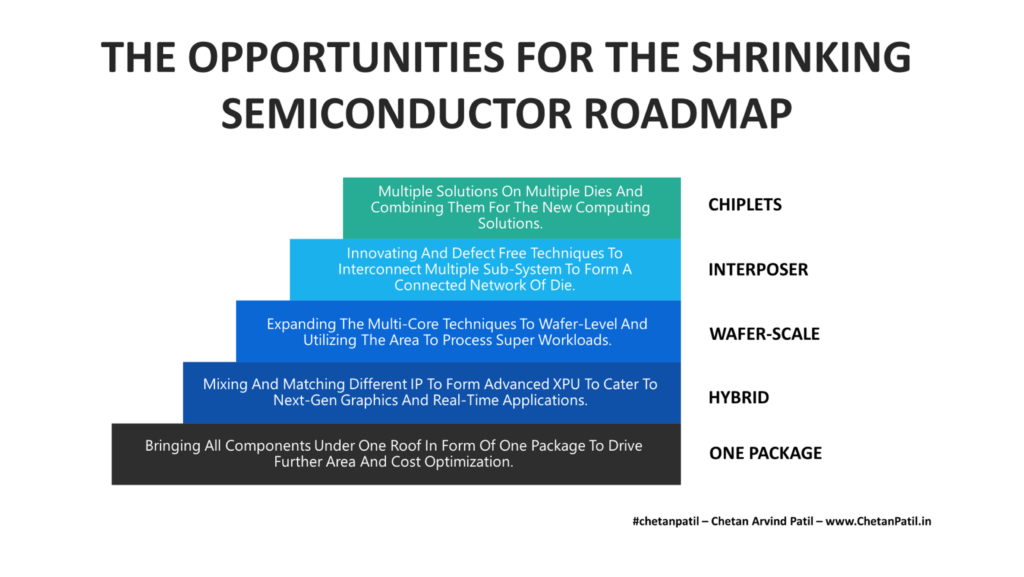
    THE OPPORTUNITIES FOR THE SHRINKING SEMICONDUCTOR ROADMAP

    The shrinking semiconductor challenges are also an opportunity for the semiconductor industry. These opportunities push the envelope of the semiconductor industry and thus create the roadmap for future technologies.

    The growing need to pack more transistors using different processes or methods has provided the semiconductor industry to drive new design ideas. Several semiconductor design innovations have matured from the research stage and are being used to manufacture next-gen devices. The drive to provide a new optimized approach is opening up the future roadmap for the semiconductor industry.

    These roadmaps are build by the opportunities created by the challenges that the industry faces today.

    Chiplets: Increase in transistor density without increasing the silicon area leads to bottlenecks. These bottlenecks are not only around design (power and performance) but also on the manufacturing side. The manufacturing technologies (via technology-node and equipment support) have advanced to enable device fabrication at 2nm. The thermal, mechanical, and electrical characteristics (due to the small silicon area) are posing a challenge to the XPU design. Such challenges are also presenting a new opportunity for XPU designers. Semiconductor XPU design companies have now adopted the multi-die technique to spread the silicon area, which also has the potential to improve overall yield. AMD and Intel have already demonstrated XPUs with chiplets for multi-die XPUs, and will certainly dominate the market (in terms of design/innovation). 

    Interposer: Chiplets manufacturing required the use of multiple dies. Connecting these different blocks to form an integrated chip/system often requires a specific silicon technology called interposer. Semiconductor companies often use different interposer terminology, but eventually, the underlying goal of each of these is to provide a common place for two or more die/blocks. Interposers usage will grow with the growth in chiplets adoptions. It also means providing optimized network-based topology to arrange/stack different blocks for efficiency, which is an opportunity for the research and development teams across academia and industry.

    Wafer-Scale: Servers to supercomputers are getting faster every year. The need to shrink the data centers while not compromising on the throughput is pushing semiconductor design and manufacturing towards large-scale wafer-level solutions. For such solutions, the wafer-scale integration approach comes in as an opportunity to provide die areas as large as the wafer to create high-performance processing units. These units can then cater to any data demand of today and the future. Due to the advancement in semiconductor manufacturing, the yield at the wafer level will not be an issue, but the cost aspect can be.

    Hybrid: Monolithic chips have been in use for several decades. Later, monolithic chips got replaced by multi-core homogeneous and heterogeneous architectures. As the world moves towards a more remote-enabled world, the need for multiple hybrid architectures will grow. These hybrid architectures will have unique processing characteristics, which will enable semiconductor design and manufacturing companies to leverage new methodologies like chiplets to heterogeneous architectures to mixing/matching IPs, thus providing an opportunity to expand the semiconductor roadmap.

    One Package: System-In-A-Package (SiP) allows a way to integrate multiple systems under the same package technology (carrier package). Given the proliferation of multi-die integration, SiP will take the central stage. One package approach will allow semiconductor companies to provide a unified packaging approach to stick together different dies/IPs under the same substrate. While this will pose a challenge, the past success around similar package technology will smoothen this approach.

    Continuous technology development is the key to ensuring that the semiconductor roadmap keeps moving forward. These new technological solutions also enable different industries that leverage the new design to manufacturing methodology to drive better customer experience.

    As the semiconductor roadmap inches towards the 1nm era, it will be vital to keep innovating to move the world into the angstrom arena.


  • The Semiconductor Manufacturing Cluster

    The Semiconductor Manufacturing Cluster

    Photo by Louis Reed on Unsplash


    THE REASONS TO DEVELOP SEMICONDUCTOR MANUFACTURING CLUSTER

    Developing a dedicated semiconductor manufacturing infrastructure from scratch is a billion-dollar risk and the cost of doing so is also increasing year on year. As the semiconductor industry marches towards a new era of capacity creation, it is important to invest in strategies that can enable a high return on investment.

    Today, the majority of the big semiconductor manufacturing companies are looking for new regions to create their next-gen semiconductor device fabrication, assembly, and testing infrastructure. The cost of making the wrong choice for such a large investment is very high.

    The time, and effort required to build semiconductor manufacturing infrastructure are pushing companies, and also governments, towards utilizing (or creating) regions that already have a semiconductor history. This is one of the major reasons why companies like TSMC, Intel, and Samsung are focusing on regions that already have a large presence of semiconductor companies (end-to-end), as it allows them to make the most of the existing ecosystem and thus drives their new facilities towards breakeven.

    Semiconductor Manufacturing Cluster: A dedicated region or area, where within proximity different semiconductor companies have facilities to provide semiconductor device fabrication, assembly, testing, and distribution services. This area may and may not house a different number of semiconductor design companies.

    When multiple semiconductor manufacturing companies are located in the same region, then a semiconductor manufacturing cluster is formed. A semiconductor manufacturing cluster provides several benefits. These benefits are more geared towards semiconductor companies but in the end also benefit the city or the region where these clusters are located.

    Collaboration: A region with multiple semiconductor manufacturing (and design) companies enables collaboration that can drive the development of next-gen solutions and thus benefits the semiconductor industry at large.

    Optimization: Semiconductor manufacturing cluster will allows the development of several business resources that can aid companies. This can range from raw materials to near-by equipment provider to several other support systems that semiconductor manufacturing companies often need.

    Research And Development: The proximity of advanced semiconductor manufacturing facilities allows companies to develop research and development infrastructure. This is often in collaboration with the government and universities. Doing so speeds up development of new devices that can provide much better efficiency and thus pushes the development of new semiconductor-driven products.

    Ecosystem: Worldwide, there are different semiconductor manufacturing clusters. Some are in Taiwan, some in China, and many in the USA. All these regions have transformed themselves into powerhouses and are now an ecosystem for emerging semiconductor manufacturing facilities.

    Talent: In the end, human resources are vital for any industry. The same applies to the semiconductor manufacturing facilities wherein different skills are required to drive the development of semiconductor products. Semiconductor manufacturing cluster creates an infrastructure that attracts talents from all over the world.

    Semiconductor manufacturing clusters are not built overnight. It takes years of effort from both the government and private players. In many cases, a single entity starts from scratch and there on goes on attracting future companies. There on, over an extended period creates the semiconductor manufacturing cluster on its own. Also, having a university with a very high research and development focus is also an important factor in driving cluster-based semiconductor manufacturing regions.

    Worldwide, as governments attract new investments towards semiconductor manufacturing, it is worth planning by focusing on strategies that can eventually turn the regions into a semiconductor manufacturing cluster.


    Picture By Chetan Arvind Patil

    Picture By Chetan Arvind Patil

    THE STEPS TO BUILDING SEMICONDUCTOR MANUFACTURING CLUSTER

    Developing a dedicated semiconductor manufacturing cluster is not an easy task. It takes years of planning, investment, collaboration, failure, and risk to create one. This is the primary reason as to why there are only a handful of countries that have semiconductor manufacturing clusters.

    Semiconductor clusters can be classified into two types:

    Multiple Companies Multiple Facilities (MCMF): A specific region where multiple semiconductor manufacturing companies come together to create their own separate semiconductor manufacturing infrastructure to drive device fabrication, assembly, and testing.

    Multiple Companies Single Facility (MCSF): A specific area or a region where multiple semiconductor manufacturing companies invest to create a single large facility to provide fabrication, assembly, and testing services for different semiconductor companies.

    MCMF is very common and countries like Taiwan, Japan, South Korea, China, and the USA already have several such regions which cater to different needs of semiconductor manufacturing.

    On another hand, MCSF is very rare and the major reason is the effort required to bring different stakeholders to invest in a single facility that can cater to the manufacturing requirements of different semiconductor players. Today, planning for MCSF might be more favorable due to the cost and time, but there have been several examples where such collaborative strategies have failed.

    Countries looking to develop a region that purely focuses on semiconductor manufacturing need to plan for the next century and not a decade, and the following steps can provide a roadmap of achieving the goal of developing a semiconductor manufacturing cluster, which is what countries without semiconductor manufacturing history need today.

    Government Support: Government support is crucial in driving the development of policies, incentives, and facilities that can cater to the semiconductor manufacturing cluster. This is why countries looking to attract new semiconductor manufacturing investment should develop strategies to make an investment from private players a long-term collaboration.

    Private Partnerships: Semiconductor manufacturing clusters today will require move JV between different semiconductor companies. While single entities can themselves invest in new FABs and OSATs, but in the long run, the region needs to develop by continuously attracting new investment. This is possible if in the initial phases more JVs are formed to drive the development of the semiconductor manufacturing cluster that future private players can take advantage of.

    Aligned Goals: Both government and private players need to be on the same page so that the region chosen as a dedicated place to develop the next-gen cluster thrives for several decades. This requires not only planning for the semiconductor industry but also building regional facilities like logistics to universities and several other plans to drive day-to-day facilities. 

    Future Roadmap: In the end, dedicated clusters are divided into sub-regions that are owned and operated by different entities. However, if there is no future roadmap as to why several companies are bringing new investment (mainly if the cluster type is MCSF) then the future roadmap may not be beneficial. Hence, companies need to collaborate more to drive new manufacturing methodologies.

    Continuous Investment: Semiconductor manufacturing clusters are difficult to build and to make the most of it, continuous investment is required. This can be in the form of new investment policies from governments to attract new semiconductor companies to build new facilities (example: TSMC in Arizona) that can take the region towards a new era.

    There are multiple ways of attracting new investment into new regions/countries. Semiconductor manufacturing cluster vision and planning is one of doing so. This way, semiconductor companies (focused on manufacturing) can be confident in the future of the location they are investing in.

    Whether, the semiconductor manufacturing cluster is MCMF or MCSF, the benefits of regions with multiple semiconductor companies are profound, and governments all over the world should focus on developing semiconductor manufacturing clusters to facilitate in-country requirements of future semiconductor products.


  • The Overlapping Business Model Of Semiconductor Pure-Play FAB And OSAT

    The Overlapping Business Model Of Semiconductor Pure-Play FAB And OSAT

    Photo by Firdouss Ross on Unsplash


    THE REASONS FOR THE OVERLAPPING OF SEMICONDUCTOR PURE-PLAY FAB AND OSAT BUSINESS

    Semiconductor manufacturing is heavily dependent on external vendors. This is more true for semiconductor companies that do not have any internal manufacturing capability and have to rely heavily on outsourcing.

    This has made Pure-Play FAB and OSAT the two major driving forces of semiconductor manufacturing. It is widely known that FAB-LESS (and OSAT-LESS) semiconductor companies have contributed heavily in driving the external Pure-Play FAB and OSAT business.

    There are few widely know accepted business model that defines the semiconductor design and manufacturing:

    FAB-LESS: Semiconductor companies that only focus on semiconductor design and rely on external Pure-Play FAB and OSAT for semiconductor manufacturing.

    IDM: Semiconductor companies that focus on both semiconductor design and manufacturing and have the internal capacity to execute both and also take help of external capacity when required.

    Pure-Play FAB: Semiconductor companies that invest mainly in semiconductor fabrication capacity. Cater to both FAB-LESS and IDM.

    OSAT: Outsourced semiconductor assembly and test business that caters to any semiconductor companies without internal assembly and testing capacity.

    The above definitions were applicable in the 1980s and 1990s, and to some extent till the 2000s. However, as the reliance on the semiconductor industry has grown, so has the application of the above business models. This is at least true for Pure-Play FABs and OSATs because of the following reasons:

    Opportunity: Both Pure-Play FABs (more than OSATs) and OSATs are seeing the growing importance of providing extensive services than only specific ones. This is pushing them towards each other’s market. Some of the big Pure-Play FABs already have internal assembly and testing facilities and are already capturing OSAT business. Few Pure-Play FABs are also forming JVs with external houses to provide OSAT services like an umbrella business. This is putting pressure on OSATs and slowly they have also started exploring opportunities beyond OSAT business itself.

    Services: In the end, both Pure-Play FABs and OSATs are providing services to their customers. The more and the better services they can provide the larger market they can capture. Increasing portfolio and moving beyond dedicated services is another reason why Pure-Play FABs and OSATs are entering each other’s business market.

    Technologies: Top Pure-Play FABs are already known for providing 2.5D/3D packaging expertise. This is mainly due to More-Than-Moore solutions the semiconductor world is looking forward to. This is naturally allowing Pure-Play FABs to increase back-end business, and thus putting pressure on OSAT to innovate its back-end solutions or provide Pure-Play FAB services to even out the market.

    Resources: Both Pure-Play FABs and OSATs can drive new technological solutions from inception to production. The major factors are the internal resources (equipment, labs, facilities, etc.) and also a talented pool of researchers who can execute the new solutions on the go. This is another major reason why Pure-Play FABs and OSATs are looking at each other’s market and slowly rolling out new services.

    New Model: The high cost to develop large FAB and OSAT to only provide one set of services is raising the question as to whether there is an opportunity to extend the same facility to drive new services. This eventually means providing overlapping services and thus enabling a new semiconductor business model.

    Pure-Play FAB business started with the focus of providing big giant factories that can take design files and bring them to reality in form of silicon wafers. However, semiconductor fabrication is only one part (important though) of the semiconductor product development. Pre-fabrication and post-fabrication activities are also critical and Pure-Play FABs are realizing the importance of it, and to fill this gap, in the last few years Pure-Play FABs have started investing in assembly and testing services (design is not far behind). While this makes them essentially an Integrated Device Manufacturer (IDM), however, the percentage of assembly and testing services that Pure-Play FABs provides is still comparatively less but certainly on the rise.

    OSAT business on other hand has primarily focused on assembly and testing, and it has allowed them to build high-class facilities that can test and package the product as per the customer requirements. However, as Pure-Play FABs start getting into the assembly and testing services, the OSAT business is changing itself to extend services beyond assembly and testing. Top OSATs are looking to invest in smaller FABs that can allow them to capture the fabrication market, and some OSATs have already created subsidiaries that focus on the design aspect of semiconductor product development. Thus also colluding with the FAB-LESS business model.

    The overlapping of Pure-Play FAB and OSAT business is raising questions as to whether there even exists a specific semiconductor business model, and what are the long-term implications.


    Picture By Chetan Arvind Patil

    Picture By Chetan Arvind Patil

    THE IMPLICATION OF MERGING SEMICONDUCTOR PURE-PLAY FAB AND OSAT BUSINESS

    Semiconductor manufacturing companies expanding their business to provide more services is certainly a welcome move, but the implications of doing so can be both positive and negative. More so when Pure-Play FABs and OSATs extend their services and start capturing each other’s market.

    For semiconductor customers (mainly FAB-LESS) having more options to outsource semiconductor manufacturing will be positive news only. However, only a handful of Pure-Play FAB is capable of capturing OSAT business, and this will certainly raise the level of dependence on big manufacturing giants which might not have positive implications in the long run.

    This is why it is important to understand what are the major implications when Pure-Play FABs starts getting into the OSAT market and vice verse:

    Competition: Overlapping of Pure-Play FABs and OSATs will increase the competition to provide semiconductor fabrication, testing, and assembly services. For customers hiring Pure-Play FAB and OSAT, it is a win-win situation and so will it be for the semiconductor industry at large as there will be more capacity and also options for outsourcing to semiconductor fabrication and back end services.

    Dependence: If more semiconductor companies start providing fabrication to the assembly under one roof, then it will slowly make FAB-LESS more dependent (than today) on specific solutions providers. The major reason is due to the notion of keeping all semiconductor manufacturing under one location/flow so that the cycle time reduces. Hiring two different vendors brings more complexity than hiring a single vendor which can perform all the semiconductor manufacturing services at the same location.

    Cost: If all the semiconductor manufacturing (fabrication, testing, and assembly) services are provided by a single entity, then it can allow semiconductor design companies to lower the cost by negotiating the terms. It might also be the case that the cost of development goes up due to new facilities requiring the full cycle of qualification before it can be used to fabrication, test, and assembly the silicon products.

    Capacity: If Pure-Play FABs and OSATs ramp up their efforts to enter the new semiconductor manufacturing business, then it will bring new capacity for the semiconductor industry. In the long run, this can have a more positive impact and can certainly mitigate future semiconductor shortages.

    Emerging Solutions: Extending business to provide new services often leads to innovation. This can very well happen if OSATs start exploring the fabrication business and drive newer technological solutions that are not only limited to technology nodes but are also about new semiconductor manufacturing methodologies. The same can be true for Pure-Play FABs.

    The overlapping of Pure-Play FABs and OSATs is inevitable. One of the strategies that Pure-Play FABs and OSATs can deploy is to invest in smaller OSATs and FABs respectively. This can remove the risk of investing a large sum of money on upgrading existing facilities and can also bring life to smaller OSATs/FABs which are on the verge of closure.

    In the end, if OSAT and Pure-Play FABs keeping increasing their foothold into each other’s arena, apart from trying hands on the semiconductor design (dominated by FAB-LESS and IDMs), then does that mean all OSAT and Pure-Play FABs will turn into IDMs and eventually there will be no dedicated OSAT and Pure-Pay FABs? Only time can answer this question.


  • The Pillars Of Semiconductor Industry

    The Pillars Of Semiconductor Industry

    Photo by Tanner Boriack on Unsplash


    THE IMPORTANCE OF PILLARS IN THE SEMICONDUCTOR INDUSTRY

    There are numerous industries worldwide catering to different markets. Company from a specific industry will rarely provide all end-to-end in-house solutions to develop products.

    Almost all of the companies within a given industry rely heavily on different segments (from the same industry) to achieve the goal of producing high-quality products for their target customers.

    The same fundamentals are valid for the semiconductor industry. Without the support environment, the product will not meet the high-quality customer’s expectations. More so, when the silicon chip can be used for numerous types of applications anywhere in the world. That is why quality and reliability need to be above par.

    To satisfy customer requirements, different types of support systems are needed. In semiconductors, these support systems can be called pillars. These pillars of the semiconductor industry can be logically separated into three different segments

    Front-End: Research, design, and marketing.

    Middle-End: Support, equipment, and software.

    Back-End: Manufacturing, supply chain, and sales.

    Each of these three segments plays a crucial role in bringing a product to the market. They do so to provide the following important traits:

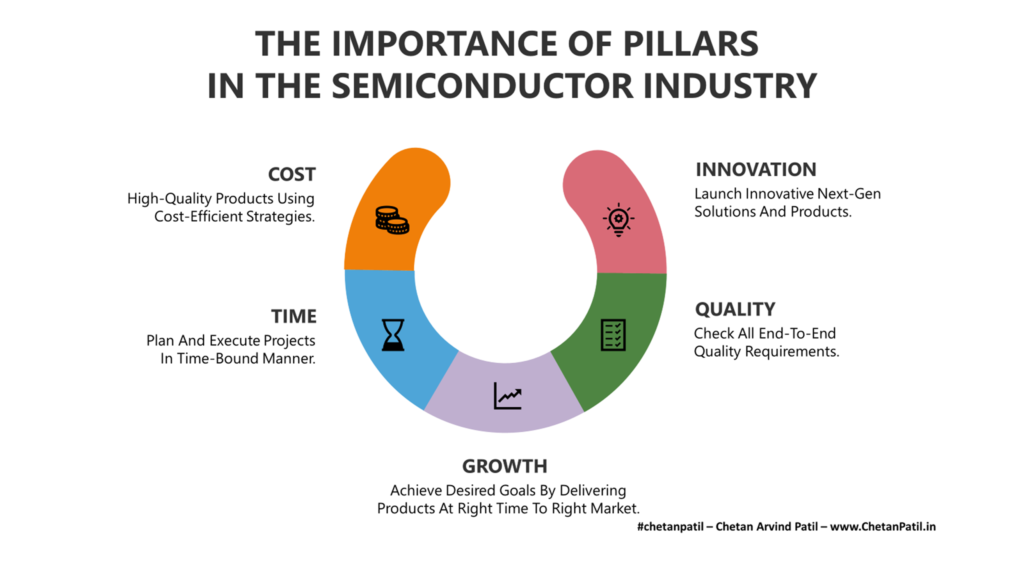
    Cost: Semiconductor companies are immensely focused on cost reduction to grow their product margin. This is something that requires three-way synchronization of the three discussed segments. These segments to do by bridging together the gaps that ensure zero-delay and zero-waste. Such practice ends up creating low-cost but high-quality flow for the semiconductor product development.

    Time: Delivering products on time is the key. Delays in projects can hurt a company’s reputation and growth. This requires all three segments to work in harmony. Using the data-sharing approach, different segments work together to ensure all possible delays are eliminated, thus ensuring time-bound delivery.

    Growth: Connecting the three segments seamlessly, ensures that the product is profitable in the long run. Ensuring there are no gaps between the three segments enables a high growth margin too.

    Quality: Working with different segments within the same industry also requires efforts to maintain high-quality and standards. This is what these three different segments work towards by ensuring different tools and processes come together to provide reliable products.

    Innovation: In the end, companies in semiconductors are focused on innovating next-gen solutions. This is possible only when all three segments are set up and connected to drive innovation, which often requires a high level of operational management, something Front/Middle/Back segments have incorporated for a long time.

    The three different pillars of the semiconductor industry play an important role when it comes to product success and profitability. However, it takes a lot of effort and time in building a network of solution providers that form a robust three-way network.


    Picture By Chetan Arvind Patil

    Picture By Chetan Arvind Patil

    THE ROLE OF DIFFERENT PILLARS IN THE SEMICONDUCTOR INDUSTRY

    The semiconductor industry views Front-End, Middle-End, and Back-End from a technology-node or semiconductor fabrication point of view. However, it is about time that the world also sees these three segments from a business point of view.

    Each of these three segments is vital in ensuring that the product is delivered to the market on time.

    Front-End: Front-End segment captures customer/market requirements which are used by teams to design a product. This is the research and development part that brings product ideas to reality. It can also be seen from a marketing point of view as a stepping stone towards next-gen products.

    Middle-End: Middle-End segment connects the design and marketing side of the product to the back-end side that delivers the fabricated product to the end-customer. It also consists of different support environments like software, equipment, facilities, and so on.

    Back-End: In this segment, the product comes to life. It is more manufacturing, logistics, and the supply chain side that ensures the design reaches the market in time. Back-End is also about working with different assembly teams to ensure the semiconductor product is mounted on the system works as per the specification.

    It might be confusing to the industry veterans who have only focused on Front/Middle/Back end systems from a fabrication point of view, but as the world is moving towards more connected product development it is equally important to understand how and which segments within the industry work in synchronization to enable advanced technology.

    Viewing the end-to-end semiconductor industry chain from the above three pillars gives a more realistic view of how the semiconductor industry works and the importance each of these segments/pillars brings.


  • The FAB-LITE Semiconductor Fabrication Model

    The FAB-LITE Semiconductor Fabrication Model

    Photo by Laura Ockel on Unsplash


    THE CHANGING SEMICONDUCTOR BUSINESS MODEL

    The semiconductor product development requires many businesses (from materials to logistics) to work in harmony. The complex process of fabricating semiconductor devices has also given rise to the cost of development. To lower the expenditure and to survive the semiconductor business, companies have leveraged different business models.

    The three types of semiconductor business model that define the design and the fabrication houses have been in use for several decades:

    Pure-Play FAB: In Pure-Play FAB (fabrication) model, the semiconductor companies invest only in semiconductor fabrication plants to turn the design into silicon products. These Pure-Play FABs in the last few years have also started investing in OSATs to leverage the growing assembly and testing demand. Examples: TSMC and GlobalFoundries.

    FAB-LESS: FAB-LESS model allows companies to focus purely on the design aspect of the semiconductor product. FAB-LESS companies either have sold all their semiconductor fabrication plants (AMD) or never had any. FAB-LESS model was a game-changer for the semiconductor industry. FAB-LESS model allowed emerging companies to make use of the semiconductor manufacturing capacity built by the Pure-Play FAB. Even today, the majority of the emerging semiconductor companies are FAB-LESS focusing on innovative solutions and designs. Examples: Qualcomm and AMD 

    Integrated Device Manufacturer (IDM): IDM is a mix of Pure-Play and FAB-LESS. It allows companies to own semiconductor fabrication and testing facilities that cater to an in-house developed product. In the rarest of the cases, the IDM works with outside vendors to allow in-house capacity usage. Examples: Intel, Samsung, and Texas Instruments.

    The majority of the emerging semiconductor companies are FAB-LESS due to the high cost of semiconductor fabrication plants and the time it takes to breakeven. Some Pure-Play FAB companies are also getting into the semiconductor design, but not at the scale at which FAB-LESS companies operate. IDMs have enjoyed the best of both worlds. However, the high CapEx to build/run the MEGA/GIGA FAB is now pushing IDMs to innovate their business model.

    FAB-LITE Model Provides Low-Cost Solution For Semiconductor Dependent Companies Without Foundry To Enter Semiconductor Manufacturing

    The semiconductor chip shortage in the automotive industry is another game-changing event for the semiconductor industry. It is driving automotive companies to think hard about the growing need for semiconductor products in the automotive solutions and how dependent the future EV (or Alternate-Fuel) market driven by high-tech semiconductor solution is going to be. 

    While there is a large number of FAB-LESS companies that can cater to the automotive industry to design innovative automotive semiconductor products, on the other hand, the capacity to cater to such high demand is not. The majority of the semiconductor manufacturing capacity available today is for advanced technology-node. Given that the smartphone to server market also requires advanced technology-node, the process to reserve the resources is becoming difficult for an industry like automotive. On top of that, the new advanced technology-node facilities under development will take many years to develop, and there on will also take months and years to run at the full capacity.

    All of this is requires the need to re-invent the semiconductor business model that caters specifically to the need for an industry like automotive that is facing an uphill battle to reserve semiconductor fabrication capacity against the top computing OEMs.

    What is the solution for an industry that requires semiconductor fabrication but is facing capacity constraints? The answer to this question may very well lie in the FAB-LITE model.

    FAB-LITE:

    – A semiconductor manufacturing model that enables in-house semiconductor manufacturing that caters to specific low-cost higher technology-node that are still in high demand in industries like aerospace, automotive, shipping, defense. etc.

    – FAB-LITE model differs from the other three semiconductor business models as it purely focuses on cost optimization, either by building FABs by the companies that never ventured into semiconductor manufacturing but are heavily dependent on semiconductors to meet day-to-day production, OR by acquiring older FABs for in-house semiconductor need. For example, Ford may want to buy/build a semiconductor manufacturing facility that caters to its automotive needs.

    FAB-LITE is not geared towards advanced technology-node but can be upgraded as the market moves from higher to lower technology-node. In automotive, the products can be in use for decades. The majority of these active semiconductor chips, do not use today’s latest and greatest technology-node, but instead are dependent on yesterday’s older technology-node.

    FAB-LITE model is perfect for an industry that never owned semiconductor manufacturing but has always relied on semiconductor fabrication. It allows lost-cost technology-node operations to ensure they never run out of semiconductor capacity and chips.

    FAB-LITE is the need of the hour and also comes up with many benefits.


    Picture By Chetan Arvind Patil

    THE NEED OF FAB-LITE FOUNDRY MODEL

    The FAB-LITE model need is because the high-tech industry is becoming increasingly dependent on semiconductor solutions.

    The vital piece to ensure the unlimited supply of semiconductor products is the fabrication, without which, the end-product of all the high-tech industry will face constraints like the automotive and consumer industry is facing in 2021.

    Following are the major factors that drive the need for a FAB-LITE mode:

    Cost: Continues improvement enables making the FAB-LITE model more cost-friendly. It can be either by sharing the resource with the competitor in the same industry with strict confidentiality.

    Control: Owning a semiconductor fabrication that is FAB-LITE allows stricter control over the quality and reliability of semiconductor products being products. It allows prioritizing products that eliminate product launch delays.

    Quality: Having an in-house fab that is FAB-LITE also ensures that the quality of the product can be strictly controlled. Thus enabling better products that meet the requirements of the end product. Such control is very crucial for an industry like automotive.

    Shortage: Companies that are not into semiconductors but into the manufacturing of products that require semiconductors at a large scale cannot afford the shortage. The automotive industry today is one such example. With growing electronics in automotive solutions. the need for semiconductors will keep growing. FAB-LITE’s low-cost approach eliminates the shortage of in-house production needs.

    Dependency: FAB-LITE business model is all about eliminating the dependency on large Pure-Play FAB. The majority of the Pure-Play FABs provide advanced technology-node. Many semiconductor driven products in the market still rely on older and high technology-node (automotive, defense, aerospace, etc.). To serve such solutions, the FAB-LITE model is ideal, given it focuses on technology-node that are in high demand and are less costly to develop (infrastructure to process lines) compared to advanced technology-node.

    FAB-LITE is not limited to non-semiconductor companies. Even FAB-LESS can take the help of the FAB-LITE model to ensure they never become 100% dependent on their semiconductor manufacturing needs. FAB-LITE is also suitable for emerging markets like India, where the semiconductor fabrication is limited to infrastructure (like space and defense) of national interests only.

    The above benefits play right into the hands of the semiconductor dependent companies that can invest today for the future semiconductor manufacturing needs by lowering the cost of the processes being used.


    Picture By Chetan Arvind Patil

    THE BENEFITS OF FAB-LITE FOUNDRY MODEL

    Like the other three actively used semiconductor foundry models, FAB-LITE also has many benefits. These benefits balance the best of the need and the cost to develop the semiconductor products in-house.

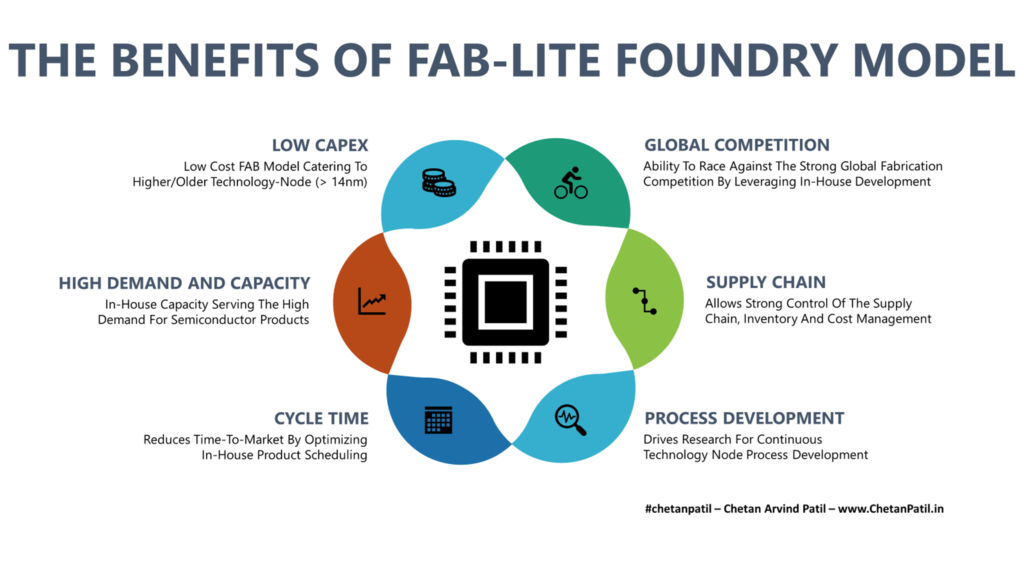
    Cycle Time: FAB-LITE enables in-house production that ensures no delay in products as there are no conflicts with the outside competition. FAB-LITE keeps the product development cycle time in line with the companies expectation and execution plan. If any impact ever occurs, then the capacity can be quickly increased to minimize future constraints.

    Low CAPEX: FAB-LITE focuses on older and higher technology-node (> 14nm). These require less capital to run compared to the advanced technology-node. There are already several old FABs that can be acquired to drive in-house requirements. These FABs later can be upgraded as the market requirement changes. Such a solution is perfect for automotive and defense solutions.

    Supply Chain: In-house FAB-LITE provides the option to control the inventory. It enables an effective supply-chain and lowers the expenditure of in-house fabrication can also aid in eliminating waste.

    Global Competition: FAB-LITE model is for the world that will run everything on the semiconductor. Having a FAB in-house allows semiconductor dependent companies to strictly control product development in the market where any slip in product launch can amount to huge losses.

    Process Development: FAB-LITE model drives in-house technology-node related research and development. It can also lead to the development of new low-cost processes that can further lower the capital expenditure. If tomorrow’s automotive market will be semiconductor driven (which it certainly will be), then companies need to adapt starting today.

    High Demand And Capacity: FAB-LITE can easily cater to the high demand and capacity requirement of products that require semiconductor solutions. Smartphones and other products are shrinking in size, and the high-tech OEMs are reserving all the available advanced technology-node capacity. Reserving full FAB capacity impacts the older/higher technology-node required by other industries. By enabling the FAB-LITE in-house model, companies can balance the high demand for semiconductor solutions by strategically implementing the FAB-LITE model.

    Given how hard the automotive industry (and many other industries dependent on semiconductors) got hit by the semiconductor chip shortage, it will be interesting to see if the learning from such chip shortage can drive in-house semiconductor fabrication via the FAB-LITE model.