Category: CAPACITY

  • The Semiconductor Capacity Leaders

    Photo by Ian Taylor on Unsplash


    The future of semiconductor capacity is uncertain due to the increasing demand for chips and the limited availability of production facilities. It has led to a situation where certain countries, regions, and companies monopolize producing semiconductors.

    The distribution of semiconductor capacity across different countries and regions is also an essential factor in determining the future of this industry. Thus, semiconductor capacity management should be the primary focus. Where by managing the resources and processes involved in the fabrication, testing, and assembly of semiconductor components.

    Capacity: The Future Of Semiconductor Capacity Is Uncertain Due To The Increasing Demand For Chips.

    Distribution: The Distribution Of Semiconductor Capacity Across Different Countries And Regions Is Also An Essential Factor.

    In such scenarios, public policies promoting investment in new semiconductor technologies and infrastructure can ensure that all countries have access to the latest technology. Additionally, governments should consider incentives for companies to invest in new production facilities to increase competition and reduce monopolies.

    It involves planning for future capacity needs, allocating resources to meet them, and monitoring performance to ensure capacity meets demand. By managing semiconductor capacity effectively, companies can reduce costs while ensuring that their products are produced on time and with high quality.


    Picture By Chetan Arvind Patil

    As semiconductor technology proliferates, countries and companies worldwide have started competing to dominate the market. They must also have effective strategies to ensure they can stay ahead of their competition.

    The regions that dominate semiconductor manufacturing have access to a wide range of resources, including labor, cost, and next-gen technology. These countries have invested heavily in research and development to stay ahead of the competition. It has enabled them to produce high-quality products at competitive prices.

    Quality: Manufacturing High-Quality Semiconductor Products At Competitive Prices Is An Important Factor.

    Technology: Countries That Have Invested Heavily In Research And Development To Stay Ahead Of The Competition Will Dominate.

    Countries that want to lead semiconductor manufacturing must also have effective management strategies to stay ahead of their competition. By leveraging the right resources, new regions can gain an edge over their competitors and slowly but surely become a leader in the industry.

    Eventually, the country and companies dominating semiconductor manufacturing have an advantage over its competitors. All of this allows them to manufacture high-quality semiconductor products at competitive prices.


  • The Semiconductor Capacity Expansion Flow

    The Semiconductor Capacity Expansion Flow

    Photo by frank mckenna on Unsplash


    Semiconductor capacity is a critical factor in the future of the electronics industry. Thus, it is essential to ensure a balance between the demand and supply of semiconductors, as well as cost-effectiveness and capital expenditure (CapEx).

    Also, the semiconductor industry has seen tremendous growth recently, with the demand for chips increasing significantly. It has increased CapEx for semiconductor manufacturers as they strive to meet the growing demand. However, this increased spending has also resulted in higher costs for consumers.

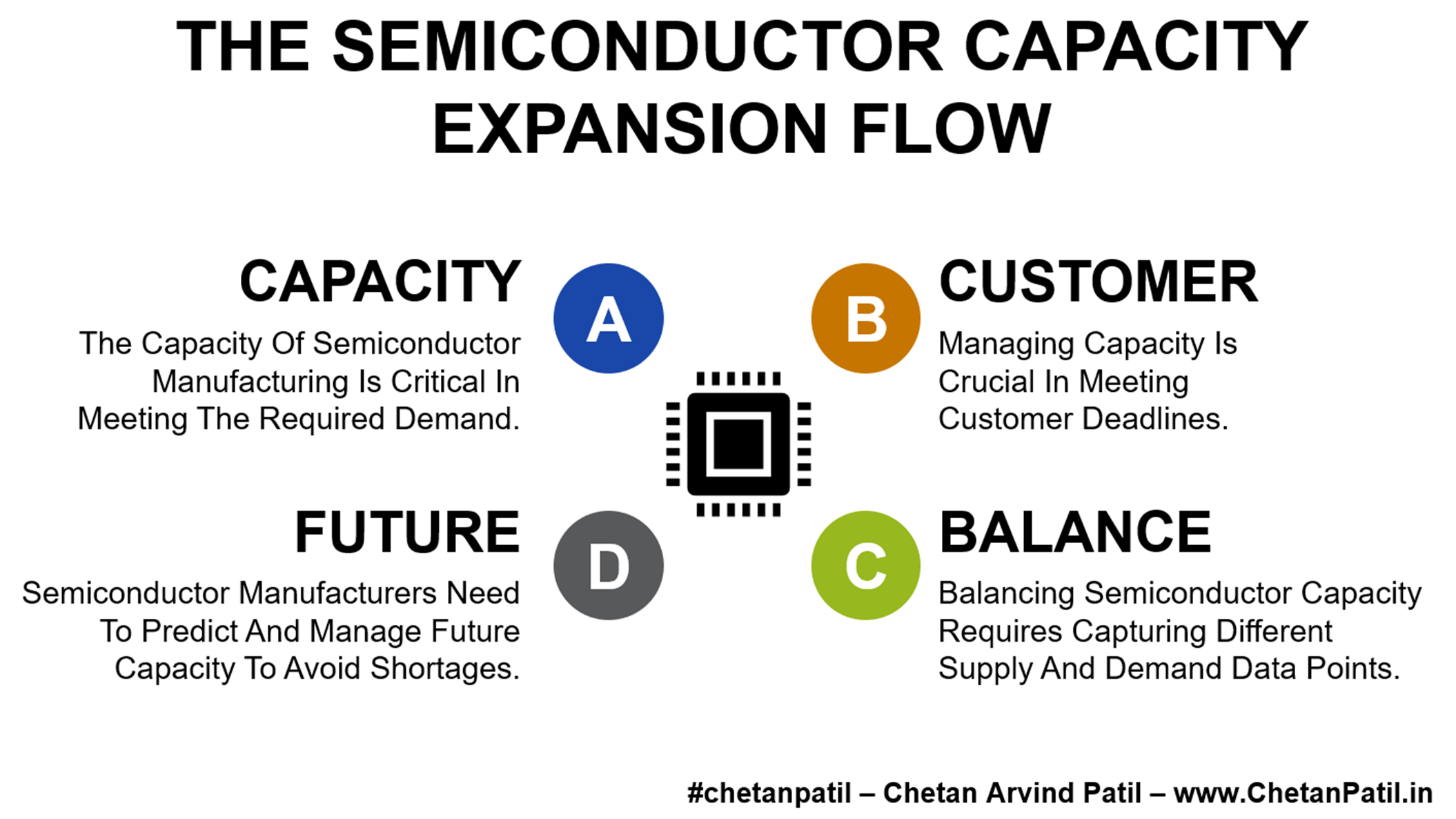
    Capacity: The Capacity Of Semiconductor Manufacturing Is Critical In Meeting The Required Demand.

    Customer: Managing Capacity Is Crucial In Meeting Customer Deadlines.

    Thus, companies must manage their semiconductor capacity effectively to remain competitive and profitable. It means understanding the current market conditions and predicting future trends so that they can plan accordingly.

    On another side, investing in the latest technology node is also essential for companies to stay competitive in the semiconductor industry. The technology node refers to the size of a chip measured in nanometers and directly impacts performance and data processing capabilities. As such, companies are investing in new technology nodes that can give them an edge over their competitors.


    Picture By Chetan Arvind Patil

    The cost of investing in new technology nodes can be high, but the potential benefits are significant. Semiconductor companies must carefully consider their investment strategy before investing in a new technology node. Otherwise, the long-term negative impact can derail companies from their stronghold and put them behind in the market.

    The semiconductor supply chain is a complex system that requires careful management to ensure cost-effectiveness and reliability. With the increasing demand for semiconductors, it is becoming increasingly important to accurately predict future shortages and manage the data associated with the supply chain.

    Balance: Balancing Semiconductor Capacity Requires Capturing Different Supply And Demand Data Points.

    Future: Semiconductor Manufacturers Need To Predict And Manage Future Capacity To Avoid Shortages.

    Semiconductor capacity planning is a critical process for the success of any semiconductor manufacturing business. It involves carefully considering factors such as OSAT, FAB, wafer cost, assembly and testing process flow, and other related costs. By understanding these factors and their impact on the production process, companies can make informed decisions about optimizing their production capacity. It will help them to maximize efficiency while minimizing costs.

    The semiconductor industry is one of the world’s most dynamic and rapidly changing industries. As technology advances, so makes the demand for semiconductors, and to meet all this demand, it will be crucial to plan the manufacturing capacity correctly and invest and develop resources today.


  • The Balancing Act Of Semiconductor FAB And OSAT

    Photo by Christophe Hautier on Unsplash


    Semiconductor manufacturing relies heavily on the semiconductor FAB and OSAT. Semiconductor FAB turns the design into fabricated wafers. On another side, OSATs convert fabricated wafers into finished goods. End customers to develop consumer and enterprise solutions using the finished goods.

    Semiconductor FAB and OSAT are so critical that any bottleneck can directly impact the semiconductor supply chain. It was already evident from the semiconductor shortage, which did impact all the industries that rely on it.

    FAB: The Capacity Of Semiconductor FABs Is Slowly But Surely Increasing To Meet The Demand.

    OSAT: Managing Capacity To Drive Back End Process Of Semiconductor Is Crucial.

    Such significant dependency and impact are the primary reason FABs and OSATs need a balanced capacity that provides options to different customers and ensures the semiconductor industry is positively growing.

    FABs and OSATs are also two different types of businesses. Managing these two requires a detailed overview of semiconductor technology node progress, assembly innovation, and testing developments. With the help of a technology roadmap, semiconductor manufacturing can also plan how to manage and expand capacity. As both FABs and OSATs need not grow in number together.


    Picture By Chetan Arvind Patil

    Worldwide, there is also a race to set up a semiconductor manufacturing ecosystem, and manufacturers have to take a call on whether to focus on FABs or OSATs.

    In this process, new semiconductor manufacturing ecosystems get attracted toward the FABs. The primary reason seems to be the innovation and significance of the semiconductor industry. However, the business side also plays a vital role in developing the new semiconductor manufacturing ecosystem. In the long term, it might be better to focus on OSATs and build an ecosystem of raw materials, testing equipment, and the talent trained at handling the assembly process.

    Balance: The Capacity Of FABs And OSATs Needs To Be Balanced So That Industry Has Options.

    Future: Future Of FABs And OSATs Relies Heavily On New Semiconductor Manufacturing Ecosystem.

    Then, using the platform created by the OSAT business, the new semiconductor manufacturing ecosystem can focus on building the FABs and thus slowly creating the end-to-end semiconductor manufacturing ecosystem. There are a few countries that have followed this process and have created a niche of their own.

    As the focus on building better and larger semiconductor FABs and OSATs grows, the crucial point will be which capacity to focus on and plan. So that it not only benefits the location but also pushes the semiconductor industry forward.


  • The Semiconductor Learning From The Capacity Crisis

    The Semiconductor Learning From The Capacity Crisis

    Photo by Liam Briese on Unsplash


    In the last two years, the semiconductor manufacturing capacity has seen all the ups and downs it could have. From rising silicon demand to overflowing orders to capacity crunch to building new futurist capacity, all of these in a short period. In the end, the semiconductor manufacturing enterprises could fulfill orders based but not without long cycle times.

    The overflowing orders without the ability to cater to all requests in the standard cycle time have been a steep learning curve for semiconductor companies and semiconductor-dependent industries. This learning ranges from finding the weakest link to empowering better forecasts via data and planning.

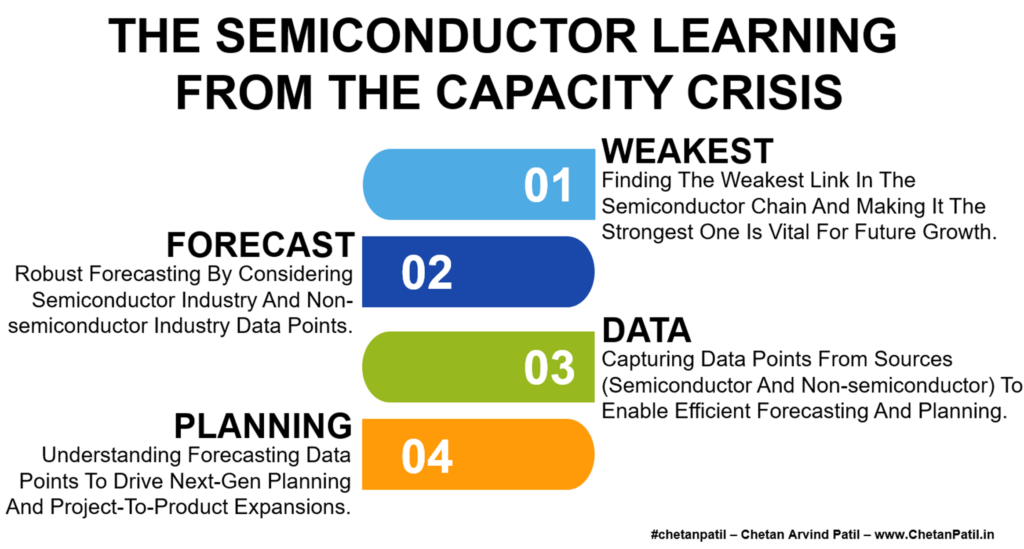
    Weakest: Finding the weakest link in the semiconductor chain and making it the strongest one is vital for future growth.

    Forecast: Robust forecasting by considering semiconductor industry and non-semiconductor industry data points.

    Focusing on the weakest link and planning is the key to leveraging time to prepare for future demands. Today, the weak link in semiconductor manufacturing is capacity. The semiconductor industry has started the journey to turn the weak link into the strongest one. However, the time taken to do so will be years (maybe decades), and till then the capacity constraints will exist.

    Forecasting is another learning that the semiconductor capacity crunch has brought. No one saw the sudden spike in demand leading to the overflowing capacity request. Also, the forecasting (a big part of any manufacturing industry) for such scenarios was not realistic and should have considered several factors apart from what is relevant and not relevant to the semiconductor industry.


    Picture By Chetan Arvind Patil

    Finding the weakest link and enabling accurate forecasting requires data-driven planning. Semiconductor manufacturing capacity needs to consider different types of data points that come from the core semiconductor business but the happenings around the world and how they may or may not impact the semiconductor industry.

    Considering different industry data points also empowers the semiconductor industry to plan based on where the market is heading and how situations like the pandemic positively or negatively impact it. It will surely enable more robust planning than ever.

    Data: Capturing data points from sources (semiconductor and non-semiconductor) to enable efficient forecasting and planning.

    Planning: Understanding forecasting data points to drive next-gen planning and project-to-product expansions.

    Semiconductor manufacturing capacity planning is capital-intensive and time-demanding. It directly implies a robust strategy is needed to cater to different types of market demand. A data-driven approach helps create error-proof planning. Doing so also enables semiconductor manufacturers to balance next-gen solutions alongside customer needs driven by market requirements.

    There are numerous lessons learned due to the semiconductor manufacturing capacity crisis. Out of all, finding the weakest link to enable robust forecasts by utilizing data to plan future execution are the four major course corrections the semiconductor industry needs to focus on to drive shortage-free future growth.


  • The Semiconductor Over Capacity Risk

    The Semiconductor Over Capacity Risk

    Photo by Taylor Hammersla on Unsplash


    Semiconductor capacity has been the most talked-about topic due to the semiconductor shortage. Companies and countries are upgrading or building semiconductor manufacturing to cater to ever-increasing demand. However, simply increasing the semiconductor capacity is not the answer and often comes with several techniques to business challenges.

    The technical challenge involves deciding on the technology-node and package technology to focus on, which is not an easy decision and requires an end-to-end view of how the market will evolve and which technology will be crucial. Yield and throughput also play a role. On top of all this, the technology (lithography as an example) equipment required should work as expected. More so when the new capacity focuses on advanced semiconductor solutions.

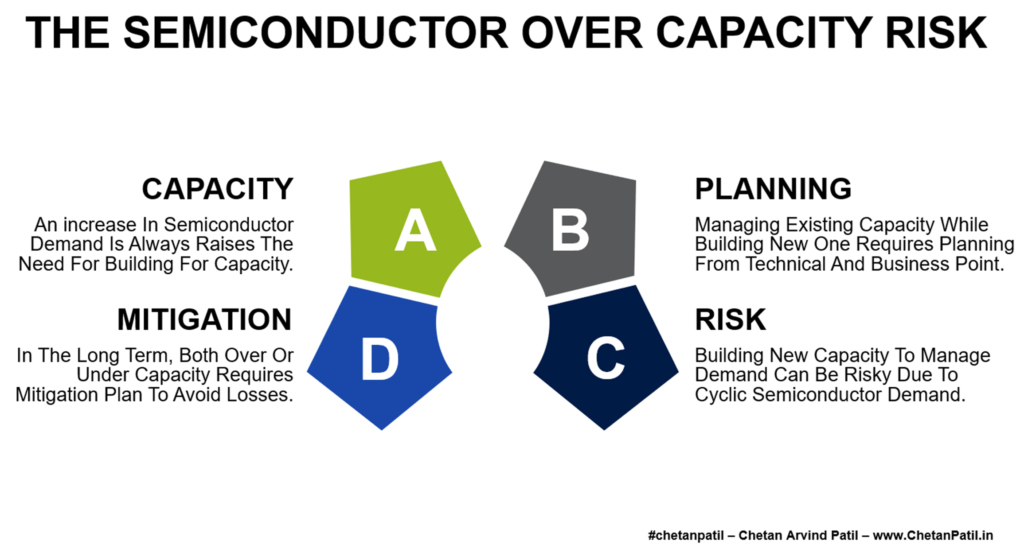
    Capacity: Building new semiconductor manufacturing capacity is not always the answer to capacity constraints. It can solve the problem in the short term. As a robust strategy, a more predictive, not reactive approach is suitable.

    Planning: Near-accurate prediction of how the industry will evolve is required. It enables accurate planning of how and when to build new capacity apart from when to upgrade the existing one.

    From the business perspective, the challenge is justifying the capital expenditure against the return on investment. In semiconductor manufacturing, 100% utilization is key to achieving a faster break-even point, and at the same time, it is not always possible to achieve such throughput. It is where government incentives come into the picture and act as a catalyst to drive the positive margin gain year on year.

    Even after overcoming the technical and business challenges, there is always the risk of building new capacity, which is driven by how the market demand evolves in years to come and how it will impact the manufacturing business in the long term.


    Picture By Chetan Arvind Patil

    Historically, the semiconductor business has always followed a cyclic nature, whereby the supply and demand are adjusted. This adjustment then triggers a round of discussion on expanding manufacturing capacity. By the time capacity comes up, the market demand may go down, and this can cause lower than expected orders for specific semiconductor silicon, which can derail the ROI plans of the given semiconductor manufacturing facility.

    Tackling such unknown scenarios is not straightforward. Thus, it is vital to have a full-proof risk mitigation plan. An ideal risk mitigation plan focuses on what-if scenarios and adapts to how the market changes. The manufacturing facility adapts to the requirement while maintaining the path towards break-even. It can demand continuous capital and is a must-have to run a successful semiconductor manufacturing facility.

    Risk: Expanding capacity without planning is a risk-driven approach. There needs to be a risk management strategy to mitigate any unknown event that can impact the planning of capacity building or upgrading.

    Mitigation: Mitigation strategy for capital-intensive semiconductor manufacturing is a big challenge. An adaptive approach that focuses on the market scenarios is a must-have.

    On paper, such planning is good but equally hard to implement. The reason is the inability to adapt semiconductor manufacturing planning without adding the time factor, which is needed to change the future course of any production facility.

    As new semiconductor FABs and OSATs come up, the question industry should ask is whether it is preparing itself for an over-capacity scenario and what is the mitigation plan when the market swings.