
Category: COST

  • The Rising Cost Of Semiconductor Test Analytics

    Image Generated Using Nano Banana


    What Is Silicon Test Analytics

    Silicon test analytics refers to the systematic analysis of data generated during semiconductor testing to improve yield, product quality, and manufacturing efficiency. It operates across wafer sort, final test, and system-level test, using test results to understand how silicon behaves under electrical, thermal, and functional stress.

    At a practical level, test analytics converts raw tester outputs into engineering insight. This includes identifying yield loss mechanisms, detecting parametric shifts, correlating failures across test steps, and validating the effectiveness of test coverage. The objective is not only to detect failing devices, but to understand why they fail and how test outcomes evolve across lots, wafers, and time.

    Unlike design-time analysis, silicon test analytics is closely tied to manufacturing reality. Data is generated continuously under production constraints and must reflect real test conditions, including tester configurations, temperature settings, test limits, and handling environments. As a result, analytics must account for both device behavior and test system behavior.

    In advanced production flows, silicon test analytics also supports decision-making beyond yield learning. It informs guardbanding strategies, retest policies, bin optimization, and production holds or releases.

    These decisions directly affect cost, throughput, and customer quality, and as test analytics becomes embedded in daily manufacturing decisions, it becomes increasingly important to understand the rising cost associated with test data analytics.


    What Has Changed In Silicon Test Data Analysis

    The defining change in silicon test data is its overwhelming scale. Modern devices generate much more test information due to higher coverage, deeper analysis, and complex requirements. What used to be manageable files are now relentless, high-volume streams.

    The increase in test data generation results in higher costs due to longer test times, more measurements, more diagnostic captures, and more retest loops. Even precautionary or future-use data incurs immediate expenses, including tester time, data transfer, and downstream handling.

    Storage demands have grown as test data volumes now reach gigabytes per wafer and terabytes per day in production. Storing such volumes requires scalable, governed systems and incurs costs regardless of how much data is actually analyzed, since unused data still consumes resources.

    Analysis has also become more resource-intensive. Larger, more complex datasets mean analysis has moved beyond manual scripts and local tools. Centralized compute environments are now required. Statistical correlation across lots, time, and test stages needs more processing power and longer runtimes, driving up compute costs and placing greater financial pressure on infrastructure budgets.

    Maintaining these integrations adds to system complexity, increases licensing costs, and requires ongoing engineering effort, often resulting in higher overall operational expenses.

    These developments have transformed test analytics from a lightweight task into a significant infrastructure challenge. Data generation, storage, analysis, and integration now drive operational costs and business decisions.


    Image Credit: McKinsey & Company

    Analytics Now Requires Infrastructure And Not Just Tools

    As silicon test data volumes and complexity increase, analytics cannot be supported by standalone tools or engineer-managed scripts. What was once handled through local data pulls and offline analysis now requires always-available systems capable of ingesting, storing, and processing data continuously from multiple testers, products, and sites. Analytics has moved closer to the production floor and must operate with the same reliability expectations as test operations.

    This shift changes the cost structure. Tools alone do not solve problems related to scale, latency, or availability. Supporting analytics at production scale requires shared storage, scalable compute, reliable data pipelines, and controlled access mechanisms. In practice, analytics becomes dependent on the underlying infrastructure that must be designed, deployed, monitored, and maintained, often across both test engineering and IT organizations.

    Infrastructure ComponentWhy It Is RequiredCost Implication
    Data ingestion pipelinesContinuous intake of high-volume tester outputEngineering effort, integration maintenance
    Centralized storageRetention of raw and processed test data at scaleCapacity growth, redundancy, governance
    Compute resourcesCorrelation, statistical analysis, and model executionOngoing compute provisioning
    Analytics platformsQuerying, visualization, and automationLicensing and support costs
    MES and data integrationLinking test data with product and process contextSystem complexity and upkeep

    As analytics becomes embedded in manufacturing workflows, infrastructure is no longer optional overhead, it becomes a prerequisite. The cost of test analytics, therefore, extends well beyond software tools, encompassing the full stack needed to ensure data is available, trustworthy, and actionable at scale.


    Cost Also Grows With Context And Integration

    As test analytics becomes more central to manufacturing decisions, cost growth reflects not just data volume but also the effort to contextualize and integrate data into engineering and production systems. Raw test outputs must be tied to product genealogy, test program versions, equipment configurations, handling conditions, and upstream manufacturing data to deliver meaningful insight.

    Without this context, analytics results can be misleading, and engineering decisions can suffer, forcing additional rounds of investigation or corrective action.

    Building and maintaining this context is neither simple nor cheap. It needs data models that show relationships across disparate systems and interfaces between test data and MES, ERP, or PQM systems. Continuous engineering effort is needed to keep metadata accurate as products and processes evolve. Any change to test programs, equipment calibration, or product variants requires updating these integrations to keep analytics accurate and usable.

    This trend matches broader observations in semiconductor analytics. While data volumes keep growing, many companies use only a small fraction of what they collect for decision-making. Industry analysis shows enterprises worldwide generate vast amounts of data but use only a small percentage for actionable insights. This highlights the gap between collection and effective use.

    Ultimately, the rising cost of test analytics is structural. It reflects a shift from isolated file-based analysis to enterprise-scale systems. These systems must ingest, connect, curate, and interpret test data in context. As analytics matures from a manual exercise to an embedded capability, integration and data governance become major engineering challenges. This drives both investment and ongoing operational cost.

    Eventually, understanding the economics of test analytics today requires looking beyond tools and data volumes. It means focusing on the systems and integrations that make analytics reliable, accurate, and actionable.

  • The Real Cost Of Scaling A Semiconductor Design From Prototype To Production

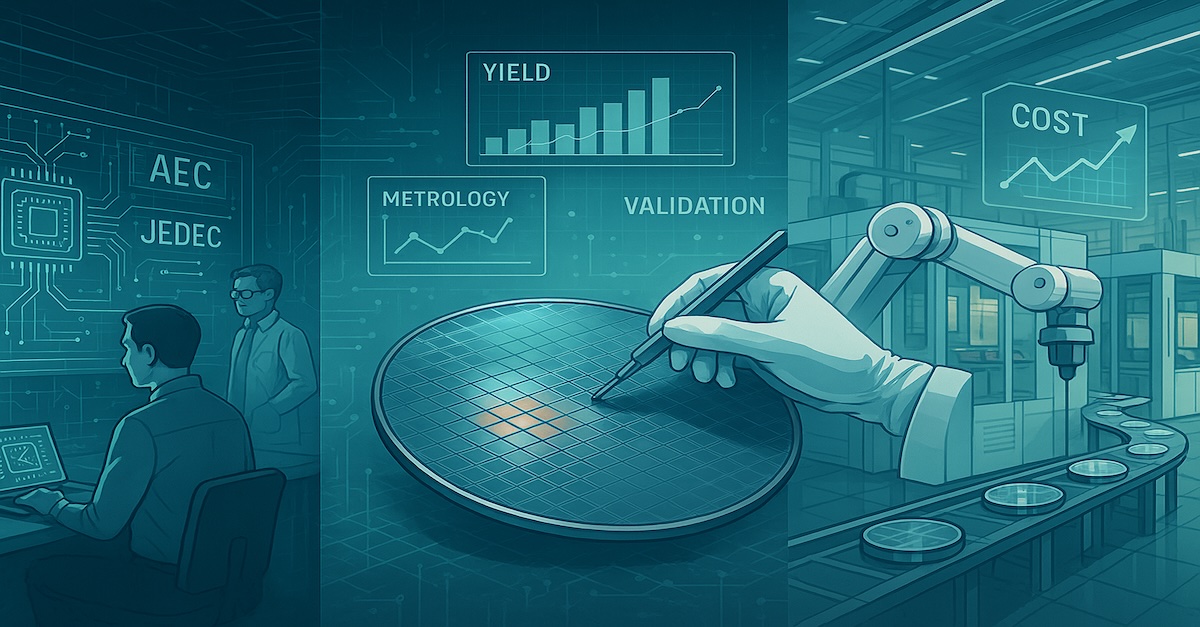
    Image Generated Using DALL-E


    Prototyping Is Not A Production

    Scaling a semiconductor design from prototype to production is where promising ideas meet harsh reality. A prototype demonstrates feasibility and shows that a concept can work under controlled conditions but is not a finished product. Many teams celebrate the first silicon success, only to realize later that this milestone marks the beginning of the journey to market, not the end.

    The challenges of scaling are often underestimated. At advanced nodes, a single complete mask set can cost upward of a million dollars. A seemingly minor design change, such as adjusting a clock buffer or modifying a pin assignment, can require a complete mask revision and push schedules back by several weeks.

    On the other hand, custom test boards, essential for silicon bring-up and debugging, often cost hundreds of thousands of dollars per iteration, depending on complexity. Then, the debug cycles after prototype validation, whether addressing signal integrity issues, timing violations, or power delivery concerns, can add four to eight weeks per iteration.

    Prototypes often rely on multi-project wafer shuttles to reduce early costs, but these shared runs offer only a limited view of production readiness. They do not reflect the true complexity of dedicated wafer starts, volume scaling, or the demands of final test and qualification. A prototype proves that a design can function in the lab but does not guarantee manufacturability, stable yield, or long-term reliability in a production environment.

    This gap between a working design and a shipping product is where the real cost of scaling is revealed.


    Cost Of Prototyping

    Prototyping is the first critical milestone in the semiconductor New Product Introduction (NPI) process. It is much more than demonstrating that a design works on paper. A prototype integrates silicon fabrication, hardware development, test program creation, and validation under real-world conditions.

    Each step introduces risk, consumes resources, and requires precise coordination. Early success with a prototype can create the impression that a design is ready for production, but this is often misleading.

    A functioning prototype does not ensure the design will meet yield, reliability, and manufacturability targets in volume. The complexity of scaling is frequently underestimated, leading to unexpected delays, rework cycles, and increased costs.

    ActivityTypical TimeframeCost Considerations
    Mask Set Development4 to 6 weeksHigh fixed cost per iteration
    Multi-Project Wafer (MPW) Shuttle3 to 4 months availabilityLower cost, limited production insight
    Test Board Design and Fabrication3 to 5 weeksMultiple iterations may be required
    ATE Test Program Development4 to 6 weeksTester time and engineering effort
    PVT Characterization3 to 5 weeksRequires multiple wafer lots
    Qualification (JEDEC, AEC)8 to 12 weeksFull wafer lots, package variants, and extended testing
    Debug and Correlation Cycles2 to 4 weeks per issueAdditional wafer use and test time

    The path from prototype to production demands a tightly managed flow that balances silicon development, board design, test engineering, and system validation. Minor design changes can trigger costly and time-consuming rework. At the same time, late-stage discoveries of signal integrity issues, timing violations, or power delivery challenges can set entire programs back by weeks or months.

    Prototypes typically rely on shared wafer shuttles and lab setups that do not reflect the realities of dedicated high-volume production. Without a robust plan for test coverage, validation, and correlation, teams risk entering production with incomplete knowledge of their design’s behavior.

    A successful prototype results from cross-functional alignment between design, hardware, and validation teams. When this coordination breaks down, the actual cost of prototyping reveals itself in missed schedules, strained budgets, and compromised product launches.


    Transitioning To Production

    Transitioning a semiconductor design from prototype to production is not a simple handoff. It is a complex, iterative process that requires carefully coordinating design teams, manufacturing partners, test engineers, and supply chain specialists.

    What works in a lab must now perform reliably across millions of units. This step demands a shift in mindset from optimizing for a single working chip to building a repeatable, scalable process that delivers consistent performance and yield.

    Production readiness hinges on a deep understanding of the entire flow. Foundry slots must be secured based on realistic forecasts, and wafer starts must align with packaging and test capacity. Any misalignment in this chain introduces delays that ripple across the schedule.

    For example, a late-stage design change can trigger a new mask spin, delay wafer starts, and require revalidation of test programs and packaging processes. Each step consumes time and resources, creating a compounding effect that can push out delivery timelines and strain customer relationships.

    Transitioning to production is not just about pushing more wafers through a fab. It is about building a reliable, predictable system that balances technical rigor with operational efficiency. Success at this stage determines whether a design remains an engineering milestone or becomes a commercially viable product.


    Takeaway

    Scaling a semiconductor design from prototype to production is a complex, multi-dimensional challenge. A design must not only work in a lab but also withstand the realities of high-volume manufacturing, tight supply chains, and demanding customer timelines.

    The costs and risks involved at each stage, from mask sets and test infrastructure to packaging yield and logistics, compound quickly. Small inefficiencies in yield or test throughput can multiply into significant financial losses when measured across millions of units.

    Success in semiconductor scaling is not the result of technical brilliance alone. It is built on operational discipline, proactive risk management, and cross-functional alignment across design, manufacturing, and supply chain teams.

    Teams that plan for the entire journey anticipate challenges and maintain a deep focus on execution, ultimately succeeding in turning innovative designs into commercially viable products.


  • The Ever Increasing Cost Of Semiconductor Design And Manufacturing

    The Ever Increasing Cost Of Semiconductor Design And Manufacturing

    Photo by Anne Nygård on Unsplash


    The complexity of semiconductor devices is increasing at a rapid pace. The reason is the demand for new features, which requires novel design and manufacturing approaches, which come at a higher cost due to the time, resources, and investment needed to enable new semiconductor solutions.

    On the design side, it has become easier to bring up new solutions and prove them using an advanced simulation approach. Eventually, these solutions should be fabricated and validated, which costs millions of dollars, and with every next-gen design and manufacturing process, the cost of prove-in keeps increasing.

    Design: Complex solutions demand time and resources, which increases the cost of new solutions.

    Manufacturing: Bringing new solutions to the market means investing in new-age manufacturing facilities.

    The connected (equipment, material, raw wafers, tools, and so on) semiconductor supply chain can also delay the plans, which increases the cost of introducing new solutions.

    Semiconductor companies have to manage and plan future market requirements so that the new solutions are not too costly to develop. On another side, given that the semiconductor industry is highly connected and driven by the connected semiconductor supply chain, it is not easy to keep the cost of development low.


    Picture By Chetan Arvind Patil

    The design and manufacturing of semiconductor products are dependent on several technical factors. Apart from it, there is a business aspect (market-driven) that also impacts the total cost of semiconductor product development.

    Higher demand for semiconductor products increases the need to produce more silicon chips. However, not being able to fulfill these requests on time eventually adds to the negative cost. On another side, the supply constraint of any goods needed by the semiconductor process (manufacturing equipment, wafers, materials, etc.) can increase, thus directly impacting the overall design and manufacturing cost.

    Demand: Continuous investment to meet market demand adds to the overall cost of semiconductor product development.

    Supply: Increase in the cost of a connected supply chain directly impacts the semiconductor design and development.

    This cyclic nature of demand and supply also impacts the total cost of the semiconductor industry, more so when there is a need to add new capacity to bring supply-demand equilibrium.

    As the semiconductor industry embarks on a new era of design and manufacturing processes, the need to balance the cost to enable affordable market solutions will be crucial. Otherwise, it will not be easy to drive the faster break-even point for the next-gen capacity, which will also shape the future of several semiconductor manufacturing companies.