Category: DATA

  • The Semiconductor Data Theft Driving A Trillion-Dollar Risk

    Image Generated Using DALL·E


    Semiconductor And Theft

    The global semiconductor industry is under growing pressure, not only to innovate, but to protect what it builds long before a chip ever reaches the fab. As the design-to-manufacture lifecycle becomes increasingly cloud-based, collaborative, and globalized, a critical vulnerability has emerged: the theft of pre-silicon design data.

    This threat does not target hardware at rest or devices in the field. Instead, it targets the foundational design assets: RTL code, netlists, and layout files. It defines the behavior, structure, and physical manifestation of chips. These assets are being stolen through insider leaks, compromised EDA environments, and adversarial operations. The result is a growing ecosystem of unauthorized design reuse, counterfeit chip production, and compromised supply chains.

    The implications are severe. This is not just a technical concern or a matter of intellectual property (IP) rights, it is a trillion-dollar global risk affecting innovation pipelines, market leadership, and national security.


    The Threat Landscape

    The theft of semiconductor design data is not a hypothetical risk, it is a growing reality. As chip design workflows become more complex, distributed, and cloud-dependent, the number of ways in which sensitive files can be stolen has expanded significantly.

    Threat SourceDescriptionRisk to Design Data
    Compromised EDA Tools and Cloud EnvironmentsCloud-based electronic design automation (EDA) tools are widely used in modern workflows. Misconfigured access, insecure APIs, or shared environments can allow attackers to access design files.Unauthorized access to RTL, test benches, or GDSII files due to cloud mismanagement or vulnerabilities.
    Unauthorized IP Reuse by PartnersThird-party design vendors or service providers may retain or reuse IP without consent, especially in multi-client environments. Weak contracts and missing protections increase exposure.Loss of control over proprietary designs; IP may be reused or sold without permission.
    Adversarial State-Sponsored OperationsNation-states target semiconductor firms to steal design IP and accelerate domestic chip capabilities. Several public cases have linked these efforts to cyberespionage campaigns.Targeted theft of RTL, verification flows, and tapeout files through cyberattacks or compromised endpoints.
    Risk at the FoundryExternal foundries receive full GDSII files for fabrication. In low-trust environments, designs may be copied, retained, or used for unauthorized production.Fabrication of unauthorized chips, IP leakage, and loss of visibility once design leaves originator’s control.

    Pre-silicon design assets like RTL, netlists, and GDSII files pass through multiple hands across internal teams, external partners, and offshore facilities. Without strong protections, these files are exposed to theft at multiple points in the workflow.


    Economic And Strategic Impact

    The theft of semiconductor design data results in direct financial losses and long-term strategic setbacks for chipmakers, IP vendors, and national economies. When RTL, netlists, or layout files are stolen, the original developer loses both the cost of creation and the competitive advantage the design provides. Unlike other forms of cyber risk, the consequences here are irreversible. Once leaked, design IP can be used, cloned, or altered without detection or control.

    Estimates from industry and government reports indicate that intellectual property theft costs the U.S. economy up to $600 billion per year. A significant portion of this comes from high-tech sectors, including semiconductors. With global chip revenues projected to reach $1.1 trillion by 2030, even a 10 percent exposure to IP leakage, replication, or counterfeiting could mean more than $100 billion in annual losses. These losses include not only development costs but also future market position, licensing revenue, and ecosystem trust.

    Key Impact Areas:

    • Lost R&D Investment: High-value chip designs require years of engineering and investment. Once stolen, the original developer has no way to recover sunk costs.
    • Market Erosion: Stolen designs can be used to build similar or identical products, often sold at lower prices and without legitimate overhead, reducing profitability for the originator.
    • Counterfeit Integration: Stolen layouts can be used to produce unauthorized chips that enter the supply chain and end up in commercial or defense systems.
    • Supply Chain Risk: When stolen designs are used to produce unverified hardware, it becomes difficult to validate the origin and integrity of chips in critical systems.
    • Loss of Licensing Revenue: Third-party IP vendors lose control of their blocks, and future royalties become unenforceable when reuse happens through stolen design files.

    Governments investing in semiconductor R&D also face consequences. Stolen IP undermines public investments, distorts global market competition, and creates dependencies on compromised or cloned products. When this happens repeatedly, it shifts the balance of technological power toward adversaries, weakening both commercial leadership and national security readiness.

    Beyond direct monetary impact, the strategic risk is amplified when stolen IP is modified or weaponized. Malicious actors can insert logic changes, backdoors, or stealth functionality during or after cloning the design. Once deployed, compromised silicon becomes extremely difficult to detect through standard testing or field validation.


    Image Credit: ERAI

    Global Implications

    The theft of semiconductor design data is no longer a company-level problem. It has become a national and geopolitical issue that affects how countries compete, collaborate, and secure their digital infrastructure.

    As nations invest heavily in semiconductor self-reliance, particularly through policies like the U.S. CHIPS Act or the EU Chips Act, stolen design IP can negate those investments by giving adversaries access to equivalent capabilities without the associated R&D cost or time. This reduces the effectiveness of subsidies and weakens the strategic intent behind public funding programs.

    At the same time, countries that rely on foreign foundries, offshore design services, or cloud-hosted EDA platforms remain exposed. Pre-silicon IP often flows through international partners, third-party IP vendors, and subcontracted teams, many of which operate in jurisdictions with limited IP enforcement or are vulnerable to nation-state targeting.

    If compromised designs are used to manufacture chips, the resulting products may be integrated into defense systems, critical infrastructure, or export technologies. This creates a long-term dependency on supply chains that cannot be fully trusted, even when fabrication capacity appears secure.


    Path Forward

    Securing semiconductor design data requires a shift in how the industry treats pre-silicon IP. Rather than viewing RTL, netlists, and layout files as engineering artifacts, they must be recognized as high-value assets that demand the same level of protection as physical chips or firmware. Security needs to be built into design workflows from the beginning, not added later.

    This includes encrypting design files, limiting access through role-based controls, and ensuring that every handoff, whether to a cloud platform, verification partner, or foundry, is traceable and auditable.

    To reduce systemic risk, companies must adopt stronger controls across the design chain and align with emerging standards. Without widespread adoption, the risk of IP leakage, unauthorized reuse, and counterfeit production will persist. The next phase of semiconductor security must begin before manufacturing ever starts, and with a clear focus on protecting design data at every stage.


  • The Semiconductor Data Gravity Problem

    Image Generated Using 4o


    What Is Data Gravity And Why It Matters In Semiconductors

    The term “data gravity” originated in cloud computing to describe a simple but powerful phenomenon: as data accumulates in one location, it becomes harder to move, and instead, applications, services, and compute resources are pulled toward it.

    In the semiconductor industry, this concept is not just relevant, it is central to understanding many of the collaboration and efficiency challenges teams face today.

    Semiconductor development depends on highly distributed toolchains. Design engineers work with EDA tools on secure clusters, test engineers rely on ATE systems, yield analysts process gigabytes of parametric data, and customer telemetry feeds back into field diagnostics.

    Consider a few common examples:

    • RTL simulation datasets stored on isolated HPC systems, inaccessible to ML workflows hosted in the cloud
    • Wafer test logs are locked in proprietary ATE formats or local storage, limiting broader debug visibility
    • Yield reports are buried in fab-side data lakes, disconnected from upstream design teams, and are used for troubleshooting quality issues
    • Post-silicon debug results that never make it back to architecture teams due to latency, access control, or incompatible environments

    Yet all of this breaks down when data cannot move freely across domains or reach the people who need it most. The result is bottlenecks, blind spots, and duplicated effort.

    These are not rare cases. They are systemic patterns. As data grows in volume and value, it also becomes more challenging to move, more expensive to duplicate, and more fragmented across silos. That is the gravity at play. And it is reshaping how semiconductor teams operate.


    Where Does Data Gravity Arise In Semiconductor Workflows?

    To grasp the depth of the data gravity problem in semiconductors, we must examine where data is generated and how it becomes anchored to specific tools, infrastructure, or policies, making it increasingly difficult to access, share, or act upon.

    The table below summarizes this:

    StageData GeneratedTypical Storage LocationGravity Consequence
    Front-End DesignNetlists, simulation waveforms, coverage metricsEDA tool environments, NFS file sharesData stays close to local compute, limiting collaboration and reuse
    Back-End VerificationTiming reports, power grid checks, IR drop analysisOn-prem verification clustersData is fragmented across tools and vendors, slowing full-chip signoff
    Wafer TestShmoo plots, pass/fail maps, binning logsATE systems, test floor databasesDebug workflows become localized, isolating valuable test insights
    Yield and AnalyticsDefect trends, parametric distributions, WAT dataInternal data lakes, fab cloud platformsInsightful data often remains siloed from design or test ML pipelines
    Field OperationsRMA reports, in-system diagnosticsSecure internal servers or vaultsFeedback to design teams is delayed due to access and compliance gaps

    Data in semiconductor workflows is not inherently immovable, but once it becomes tied to specific infrastructure, proprietary formats, organizational policies, and bandwidth limitations, it starts to resist movement. This gravity effect builds over time, reducing efficiency, limiting visibility, and slowing responsiveness across teams.


    The Impact Of Data Gravity On Semiconductor Teams

    As semiconductor workflows become more data-intensive, teams across the product lifecycle are finding it increasingly difficult to move, access, and act on critical information. Design, test, yield, and field teams each generate large datasets, but the surrounding infrastructure is often rigid, siloed, and tightly tied to specific tools. This limits collaboration and slows feedback.

    For instance, test engineers may detect a recurring fail pattern at wafer sort, but the related data is too large or sensitive to share. As a result, design teams may not see the whole picture until much later. Similarly, AI models for yield or root cause analysis lose effectiveness when training data is scattered across disconnected systems.

    Engineers often spend more time locating and preparing data than analyzing it. Redundant storage, manual processes, and disconnected tools reduce productivity and delay time-to-market. Insights remain locked within silos, limiting organizational learning.

    In the end, teams are forced to adapt their workflows around where data lives. This reduces agility, slows decisions, and weakens the advantage that integrated data should provide.


    Overcoming Data Gravity In Semiconductor

    Escaping data gravity starts with rethinking how semiconductor teams design their workflows. Instead of moving large volumes of data through rigid pipelines, organizations should build architectures that enable computation and analysis to occur closer to where data is generated.

    Cloud-native, hybrid, and edge-aware systems can support local inference, real-time monitoring, or selective data sharing. Even when whole data movement is not feasible, streaming metadata or feature summaries can preserve value without adding network or compliance burdens.

    Broader access can also be achieved through federated data models and standardized interfaces. Many teams work in silos, not by preference, but because incompatible formats, access restrictions, or outdated tools block collaboration.

    Aligning on common data schemas, APIs, and secure access frameworks helps reduce duplication and connects teams across design, test, and field operations. Addressing data gravity is not just a technical fix.

    It is a strategic step toward faster, wiser, and more integrated semiconductor development.


  • The Semiconductor Data-Driven Decision Shift

    Image Generated Using 4o


    The Data Explosion Across The Semiconductor Lifecycle

    The semiconductor industry has always been data-intensive. However, the conversation is now shifting from quantity to quality. It is no longer about how much data we generate, but how well that data is connected, contextualized, and interpreted.

    Semiconductor data is fundamentally different from generic enterprise or consumer data. A leakage current reading, a fail bin code, or a wafer defect has no meaning unless it is understood in the context of the silicon process, test environment, or design constraints that produced it.

    In the early stages of product development, design engineers generate simulation data through RTL regressions, logic coverage reports, and timing closure checks. As that design progresses into the fabrication phase, silicon data begins to accumulate, including inline metrology readings, critical dimension measurements, tool state logs, and wafer-level defect maps. Each wafer and lot carries a unique signature, influenced by upstream process variability and tool interactions.

    By the time the product reaches assembly and packaging, new forms of data emerge. Material-level stress tests, warpage analysis, and thermal cycling behavior contribute additional layers that directly influence the chip’s electrical characteristics. Test data provides even more clarity, offering per-die measurement results, analog waveforms, and bin distributions that give a definitive verdict on performance.

    What often gets overlooked is field and reliability data. Customer returns, in-system failures, or aging trends can reveal issues not caught during qualification, but only if they are traceable to original silicon and test metadata. This level of visibility requires not only data collection but also a deep integration of context across multiple lifecycle stages.

    When this information is viewed in fragments, it remains passive. However, when connected across design, fabrication, test, and field, with the help of domain expertise and timing correlation, it becomes a powerful driver of yield learning, failure analysis, and operational improvement.


    Why This Data Explosion Matters And What The Future Holds

    Historically, many semiconductor decisions relied on engineering experience and past norms. That worked when processes were simpler and product diversity was limited. However, today’s environment involves complex interactions among design, process, and packaging, often monitored through hundreds of sensors per wafer and analyzed across multiple-site operations. In this landscape, judgment alone is no longer sufficient.

    Semiconductor data without context quickly becomes noise. Engineers are now expected to interpret results from thousands of bins, multiple product variants, and evolving test conditions. The complexity has outpaced manual tracking, and the risk of subtle, systemic failures has increased. A defect might only surface under extreme conditions, such as thermal, voltage, or frequency extremes, and often only becomes visible when data from design, fabrication, and testing are brought together.

    Modern yield learning relies on this integration. Identifying the root cause of a parametric drift may involve tracing back through etch step uniformity, layout geometry, and even packaging stress. Product decisions, such as qualifying a new foundry or modifying test content, now require simulations and data modeling based on historical silicon behavior. The accuracy and speed of these decisions are directly tied to how well the data is connected.

    Looking ahead, the role of data will become even more critical. Real-time adjustments within fab and test operations, AI-assisted diagnostics built on die-level signatures, and traceability frameworks linking field failures back to initial silicon lots are becoming standard. The goal is not just to collect data, but to create systems where decisions adapt continuously based on reliable, context-aware insights.


    Tool TypePrimary Purpose
    EDA Analytics PlatformsAnalyze simulation logs, coverage gaps, layout issues, and IP reuse patterns
    Yield Management Systems (YMS)Detect wafer-level spatial defects, monitor process trends, and bin correlations
    Manufacturing Execution SystemsTrack wafer routing, tool excursions, process skips, and inline inspection logs
    Test Data Analysis PlatformsAggregate multisite ATE results, identify failing die clusters, and escape risks
    Data Lakes and PipelinesCentralize structured/unstructured data across fab, test, and reliability stages
    BI Dashboards & Statistical ToolsPresent KPI trends, failure rates, and yield performance to engineering teams

    Types Of Tool Enabling The Data-Driven Flow

    The move toward data-driven decisions in semiconductors is only possible because of an expanding class of specialized tools. These tools are built not just to process data, but to respect the context of semiconductor manufacturing, where each decision is linked to wafer history, test condition, and physical layout.

    Unlike generic enterprise systems, semiconductor tools must track process lineage, equipment behavior, lot IDs, and die-level granularity across globally distributed operations. The result is a layered, highly domain-specific tooling stack.

    Integration remains the hardest part. Viewing a failing wafer map is one thing, linking that map to a specific process drift or a marginal scan chain requires a seamless connection between these tools. As this ecosystem matures, the goal is no longer just to collect and display data but to make it actionable across teams and timeframes.

    Ultimately, the strength of any data system is not in the software alone but in how effectively engineers use it to ask the right questions and drive better outcomes.


    Skills For The Data-Driven Semiconductor Era

    As semiconductor operations become more data-centric, the skills required to succeed are evolving. It is no longer enough to be an expert in one domain. Engineers and managers must now understand how to interpret complex datasets and act on them within tight product and business timelines.

    The ability to work with silicon and chip data, coupled with the judgment to understand what the data means, is quickly becoming a core differentiator across roles.

    Skill CategoryDescriptionWhere It Matters Most
    Data ContextualizationUnderstanding where data comes from and how it ties to process steps, design intent, or testYield analysis, silicon debug, test correlation
    Tool ProficiencyWorking fluently with tools like JMP, Spotfire, YieldHub, Python, SQL, Excel VBA, or cloud dashboardsATE debug, failure analysis, KPI reporting
    Statistical ReasoningApplying SPC, distributions, hypothesis testing, variance analysis, regression modelsProcess tuning, guardband optimization, lot release criteria
    Cross-Functional ThinkingBridging design, fab, test, packaging, and field return dataAutomotive, aerospace, high-reliability segments
    Traceability AwarenessLinking test escapes or RMAs to silicon history, probe card changes, or packaging issuesReliability, RMA teams, quality control
    Decision FramingConverting data into business-impacting insights and prioritizing next actionsProduct and test managers, program owners
    Data Cleaning and WranglingDetecting and correcting anomalies, formatting raw logs, aligning inconsistent sourcesATE log analysis, fab tool monitoring, multi-LOT reviews
    Root Cause Pattern RecognitionRecognizing recurring patterns across electrical and physical data layersFailure debug, device marginality analysis
    Visualization and ReportingBuilding dashboards or visuals that accurately summarize issues or trendsWeekly yield reviews, executive reports, test program signoff
    Data Governance AwarenessUnderstanding data security, version control, and access in shared environmentsShared vendor ecosystems, foundry engagements
    AI/ML FamiliarityRecognizing where AI models can assist in diagnostics or decision supportPredictive maintenance, smart binning, parametric modeling

    These skills are not replacements for engineering fundamentals and they are extensions. An engineer who can ask better questions of the data, challenge its quality, or trace it to the right source is far more valuable than someone who simply views a chart and moves on.

    As data continues to becomes core to every semiconductor engineering judgment, the ability to understand, shape, and explain that data will define the next generation of semiconductor professionals.


  • The Hidden Costs Of Generating Semiconductor Data: Understanding The Global Economic Impact And The Need For Open Access

    Image Generated Using DALL-E


    The Value And Cost Of Semiconductor Data

    Semiconductor data is a vital yet costly resource. Unlike other data types, it requires significant financial investments to generate and maintain. Today, let us explore the economic impact of semiconductor data generation, supported by real-world examples and statistics.

    What Is Semiconductor Data: It encompasses a wide range of information, including diffusion process data, assembly data, test data, and yield data. This data is essential for ensuring the quality, efficiency, and reliability of semiconductor products. For example:

    Diffusion Process Data: Information on how materials are diffused in semiconductor wafers

    Assembly Data: Details on the assembly of semiconductor components into final products

    Test Data: Results from testing semiconductor devices to ensure they meet required specifications

    Yield Data: Statistics on the number of functional devices produced from a batch of semiconductor wafers

    Generating this data involves a series of complex and expensive processes. From setting up state-of-the-art fabrication plants (fabs) to conducting extensive research and development, the costs add up quickly.

    For instance:

    AspectDescription
    Setting Up FabsBuilding and equipping a semiconductor fab can cost billions of dollars. These facilities need to be equipped with cutting-edge technology and machinery to handle the intricate processes of semiconductor manufacturing.
    Research And DevelopmentRnD is a continuous and costly endeavor in the semiconductor industry. Developing new technologies and improving existing ones requires significant investment in talent, equipment, and time.
    Testing And Quality AssuranceEnsuring that semiconductor products meet high standards of quality and reliability involves rigorous testing and quality assurance processes, which are both time-consuming and expensive.

    Understanding The Economics Of Semiconductor Data

    The generation of semiconductor data is not just a technical challenge but also a significant economic endeavor. The costs associated with obtaining high-quality data for semiconductor processes are immense, impacting both the industry and the broader economy. To understand this impact, it is essential to look at the financial investments required and the economic benefits that follow.

    Statistics-Based Analysis:

    Infrastructure Investment:

    Intel in Chandler, AZ: Invested $32 billion, creating 3,000 jobs, for two new fabs. This highlights the significant upfront costs involved in setting up semiconductor manufacturing facilities.

    TSMC in Phoenix, AZ: Invested $65 billion, creating 6,000 jobs, for three new fabs. This investment underscores the massive financial commitment required to expand semiconductor manufacturing capabilities.

    Research And Development Costs:

    According to a report by Semiconductor Industry Association (SIA), global semiconductor RnD spending reached approximately $71.4 billion in 2020. This demonstrates the continuous and substantial investment required for innovation and maintaining competitive advantage in the industry.

    Testing And Quality Assurance:

    The cost of testing and quality assurance in semiconductor manufacturing can account for up to 30% of the total manufacturing cost. This significant expenditure is necessary to ensure the reliability and performance of semiconductor products.

    Connecting Expense With Yield Data Generation:

    Yield Data Generation:

    Yield data, which refers to the proportion of functional semiconductor devices produced from a batch of wafers, is critical for assessing and improving manufacturing processes.

    Economic Impact:

    Improved yield data can lead to higher production yields, reducing the cost per unit and increasing profitability. For instance, if a fab can increase its yield from 80% to 90%, it can produce more functional devices from the same number of wafers, enhancing overall efficiency and profitability.


    Picture By Chetan Arvind Patil

    Global Case Studies: Investments In Semiconductor Data

    The global semiconductor industry is marked by substantial investments aimed at generating high-quality data essential for manufacturing and innovation. These investments vary across regions but consistently highlight the significant financial commitments required. Here, we delve into some global case studies, supported by statistical data, to illustrate the economic impact and strategic importance of these investments.

    CityStateCompanyInvestment (Billion $)Investment TypeYield Data Context
    ChandlerAZIntel32New (2 fabs)Advanced manufacturing and process optimization
    PhoenixAZTSMC65New (3 fabs)High-volume production, process stability
    FremontCAWestern Digital0.35ExpansionMemory technology enhancement and scalability
    KissimmeeFLSkyWaterNot AvailableExpansionAdvanced packaging and integration
    BoiseIDMicron25NewMemory yield improvement and reliability
    TaylorTXSamsung17New (1 fab)Advanced logic chips and high performance
    ShermanTXTexas Instruments30New (2 fabs)Mixed-signal and analog technology
    MaltaNYGlobalFoundries1ExpansionFoundry services, process variability data
    SyracuseNYMicron100New (4 fabs)Large-scale memory and storage solutions
    ColumbusOHIntel20New (2 fabs)Advanced semiconductor technology, high yield

    These examples highlight the global scale and financial intensity of generating semiconductor data, essential for countries aiming to establish or enhance their semiconductor industries.

    The Case For Open And Collaborative Semiconductor Datasets

    The semiconductor industry stands at the forefront of technological innovation, yet it grapples with significant challenges related to data access and sharing. The high costs and proprietary nature of semiconductor data often hinder widespread research and development. This section explores the benefits of open and collaborative semiconductor datasets and how they can transform the industry.

    AspectDetails
    Enhancing Innovation And Research– Accelerated Development: Sharing data speeds up technological advancements.
    – Cross-Disciplinary Insights: Enables collaboration across fields for innovative solutions.
    Reducing Costs And Redundancy– Economies of Scale: Spreads the cost of data generation across a broader base.
    – Avoiding Duplication: Prevents redundant data collection, saving time and resources.
    Improving Data Quality And Reliability– Peer Review and Validation: Wider scrutiny improves data accuracy and reliability.
    – Standardization: Leads to consistent and easy-to-use data formats.
    Fostering Global Competitiveness– Leveling the Playing Field: Democratizes innovation by making data accessible to all.
    – Enhancing National Security: Reduces dependency on foreign data and technology.
    Case Studies And Examples– DARPA’s ERI: Encourages collaboration and data sharing for advancements in electronics.
    – Open Compute Project: Demonstrates rapid innovation and cost reduction through open collaboration.
    Challenges And Considerations– Intellectual Property Concerns: Balancing data sharing with protecting competitive advantage.
    – Data Security: Ensuring the security and integrity of open datasets.
    – Incentive Structures: Developing frameworks to encourage data sharing while protecting commercial interests.

    Take Away

    The semiconductor industry is both a cornerstone of technological innovation and a domain with immense economic implications. Generating the necessary data for semiconductor manufacturing is a costly and complex endeavor, requiring substantial investments in infrastructure, research, and quality assurance. Despite these high costs, semiconductor data is essential for ensuring product quality, efficiency, and competitiveness.

    Understanding the hidden costs and economic impact of generating semiconductor data is crucial for stakeholders. By embracing open access and collaborative approaches, the semiconductor industry can overcome financial barriers, drive innovation, and achieve sustainable growth. This strategic approach will benefit not only the industry but also the broader technological landscape, paving the way for future breakthroughs and economic prosperity.


  • The Case Of High-Speed Data Transfer Between Semiconductor Components: PCIe VS CXL

    Image Generated Using DALL-E


    Introduction To PCIe:

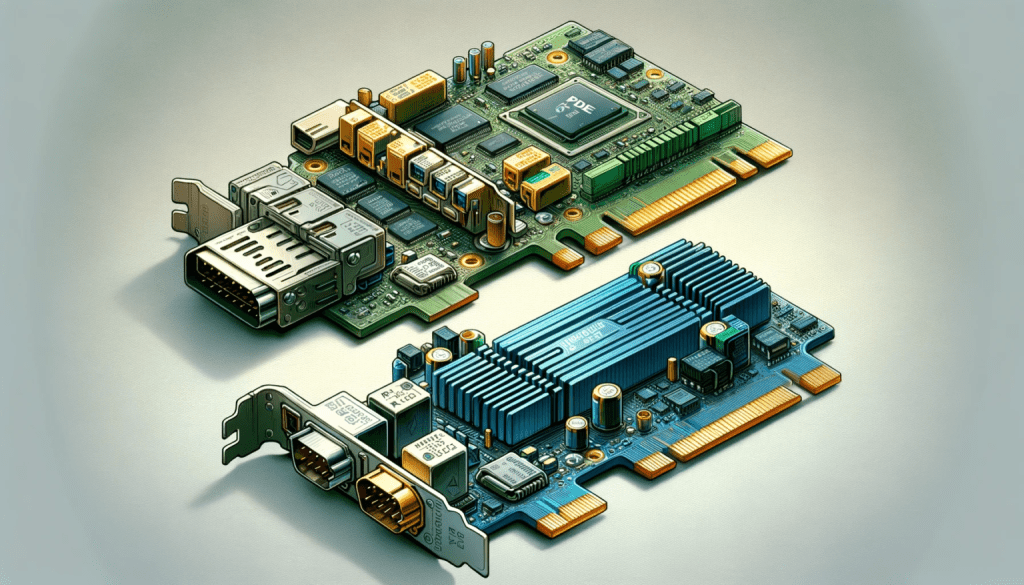
    Peripheral Component Interconnect Express (PCIe) is a high-speed serial computer expansion bus standard designed to replace the older PCI, PCI-X, and AGP bus standards. It connects high-speed components in a computer, such as graphics cards, SSDs, and network cards. Unlike its predecessors, PCIe provides higher data transfer rates and is more flexible regarding the layout of the physical connections. It operates using a point-to-point topology, with separate serial links connecting each device to the host, which reduces latency and increases data transfer efficiency.

    Pros of PCIe:

    Higher Bandwidth: PCIe offers significantly higher bandwidth than older standards like PCI and AGP (Accelerated Graphics Port), allowing faster data transfer between components.

    Scalability: The standard supports various configurations (x1, x4, x8, x16), enabling devices to use the number of lanes that best matches their performance requirements.

    Lower Latency: The point-to-point architecture reduces latency as each device has a dedicated connection to the host.

    Backward Compatibility: PCIe is backward compatible, allowing newer devices to work with older hardware, albeit at lower performance.

    Flexibility: It supports various devices. It is also widely used in consumer and enterprise environments.

    Cons of PCIe:

    Cost: PCIe devices and motherboards are more expensive than their older PCI or AGP counterparts.

    Complexity: The increased performance and capabilities come with increased complexity in design and implementation.

    Physical Space: Higher bandwidth versions like x16 slots can take up more physical space on motherboards, limiting the number of places available.

    Power Consumption: High-performance PCIe devices, especially GPUs, can consume significant power, requiring better power supply and cooling solutions.

    Upgradability Issues: Some older motherboards might not support the latest versions of PCIe, limiting upgrade options.

    Future of PCIe:

    The future of PCIe is promising, with continuous development to increase bandwidth and efficiency. PCIe 5.0 and upcoming standards like PCIe 6.0 and 7.0 are set to offer even higher bandwidth and performance improvements, catering to the growing demands of data centers, AI, and high-performance computing. The adoption of PCIe in emerging technologies like autonomous vehicles is broadening its applications beyond traditional computing. Moreover, integrating advanced features like increased data security and power management will likely make PCIe more versatile and sustainable for future technology needs.


    Picture By Chetan Arvind Patil

    Introduction To CXL:

    Compute Express Link (CXL) is an open standard interconnect for high-performance computing components. It is built on the PCI Express (PCIe) physical and electrical interface but is distinct in its operations and objectives. CXL focuses on creating high-speed, efficient links between the CPU and workload accelerators like GPUs, DPUs, FPGAs, and memory expansion devices. CXL addresses the high-bandwidth, low-latency needs of next-generation data centers and computing applications, facilitating efficient sharing of resources and improved performance.

    Pros of CXL:

    High Bandwidth And Low Latency: CXL provides high bandwidth and low-latency communication between the CPU and connected devices, crucial for data-intensive tasks.

    Memory Coherency: One of the critical features of CXL is its support for memory coherency, allowing devices to share memory resources efficiently.

    Scalability: CXL supports various device types and sizes, making it highly scalable for different computing demands.

    Future-Proofing: As an evolving standard, CXL is future-proof, with capabilities to support upcoming computing needs in AI, machine learning, and big data analytics.

    Interoperability With PCIe: Since the PCIe infrastructure inspires CXL, it leverages the widespread adoption and existing ecosystem of PCIe, easing integration and adoption.

    Cons of CXL:

    Complexity In Implementation: Implementing CXL can require significant hardware design and architecture changes.

    Compatibility Issues: While CXL is compatible with PCIe, there may be compatibility issues with existing hardware that must adopted for CXL.

    Limited Adoption Currently: As a relatively new technology, CXL is still in the early stages of adoption, which might limit its immediate availability and support.

    Cost Implications: The Adoption of CXL could imply additional costs in terms of hardware upgrades and data center reconfigurations.

    Requirement For Newer Hardware: To leverage CXL’s benefits, newer CPUs and devices that support the standard are required, which may only be feasible for some organizations.

    Future of CXL:

    The future of CXL looks promising and is poised to play a significant role in the evolution of data center architectures and high-performance computing. As the demand for faster data processing and improved memory access grows, CXL will become more prevalent in new CPU architectures. Its ability to efficiently connect CPUs with high-speed accelerators and memory expanders aligns well with AI, machine learning, and significant data trends. Ongoing development and refinement of the CXL standard and growing industry support suggest that CXL will become a key technology in enabling more flexible, efficient, and robust computing systems.


    Comparison of PCIe and CXL:

    Below table highlights the main technical differences and similarities between PCIe and CXL. PCIe is a more general-purpose interface with a broad range of applications. At the same time, CXL is specialized for high-speed, coherent connections between CPUs and specific types of accelerators or memory expanders. The development and adoption of both technologies are continually evolving, reflecting the changing demands of computer hardware and data processing.

    Features
    Specification
    PCIe (PCI Express)CXL (Compute Express Link)
    Purpose General-purpose high-speed I/O interfaceHigh-speed interconnect for CPU-to-device communication and memory coherency
    Introduced 20032019
    Based On Original PCIe standardsBuilt on PCIe 5.0 physical and electrical interface
    Bandwidth (Per Lane) PCIe 5.0: 3.94 GB/s, PCIe 6.0: 7.56 GB/s, PCIe 7.0: 15.13. GB/sBased on underlying PCIe standard; same as PCIe
    Topology Point-to-pointPoint-to-point
    Lanes x1, x4, x8, x16, x32Based on PCIe, typically x16
    Max Throughput PCIe 5.0: 63.00 GB/s (x16), PCIe 6.0: 121 GB/s (x16), PCIe 7.0: 242 GB/s (x16)Based on PCIe lanes; subject to the PCIe version used
    Use Cases Wide range: GPUs, SSDs, Network Cards, etc.Primarily for workload accelerators (GPUs, FPGAs), memory expanders
    Key Features Scalability, backward compatibility, high bandwidthMemory coherency, low latency, high-speed CPU-device interconnect
    Power Management Advanced power management featuresInherits PCIe’s power management and adds advanced features for connected devices
    Market Adoption Widespread in consumer and enterprise hardwareEmerging, primarily in data centers and high-performance computing
    Backward Compatibility Yes, with previous PCIe versionsCompatible with PCIe, but specific features require CXL-compatible hardware
    Security Depends on implementation; no inherent security layerPotentially includes support for secure device sharing and memory protection
    Future Development Continued bandwidth improvements (PCIe 6.0 and beyond)Increasing adoption, integration with AI and ML applications, and further development of memory coherency features

    In conclusion, while sharing some foundational technologies and physical interfaces, PCIe and CXL serve distinct purposes in the computing landscape.

    The interplay between PCIe and CXL in the future of computing is significant. PCIe continues to serve as the backbone for general hardware connectivity.

    At the same time, CXL will enhance the capabilities of high-end computing systems, addressing specific challenges in memory access and device communication.

    As technology advances, the integration and co-evolution of PCIe and CXL will be crucial in shaping the next generation of computing architectures and systems.


  • The Semiconductor Data And Future Implications

    Photo by Mathew Schwartz on Unsplash


    Data has become more relevant than ever for semiconductor product development. More so when the applications of silicon devices are increasing year after year and touching every aspect of day-to-day life. As the semiconductor data complexity increase

    This increase in the importance of semiconductor data has pushed companies to invest in the resources required to drive data collection at every step of product development. The primary focus is to capture and analyze data to deliver high-quality products.

    Application: Application Types Are Increasing The Complexity Of Semiconductor Data.

    Analysis: The Cost Of Semiconductor Data Analysis Is Increasing With The Increasing Complexity.

    The increase in application and use cases of silicon devices also demands new equipment and tools that deliver the correct data. Even though several such solutions are already available, there is always a need to adapt these tools for the next-gen processes that require better accuracy and resolution, thus leading to new investment.

    The growing importance of data is the primary reason why the semiconductor industry has always found ways to capture data cleanly. Capturing relevant data has helped semiconductor design and manufacturing. However, as the reliance on semiconductor data grows, it is crucial to implement end-to-end data integrity.


    Picture By Chetan Arvind Patil

    The proliferation of semiconductor solutions in every aspect of life raises the question of whether the semiconductor data is the next-gen oil. Irrespective of it, the impact of semiconductor data and using it in the decision-making process has increased more than ever.

    Semiconductor manufacturing needs to be accurate, and any deviation can impact the production line. Semiconductor data during the fabrication and post-fabrication stages can reveal whether the product functions accurately. It can also provide insights to correct the issues before the product is shipped out.

    Impact: The Time To Analyze Semiconductor Data Is Increasing Due To Complex Processes.

    Quality: Semiconductor Data Helps Designers And Manufacturers To Provide High-Quality Products.

    Semiconductor data will become more critical during the angstrom era. Hence, it will be crucial for the semiconductor equipment industry to innovate solutions that ensure that complex and advanced products do not lead to data escapes. All this while also balancing the time and cost of semiconductor data.

    The journey of semiconductor data is an interesting one. It comes from different process steps that depend on several facilities, equipment, and human resources. And, to achieve high-quality silicon solutions, the need to deploy better and advanced data capturing and analysis will always increase.


  • The Importance Of Capturing Semiconductor Data

    The Importance Of Capturing Semiconductor Data

    Photo by Anne Nygård on Unsplash


    Data has become a vital commodity in today’s market. The same is valid for the semiconductor industry. More so when the cost to capture the semiconductor data is rising. The semiconductor data capturing is directly tied to the process level solution that demands high-cost LAB and FAB to enable data collection to make accurate decisions.

    Rock’s Law (Moore’s Second Law) states that the cost of building a semiconductor manufacturing facility doubles every four years. However, in the last few years (market dynamics), Rock’s Law is not only changing in terms of cost but also time.

    Today, the cost doubles every two years (or even less). It is primarily due to the faster advancement in the technological solution that is creating the need for next-gen equipment and processing tools. All of this implies that the total cost of manufacturing is increasing.

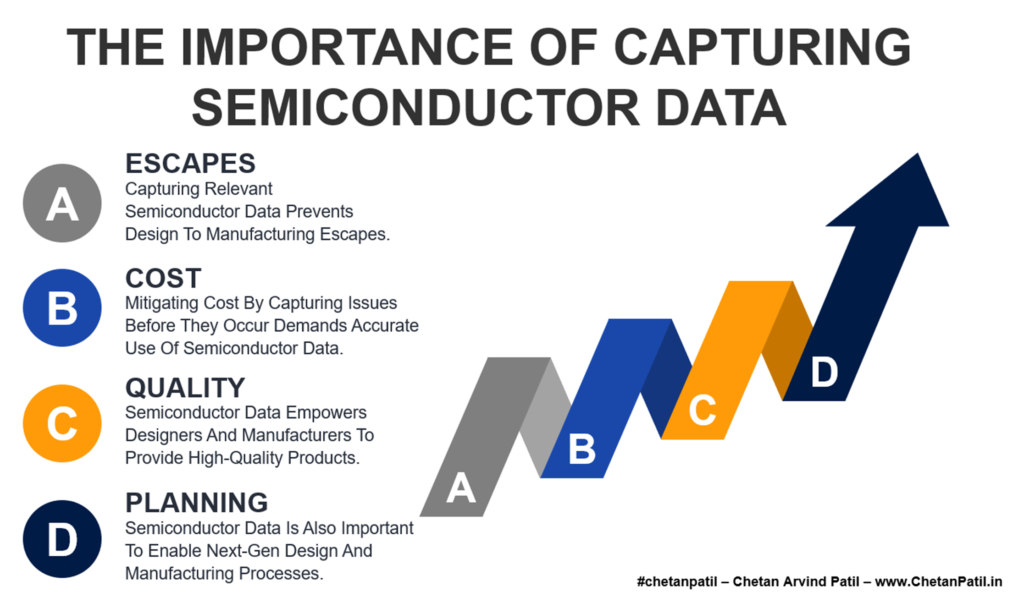
    Escapes: Capturing relevant semiconductor data prevents design to manufacturing escapes.

    Cost: Mitigating cost by capturing issues before they occur demands accurate use of semiconductor data.

    As the cost of manufacturing increases, so does the cost of generating the data out of silicon. Without semiconductor data, escapes get introduced during the manufacturing phase, and if an escape does occur, it can add unnecessary costs.

    Semiconductor data accuracy becomes more relevant when the silicon can be active in the field for a very long time (years to decades). Any failure can then have a catastrophic impact on the customer and eventually impacts overall product quality.

    While the cost to generate the silicon data to enable next-gen devices is increasing. On another side, it is also vital to keep investing in tools to drive data-driven semiconductor product development.


    Picture By Chetan Arvind Patil

    Semiconductor data also plays a crucial role in enabling planning while driving quality products. Planning aspects come into the picture when the process of die-level data is collected to dive into futuristic device development. Without the semiconductor data, the designers and manufacturers cannot plan the roadmap for next-gen devices to improve the performance and the quality of the products.

    Data via simulation is helpful up to a certain extent. For long-term manufacturing investments, short-term investment is required to enable the validation of silicon products. And doing so requires investing in LABs to capture relevant silicon data, which is a time and cost-demanding process.

    Quality: Semiconductor data empowers designers and manufacturers to provide high-quality products.

    Planning: Semiconductor data is also important to enable next-gen design and manufacturing processes.

    The semiconductor industry is planning for the world beyond 2nm, and implementing such plans demands silicon data that can prove the solutions work out in reality. On paper (via simulations), the planning can only go out to a certain extent, beyond which companies need to drive validation via CapEx.

    The semiconductor data is getting costlier. However, semiconductor companies still have to keep investing to capture relevant data to mitigate escapes. On top, data enables quality products and robust (technical and business) planning. If semiconductor companies are planning for manufacturing capacity, then they should always account for the semiconductor data cost and its positive impact.


  • The In-Memory Semiconductor Processing

    The In-Memory Semiconductor Processing

    Photo by Patrick Lindenberg on Unsplash


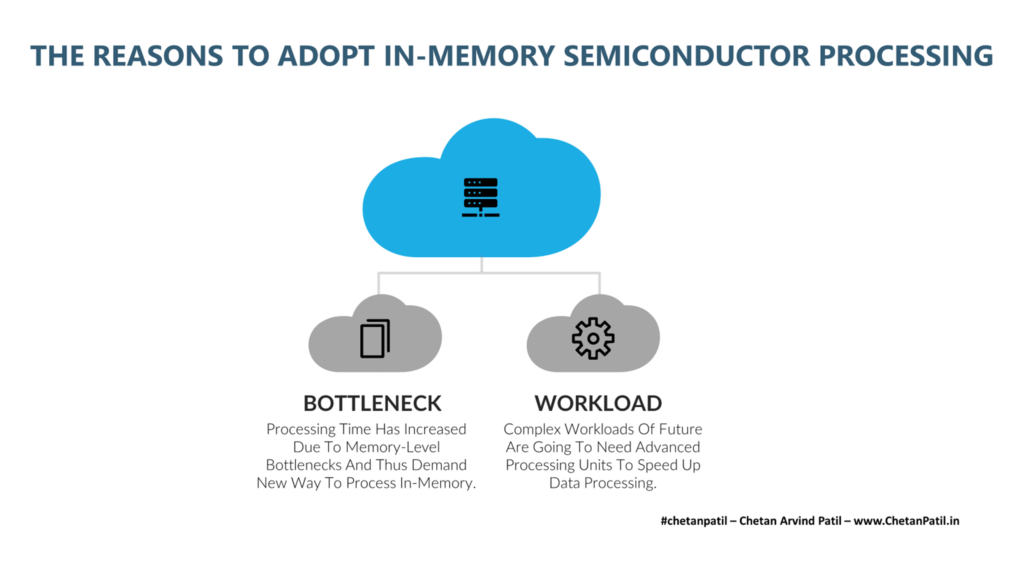
    THE REASONS TO ADOPT IN-MEMORY SEMICONDUCTOR PROCESSING

    Over the last decades, both industry and academia have spent numerous hours to enable different types of semiconductor design and manufacturing methodology to drive next-gen processing units. These processing units today power the computing world and often require billions of ever-shrinking structures.

    As the data world moves towards more complex workloads coupled with the need for faster and real-time processing, the traditional processing units will not be enough for the computing task. To overcome challenges, the semiconductor industry (mainly companies focused on XPUs) is now adopting new semiconductor design and manufacturing methods for processing units. Chiplets is one such example.

    In-Memory Processing Combines The Memory Units And Processing Units Into One Single Block And Thus Enabling Faster

    However, the problem chiplets solves is the technology-node wall, and thus enable the future demand of a more efficient system without compromising the shrinking transistor size. In the long run, chiplets may not solve the memory bottleneck, as it occurs due to the need to bring the data from the lower level memory to memory closer to the processing units. All this leads to traffic and thus architecture-level bottlenecks.

    Bottleneck: The time required to bring the data from lower-level memory to high-level memory (closer to the processing units) adds a time-related penalty and leads to a bottleneck when a given XPU has many processing units. Memory and compute level bottlenecks are thus demanding new processing solutions, and in-memory processing could be one such solution.

    Workload: Workloads today demand video to audio to text to graphics-related processing. Traditional XPU design can handle these but again require different dedicated processing units for specific processing requests. NPU for neural, CPU for computing, DSP for digital, and so on. Specific purpose processing units add complexity. Thus, an in-memory processing unit solution can provide a foundation to minimize the block-level complexity and thus enable faster workload processing by bringing computing to the core of memory units.

    Designing and fabricating different computing units can unlock new features that can speed up the computing world for future workloads. There are several challenges and hurdles in bringing this to reality. However, if done correctly, then the impact is only positive. In the long run and how the computing world is changing year on year, In-Memory processing is a path forward for data-heavy systems like server-grade XPUs.


    Picture By Chetan Arvind Patil

    Picture By Chetan Arvind Patil

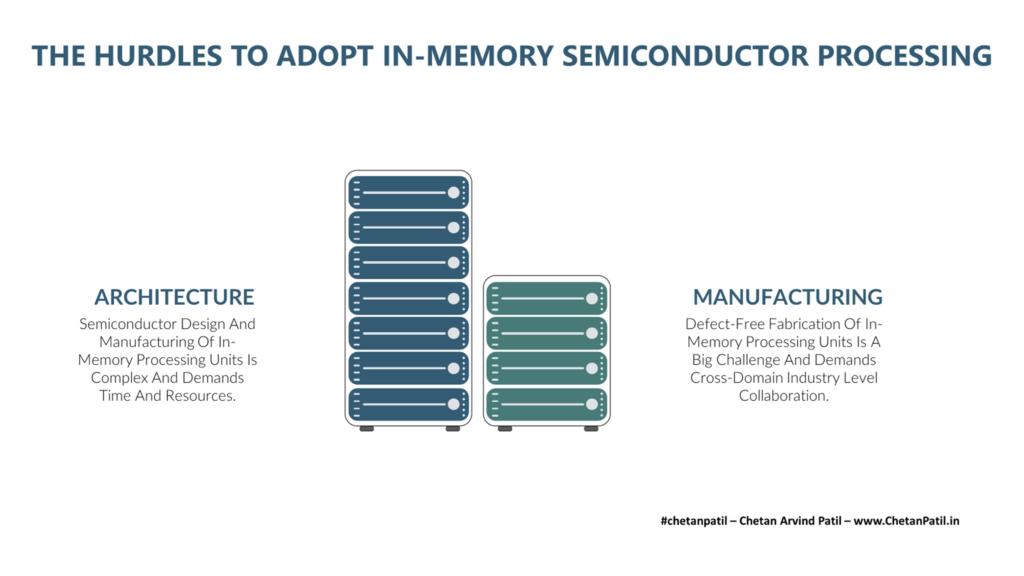
    THE HURDLES TO ADOPT IN-MEMORY SEMICONDUCTOR PROCESSING

    In-Memory processing units are a promising solution to tackle both the XPU bottleneck and the demand to handle complex workloads. Both academia and industry have proposed several solutions with many in-memory processing units ideas already tried and tested.

    However, using in-memory processing units at the server level (where this solution finds the perfect fit) is still a far distant dream. The two critical hurdles stopping the large-scale adoption of in-memory processing units, and both of these go hand in hand.

    Architecture: Combining processing units and memory units into a single unit (manufactured together) demands thorough research and design. It takes resources, cost, and time to do so before a viable product gets released. While it is not impossible to come up with a working mass-market in-memory processing unit solution, the time taken and risk involved is too high, something only a selected few companies in the market are capable of doing so.

    Manufacturing: After semiconductor design, the semiconductor manufacturing stage is critical in fabricating two different units into one. In-Memory processing units demand combining two separate semiconductor manufacturing worlds. Doing so requires semiconductor design, semiconductor FAB, and also semiconductor equipment manufacturers to come together.

    XPUs for the throughput-oriented requirement will keep evolving. Yesterday it was CPU and GPU, today ASIC/FPGA, and tomorrow it could be In-Memory processing units. In the end, as long as the solution is feasible from both the design and manufacturing point of view, the market will embrace it.

    Several emerging companies are already coming up with new architectures to design next-gen XPUs. In-Memory processing units will also go similar traction, and it will be interesting to see how the market will behave.


  • The Semiconductor Benchmarking Cycle

    The Semiconductor Benchmarking Cycle

    Photo by Lars Kienle on Unsplash


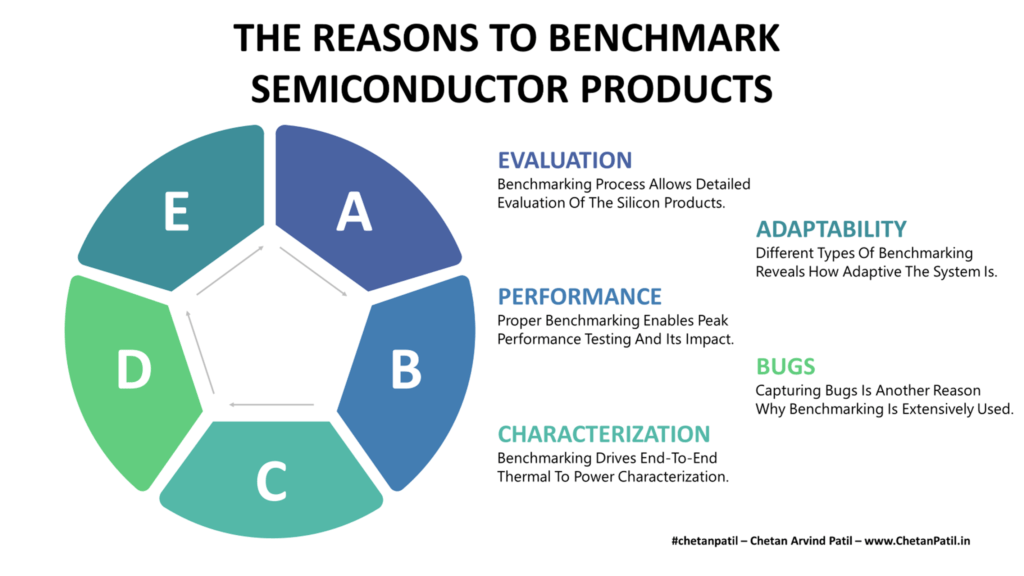
    THE REASONS TO BENCHMARK SEMICONDUCTOR PRODUCTS

    Benchmarking a product is one of the most common evaluation processes, and from software to hardware, benchmarking is extensively used.

    In the semiconductor industry, benchmarking is mainly used to evaluate products against their predecessors and also competitors. CPU and GPU get benchmarked more often than any other type of silicon product, and the reason is the heavy dependence on day-to-day computing on these two types of processing units.

    Benchmarking: Capturing technical characteristics and comparing them against other reference products to showcase where the new product stands.

    Comparing one semiconductor product with another or old one is one of the reasons to benchmark. Benchmarking enables several key data points and makes the decision-making process easier for end customers. In many cases, it also pushes the competitors to launch new products.

    Evaluation: Benchmarking provides a path to unravel all the internal features of a new semiconductor product. Evaluating products using different workloads presents a clear technical picture of device capabilities.

    Performance: The majority of the semiconductor products get designed to balance power and performance, while several are also focused purely on peak performance without considering the power consumption. Either way, executing the benchmarking workload on a silicon product allows capturing of detailed performance characteristics.

    Characterization: Power, performance, voltage, and time are few technical data points that enable characterization. Benchmarking tools are capable of capturing these details by stressing the product with different operating conditions. Such data point provides a way to capture the capabilities of a product over different settings.

    Bugs: Stressing a product using different benchmarking workloads can reveal if there are bugs in the product. Bugs are captured based on whether the benchmarking criteria are leading to expected data as per the specification. If not, then designers and manufacturers can revisit the development stage to fix the issue.

    Adaptability: Benchmarking also provides a path to capture how adaptive the semiconductor product is. It can be done by simple experiments wherein the product is stressed using benchmarking workloads under different temperature to voltage settings. Any failure or deviating results during such benchmarking can provide a way to capture and correct issues before mass production.

    Benchmarking also reveals several data points to the buyers and empowers them with information about why a specific new product is better than the other. Relying on benchmarking process has become a norm in the computing industry. It is also why any new semiconductor product launch (CPU or GPU) comes loaded with benchmarking data.

    With several new semiconductor products coming out in the marking and catering to different domains (wireless, sensor, computing, and many more), benchmarking presents a way to capture the true potential of the new product.

    However, correctly executing a benchmarking process is critical, and any mistake can present a false impression about the product getting evaluated. Hence it is vital to benchmark a product correctly.


    Picture By Chetan Arvind Patil

    Picture By Chetan Arvind Patil

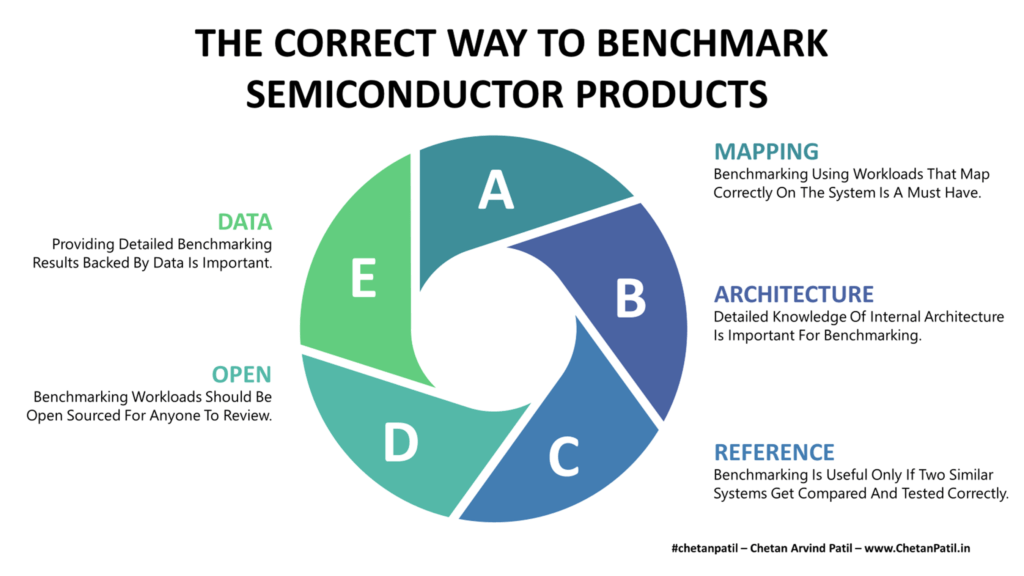
    THE CORRECT WAY TO BENCHMARK SEMICONDUCTOR PRODUCTS

    Benchmarking semiconductor products like XPU (and several others) is not an easy task. It requires detailed knowledge of internal features to ensure the workload used for benchmarking is correctly utilizing all the new embedded features.

    A false benchmarking process can make or break a product, and it can also invite several questions on any previous product that used a similar benchmarking process. To correctly benchmark a product requires covering several unique points so that all the features get evaluated.

    Mapping: The benchmarking world has several workloads. However, not all are designed and then tested by correctly mapping the software on top of the hardware. For correct benchmarking, it is critical to capture all the features that enable the correct overlay of the workload on top of the silicon product. Doing so ensures that the benchmarking workload can take benefits of all the internal architectural features before.

    Architecture: Understanding different features and architectural optimization is a vital part of correctly benchmarking the products. There are generic benchmarking tools and workloads, but not all can take advantage of all the register level techniques to optimize the data flow. A good understanding (which also requires detailed documentation from the semiconductor company) of architecture is necessary before any benchmarking is executed. This also enables a fair comparison without overlooking any features.

    Reference: The major goal of benchmarking is to showcase how good the new product is. To showcase such results require a reference, which can be a predecessor product from the same company or a competitor. Without a reference data point, there is no value in positive benchmarking results. Hence, having as many references benchmarking data points as possible is a good way to compare results.

    Open: To drive fair benchmarking, open-sourcing the software (workloads) code can instill a high level of confidence in the results. The open process also allows code contribution, which can improve the workloads, and thus the benchmarking results will be more reliable than ever.

    Data: Sharing as much benchmarking data as possible is also a good strategy. Peer review of the data points also improves the benchmarking process of future products. Historical benchmarking data points also drives contribution from data enthusiast and thus can help improve the benchmarking process and standardization.

    Several tools and workloads are available to evaluate and benchmark a semiconductor product. However, the majority of these workloads/tools are written without 100% information about the internal features of any given product, which might lead to false-positive/negative benchmarking data points.

    All this pushes the case for standardizing the benchmarking process so that any semiconductor product when compared against others (in the same domain), gets evaluated for set/standard data points. On top, as more complex XPUs and similar products (neuromorphic chips) come out in the market, standard benchmarking protocols will provide a way to correctly evaluate all the new technologies (and design solutions) that several old/emerging companies are launching.

    Benchmarking is not a new process and has been around in the semiconductor industry for several decades, and it will be part of the semiconductor industry for decades to come. The only question is how fair the future benchmarking process will be.


  • The Semiconductor Data Integrity

    The Semiconductor Data Integrity

    Photo by Denny Müller on Unsplash


    THE IMPORTANCE OF SEMICONDUCTOR DATA INTEGRITY

    The semiconductor industry has been utilizing data to drive design and manufacturing for a very long time. The reason is the high cost and penalty of manufacturing a product without thoroughly reviewing the semiconductor data.

    The growing importance of data is the primary reason why the semiconductor industry has always found ways to capture data cleanly. Capturing relevant data has helped semiconductor design and manufacturing. However, as the reliance on semiconductor data grows, it is crucial to implement end-to-end data integrity.

    Semiconductor Data Integrity: How accurate, complete, and consistent semiconductor product-related data is.

    Data integrity questions arise in the semiconductor (and several other industries) industry when for any given process steps or product, there are parts of the data that are missing or not traceable. Such miss-steps can occur when there is a need to go back and look at the historical data to capture any deviations that might in the future lead to re-calls (a process that the automotive industry has mastered and deployed for decades) to avoid failure in the field.

    There are specific sub-steps in the semiconductor product development (mainly the manufacturing side) process that should be compliant from a data integrity point of view.

    Equipment: Advanced equipment gets used for semiconductor testing, validation, and manufacturing. Capturing the data correctly and accurately is key to validating the product behavior. Any miss-steps causing data integrity issues can lead to an incorrect decision which can eventually cause losses in terms of revenue and time.

    Process: There are thousands of steps that every semiconductor chip has to follow during the fabrication stage. Data is the only way to validate whether the process steps (lithography, etching, etc.) got successfully executed. If the data is missing or not correctly captured, then a faulty product will get fabricated.

    Test: Electrical data during the post-silicon stage is required to validate the compliance aspect of the product development apart from capturing yield trends/issues. Data integrity during electrical testing is vital in driving accurate conclusions. An incorrect assumption or analysis (due to inaccurate data) can have negative consequences during the production phase.

    Assembly: Assembly data integrity is vital as it is the final stage of any manufacturing process. After assembly, the parts get delivered to the customers. Any last-minute data points that can alert the manufacturing houses of possible issues can eventually save thousands of dollars apart from saving time. Hence, data needs to be accurate and compliant. 

    Supply-Chain: Balancing the inventory with market demand is a vital part of the semiconductor industry. Doing so requires relying on market intelligence. Thus the data provided by the market intelligence tools should be error-free. Hence, data integrity also applies to the data-driven supply chain.

    Above are the handful of areas where the semiconductor data integrity is applicable by default. There are still specific steps that semiconductor companies/industry needs to revisit to ensure that product that goes out in the market has end-to-end data integrity.

    In the long run, applying data integrity to semiconductor product development provides a positive impetus for the semiconductor industry/company. On top of that, it pushes them to produce more critical products for a wide range of industries apart from enabling customers with information about any data points that can have both negative and positive impacts on semiconductor products.


    Picture By Chetan Arvind Patil

    Picture By Chetan Arvind Patil

    THE PATH TOWARDS SEMICONDUCTOR DATA INTEGRITY

    An efficient semiconductor product development process requires semiconductor data integrity and should be a default feature. Otherwise, the semiconductor data collected and analyzed can lead to incorrect decisions that can severely impact the new product launch.

    Over the last decade, several new data solutions have taken the process of semiconductor device design and manufacturing to a whole new level. However, there are still opportunities to apply data integrity around specific steps. Doing so will raise the bar of the semiconductor company deploying data integrity features, as it will encompass an error-free process.

    Archiving: Long-term storage of semiconductor data should be the first and foremost goal of any semiconductor company. Faster storage and retrieval drives efficient data analysis to capture different features of a given product. There is a need for default features to validate the archiving process to capture gaps or missing data points. Such features will ensure any data retrieved in the future will be reliable, completed, and accurate. Thus data integrity needs to be a default part of archiving process. 

    Traceability: Traceability allows connecting the data to a specific product. Billions of semiconductor products get shipped out every year, and it is critical to capture every actionable data a given semiconductor product generates. It demands a unique and robust traceability process so that the data can be correctly connected to the right product, thus driving next-gen data integrity in the semiconductor. Several approaches are already present, and as more products get shipped out, the importance of traceability will only grow.

    Standardization: Semiconductor industry has several standards it follows diligently. However, it is important to keep revisiting these standards to ensure that the latest learnings from different semiconductor companies (and processes) are applied. It will drive further make the standardization processes more robust. The semiconductor industry should also focus on data standards by bringing more efficient data formats that are easy to store, parse, use, and analyze. All this can ensure end-to-end data integrity.

    Verification: Data generation is half job done. It is also vital to verify the data generated. Cross-checking, validating properties, questioning data, and analyzing are keys to ensuring the semiconductor data is 100% compliant and is accurate. Moving forward, semiconductor companies relying on data analysis will have to by default deploy data verification techniques to capture any anomaly, thus avoiding miss-information and driving data integrity by default.

    Product Life-Cycle Management: Product life-cycle management software tools have been around for decades. Cloud-driven solutions have also positively impacted product management, mainly the bill of material. However, slowly these software tools are becoming complex. Complexity makes the process error-prone and can lead to inaccurate information, thus affecting the data connected with the product. PLM tools will have to evolve and produce simple, minimal, and robust solutions that minimize human efforts and maximizes efficiency by keeping data integrity at the center stage.

    The majority of the above points are already in place but are becoming complex due to the increasing semiconductor data (along with products) year on year. Managing data without losing its integrity should be the default focus of the semiconductor data solutions provider and users (semiconductor companies). Any missing points or issues at the source can invite confusion in the future. Hence, capturing and solving the gaps at the first step should be the goal of semiconductor data tools.

    The semiconductor data integrity will also be a key for the emerging semiconductor FAB-LESs and FABs. It certainly requires investing in the new semiconductor data handling process. In the long run, it also implies that the demand for talents with data skills for the semiconductor industry will keep increasing.