
Photo by Shubham Dhage on Unsplash
The end-to-end semiconductor design and manufacturing are dependent on the ecosystem. It is evident from the regions that have become a pillar of the semiconductor industry. These regions have grown steadily for decades while creating business and employment opportunities.
Developing a semiconductor ecosystem is not an easy process. It demands time, resources, and capital, which are not easy to come by together. Existing semiconductor ecosystems have been around for more than two to three decades and thus have become a benchmark for the upcoming semiconductor regions.
New regions that want to attract semiconductor businesses should focus on creating a semiconductor ecosystem. Doing so requires following a set process to bring together different building blocks of the semiconductor industry. These fundamental blocks create a platform that allows semiconductor-focused businesses to thrive for decades to come.
Core: Focus on developing the region for one specific type of semiconductor business. For example, focusing on semiconductor design or manufacturing is far better than focusing on both.
Support: Apart from developing core competency, also build a supportive environment that supports and helps the growth of different semiconductor businesses.
The semiconductor ecosystem development starts with the core focus. Focus on one solution rather than focusing on all the segments of semiconductors. It is how some of the semiconductor ecosystems in Taiwan (manufacturing), the EU (equipment), Japan (material and equipment), China (assembly), and the USA (design) started and are now (or already have) becoming ecosystem with multi-segment semiconductor business.
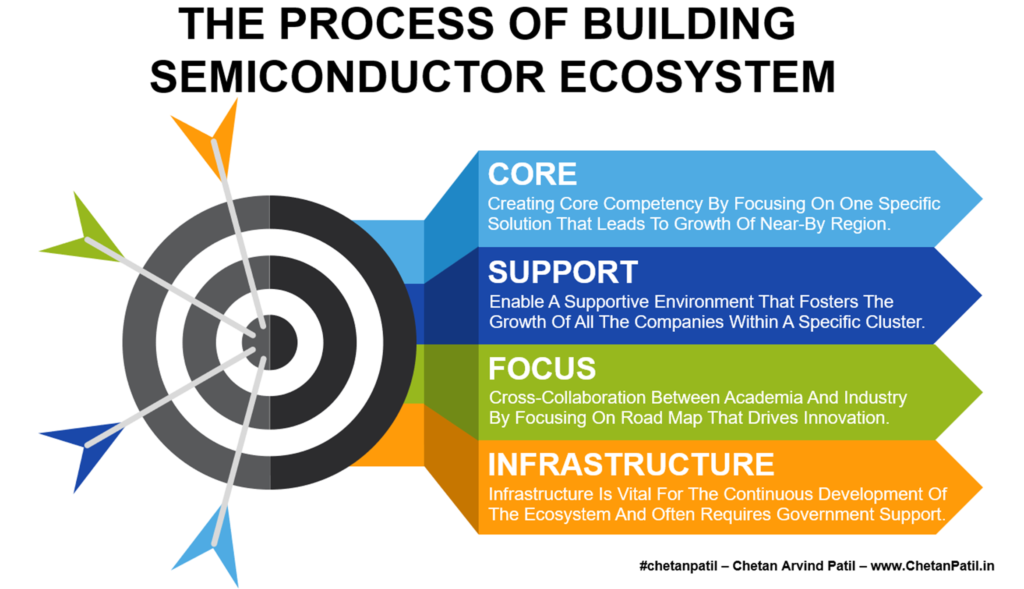
The continuous growth of the semiconductor ecosystem demands a supportive environment. Companies within a semiconductor ecosystem should thus focus on cross-collaboration. Such an approach allows the development of a new type of semiconductor technology.
Focus: Long-term focus is required by enabling collaborative culture that allows the flow of innovative ideas.
Infrastructure: Basic infrastructure developed by public bodies goes a long way in making a robust semiconductor ecosystem.
Public bodies also play a vital role in creating a semiconductor ecosystem. It ranges from providing adequate infrastructure to laying out policies to make it easy to do business. Education infrastructure is also critical for the free flow of talent that eventually drives the semiconductor ecosystem forward. There are already several examples whereby the proximity of a university powered the overall growth of the semiconductor business.
As the race to attract semiconductor businesses to set up the design to manufacturing houses speeds up, the case to create a semiconductor ecosystem will grow and might be a de-facto way of developing regions.
