Category: HARDWARE

  • The Edge Computing

    The Edge Computing

    Photo by Tony Stoddard on Unsplash

    In the hardware systems, the cache is used by Central Processing Units (CPU) to reduce the time which is required to access the data from the lower level memory like RAM. It does so by bringing the data beforehand (depending on the policy used) in the cache, which re-sides closer to the CPU.

    This allows CPUs to perform calculations faster as the cycle time gets reduced and the latency is lowered. It also lowers the time and energy required to perform the computation task.

    Same concept is applicable for the software systems, in which caching of data leads to faster access which reduces the response time and improves user experience. Content Delivery Network (CDN) is one of the best examples of software caching. Even web browsers use it.
    Image
    Picture By Chetan Arvind Patil

    However, both the hardware and the software caching systems are good from a data point of view, but not for computation. In the hardware systems, data is brought closer to the CPU for processing while in software systems the data is brought closer to the user after processing. For both the systems, if the source data is updated, then new data has to be fetched, which adds cost, time, and energy.

    With the growing digital user base and improved connectivity around the world, the importance of caching is increasing to cater the data and computation demand.

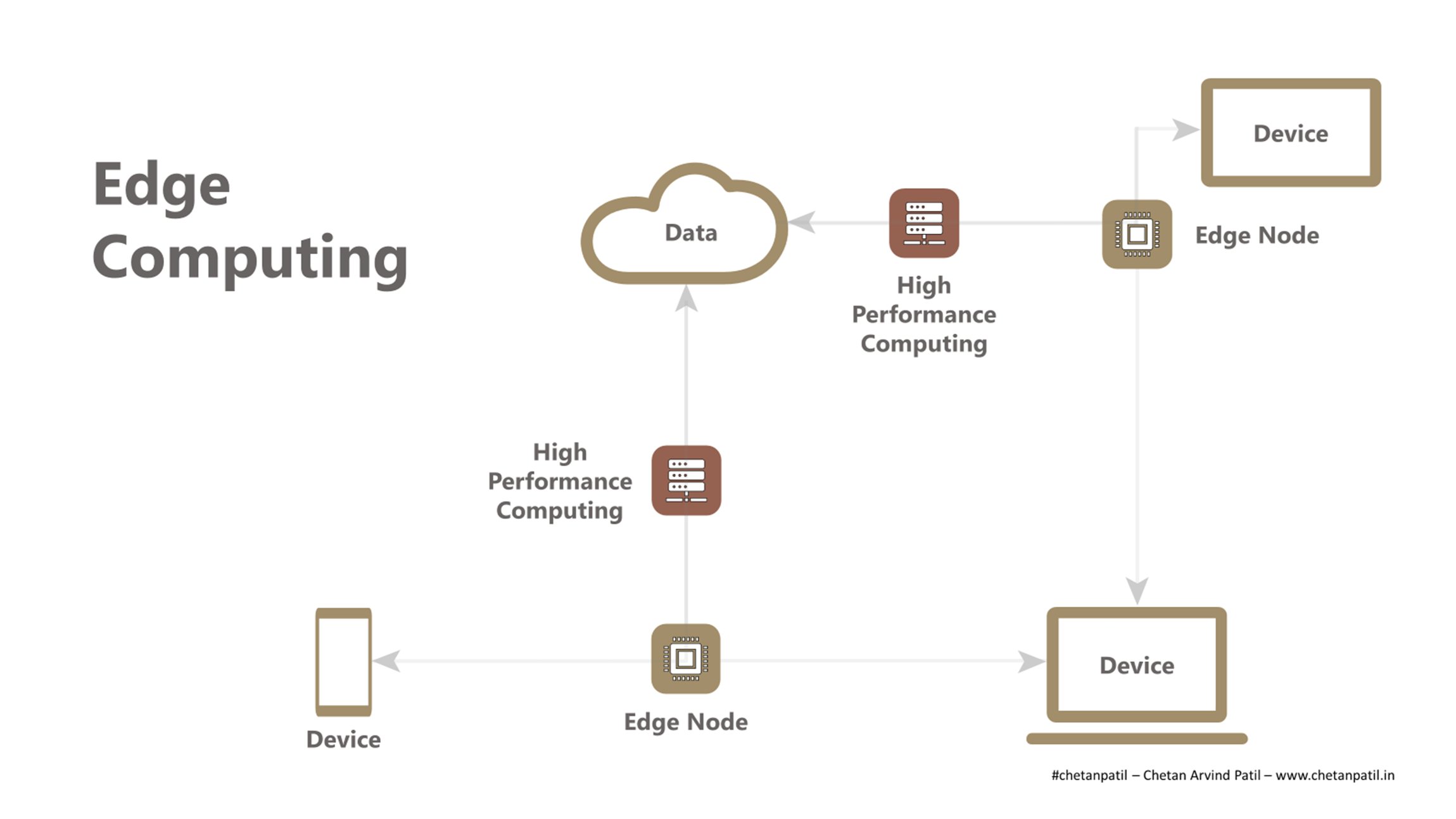
    In order to serve this growing demand, the edge computing is being deployed. In a nutshell, the edge computing provides data and computation closer to the nodes requesting it with the help of widely deployed array of hardware. This leads to faster response time, reduces time to deliver the content, and provides massive distributed processing power.


    EDGE COMPUTING BENEFITS

    Large scale deployment of the edge computing is going to be a win-win situation for both the businesses and the consumers. The hardware and software deployment and development around the edge computing are also going to bring a tremendous amount of skill-based employment opportunities. The edge computing has numerous benefits. There are already several solutions from the semiconductor industry for the edge computing.

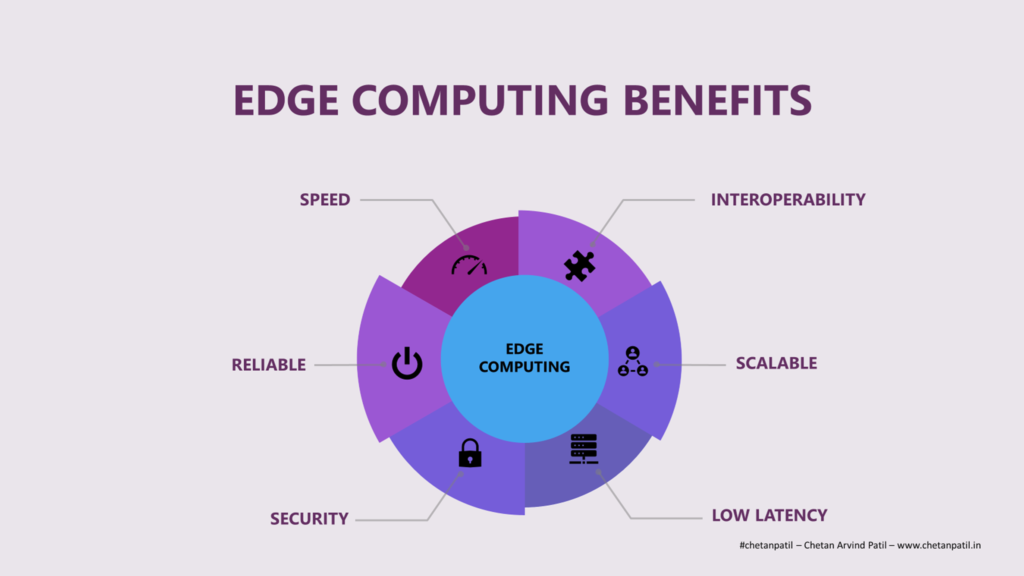
    One of the important benefit of the edge computing is the computation speed. The edge computing can distribute the single task across different edge nodes, which reduces time to accomplish task. With 5G and Wi-Fi 6, the off-loading of the task to nearby edge nodes is going to ensure low latency and reliable service.

    By reducing the number of hopes required to access the computation and data resources, the edge computing will also provide better security. The computation to be performed can be done by nearby nodes and the data to be accessed can also be stored at the same nodes. This process shields against any intruders trying to access the data by reducing the number of hops.
    Picture By Chetan Arvind Patil

    The edge computing is also designed to be scalable. There are no restrictions on the number of edge nodes that a specific network can hold, as long as the edge computing network is balancing the supply and demand requirement, and is not high on cost.

    Adoption of 5G will be a gradual process. Consumers will take time to upgrade devices that are 5G compatible. To cater to the previous generation (2.5G/3G/4G) technology users, interoperability is important. The edge computing is capable of providing interoperability, thus both new and legacy devices can work with the same edge node.

    The major application areas of the edge computing is going to be On-Device Artificial Intelligence (AI), which will allow smart devices (smartphones, cameras, sensors, etc.) to off-load the compute intensive task to the nearby edge nodes.

    The edge computing will take digital experience to the next level.


    EDGE COMPUTING OPPORTUNITIES

    Every new technological solution presents new opportunities for the businesses. Consumers also gain due to the new products and services. From a business point of view, the edge computing provides several ways to generate revenue.

    The edge computing will drive the introduction of new products. Both software and hardware solutions will be introduced. Businesses can explore the edge computing in form of Edge As A Service (EAAS) by allowing smaller companies access to the edge resources in order to provide over the top services. This will also drive revenue.

    Picture By Chetan Arvind Patil

    Computing at the edge also requires a networks of hardware that can accept the task request, process it, and send it back to the requester. To develop such smart hardware for the edge computing, the semiconductor companies are comping with low energy and high-performance electronic chips, which can used by the developers to launch new hardware products. All this opens new revenue opportunity for different segments for smaller, mid to high scale enterprises.

    The edge computing on top of the smart hardware will increase the adoption rate of the digital services. This will also lead to acquisition of new consumers and will open multiple revenue opportunities.


    The edge computing offers exciting benefits and opportunities. Both businesses and consumers are going to be at advantage.

    The major application areas that the edge computing is going drive are smart cars, smart cities, smart industry, smart manufacturing, and smart home automation systems.

    Picture By Chetan Arvind Patil

    It will be interesting to see how the industry comes forward and uses the edge computing to launch new digital solutions for the market.

    The country which will deploy and adopt the edge computing enabled 5G networks faster is going to be the leader in digital services and information technology for the next decade.

  • The Drones Are Flying

    Photo by asoggetti on Unsplash


    DRONE

    Unmanned Aerial Vehicles (UAV) have been in use since 1849. Several countries around the world have invested in massive research and development activities to make use of UAV for surveillance activities by the armed forces. All the military-grade UAVs are distinctly complex and wide-body machines.

    In recent years, due to the development in the semiconductor process technology and the advancement in software development, the form factor of high-tech hardware and software solutions have been shrinking. Along with the improved connectivity and wireless communication technology, the UAVs are now also being used by civilians for personal and professional non-military activities.

    The civilian UAV are more popularly known as drone.

    Picture By Chetan Arvind Patil

    With the flying capability and ability to get controlled remotely, the drone can reach places easily where humans require heavy machinery to do so.

    The primary usage of the civilian drone has been for aerial photography and videography due to the high-resolution cameras that the drone can fly with. Lately, the application area has widened to agriculture, scientific research, and numerous other business segments.


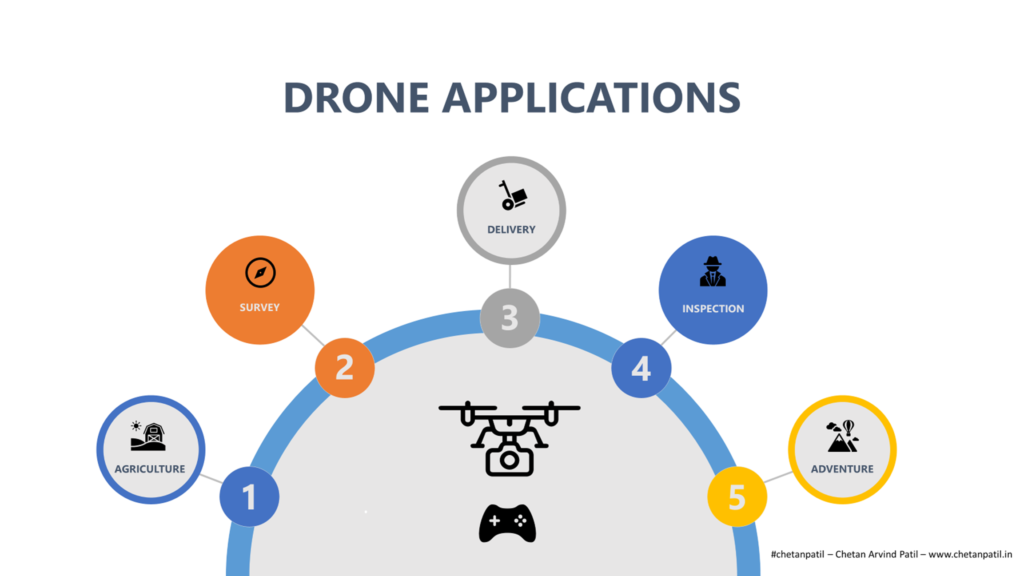
    DRONE APPLICATIONS

    There are different areas where the drone is useful. Mainly in the areas where deployment of the drone can lead to lower operating cost compared to the existing solutions.

    In Agriculture it is not only important to monitor the yield of the crops but also critical to understand the effect of the new agriculture technique. Going by the traditional approach of performing the acres of land inspection manually is not only time consuming but is a labor-intensive task too. This is where the drone come into the picture. The drone can either fly from nearby centers to monitor the farming or can reside near the field. In both the cases it can be controlled remotely. On top, farmers can also be trained to fly the drone.

    The drone can be programmed with the map of the agriculture land to automatically capture the aerial high-resolution pictures and videos. The data captured can then be uploaded to the cloud servers for further analysis. The farmers can then get the accurate feedback on the progress of their crops, along with live audio/video advice.

    Another important application area of the drone is to perform survey. Surveys can be to understand the structure of a high rise, finding any faults on long pipelines located in terrain land, checking on the high rise electric pole lines, and many other important areas where humans will require heavy instruments (high cost) to reach. The drone can also be very handy in surveying bridges and tunnels. Similar to the agriculture application, the data captured from the cameras can aid in understanding whether maintenance is required or not.

    Picture By Chetan Arvind Patil

    The drone are also being used for adventure activities like capturing videos during a movie stunt, aerial view of national parks and many other adventure activities. The high resolution cameras provide breathtaking view from a point of location that humans cannot read easily.

    The drone is already is use at police and firefighter departments across the world. The primary reason to use the drone by the police departments is to inspect suspicious areas. With the help of sensors and cameras, the drone can per-alert and provide details about whether it is safe enter the area or not. The firefighters are deploying water loaded drones to put off the fire in buildings or complex, where it is not safe for a human to reach. Civil engineering and the oil/gas industry are also increasingly deploying the drone to inspect infrastructures in order to predict maintenance.

    Lately, the most crucial use case of the drone being discussed a lot is the delivery of the packages within the city flying zone. Few of the companies have already got an operating license to do so on a pilot basis. If implemented at large scale across different cities, the cost and time benefits are humongous.

    The drone will also help in reducing the carbon footprint.


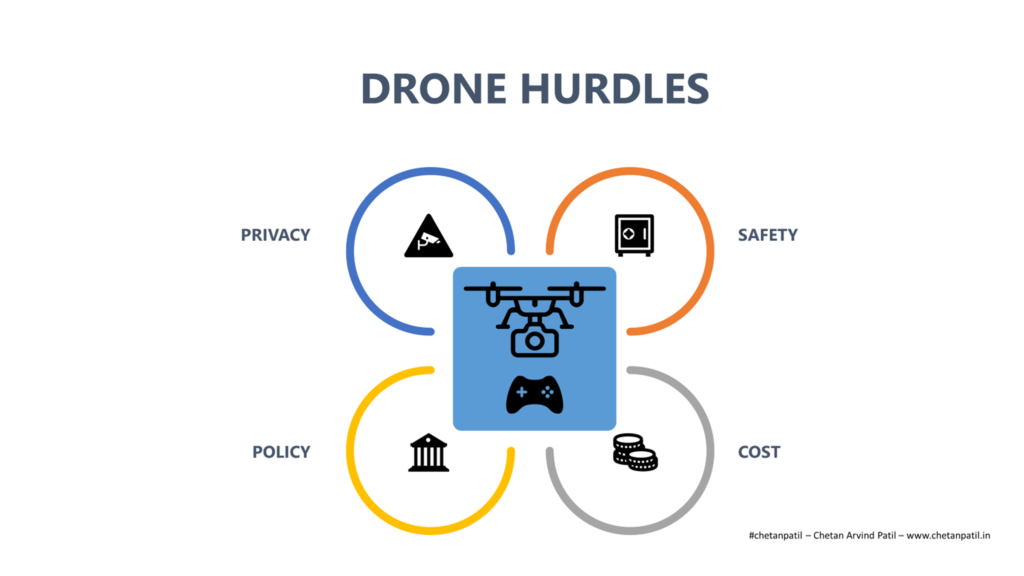
    DRONE HURDLES

    The drone have numerous use cases. Hardware companies are launching new drone concepts every month. At the same time the software companies are making it easier to fly the drone along with data capturing and processing.

    However, with opportunities come hurdles.

    Currently, the biggest battle around the drone is who can use it for the commercial purpose. Many countries are coming up with the state and national level policies on the drone commercial activities. The major (and important) requirement is going to be the basic training and license required to operate the drone. It will take a few more years before the drone policies are aligned between the businesses and governments.

    Picture By Chetan Arvind Patil

    The next big challenge is the privacy. Due to the ability to fly at high altitudes, the drone may capture aerial footage of the private locations. There are already the drone catcher technologies, however these require investment and capital which not everyone can afford. Hence, clear guidelines and laws need to be defined around the drone and the privacy breach.

    Safety is another hurdle. The autopilot has been in use for a long time but only for commercial flights flow by trained pilot. When it comes to the drone, the operator is not trained for hours. It is certainly possible to automate the drone flying, but there are still users who would like to control the drone flight. There is a possibility that the flight control can be lost, thus raising safety concerns.

    The drone are becoming cheaper year-on-year. Every year, new solutions and the software/hardware technologies in the drone is also making it costly. To break even the investment on the drone systems from the business and consumers point of view can be challenging task. A subscription based buying model can be helpful.


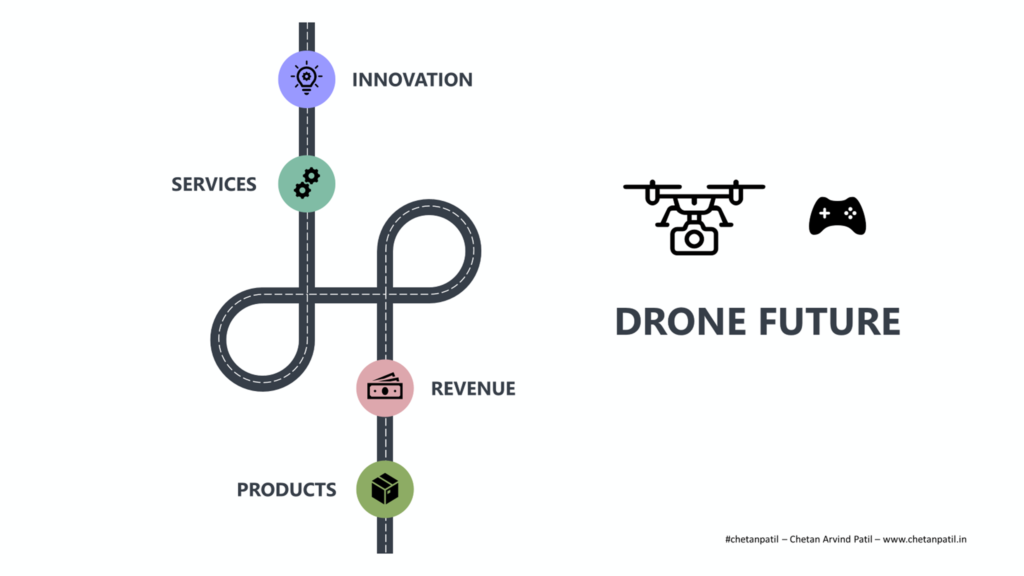
    DRONE FUTURE

    The drone segment is poised to become a $50 Billion market by 2025. The application areas are clearly defined. Many new use cases and promising innovation around the drone technology are being implemented by several companies and startups around the world.

    Ecommerce and logistics companies have already started to experiment with the drone delivery services. Drone enables faster delivery, are more carbon-friendly, and lower the shipping cost. The drone delivery system will be game changer for cities with heavy road traffic.

    Picture By Chetan Arvind Patil

    The drone will also drive innovation of smart hardware and software products. With the expanding market, new electronic sensor-based solutions will be developed along with smart software tools to make drone flying experience safer. All this will open new revenue sources for both the software and the hardware businesses.

    The time for the drone to take off has come.


  • The Hearables

    The Hearables

    Photo by Yogendra Singh on Unsplash


    THE HEARABLES

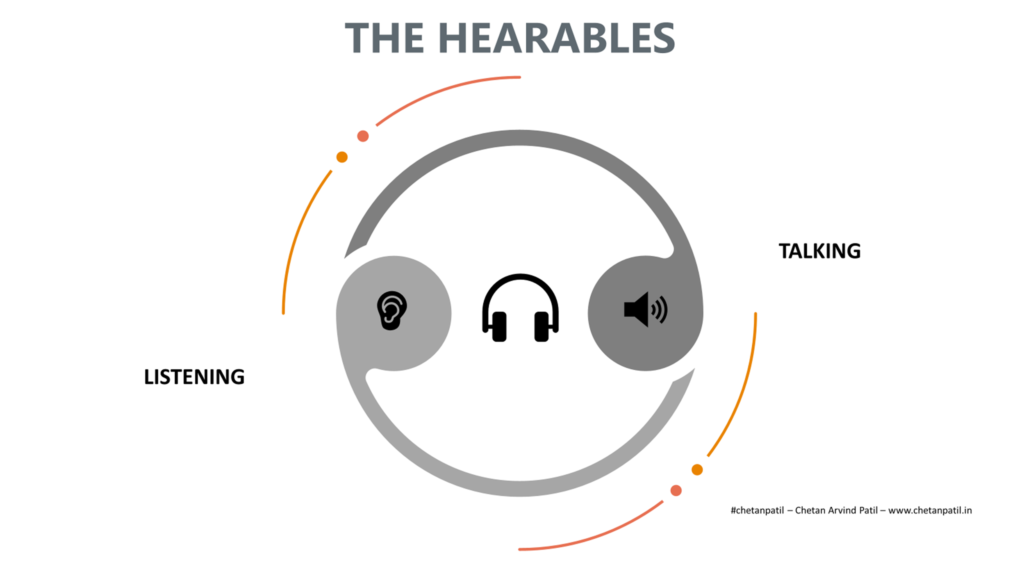
    The hearables are the smart technology-enabled over-the-ear or in-the-ear devices that are mainly used for music listening. The natural language assistant has equipped the hearables with the ability to talk. These smart assistant can interactively talk to the user using the inbuilt speakers, and then can also listen to the user with the help of the microphone. The hearables also have inbuilt features like ambient sound control and active noise cancellation.

    The majority of the hearables use Bluetooth for wireless connectivity, which allows voice control of the smart phone with the help of the virtual assistant. Though not everyone is comfortable talking to these virtual assistants in public, however with the increasing use, it is becoming a new normal.

    Picture By Chetan Arvind Patil

    Every major smartphone and audio company in the world has launched its own hearables. Technology companies are merging the best of the audio, hardware, and software to create new solutions around the hearables. Google is deploying artificial intelligence-enabled voice assistant, while Amazon is focused on enhancing online shopping and audiobook experience with the help of the hearables.

    There are already numerous applications of the hearables and it will be exciting to see what the consumers get to experience in coming years.


    THE HEARABLES APPLICATIONS

    The application of any technological solutions requires multiple functions to work in harmony. First and foremost is the underlying hardware technology, the second is the connectivity (mainly wireless), third is the software systems running on top of the hardware and fourth is the application ecosystem driven by the developer community.

    Starting from pre-internet to the post-internet ear, all the consumer-oriented solutions have relied on these four major points for success. Whether it is Windows powering the majority of the world personal computer or Android changing the landscape of the mobile industry. The same is also applicable for the hearables, except that majority of these underlying solutions (hardware, software, connectivity, and ecosystem) already existed beforehand. With the hearables, the companies have simply taken the existing software/hardware infrastructure and extended it to the hearables. So far, the outcome has become anything but positive.

    Entertainment has always been the default application of the hearables. The small form factor and features like active noise cancellation has surely taken the audio experience to the next level. The applications on the mobile devices can now connect to the hearables via Bluetooth, which provides an ability to control different features using the smart gestures.

    Picture By Chetan Arvind Patil

    Another major application of the hearables has been to swiftly interact with the voice assistant. The offloading of tasks after sending instructions via the hearables has made the smart devices more interactive. It can be used to retrieve important information like the weather forecast, nearby places, and many other useful data. All this has been possible due to the underlying smart hardware that can capture and process the natural voice.

    The hearables also offer audio privacy and enable one to interact with the party on the other side without compromising the confidential information exchange. There are still gaps, mainly from the speaker’s point of view and it will take a breakthrough technology to overcome some of the gaps.

    Cross reality by default requires a pair of devices to connect with ears. The hearables are the perfect candidate due to the smaller form factor. The hearables mixed with cross reality is going to provide new avenues on how to project information in the virtual world.

    In the coming decade, the application areas of the hearables will surely expand.


    THE HEARABLES OPPORTUNITY

    The smart features requires the smartest of hardware and software.

    The hearables might be marketed by a specific company, but a lot goes inside these little devices which requires effort from several design, development, and manufacturing companies. The software part is still being handled majorly by the vendors selling the hearables, but the application ecosystem opens up a lot of opportunities for the developers.

    Hardware companies, mainly semiconductors, will have a lot of opportunities to launch new low power and smaller electronic audio/voice chipNoise cancellation system will have to keep improving to consider the work from anywhere scenario, which also opens up new opportunity and revenue for the semiconductor companies. Context-awareness is another promising feature, for which the hearables will require smart sensors in order to adapt to the environment.

    Wired charging will be phased out of the market in the next decade, and the hearables will also have to adopt wireless charging system. Already different wireless charging solutions are available in the market, but fast wireless charging will be the key until the battery technology evolves. A portable battery bank cum carrying case for the hearables will be another area that companies can target.

    Picture By Chetan Arvind Patil

    Software innovation will also open up new opportunities. It is expected that going forward the hearables will be able to connect with the cellular towers, and when that happens the services will have to be provided mostly over the voice. This will require smart applications to make most of the hearables. For example, the banking application on the hearables can provide details about the bank balance or initiate transfer with voice commands. 

    Voice assistants are already in use, but local language support will be the key. Providing local language support will increase the reach of the hearables. Audio control is already part of the hearables. Extending it beyond just the master mobile device will open up new ways to interact with the world. For example, controlling car infotainment using the hearables.

    Hardware electronic chips can only cancel 70-80% of the noise. In order to achieve 100% noise cancellation, software adaptive features are required, which can capture and filter out the noise. Innovation around the software noise cancellation will also lower the cost of the hearables, as it will eliminate the need to have a dedicated hardware chip inside the hearables.

    The hearables have opened new opportunities for both the hardware and software domains. The domain is expected to grow more in coming years.


    THE HEARABLES FUTURE

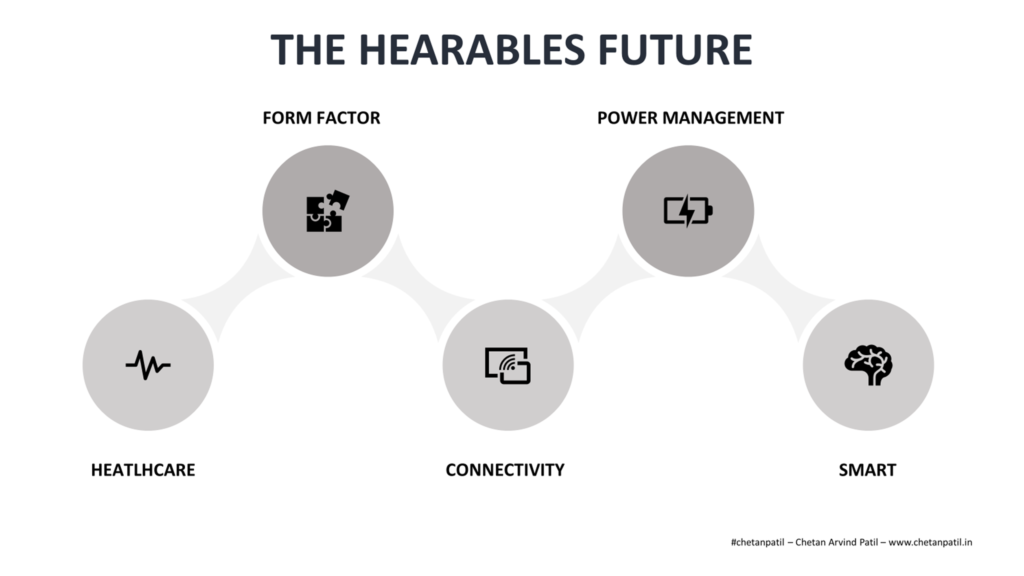
    Over the next decade, the adoption of the smart devices will increase, mostly in the developing market. With Google becoming more of an AI service business, many local vendors from the developing market can take advantage of its solution to provide locally manufactured smart hearables.

    It is inevitable that Android will also find its way on the hearables and it will make them a standalone device rather an add-on one. However, to make the hearables work as a standalone system, it will be critical to provide better power management. Dynamic task management can only drive efficiency to a certain extend and that is why the advanced battery technology is need of the hour.

    Picture By Chetan Arvind Patil

    The development of the hearables as a technology platform will demand different form factors. Advanced semiconductor process nodes along with flexible hybrid electronics will ensure that hearables become much smaller and flexible than they are now.

    Expansion of 5G small cell connectivity will ensure that the hearables can form a network that securely allows sharing of the information within a specific range. This will take the person-to-person voice communication to a new level and make the hearables smarter than ever.

    One of the major domains that every smart device eventually tries to target is healthcare. The hearables are yet to enter this market due to the limited use case. It will be exciting to see how the evolution of the hearables occurs over the next decade from healthcare point of view.

    The hearables have got lot of traction and have already captured the market faster than other smart devices. Next few years will be exciting as the innovation around the hearables grows.


  • The Modern Ecosystem – Technology Platforms

    The Modern Ecosystem – Technology Platforms

    Photo by Reginar on Unsplash

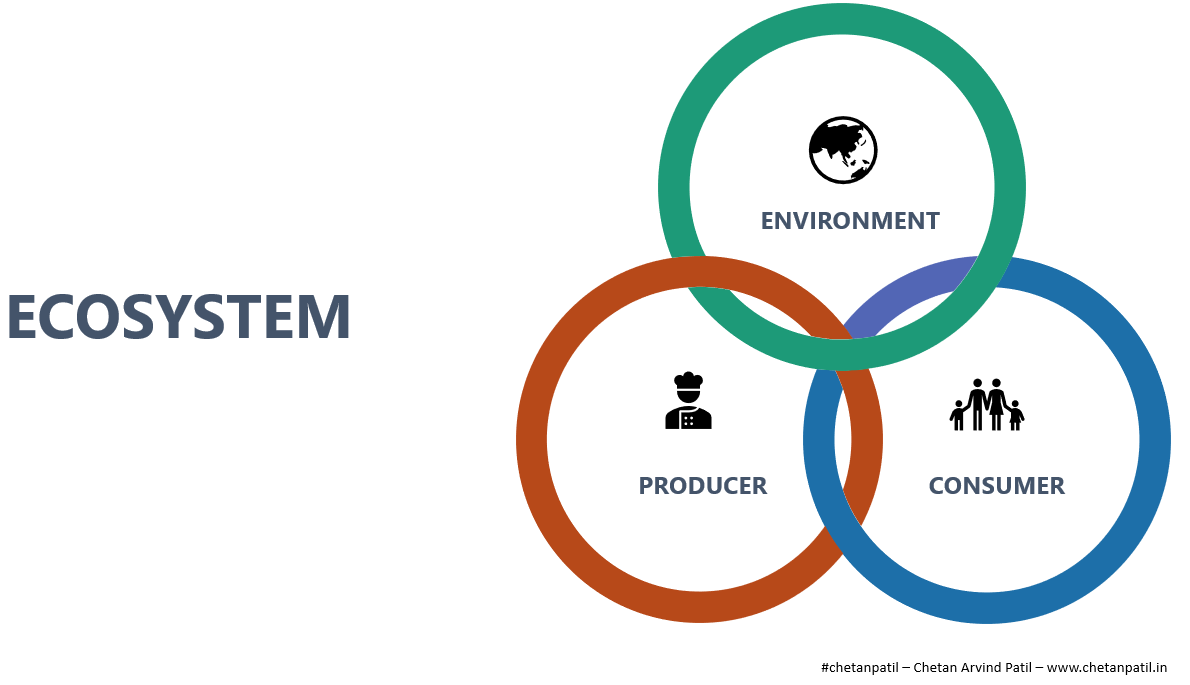
    An ecosystem requires synchronized interaction of a Producer, Environment, and a Consumer. The inter-dependency and synchronous working leads to a perfect ecosystem on which life survives.

    In the last few decades, the definition of the ecosystem has been applied to the technology world. Ecosystem development in different business segments has enabled innovations, which has in turn provided the world with new products and solutions.

    Picture By Chetan Arvind Patil

    In technology, an ecosystem is majorly reliant on the software and hardware systems. Due to the increased proliferation of internet users worldwide, the ecosystem has moved to the digital domain too.

    All the ecosystems in software, hardware, and digital domain have created different platforms for anyone with the right skills to develop elegant solutions. The connected world allows anyone to take advantage of the existing infrastructure to provide products and services directly to the intended consumer.

    However, the development of ecosystems has been limited to each of these three domains only and it is vital to understand how future modern platforms will look like.


    HARDWARE PLATFORMS

    The invention and innovation of transistors in the last half-century made possible the development of several unique hardware solutions that have taken computing to every corner of the world.

    The form factors of computing devices have changed a lot in the last two to three decades, largely due to the Moore’s law. Every year the world gets to witness incredibly compact and insanely fast computer systems.

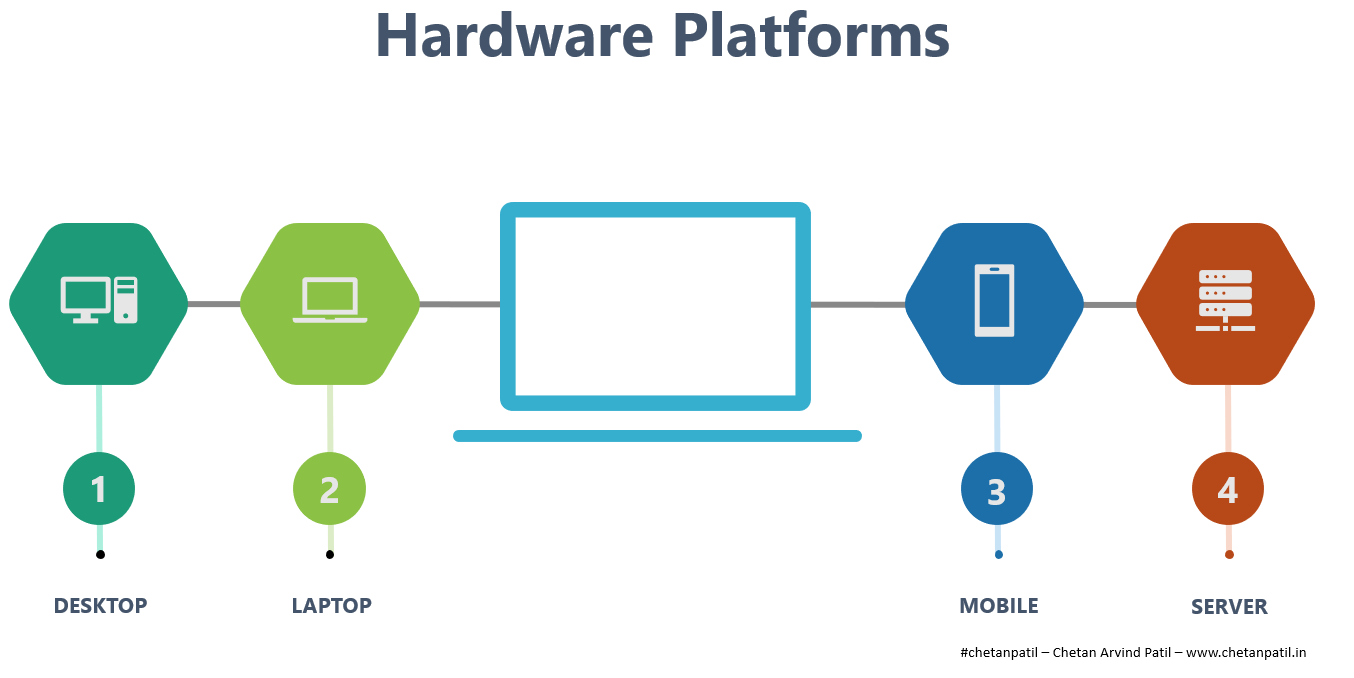
    The computers that were only supposed to be part of the research centers in the form of mainframe and servers, transformed into the smaller form factor of desktops in the 1980s and 1990s.

    The desktop allowed everyone to have their personal computers (PCs) at homes and offices. These PCs are capable of performing fast calculations, running high resolution videos and games apart from having ability to run applications that allow completion of numerous tasks in the shortest possible time.

    Picture By Chetan Arvind Patil

    In the late 1990s and early 2000s, portable laptops took over the world. Companies started innovating with advancement processors and graphics, and so were able to deliver content on the go. Businesses also became more mobile.

    Right after laptops, smartphones were launched in the early 2000s which allowed on the go connectivity. Smartphones connected the world at the click of a button. The form factor and battery life made it very easy to capture and consume information in real time.

    All these hardware devices have lead to the creation of hardware platforms that allow anyone to be connected and perform task remotely. The ecosystem of hardware platforms ensures that one can deploy ideas, software, and applications for consumers to use from anywhere on any hardware of their choice.

    The amazing innovative work being done by semiconductors, manufacturing, and assembly companies around the world is also the major reason for the existence of hardware platforms for everyone.

    With the improvement in connectivity, these hardware platforms have become the most critical part of the life. All the smart devices, computers, servers, sensors, and internet routers together drive hardware platforms, that are enabling innovation like never before.


    SOFTWARE PLATFORMS

    In parallel to the invention of hardware (transistors and electronics chips), one more innovative work was getting developed. It started with different types of programming languages and then moved to graphical user interface (GUI). A combination of both gave birth to the advanced softwares.

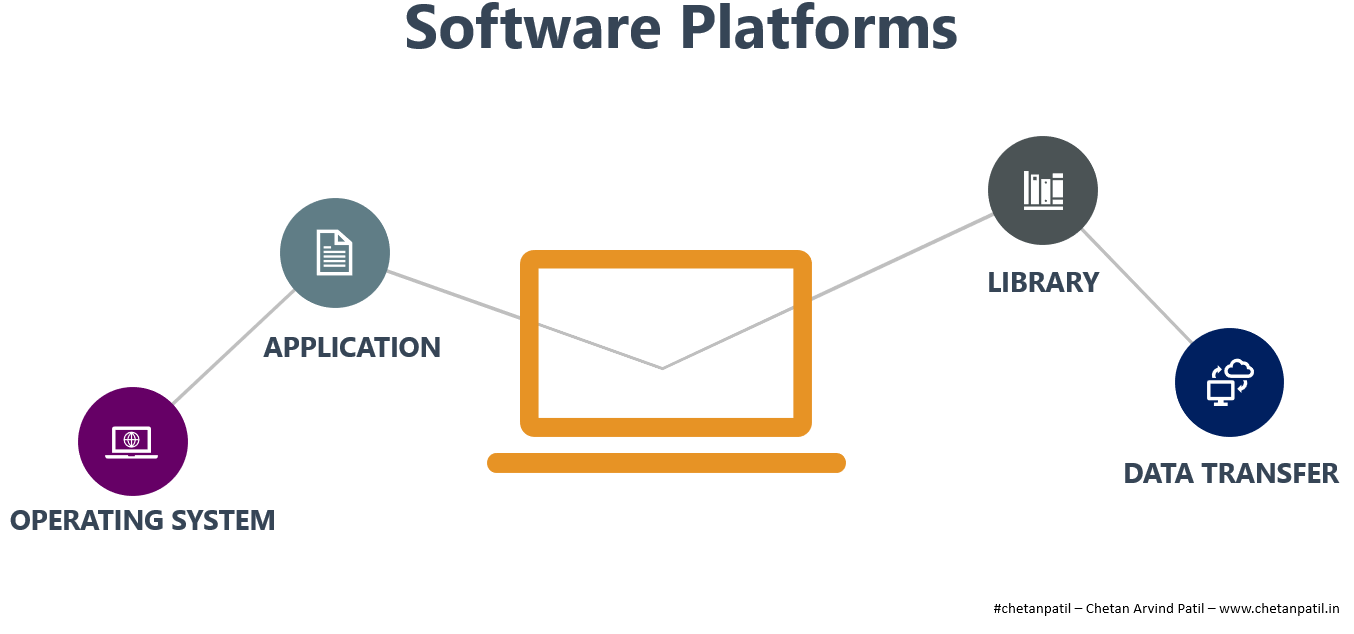
    Software took advantage of the computing capability of the hardware to provide solutions that allowed completion of tasks in hours, which otherwise would take days. Later on, with the introduction of operating systems, the hardware started to become more intuitive and smart.

    UNIX, LINUX, and Microsoft Windows played key role in ensuring that developers can contribute by deploying applications written for hardware systems.

    Picture By Chetan Arvind Patil

    Software innovation has also allowed access to the hardware internals with the help of drivers written using different libraries. With the synchronized working of the operating systems, libraries, and applications on top of a hardware platform enabled data transfer.

    In the pre-internet era, data transfer was largely limited to a floppy disk, hard drive, and a pen drive. However, post-internet era has been all about data packet transfer from one hardware to another with the help of secure software platforms.

    Software, which started a journey on mainframes as punch cards, now could run on the smallest possible hardware and sensors with minimal power consumption. This has lead to the creation of software platforms that allow the world to be digitally connected and is more real-time than ever.


    DIGITAL PLATFORMS

    Hardware and software have been in existence for many years. The last 40 years saw numerous innovations, form factors, and the true potential of these two computer systems. The computer solutions built with hardware and software combination helped building a nexus between people by providing enormous life-enriching smart solutions.

    Today, with the internet becoming part of everyone’s life, the opportunities for the next few decades are infinite. Already, modern services in 2020 are more data-driven which ensure that the right product is available at the right time for the right user.

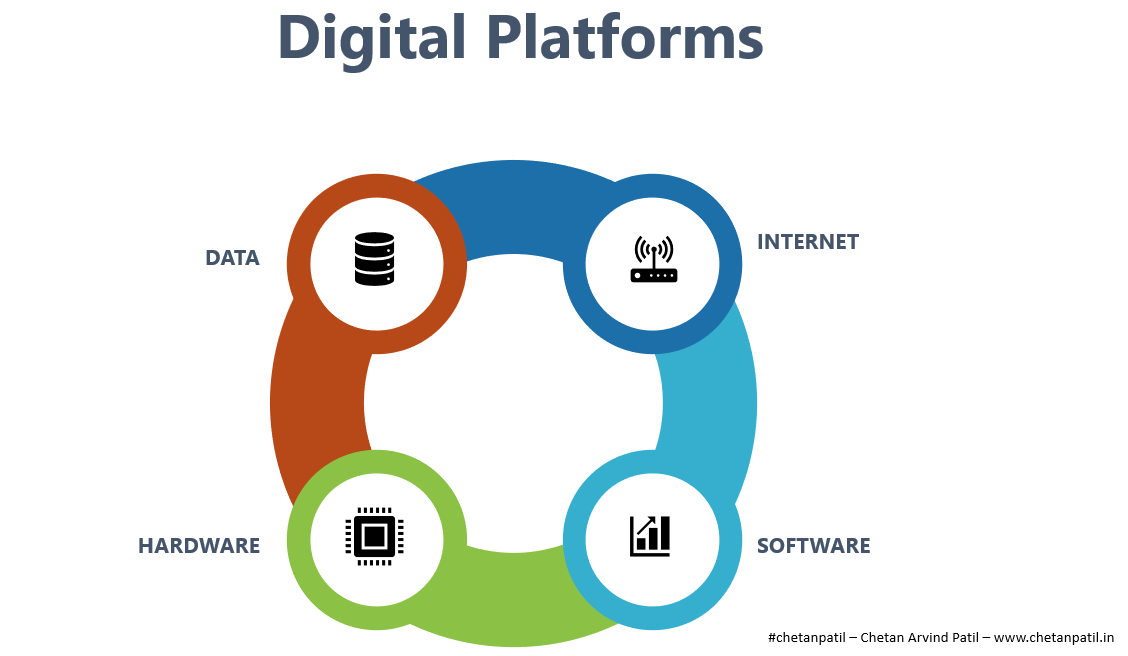
    The combination of hardwaresoftwaredata, and the internet has provided a new platform to the world, called digital platforms.

    Picture By Chetan Arvind Patil

    Digital platforms are built on top of the hardware and software, but it differs from hardware and software platforms due to the additional use of data and the internet to provide over the top product and services. With the help of the internet, products and services can be optimized and delivered remotely.

    The data points generated with the increased usage of the internet allows any business to adapt to the consumer’s needs by accessing demand based on data points from different consumer behavior.

    As the world moves towards more advanced wireless solutions, the innovative solutions on top of the digital platforms are only going to increase.


    TECHNOLOGY PLATFORMS

    In computer programming, the concept of Application Programming Interface (API) is so powerful that it gets overwhelming to realize the elegance of solutions it helps to implement.

    In short, API allows access to the services with the help of the software commands. For example, consider the payment gateway on an eCommerce website using a third party payment solution to process payments. With the help of API, the consumers can pay using different payment modes while the eCommerce website need not be worried about the processing and security of the payment details, as it relies on the secure API from by the third party.

    Similarly, there are other solutions in the market that are API driven.

    Picture By Chetan Arvind Patil

    The technology platform applied using API will play a crucial part in realizing the one world market,

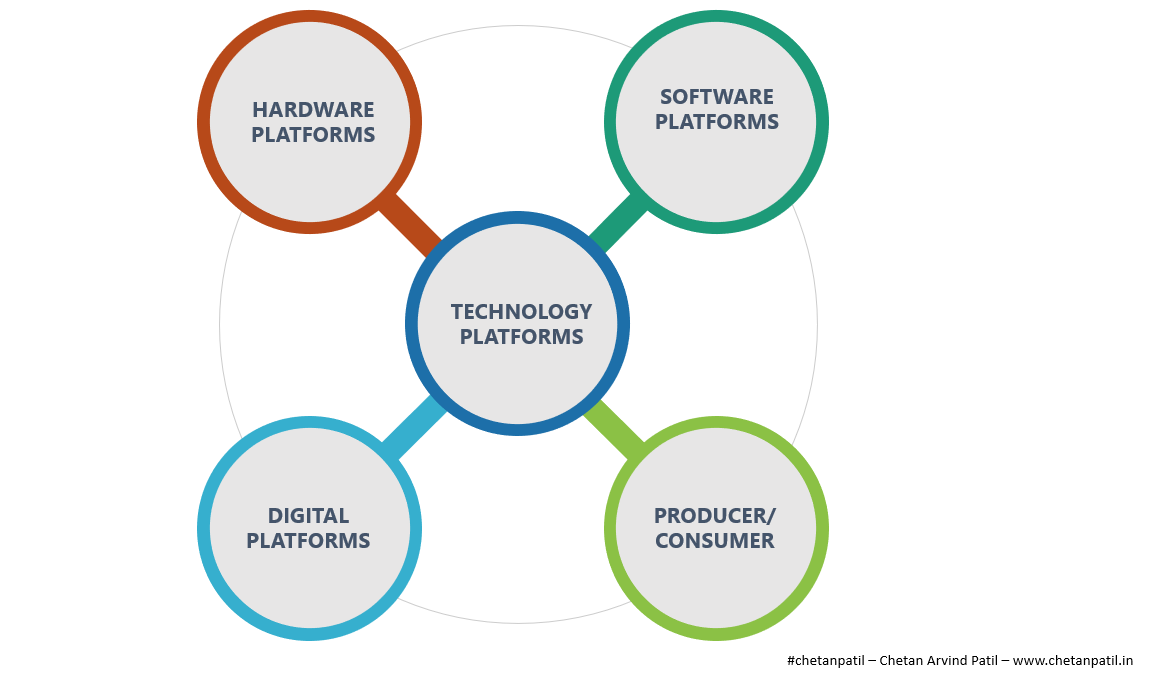
    Technology platforms are a combination of hardwaresoftware, and digital platforms with the added element of a producer and a consumer. It is an open platform that has consumers on board with producers who have become capable of selling products without investing capital in the underlying technology.

    Technology platforms also allow single or combination of other platforms to exists and thrive. The creators of the technology platforms themselves will not be able to make full use of it until and unless the platform itself is open to both the producer and consumer.

    One of the major drawbacks of technology platforms will be the amount of time and capital expenditure it will take to create. Not every company will be able to develop the technology platforms, and thus their number will be limited.


    It is fair to say that the technology platforms were already in the making for the last few decades. Today, these platforms are more relevant than ever. Mobile networks is one example of such platforms that allow hardware to digital platforms creation.

    It will be exciting to see how the next decade with the proliferation of high-speed wireless networks will drive the technology platform innovation.


  • The Wireless Charging World

    The Wireless Charging World

    Photo by Lucian Alexe on Unsplash

    The major reason smart devices, mainly smartphones, are immensely useful is due to the portability they provide with the help of the battery management system. This allows consumers to make use of the device without direct supply for an extended period.

    Even though every new smart device is more efficient compared to the last concerning the power consumption and battery life, there are still gaps on the battery technology innovation side that have not kept up with the growing software and hardware demand.

    To tackle this critical gap, the industry is moving from wired to wireless charging solutions as it provides charging wire-free and aims to make it ubiquitous. The solution has gained traction in the smartphone domain where charging points are increasingly being switched to wireless hotspots than wired.

    By 2030, Wireless Charging Will Be $50 Billion Market

    The concept of wireless electricity is not new and has been in existence since 1900s. The major gap has been in adoption in the areas where there is need to have wireless charging solution to ensure consumers and businesses never run out of power.

    With the popularity of electric vehicles, it will be quite interesting to see what type of innovative solutions come out to provide hassle-free charging.


    WHY WIRELESS CHARGING

    With the growing demand to perform day to day activity on the go also means the power required to run the smart devices should be available any time. Most of the devices that reside at one location like smart cameras, smart sensors, and so on, can be hooked directly to the power outlet to draw electricity 24x7x365. This does not apply to the devices that have to be used remotely like smartphones, laptops, or an electric car.

    Though these devices can get hooked to the power outlet, but do suffer from the fundamental issue of requiring a different set of adapter for each of the devices.

    How useful will it be if the source or the adapter is capable of adapting the current and voltage requirement of the device so that one adapter device fits all?

    Picture By Chetan Arvind Patil

    This will not only drastically decrease the need to have different types of charging points and devices, but will also make the system smart by providing always-on charging capability. This adds one more ease of use layer on top of what is currently provided by the smart devices concerning compute and connectivity.

    In the end, the demand to use smart portable devices and solutions will not go down. The form factor may change, but the need will always be there. It is about time that the way these smart devices get powered also becomes smart, and wireless charging is the way to do it.


    IMPACT OF WIRELESS CHARGING

    Imaging a scenario where you have four different types of smart devices to charge, with each using different power adapter, and on top of this, there is only one power outlet to use. What do you do? The simple answer is charge as per the priority of the device that needs to be active for a critical task. Is this a smart way to charge smart devices in a smart world?

    Wireless Charging Is Not About Smart Devices But About Smart World

    If the answer is no, then certainly the way to power these devices should change. This can be with the use of Quick Charge technology, but it requires that the device is equipped with a specific System on Chip (SoC).

    Another important factor is that charging in the future will not be limited to consumer electronic smart devices only. The definition is going to extend to automotive and all the connected systems that will go wireless.

    The impact of wireless charging is huge not only from the market demand point of view but also on how much good change and impact it will have on the usage.

    Wireless charging will extend the life of using the device and will ensure that the smart systems never run out of the power. These always-on systems will make use of a smart sleeping mechanism to provide savings to businesses, industries, and consumers.

    Picture By Chetan Arvind Patil

    Wireless charging will drive innovation by introducing solutions that are built on top of next-gen connectivity standard. The portability wireless charging will add will also ensure standardization by eliminating the need to have different types of adapters, cables, and power outlets.

    The opportunity and solutions around wireless charging are also going to drive faster adoption of an electric vehicle by providing more mileage without worrying about the stoppage to charge the car as roads and the nearby system itself can provide wireless charging solutions.

    The wireless charging system by default is COVID-19 compliant.


    WIRELESS CHARGING INNOVATION

    The innovation around wireless charging is going to be the key factor in faster adoption. There are already many interesting ideas that are out in the market that showcase the power of wireless charging.

    AiraPower’s FreePower technology shows how customized solution that provides multi-device wireless charging is going to change the day to day charging points at home, automotive, and business zones.

    Energous also showcases different possible ways wireless charging is going to be part of the daily life. It provides a unique approach to how the smart devices can draw energy wirelessly the moment the battery level goes down a specific threshold.

    Semiconductor companies have already started to provide solutions that can be deployed around the city to enable the charging of electric vehicles an enjoyable and more innovative. The current solution focuses on dedicated parking spots with wired cables that can be used by electric vehicles. Imagine parking the vehicle in a shopping mall and it charges using the wireless pads in the parking spot while one enjoys the shopping.

    All this leads to a true benefit when the electric vehicle cannot be refilled as fast as a fossil fuel-powered vehicle.

    These are a few of the many solutions out in the market. The next year or two more innovative and advanced approaches will show up with more smart devices starting to adopt wireless charging.


    FUTURE OF WIRELESS CHARGING

    It is important to understand the future of wireless charging. The current use cases are well defined, with more emphasis on smartphones than any other consumer electronics.

    Currently, the wireless solution is confined to specific locations like a couple of devices at home and in the workplace. Going forward, there are going to be three key areas which will see faster and exponential adoption this leading to the standardization of wireless charging solutions.

    These three domains are: automotive, home and work place.

    In automotive, the electric vehicles are going to adapt to the wireless charging more than any other solution. It will showcase the true potential of an inductive charging for high power devices like a motor car or a bus. China being one of the fastest-growing markets will lead the way in showcasing innovative approaches concerning wireless charging and electric vehicles.

    Picture By Chetan Arvind Patil

    For home, the solutions will move beyond smartphones to television and cooking appliances. The number of power outlets will decrease, and home buyers and renters will see how real estate will make use of wireless charging solutions to provide Over The Top (OTT) services. This may add cost to the buyers and renters, but will also see a balance by removing the need to have different types of power outlets and adapters.

    Workplace (including business and entertainment zones) will start adopting to the solutions whenever there is a gathering of employees or the number of visitors in a business zone is more than the number of power outlets. Such places will see more wireless charging stations that will not require cables and will only have pads that will act as charging points.


    This decade with advanced connectivity will demand always-on devices. This is going to push for the faster adoption of wireless charging. It will be interesting to see what other innovative use cases of wireless charging come up as adoption grows.


  • Technology Is Building Smart Spaces

    Technology Is Building Smart Spaces

    Photo by Peerapon Chantharainthron on Unsplash

    When smart systems are deployed at every location, it leads to the creation of Smart Spaces. These Smart Spaces can be a residential area, a business zone, an educational institute, or a parking lot. As long as, day to day activities are tracked by the use of the technological solution to enable faster decision making a place qualifies as Smart Spaces.

    Over the last decade, the affordability of smart devices and smartphones have to lead to an exponential increase in the deployment and adoption of such places. The reason is the information from smart devices provided with help of sensors can be accessed in real-time. Which can then be used for important decision making.

    It is critical to understand different sub-zones within the Smart Spaces along with its impact, innovation, and the future.


    SMART SPACES

    Smart Spaces mainly comprises of six major components: Smart Security, Smart Maintenance, Smart Energy, Smart Utilities, Smart Connectivity, and Smart Parking.

    Smart Places by default have Smart Security. Smart Security is built on top of an efficient hardware capable of running advanced motion detection along with real-time notification software. These devices are capable of ensuring the area covered is secure and also the incident reports are available to the public. It is also one of the domains that have recently attracted the attention of big technology giants. Amazon a few years ago acquired Ring and recently Google even after acquiring Nest invested in ADT.

    The next important piece of Smart Spaces is Smart Parking. Many companies are engaging with local city authorities in order to make parking decisions easy for the public. It involves tracking of spots that are available for parking along with pre-booking to ensure that anyone can pre-plan the visit and be free from the decision about where to park the car. Smart Parking can be a standalone software-based solution by tracking the entry and exit at specific location. However, many of the Smart Parking solutions are also based on the sensors thus requiring a lot of hardware deployment.

    Smart Energy is critical too. Without proper utilization of the energy that minimizes the impact on the environment, a Smart Space will for sure not qualify as one. Smart Energy is built with a net-zero impact. In order to achieve this the source of energy has to be environment friendly. Solar or wind energy is usually the main source of energy supply to the Smart Spaces. Smart Energy is also enabled by deploying heating/cooling solution such that same single source can be used by specific area or citywide population. It can be a centralized water-based cooling like Phoenix Downtown has. Smart Energy is also about tracking utilization in real-time for adaptive decision making.

    Picture By Chetan Arvind Patil

    Smart Utilities are another aspect of Smart Spaces. It ensures that gas and water supply are available all the time by ensuring efficient usage. Numerous data points are collected to allow for timely delivery of these resources. Such data points allow families and businesses to understand the real use versus waste. By capturing such details, the city authorities can also come up with adaptive and smart incentives for residents.

    Smart Maintenance is all about predicting when a specific location or service is going to see a downtime and in advance how to act on it. This is done with the help of data tracking that provides life and aging details of the components deployed across the Smart Spaces. This can range from sensors in the water supply system to building structure maintenance to electric sub stations. Smart Maintenance also ensures that human resources are used wisely and in a timely manner.

    The last and critical piece of Smart Spaces is Smart Connectivity. Without access to the high-speed networks from the internet to a cellular connection, it is difficult to make any solution to work in a Smart Space. Data generated out of the different aspects of Smart Spaces requires connected systems that can work only if always-on connectivity is provided. The decision making for other critical zones within the Smart Spaces is also relying on connectivity. With the deployment of 5G and smart Wi-Fi 6, Smart Connectivity is going to see much more innovative use than in the last decade.


    SMART IMPACT

    Deployment of Smart Spaces across cities and countries is only possible on a large scale if the impact of such Smart Spaces is understood. There are many benefits to having Smart Spaces, but the critical Smart Impact are savings, opportunities, complexity, dependency, and ease of use. These impact are combination of the good and the bad.

    Savings is the most important reason for making any space a smart one. The real-time usage of securing the place helps in long term planning with eventually leads to savings not only for the residents but also for the businesses. It can be understanding what services work and don’t work, thus making a decision to switch or do away with such service. Maybe it can be about understanding what room temperature works for one by utilizing sensors such that the temperature of the cooling system can be adaptive accordingly. Scaling these savings at larges scale eventually leads to savings of resources.

    Immense opportunities are created by Smart Spaces. From employment to small business to large scale industries. Smart Spaces deployment ensures that different new opportunities from regular maintenance to data to security analysts are available for better decision making. Thus opening up new skill-based employment. It also ensures that the business providing smart solutions are able to create a supply chain that drives other business.

    Picture By Chetan Arvind Patil

    All this leads to ease of living life. Ensuring that not only the spaces are safe but are also smart based on data generation. It allows efficient utilization of resources that improves day to day life activity and thus provide ease by which goals can be achieved.

    One of the biggest drawbacks of Smart Spaces is dependency. The more the smart systems are deployed, the more dependent the people and businesses become. If one or two things go out of service, the day to day routine suffers. It also impacts decision making.

    The biggest challenge when deploying Smart Spaces is to ensure that all these Smart Impacts are in balance. Anyone thing that grows more than the other will lead to critical security to safety issues. This means Smart Spaces are very complex too due to inter-dependent systems.


    Always On Connected Sensors Taking Decision Will Run Smart Spaces


    SMART INNOVATION

    Necessity is the mother of invention. It is correctly applied by any industry that is fighting to survive the market competition.

    For the software businesses, it is important to ensure that there are always new and better programming environments along with the tools to develop advanced and smarter software systems. This also means new business opportunities by showcasing efficiency and cost gain over existing tools and solutions.

    The same is applicable for the hardware businesses by ensuring that there are new solutions available as the market demand grow and the need changes. These can be an efficient sensors that allow more savings over existing and previous generations. To ensure such a solution exists in the future, continuous research and development is required.

    Picture By Chetan Arvind Patil

    Smart Innovation around Smart Spaces is built on top of the savings that the existing system provides. This can be due to the data generated across the zones within the Smart Spaces that lead to deployment of cost efficient solutions. Which was in turn used at large scale by businesses. These savings can also be built on top of dynamic pricing which is applicable mostly for housing and real estate business but is also getting deployed for smart energy and utilities.

    A combination of data and dynamic pricing built on top of Smart Innovation by Smart Spaces will eventually lead to New Products and New Services.

    The more the savings, the better the future solutions from companies in the domain of software and hardware.


    SMART FUTURE

    Everyone talks about Smart Spaces, but what is the Smart Future going to be like?

    There can be different takes on how the Smart Spaces will evolve. It can be dependent on how the industry innovates to keep up with the growing demand for the smart solutions. It will also depend on cities’ and citizens’ comfort to adapt to a fast-changing smart environment.

    In short, there are four key aspects of how the Smart Future of Smart Spaces is dependent.

    Picture By Chetan Arvind Patil

    The first is being connected. It ensures that the information generated from the Smart Spaces is always available. These connected systems will run on top of the sensors. It is already deployed across many cities and real estate. However, unless and until everyone in such location is able to utilize to full extent, it will be difficult to ensure that the connected sensors are efficiently used. Thus the second requirement of a smart future is sensors. The third critical piece is always on. Without which it is not useful to deploy connected sensors. The last part is the decision. If these always-on connected sensors cannot make a decision with or without human input, then it is a waste of money and time.

    Opportunities and possibilities are numerous. All technological solutions certainly improve life as long as the users are able to afford the same. Only time will show how Smart Spaces will evolve, but are certainly going to be everywhere.


  • One Breakthrough Technology That Is Must For Work From Anywhere Workplace

    One Breakthrough Technology That Is Must For Work From Anywhere Workplace

    Photo by Andrea Caramello on Unsplash

    Work From Anywhere Workplace is becoming the standard mode of working. Many of the top companies have started providing Work From Anywhere Workplace as an option to the employees. According to the survey by Buffer, 98% of the respondents will prefer remote working if given an option.

    Many software and hardware tools are required to ensure that Work From Anywhere Workplace experience is as good as Work From Office. These resources and tools are only valid when the nature of the job enables employees to work remotely. Unfortunately, not all jobs fall into this category.

    Even though there are so many resources available for Work From Anywhere Workplace, there are still gaps needed to be filled.


    THE TOOLS

    To work efficiently from anywhere, one needs a set of correct tools. These tools increase productivity.

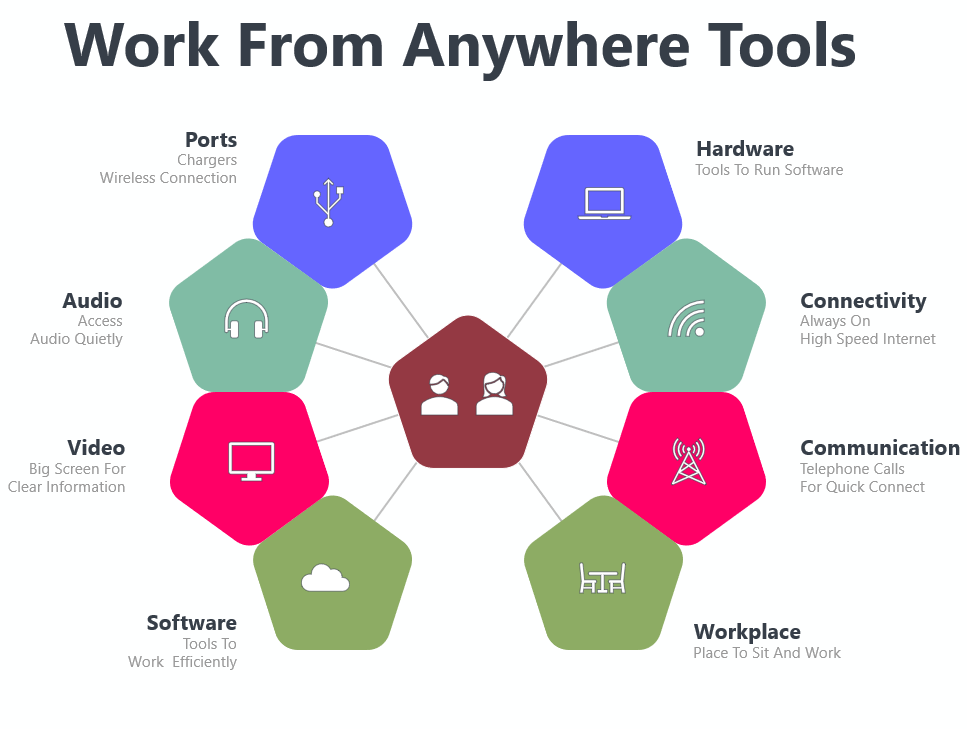
    Any person working in the technology-enabled domain has to have the basic tools like hardware that establishes connectivity to the external remote work. This hardware tool runs the software. Depending on the need and nature of the work, this can be a smartphone, a tablet, a desktop, a laptop, or an ultra-book.

    To make use of hardware, seamless connectivity is required. Always-on high-speed internet networks are so crucial that without it none of the tools running on top of the hardware can be utilized fully. High-speed connectivity is defacto but still suffers from issues of downtime and intermittent slowness.

    Connectivity also comes in the form of ensuring enough ports are available from the power outlets to multiple USB and HDMI outlets via a docking systems.

    Picture By Chetan Arvind Patil

    Communication is a key aspect of Work From Anywhere Workplace. It requires a reliable cell network for tasks that demand urgent inputs from the team. Many use VoIP tools nowadays, but the fact that calling and asking for solutions establishes resolves issues quickly.

    Audio and Video are key tools to Work From Anywhere Workplace. Getting up from the cubicle and walking to the colleague for help is not possible in remote work. The only way to efficiently hold project presentations and important work calls are by using audio and video compatible tools.

    All these tools discussed above are good to work efficiently from anywhere. Workplace need not be just home but can be any place like an outdoor place, co-working area, or even a coffee shop.

    If all the tools that are required for remote working are available then what is the missing link?


    THE NEED

    A quiet place to work is everyone’s dream setup. No interference mainly from the surrounding noise is key to working efficiently. To eliminate any type of noise, many have started using noise cancellation headphones. These work perfectly and do the job of eliminating noise but are often costly to afford and not everyone is willing to pay the high premium cost. On top, not everyone likes to keep headphones on all the time.

    Another solution to a focused workplace remotely is to have a dedicated room that can allow focused working. However, finding a quiet place in a home environment with family members is not an easy task. If the employee is working from a public places then too it is difficult to find a quiet corner.

    Picture By Chetan Arvind Patil

    Apart from noise, there is a privacy concern too. What you hear can be routed through headphones/earphones/speakers, but then when one speaks over the work call, then it is not possible to cancel the outgoing noise. In Work From Anywhere Workplace environment, one can be working next to anyone, thus inviting privacy concerns when sensitive work information is discussed.

    If we take a holistic look, then there are different types of sounds that a person working in an remote working environment has to deal with. These ambient sounds can be from nearby houses or roads, or from people in close proximity. All this leads to audio privacy concerns.

    This audio privacy concern is the missing link from calling a Work From Anywhere Workplace a perfect workplace environment. The question is how to ensure audio privacy with the help of Audio Privacy Technology.


    THE SOLUTION

    Audio Privacy Technology solution involves eliminating noise/sound without the need for a dedicated headphones/earphones. Even if one uses headphones/earphones, then these devices are only capable of eliminating ambient noise but do not ensure that the output audio from the employee is only heard by the employer and the team, and no one else.

    A perfect Audio Privacy Technology will ensure that without using any device and by only having the workstation, one is able to create different focused Work From Anywhere Workplace Zone.

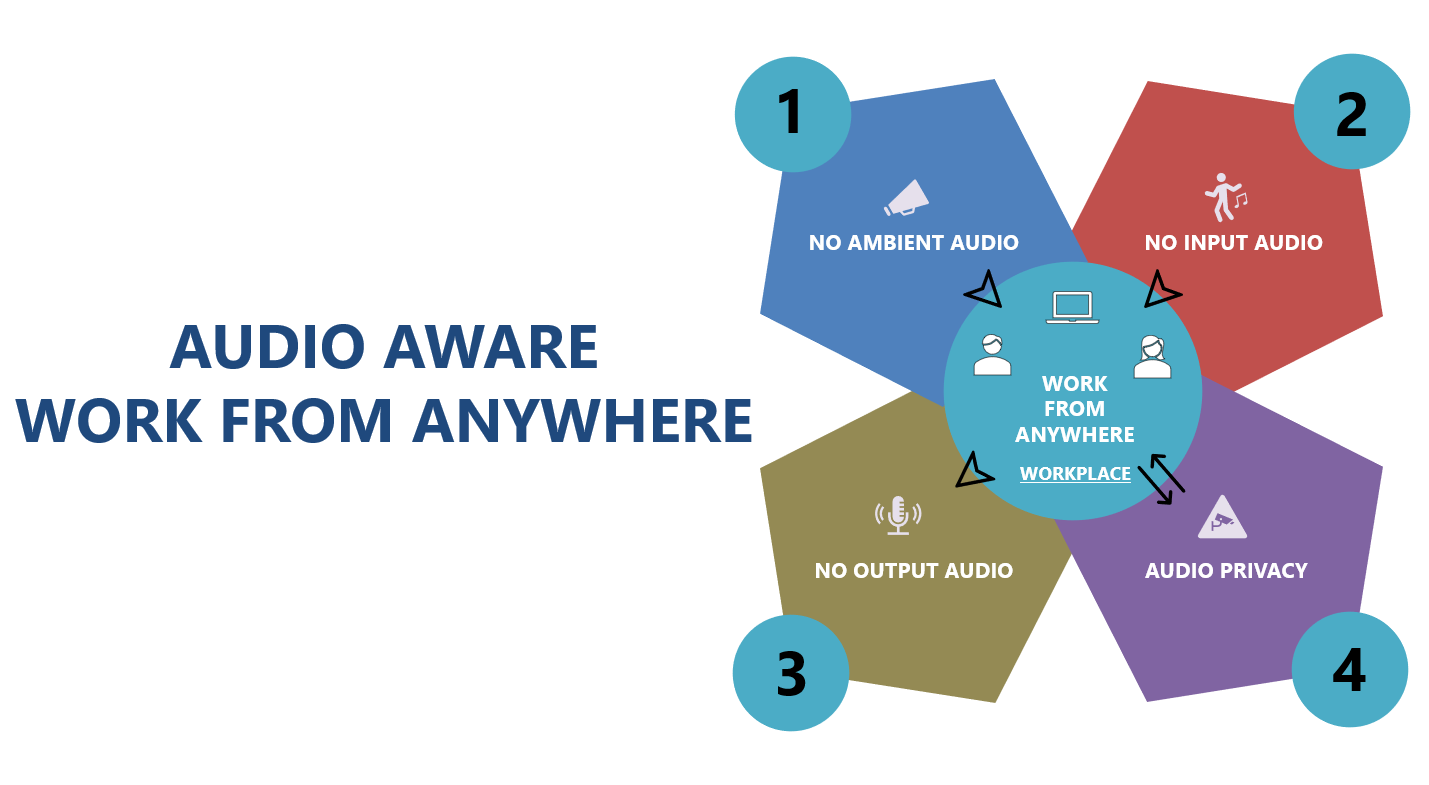
    These focused sound zones work in harmony with the nearby environment to ensure that none of the ambient sounds sneak into Work From Anywhere Workplace Zone. It also ensures that the sound generated from the Work From Anywhere Workplace Zone does not disperse.

    These two features working in synchronization ensure that there is bi-directional audio privacy.

    Picture By Chetan Arvind Patil

    Audio Privacy Technology is audio aware. It provides breakthrough solutions that can not only be used for Work From Anywhere Workplace but can also be applied in different zones like in cars, public areas, airports, flights, and many more places where audio privacy is non-existent.

    Another impact of Audio Privacy Technology is the elimination of headphones/earphones. With the decreasing number of ports in laptops to smartphones, wireless devices are the only solution. With wireless, the solution is not an issue but the degrading battery power when working remotely for longer hours is.

    Thus, having a chip-based feature that is embedded inside the smart devices which is capable of creating audio zones is the need of the hour. This will also make headphones/earphones obsolete. On top of it, not everyone likes to be wired all the time, and having bi-directional audio privacy without the need for headphones/earphones can make people more productive.


    THE BREAKTHROUGH

    There are already Audio Privacy Technology solutions in the market. The key is to make it accessible at large scale. Like the elimination of audio jack lead to the adoption of wireless headphones/earphones. Similarly, one-day electronic chips embedded in the smart devices will remove the need of having headphones/earphones. One less device to carry as embedded chip with Audio Privacy Technology will ensure more privacy and noise cancellation than any other solution currently in use.

    Noveto Systems already have the 

    SeatCentric by Bose already has Audio Privacy Technology. It will be interesting to see how soon they can release products that can be used by employees Working From Anywhere Workplace.

    Video By Bose

    Hyundai also has the Audio Privacy Technology ready, and “>certainly, it looks promising.

    Samsung owned HARMAN also showcased a similar solution back in 2015 CES.


    It will be interesting to see how the future of Work From Anywhere Workplace evolves with Audio Privacy Technology. This breakthrough technology will not only help audiophiles but can literally make headphones and earphones obsolete while ensuring that anyone can work remotely at any given location by soundproofing the work zone.

    Audio Privacy Technology can also be applied in Work From Office environment where one doesn’t like to listen to colleagues speaking loudly, or the noise from table fan used by someone next to the work cube.

    There will be concerns about not being able to hear emergency information from nearby surroundings, but then the same applies when someone is wired in with noise cancellation headphones. Surely, there will be options and features to enable emergency information to sneak in.

    Only time will tell how the solution will evolve, but certainly Audio Privacy Technology breakthrough is must for Work From Anywhere Workplace.


  • Smart Speakers With Smart Processors

    Smart Speakers With Smart Processors

    Photo by Paul Esch-Laurent on Unsplash

    Hardware plays crucial role in product success as much as software does. Smart speakers are getting lot of traction and every big tech giant with smart assistant is fighting to get hold of this market share. Part of the reason is to get the services delivered using a different medium, however major goal is to get hold of the data that can be used to make algorithms better to provide much personalized services.

    Amazon Echo was one of the first devices to bring smart speaker solution. It kick started race and Big-5 (Apple, Amazon, Google, Microsoft and Samsung) started gearing up to get similar solution out. Amazon never had success in smartphone business, but it got good traction in smart speaker domain due to seamless connectivity to the e-commerce, video and music database it created over two decades. On other hand, other four of the Big-5 have strong hold on smartphone domain and they rely on it as a device that provides smart assistive services. Due to the potential business opportunity, rest of the Big-5 have also launched (some in process) similar hardware solution. Hence, I decided to take a quick look at what type of processors each of the devices from Big-5 is using with help from iFixit.

    Echo By Amazon

    Amazon Echo uses Texas Instrument’s DM3725CUS100 Digital Media Processor (marked in red), which provides a reliable low power ARM processor solution. It is a single core which I think is good enough for such domain specific device. Also many of the functionality used by Echo is voice based so it also helps to have a DSP.

    (Image by iFixit)

    Home By Google

    Google Home comes with Marvell 88DE3006 Armada 1500 Mini Plus (marked in red), which is a dual core ARM. As per iFixit it’s similar processor used in Google’s Chromecast device. This make sense as it is cheaper to port similar solution in another form factor as long as it does provides the solution required.

    (Image by iFixit)

    HomePod by Apple

    Apple recently announced HomePod smart speaker. As is the case with every Apple device this, it uses home designed solution Apple A8 APL1011 SoC. Similar to Google it’s re-used from other smart devices from Apple.

    (Image by iFixit)

    Harman Kardon INVOKE by Microsoft

    Microsoft hasn’t designed the hardware for INVOKE smart speaker by Harman Kardon, but they have powered it up using the Cortana virtual assistant. iFixit hasn’t done a tear down on it, so I will skip details on this device. I expect it to run ARM only, what else?

    Galaxy Home By Samsung

    The last on the list is Galaxy Home. It’s not out in the market yet, but Samsung has announced Exynos processors for smart speakers which they are hoping will not only be used by them but also by other companies in smart speaker domain.

    Conclusion

    At the end the form factor changes, but the processors inside them remains similar to smartphones. It will be good to see how the hardware aspect of smart speakers change as newer versions of new products mainly HomePod, INVOKE and Galaxy Home are launched.

    Samsung and Apple do have an advantage as they can use in house hardware design capabilities to make system more efficient and reliable. On other hand Google, Microsoft and Amazon have advantage on software side due to the huge data they have. It will all come doing to who uses the best of both software and hardware world for such a domain specific device.

    I am also expecting all the music hardware giants like Bose, JBL and Plantronics to follow smart speaker/device trend which eventually plays in hands of processor companies like TI, Marvell and Samsung.

  • Hardware Is Running The World

    Hardware Is Running The World

    Photo by Fancycrave on Unsplash

    In 2011, Marc Andreessen wrote widely read article Why Software Is Eating The WorldLast few years saw similar trend to what he projected, but 2016 was special and showed a new trend which not many would have expected in the year 2011.

    Year 2016: Hardware is running the world.

    Hardware has always acted like a catalyst in the world of technology, where many things are done with click of button. Eventually, to process all this information and get user what he she needs, one has to have excellent set of hardware tools, right from WiFi chip, to CPU, to routers, to powerful servers. As it has happened every year since 1971, 2016 too quietly kept introducing hardware oriented products with epic performance and perfect solutions.

    Marc in his article emphasized how technology giants like Google, Amazon and others are writing zillions of code to make everyday decisions in one’s life. Which to some extent is true, but can’t be done without the help of hardware that can process all these zillions of code.

    My goal in this blog post is to emphasize the hardware developments and products that came from same technology giants (and many others) who were mainly focused on software are now moving ahead with software is eating the world and hardware is running it motto.

    Personal Mobile Devices:

    This is the most active domain out of all in computer hardware, and 2016 again showed growing importance of having good hardware for the best OS and applications. Google introduced Pixel smartphones out of the frustration of not having good say in designing hardware and deep integration of its AI services. A smartphone designed by Google allows it to make use of the all the features beneath the architecture which otherwise would have been difficult, and it also shows other Android vendors on how to make best use of Android’s ecosystem by designing something that’s minimal yet so powerful.

    It won’t be wrong to say that Apple literally owns this domain because of deep amalgamation of hardware and software. iPhone saw another version, but what caught everyone’s attention were these tiny little Apple Airpods. It is being said, that Apple’s future products will be inspired from Airpods, because they may allow Apple to have control over on the go virtual reality (VR), a promising and upcoming domain.

    Of all the mobile hardware advancements, something very unexpected happened, Samsung’s Note 7 exploded and raised a very important question on brutal and fast product development to outperform competitors at the cost of user safety. Even after this, mobile hardware development kept pace with market demand, and also saw ARM, leader in mobile processor IP, being acquired by SoftBank. Even Lenovo realized that it can’t produce the best hardware and acquired Motorola, which has wide variety of hardware running Android.

    Overall, 2016 saw growing importance of mobile hardware, which will help software developers in writing applications that can help users to be more productive. In 2017, I think Microsoft with Windows 10 and Google to Samsung with Android OS will show importance of great hardware for great software.

    Desktops:

    Ever since smartphones got traction, desktop is something which everyone keeps writing off, but there are section of people who do want it to survive, even I do, and so does Microsoft. Microsoft’s Surface Studio was what desktop community needed, it showed how designing hardware which is not only powerful, but attractive to use can revive desktop sales. This has got other companies like HP and Dell, who have strong presence in desktop market, pumped up as Microsoft’s major goal is to not be a hardware vendor, but to show other hardware vendors how designing hardware differently can make bring best out of the Windows 10 ecosystem.

    To keep pace with growing software and improved Windows version, Intel throughout the year 2016 kept introducing powerful and efficient CPUs. This perfect development in desktop domain has forced even Apple to rethink about iMacs, and this only means better days for desktop and macOS users. And with Windows 10 finding home in ARM, 2017 is going to be a roller coaster for both hardware development and the race of which chip will run the OS.

    Servers:

    Cloud computing requires the most powerful and efficient processors, and often giants like Google, Microsoft and Facebook have complained about the lack of push by Intel, the leader in this domain. To get the best out of the server grade processors, all software giants decided to take matters in hand, and created teams that work specifically on CPUs for servers with AI and deep learning mechanisms embedded for better efficiency.

    Even Nvidia took the lead and showed the future of chip for AI. On other-hand, IBM showed the importance of domain specific chips for deep learning. And, Amazon acknowledging the need for programmable hardware for its cloud customers. Again emphasizing the importance of hardware in the software eating world.

    Embedded Devices:

    Embedded domain is very different from mobile devices, these are those smart products which are resting quietly somewhere in your office or home, and are waiting of your input to get into action.

    Amazon’s Echo, Google’s Home, Microsoft’s HoloLens and Dial all showed how future hardware may look like. Off course, these are powered by very smart software, but also showed importance of designing products differently. VR is going to see more action with hardware products coming from Oculus, Samsung, Google and may be even Apple?

    What to look for in 2017:

    One thing is pretty clear, that software needs a perfect hardware and it has taken 4 decades for both hardware-software to come together.

    Windows 10 is the best Windows version ever, Linux desktops are getting neat and stable, Android OS is more secure and defacto for mobile devices, IoT is getting its own software ecosystem and VR is finding way into people’s daily life. Intel, ARM, Qualcomm, Nvidia, Microtek are introducing the perfect hardware platform required for all different ecosystem and products to survive.

    Starting 2017, it’s not going to be all about software, vendors have to make best of both. Just having random hardware assembled at Shenzhen with Android installed on it is not going to last forever. Hardware development for smart devices will have to evolve and with stabilized software-hardware architecture, more futuristic products could be introduced.

    Ultrabook will be one domain that will get a major push along with more exciting smart hardware products from Google. Autonomous cars will crave for better self-driving hardware. VR may go mainstream with drones making deliveries. May be CES 2017 will have answers.