Category: INDIA

  • The Semiconductor Talent Demand In India

    Image Generated Using DALL-E


    India And Semiconductor

    India’s semiconductor industry is on the cusp of a significant transformation, driven by a huge demand for talent and rapid technological advancements. With 2.55 million STEM graduates yearly, India ranks second globally in producing Science, Technology, Engineering, and Mathematics graduates.

    As the world increasingly relies on semiconductors for everything from smartphones to electric vehicles, India’s role as a key player in this global ecosystem becomes increasingly critical.

    Thus, exploring the multifaceted dynamics of the demand for semiconductor talent in India is essential, shedding light on the historical context, current landscape, and the factors fueling this demand.

    Semiconductor Background In India

    India’s journey in the semiconductor industry began in the late 20th century, marked by the establishment of key research institutions and the advent of multinational semiconductor companies setting up operations in the country. Initially, India’s role was primarily confined to software services and design, leveraging its strong IT industry.

    Over the years, however, the landscape has evolved. Government initiatives, such as the Make in India campaign and semiconductor fabrication labs’ establishment have been pivotal in fostering a more comprehensive semiconductor ecosystem. Today, India is a hub for semiconductor design and makes strides in manufacturing and research, positioning itself as a critical player in the global supply chain.

    STEM Graduates In India

    India is a powerhouse in STEM education, with more than 2.55 million graduates yearly, second only to China. This significant pool of STEM talent positions India as a crucial player in the global semiconductor industry. The abundance of skilled graduates from Indian universities ensures a steady supply of engineers, researchers, and technicians to fuel the semiconductor sector’s growth.

    India’s prominence in STEM education underpins its potential to address the global semiconductor talent shortage. As the industry evolves with advancements in AI, the demand for highly specialized knowledge and skills increases. Indian STEM graduates, equipped with strong technical backgrounds, are thus well-suited to meet these needs, driving innovation and efficiency in semiconductor design and manufacturing.


    Image Credit: CSET

    Moreover, India’s educational institutions and government initiatives foster an environment conducive to technological advancements. Partnerships between academia and industry, alongside government incentives, are crucial in enhancing the skill sets of Indian STEM graduates, making them even more valuable to the semiconductor industry.

    In the near-term, India’s substantial number of STEM graduates will play a pivotal role in the semiconductor sector. Leveraging this talent pool can significantly impact global semiconductor supply chains, ensuring sustained innovation and competitiveness in this critical field.

    Factors Driving Semiconductor Growth In India

    Understanding the factors driving the demand for semiconductor talent in India is crucial to appreciating the industry’s growth dynamics. Government initiatives, which are significant, market growth, which is promising, technological advancements, and the push for self-reliance are all playing pivotal roles in shaping this demand.

    These elements collectively create a fertile ground for the semiconductor sector to flourish, necessitating a diverse and skilled workforce.

    FactorDescription
    Government InitiativesPolicies such as the Production Linked Incentive (PLI) scheme and Electronics Manufacturing Clusters (EMC) scheme aim to attract investments and boost local production capabilities, fostering a conducive environment for semiconductor companies.
    Market GrowthThe global semiconductor market is expanding due to the proliferation of digital technologies like AI. This growth increases the demand for skilled professionals to design and manufacture semiconductors.
    Technological AdvancementsEmerging technologies require advanced semiconductor solutions, driving the need for highly skilled workers. Indian educational institutions are focusing on these technologies, producing graduates equipped to meet industry needs.
    Self-RelianceEfforts to reduce dependency on foreign semiconductor imports and enhance local capabilities drive demand for skilled talent. Initiatives to promote domestic semiconductor manufacturing and design are crucial in achieving self-reliance.

    Picture By Chetan Arvind Patil

    Areas Of Semiconductor Talent Demand

    Understanding the areas where talent demand is most pronounced in the semiconductor industry is paramount. By delving into the various domains – design, manufacturing, and RnD – one can pinpoint the skills and expertise in high demand.

    This detailed examination will highlight the critical roles and opportunities available, shedding light on how India’s educational institutions and industry partnerships prepare to meet these demands.

    SectionDetails
    Areas Of Talent DemandDesign: Demand for roles such as design engineers, verification engineers, and system architects has surged, driven by AI and computing advancements.
    Manufacturing: Rising demand for process engineers, equipment engineers, and technicians due to government initiatives and new fab setups.
    RnD: High demand for materials science, quantum computing, and nanotechnology researchers to drive innovation.
    Education And Skill DevelopmentEducational Institutions: Premier institutions like IITs, NITs, and leading universities offer specialized electronics and engineering programs.
    Skill Gaps: Additional training in VLSI design, semiconductor fabrication, and advanced materials science is needed.
    Industry-Academia Collaboration: These partnerships, fostering sponsored research, internships, and workshops, are key to aligning academic programs with the dynamic needs of the industry, leading to a more skilled workforce.
    ChallengesBrain Drain: The migration of skilled professionals abroad for better opportunities; the need to create attractive work environments in India.
    Infrastructure: There is a need for substantial investment in advanced machinery and facilities for semiconductor fabs and research labs.
    Retention: Competitive salaries, a positive work culture, continuous learning, and clear career progression are essential to retain talent.
    Opportunities And Future OutlookStartups and Innovation: Emergence of startups focusing on AI, IoT, and specialized semiconductor applications, supported by government initiatives.
    Global Competitiveness: The industry’s strength lies in its ability to leverage highly skilled professionals, a robust education infrastructure, and unwavering government support, all of which are propelling it towards becoming a semiconductor global leader.
    Long-term Strategies: The industry is committed to a path of continuous investment in education, infrastructure, and industry collaboration, bolstered by policies that foster innovation and ease of doing business.

    Take Away

    For sure, India is pivotal in the global semiconductor industry, driven by a robust educational infrastructure, supportive government policies, and a market demand. The nation’s significant pool of STEM graduates positions it to meet the growing global and domestic demand for semiconductor talent. However, challenges such as brain drain, infrastructure limitations, and retention issues must be addressed to fully capitalize on this potential.

    By fostering solid collaborations between industry and academia, investing in advanced training programs, and creating a conducive work environment, India can bridge the existing skill gaps and enhance its competitiveness on the global stage. The rise of startups and innovation hubs, supported by government initiatives, further underscores the country’s potential to lead in semiconductor design, manufacturing, and RnD.

    Long-term strategies focusing on continuous investment in education, infrastructure, and policy support are essential to sustain and grow the semiconductor talent pool. As India navigates these challenges and opportunities, it is well-positioned to become a global powerhouse in the semiconductor industry, driving innovation and economic growth for years.


  • The Semiconductor Surge In India And The Impact On Other Industries

    Image Generated Using DALL-E


    Semiconductor And India

    In recent years, the semiconductor industry has emerged as a cornerstone of modern technology, underpinning advancements in everything from consumer electronics to automotive and healthcare systems. 

    India, recognizing the strategic importance of this sector, has embarked on a significant push to cultivate a robust semiconductor manufacturing base.

    This initiative is about augmenting India’s technological capabilities and securing its position in the global supply chain, which is crucial in a world where technological superiority increasingly dictates economic and strategic dominance. 

    As India accelerates its semiconductor production, understanding the broader impact of this on various domestic industries becomes essential, highlighting the interconnected nature of modern economies and the foundational role semiconductors play within them.

    Semiconductor Incentives And Focus

    The Indian government’s proactive measures, including substantial investments and favorable policies, are pivotal and reassuring in fostering a conducive environment for semiconductor growth. Initiatives such as the $10 billion PLI (Production-Linked Incentive) scheme aim to attract global semiconductor players and build an indigenous ecosystem supporting advanced manufacturing techniques.

    This strategic development is crucial as global industries face recurrent supply chain disruptions, most notably during the COVID-19 pandemic. This underscored the vulnerability of heavy reliance on concentrated semiconductor production hubs like Taiwan and South Korea.

    By establishing local manufacturing capacities, India aims to mitigate these risks and set the stage for transformative effects across multiple sectors, from telecommunications and automotive to renewable energies and beyond.

    The ripple effects of enhancing semiconductor self-sufficiency are vast, warranting a thorough exploration of how this technological pivot reshapes India’s industrial landscape and its implications for future growth and innovation.


    Picture By Chetan Arvind Patil

    Semiconductor Impact On Other Relevant Industries In India

    India’s burgeoning semiconductor industry is poised to impact various sectors, profoundly catalyzing innovation and efficiency improvements. In the automotive industry, for instance, increased local chip production ensures a steady supply of essential components for intelligent vehicles, reducing production delays and fostering advancements in vehicle safety and connectivity.

    For consumer electronics, the growth of India’s semiconductor industry translates to faster production cycles and significant cost reductions. It allows manufacturers to offer competitive pricing in a price-sensitive market, reassuring the industry’s competitiveness. 

    The telecommunications sector benefits from enhanced capabilities in local chip production, which is crucial for supporting the expansive deployment of 5G technology and the development of robust communication networks. Additionally, renewable energy initiatives can leverage advancements in semiconductor technology to improve the efficiency and effectiveness of solar panels and energy storage systems. 

    Overall, the growth of India’s semiconductor industry promises to bolster the technological infrastructure, leading to a more resilient economy and stimulating innovation across diverse industrial landscapes.

    Which Industries In India Will Benefit From India’s Semiconductor Manufacturing Growth

    As India scales up its semiconductor production, it is essential to understand how this foundational technology will influence various domestic industries, transforming everything from automotive to agriculture through enhanced efficiency, innovation, and competitiveness.

    Below is a list of key Indian industries that stand to benefit significantly from scaling up semiconductor production, along with a brief explanation of how they will be transformed.

    IndustryBenefits of Local Semiconductor Manufacturing
    AutomotiveEnhanced supply chain reliability for electronic components, reduced production delays, development of advanced automotive technologies like ADAS and electric vehicles
    Consumer ElectronicsLower production costs due to localized supply chains, faster market responsiveness to consumer demands, increased competitiveness in global markets
    TelecommunicationsSupport for extensive 5G rollout and infrastructure, improved manufacturing of devices like routers and modems, enhanced capabilities for IoT and smart city technologies
    Renewable EnergyAdvanced technologies for solar inverters and energy storage systems, improved grid management through sophisticated semiconductor devices, support for India’s green energy targets and sustainability initiatives
    HealthcareDevelopment of more sophisticated medical devices, enhanced reliability and functionality in healthcare equipment, support for telemedicine and remote health monitoring systems
    Defense And AerospaceImproved supply security for critical electronic components, enhanced capabilities in surveillance, communication, and navigation systems, support for indigenous production of high-tech defense equipment
    Information TechnologyAcceleration in server and data center infrastructure development, enhanced chipsets for high-performance computing applications, support for artificial intelligence and machine learning platforms
    Banking And FinanceImproved security and processing capabilities for financial transactions, enhanced data management and analysis for customer insights, support for fintech innovations like blockchain and cryptocurrencies
    ManufacturingIntegration of IoT and smart factory technologies, enhanced automation and robotics driven by reliable chipsets, greater efficiency and precision in manufacturing processes
    AgricultureAdvancements in smart agriculture technologies, enhanced capabilities for precision farming and resource management, improved IoT devices for soil, weather, and crop monitoring

    Take Away

    As India’s semiconductor manufacturing expands, its impact on various industries will become more evident. This increased local chip production will transform sectors by enhancing supply chain resilience, fostering technological innovations, and promoting economic growth. The benefits of this surge range from more robust and efficient automotive and manufacturing sectors to more innovative and sustainable agricultural and energy practices. 

    The strategic improvement of semiconductor capabilities will also strengthen India’s position in the global technology arena and ensure a future where high-tech industries, innovation, and self-sufficiency support its economy. Understanding and leveraging these effects will be critical for India as it strives to become a technological powerhouse.


  • The Status Of Semiconductor Ecosystem In India

    Image Generated Using DALL-E


    Semiconductor And India

    In 2020, I wrote an article titled “The Status Of Semiconductor Manufacturing In India,” focusing on the status of India’s semiconductor ecosystem at the time. Since then, India has seen substantial developments and strategic shifts toward establishing a self-reliant semiconductor ecosystem.

    India’s journey towards becoming a key player in the global semiconductor manufacturing space has accelerated by significant government support, strategic international partnerships, and a focus on building a comprehensive ecosystem that includes fabrication, assembly, and testing, as well as research and development, including the support ecosystem (equipment, tools, and so on).

    Conversely, the Indian semiconductor market is forecasted to reach over $60B+ by 2026, driven by demand in smartphones and wearables, automotive components, and computing and data storage sectors, with an anticipated market size of more than $100B+ and an additional half a million (direct and indirect) jobs to be created by 2030. Thus, India’s semiconductor ecosystem is a crucial contributor to the global industry’s growth to $1 trillion by 2030.


    Semiconductor Fabrication In India

    The fabrication segment is witnessing a series of transformative investments, notably with the entry of major international and domestic players. Powership Semiconductor Manufacturing Corporation (PSMC) and Tata Electronics have partnered to establish India’s first semiconductor wafer fabrication plant in Gujarat. The plant’s focus on advanced 28nm technology nodes underscores India’s readiness to cater to domestic and global markets.

    The Indian government’s commitment to nurturing the semiconductor fabrication ecosystem is evident through increased capital outlays and supportive policies. The 2024-25 budget saw a remarkable 100% increase in capital outlay for semiconductor and display manufacturing development, reaching close to a billion dollars. This substantial financial boost, coupled with the Semicon India Program and incentives for setting up fabrication units, underlines the strategic importance placed on semiconductor manufacturing within India’s broader economic and technological policy framework.


    Picture By Chetan Arvind Patil

    Semiconductor Assembly And Testing In India

    Micron Technology’s establishment of an ATMP facility in Gujarat is a pivotal development in the assembly and testing landscape. This initiative marks a significant milestone, being one of the first in India. The facility, representing more than a $3B+ investment, signifies the potential for India to become a hub for semiconductor assembly and testing, catering to local and international markets.

    Additionally, the Tata Group is establishing an ATMP facility in Assam, and a joint venture between CG Power, Renesas Electronics, and Stars Microelectronics is setting up an OSAT facility in Gujarat. These investments, valued at $15B+, are expected to contribute significantly to India’s semiconductor market growth.


    Semiconductor Design In India

    India is home to every top semiconductor company that designs silicon chips, and the sector is witnessing significant growth, underscored by its robust talent pool and strategic initiatives aimed at enhancing its global footprint in semiconductor design and innovation. These engineers are integral to global semiconductor companies and domestic design service firms, engaging in developing cutting-edge chips across various stages, from specifications and architecture to design and physical verification.

    The country’s design engineers have the needed semiconductor skills and competencies, with contributions spanning across the design process and impacting complex Integrated Circuits (ICs), Application-Specific Integrated Circuits (ASICs), and Systems on Chips (SoCs) globally. This recognition is domestic and international, with corporate leaders from significant semiconductor firms acknowledging the caliber of Indian engineers. This talent pool’s prowess also attracts substantial investment from global companies looking to expand their design and engineering capabilities in India.

    The Indian government is actively supporting this segment through various initiatives. One notable scheme is the Design-linked incentive (DLI) scheme, which offers a matching 50 percent government investment to support enterprise launches, along with “deployment-linked” incentives based on criteria like the use of Indian-made content. This initiative targets the design of ICs, chipsets, SoCs, systems, IP cores, and semiconductor-linked methods, explicitly catering to indigenous companies engaged in semiconductor design and IP development.


    Future Of Semiconductor In India

    India still has a long way to go before competing with leading global semiconductor powerhouses (mainly the EU, East Asia, and the US). One critical area in which India needs to focus is enhancing its research and development infrastructure and capabilities.

    To truly compete on the global stage, India must ensure a sustained, long-term commitment to its semiconductor industry, spanning government policies, industry collaborations, and academic contributions. It involves financial investment and a strategic focus on upskilling the workforce, fostering innovation, and creating an attractive environment for domestic and international semiconductor firms.

    Exciting times are ahead for India’s semiconductor ecosystem.


  • The Challenges And Roadblocks For Indian Semiconductor Manufacturing Industry

    Image Generated Using DALL-E


    The semiconductor industry, often termed the backbone of modern technology, is crucial for advancing and sustaining almost all major sectors, from telecommunications to automotive. As the world rapidly transitions towards a more digitized future, the significance of semiconductors has escalated, leading to a global race in semiconductor manufacturing.

    With its ambitious plans and vast potential, India has entered this race. However, the journey to becoming a semiconductor powerhouse has numerous challenges. Below is a comprehensive overview of the multifaceted hurdles that the Indian semiconductor industry currently faces, from infrastructure and skilled workforce shortages to global competition and policy constraints.

    Skilled Workforce Shortage: India has a large pool of design engineers. However, semiconductor engineers are scarce with expertise in device physics and process technology, which are essential for chip fabrication and manufacturing​​.

    High Capital Investment: Setting up a semiconductor manufacturing unit involves enormous investment, with the cost of building a new fab estimated to be over one billion U.S. dollars. Additionally, these facilities require well-trained teams and the capacity to support large production volumes from the outset​​. Currently, India is behind in both.

    Global Competition: India faces stiff competition from established semiconductor manufacturing hubs like China, Taiwan, and South Korea. Building a complete domestic value chain for semiconductors is challenging, mainly when a significant portion of this value chain is outside of India.

    Government Incentives And Policy Response: The Indian government’s incentives under schemes like the “Modified Scheme for Semiconductors and Display Fab Ecosystem” have received a lukewarm response, suggesting that the incentives might not be sufficiently attractive compared to other geographies. There is skepticism among global chip giants regarding setting up manufacturing in India​​.


    Picture By Chetan Arvind Patil

    Late Entry: India missed early opportunities to establish itself in the semiconductor industry. This delay has made it challenging to catch up with countries that started developing their semiconductor industries decades ago, such as Taiwan​​.

    Comparison: Taiwan, a global leader in semiconductor manufacturing, offers a stark contrast to India. It has a complete semiconductor manufacturing, packaging, and design ecosystem supported by skilled labor, investment in infrastructure, technological expertise, and strong government backing. In contrast, India struggles with infrastructure limitations and needs an established ecosystem.

    Cost Competitiveness: Global chip manufacturers are hesitant to operate in India due to cost competitiveness and infrastructure challenges. India’s ability to compete with established semiconductor manufacturing hubs regarding cost-effectiveness and access to advanced technology is a significant hurdle​​.

    Logistical Challenges: Semiconductor manufacturing facilities, or ‘fabs,’ require significant space, uninterrupted power, and a substantial water supply. India’s infrastructure, regarding reliable power supply and water resources, is still developing. Additionally, the proximity of airports and customs facilities is crucial for importing and exporting key components. In India, customs clearance can be time-consuming, and the lack of developed infrastructure around potential fab sites poses a challenge​​.

    As India strives to carve out its niche in the semiconductor industry, it becomes clear that overcoming these challenges requires a multifaceted approach. It involves significant government support in terms of policy-making and financial incentives and a focus on building a skilled workforce and robust infrastructure. Collaborations with global leaders in the field, fostering a conducive environment for R&D and ensuring a steady supply chain are equally critical.

    In conclusion, the journey of the Indian semiconductor industry is symbolic of the broader challenges emerging economies face in high-tech sectors. The lessons learned, and the successes achieved in this endeavor will shape India’s technological capabilities and serve as a blueprint for other nations aspiring to enter such complex and competitive fields.


  • The Semiconductor Technology Node India Should Focus On

    Photo by Maxence Pira on Unsplash


    India is betting on end-to-end semiconductor manufacturing, which is the right step to meet the growing demand for the country’s semiconductor requirements. If executed as planned, the import of silicon chips will drastically decrease and will remove the dependency on the other countries.

    The technology node is crucial to getting the semiconductor manufacturing strategy correct. It is at the core of any silicon chip that ever gets produced, and for a country like India, where the majority of the semiconductor manufacturing (mainly the FAB/fabrication part) is confined to public units and caters to the country’s space, defense, and other critical national infrastructure needs. Leveraging these foundations and extending the technology node capabilities to develop more India-centric process technologies is more beneficial.

    The Technology Node (Also Process Node, Process Technology, Or Simply Node) Refers To A Specific Semiconductor Manufacturing Process And Its Design Rules.

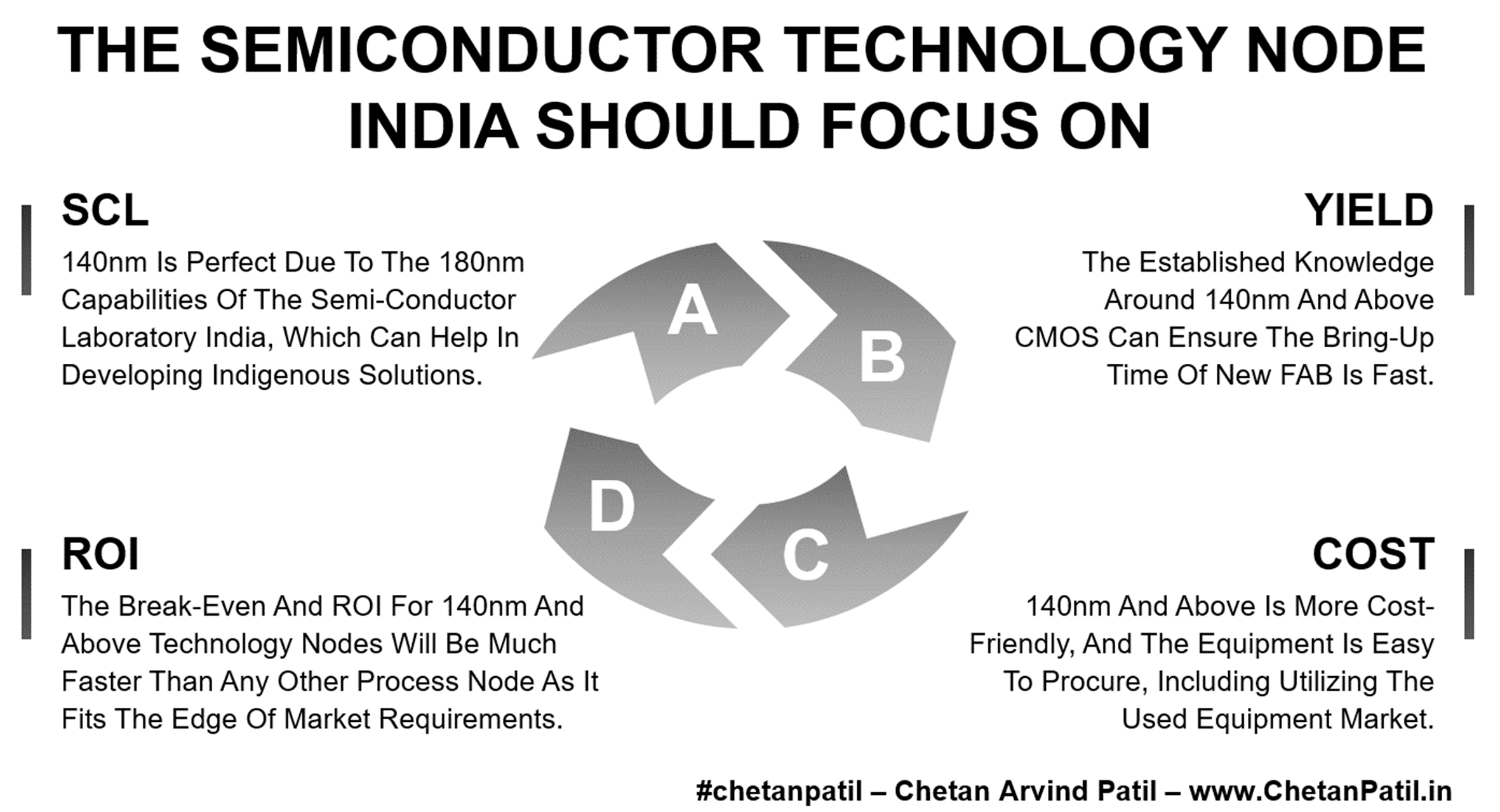
    Thus, considering the capabilities of India’s public semiconductor FAB, it is more suitable to aim for 140nm and above. The reason ranges from cost, yield, process control, and market demand. 140nm is also perfect due to the 180nm capabilities of the Semi-Conductor Laboratory, which can extend to not only develop CMOS devices to fabricate 140nm but can potentially ensure that these facilities also get upgraded – a win-win situation for all.

    If the SCL cannot develop 140nm in-house, there is also a potential to tie up with established Pure-Play vendors. Similar to Maruti-Suzuki JV. Regarding market potential, 140nm CMOS, including BiCMOS semiconductor technology, is still in high demand, mainly in the industrial, automotive, mobile, and other computing sectors.


    Picture By Chetan Arvind Patil

    The semiconductor equipment and setup cost for 140nm and above CMOS/BiCOMS semiconductor FAB is relatively lower than the advanced nodes. Yield is better, and the application area is far greater. Focusing on anything lower, mainly the advanced nodes like 7nm, etc., will be a step in the wrong direction unless a private player is willing to set up FAB by utilizing the incentives and spending endless resources.

    Benefits of 140nm and above CMOS/BiCMOS:

    Proven: 140nm and above is an established and widely used technology node that can speed up India’s semiconductor fabrication and manufacturing entry.

    Cost: 140nm and above is more cost-friendly, and the equipment is easy to procure, including utilizing the used equipment market.

    Yield: The established knowledge around 140nm and above CMOS can ensure the bring-up time of new FAB is fast.

    ROI: The break-even and ROI for 140nm and above technology nodes will be much faster than any other process node as it fits the edge of market requirements.

    While having an advanced node FAB in India can be a game-changer, but only if a private player does it. If the focus is to get Indian companies to set up FAB in India (like Vedanta, etc.), creating a tech JV with SCL and other players to develop process flow for 140nm and above indigenously could be a more significant breakthrough.


  • The Semiconductor Manufacturing Road Map For India

    The Semiconductor Manufacturing Road Map For India

    Photo by samarth shirke on Unsplash


    Countries all over the world are coming up with policies and incentives targeted towards semiconductor manufacturers. It is due to the dependence countries will have on semiconductors which are the backbone of the digital economy.

    In the same line, India has also come up with several incentives to foster the semiconductor manufacturing ecosystem. However, incentives only help to a certain extent and beyond which laser-focused road map driven planning is required. The road map also empowers the potential investors and enables them to diversify investment as part of the long-term strategy.

    When it comes to the semiconductor manufacturing road map, no one recipe fits all. India needs its India-specific road map for semiconductor manufacturing. India is already home to the majority of the top semiconductor design and research institutes. It makes the process of building semiconductor manufacturing slightly less complex but still requires a long-term strategy.

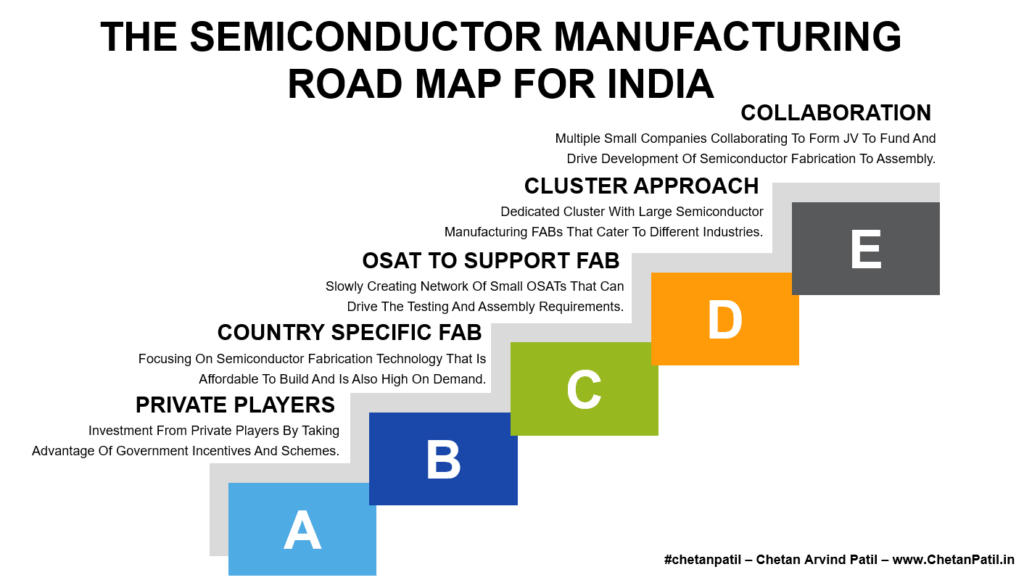
    A road map can have several key components. However, if incorporated well, it can enable a steady and robust semiconductor manufacturing growth in India.

    Private Players: Private players are critical in enabling semiconductor manufacturing. These private players often have to invest a large sum of money for a semiconductor manufacturing plant. There are already several incentives that the Indian government has launched. Now, India needs one top semiconductor manufacturer to take advantage of these schemes and thus slowly turn the plan into reality. Private entities should also actively engage with the government. It should provide a detailed overview of where the bottleneck lies and how government can help in filling these gaps.

    Country Specific FAB: India has the market and demand for semiconductor products. Focusing on these requirements and then building the semiconductor FAB can enable India (private and government) to drive in-house requirements. It will also require the potential semiconductor manufacturers to focus on semiconductor technologies that fulfill the semiconductor demand for India. And, as a long-term strategy, it can also lay the foundation of future semiconductor technology for India and the world.


    OSAT To Support FAB: Semiconductor FAB by itself does not make up the semiconductor manufacturing ecosystem. It requires a support system in the form of a supply chain, which also includes OSAT. OSAT is critical to enable packaged goods to the customer. India already has OSAT specific policies, and taking advantage of them to drive the support environment can bring an end-to-end semiconductor manufacturing ecosystem.

    Cluster Approach: India is already home to top non-semiconductor manufacturing companies. These companies have been successfully catering to not only India’s demand but also exporting to different countries. Automotive is one such example. Over the decades, dedicated automotive regions have turned into giant clusters with end-to-end automotive-focused manufacturing needs. As India moves towards the next era of the wireless and digitally connected economy, similarly, semiconductor-focused cluster manufacturing is the need of the hour.

    Collaboration: In the end, semiconductor manufacturing is all about long-term planning. Either with customers or with public bodies. All of the successful semiconductor manufacturing-focused clusters around the globe are actively collaborating and redefining their planning. They do so by actively engaging with the universities or with other private players. Such a long-term collaboration is key to driving next-gen innovation. India needs to have a collaborative environment to drive in-country semiconductor manufacturing. Several attempts have failed, and India certainly needs one such collaboration to kick off the semiconductor manufacturing story.

    Successful and profitable semiconductor manufacturing region today started with one FAB or OSAT. Today, these regions are a big part of semiconductor manufacturing and are re-developing for the next century.

    Without a medium to large-scale FAB/OSAT, India will stay dependent on its future semiconductor demands. It is about time that India embarks on the road map for the next decade. Otherwise, the gap between the semiconductor demand and semiconductor manufacturing in India will keep growing, and India will be more dependent than ever.