Category: LITHOGRAPHY

  • The Case For Energy-Aware Semiconductor Lithography

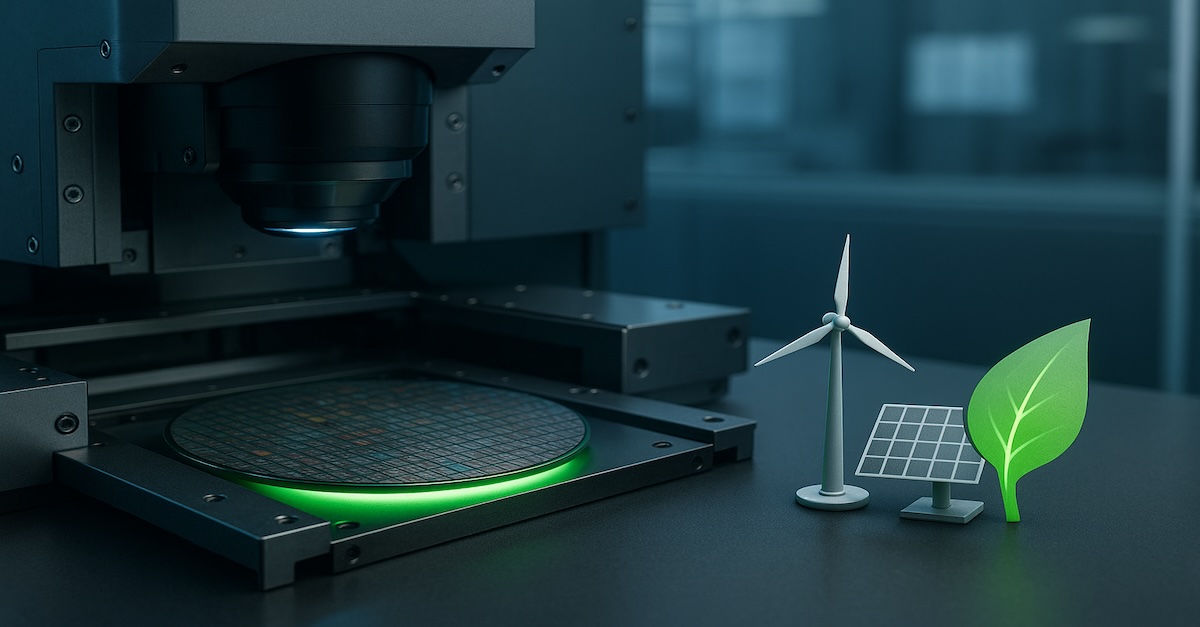
    Image Generated Using DALL·E


    Rising Energy Burden Of Lithography

    Lithography has become one of the most energy-intensive stages in the fabrication of wafers. As fabs push to 2 nm and below, every additional patterning layer increases electricity demand and associated CO₂ emissions. Industry projections now indicate that wafer-fab emissions will exceed approximately 270 Mt CO₂e by 2030, primarily from equipment-driven loads. Fabs cannot treat lithography power as a fixed cost anymore.

    High-NA EUV, expected to be widely deployed in high-volume environments, delivers the resolution needed for advanced logic. However, it also increases per-tool power requirements, precisely the kind of “performance/energy ↑” tradeoff that sustainability teams are trying to mitigate. This imbalance is the reason lithography is now being singled out in sustainability roadmaps.


    What “Energy-Aware” Really Means

    Energy-aware lithography integrates power consumption as a design and operational variable within the patterning process, alongside resolution, critical dimension control, and throughput. Instead of viewing electricity as a fixed cost, it measures kWh per wafer and CO₂ per layer as core performance metrics. Each exposure plan and dose setting is evaluated for both imaging fidelity and energy efficiency, shifting lithography from precision alone to precision with purpose.

    At the fab level, energy awareness spans scanner design, standby control, and load balancing across exposure tools. It links process control with power management, allowing for the precise achievement of exact yield and overlay targets with reduced energy consumption. In this framework, sustainability becomes an engineered outcome rather than an afterthought.


    Image Credit: IEA

    Emerging Data From Recent Research

    Recent years have seen semiconductor research institutions and equipment makers quantify lithography’s energy and carbon footprint with far greater precision. This shift from broad sustainability targets to verifiable metrics such as energy per wafer, kilowatt-hours per layer, and carbon dioxide equivalent per exposure has redefined how efficiency is measured.

    Organizations such as imec, ASML, and TSMC now publish data showing measurable progress in reducing power consumption across both process and equipment levels, aligning with the 2024 IRDS Environmental Chapter, which calls for quantifiable energy tracking throughout semiconductor manufacturing.

    At the same time, policy frameworks such as NIST’s 2024 environmental assessment and SRC’s sustainability initiatives have recognized tool-level efficiency as a direct lever for emission reduction. This alignment between research, industry reporting, and regulatory guidance represents the first coordinated movement toward energy-transparent lithography, where every exposure and patterning decision is tied to a measurable energy outcome.

    Paper TitleYear And Paper LinkSummary And Relevance
    Toward Lifelong-Sustainable Electronic-Photonic AI Hardware2025
    arXiv
    Highlights that for cutting-edge chips the embodied carbon (including lithography/EUV) is growing even as operational efficiency improves. Useful for framing lithography’s sustainability burden.
    Carbon Per Transistor (CPT): The Golden Formula for Sustainable Semiconductor Manufacturing2025
    arXiv
    Presents a quantitative model of semiconductor fabrication carbon footprint, highlighting that lithography (with other front-end steps) dominates wafer-fab emissions.
    Can we improve the energy efficiency of EUV lithography?2024
    arXiv
    Directly addresses EUV lithography power consumption and suggests routes to reduce source power by an order of magnitude, highly relevant for your lithography-energy theme.
    Modeling PFAS in Semiconductor Manufacturing to Quantify Trade-offs in Energy Efficiency and Environmental Impact of Computing Systems2025
    arXiv
    While focused on PFAS (materials), this paper also touches on patterning complexity (incl. lithography) and embodied carbon/material trade-offs, useful to show the broader sustainability context.
    Carbon Connect: An Ecosystem for Sustainable Computing2024
    arXiv
    Discusses large-scale manufacturing, including semiconductor fabs’ electricity usage (comparable to datacenters) and mentions extreme ultraviolet lithography in that context.
    How purity reshapes the upstream materiality of semiconductor manufacturing2025
    arXiv
    Addresses supply-chain/material dependencies for lithography (e.g., neon/argon gases for excimer lasers) and helpful to show indirect energy/material burdens tied to lithography.

    Recent studies from imec, ASML, and TSMC, supported by analyses such as Shintake (2024) on EUV power reduction and ElSayed et al. (2025) on carbon-per-transistor metrics, show a clear shift in how lithography energy is being addressed. The emphasis has moved from large facility upgrades to tool- and process-level optimization, where adaptive standby control, exposure planning, and dose tuning yield immediate reductions in power use.

    Together, these works demonstrate that lithography energy is now a quantifiable engineering parameter. Integrating power metrics into process control and equipment specifications turns sustainability into a driver of performance, advancing the concept of truly energy-aware semiconductor manufacturing.


    Toward A Metric Of Energy Transparency

    Latest developments across the industry have also highlighted a growing focus on the transparent reporting of lithography energy use. ASML has disclosed that its NXE:3600D EUV systems consume about 7.7 kilowatt-hours per exposed wafer pass, offering a concrete reference point for equipment-level efficiency.

    IMEC’s modeling work indicates that lithography and etch together contribute over 40 percent of Scope 1 and 2 carbon emissions at advanced logic nodes, emphasizing where process-level optimization delivers the most significant impact. TSMC’s EUV Dynamic Power Saving Program further demonstrates operational transparency by achieving a 44 percent reduction in peak power and projecting 190 million kilowatt-hours in energy savings by 2030.

    These examples collectively point toward a future where lithography energy is treated as a measurable parameter rather than an indirect cost. Adopting standard metrics, such as kilowatt-hours per exposure or carbon-equivalent per layer, would allow fabs and equipment suppliers to benchmark their performance and optimize power alongside yield and throughput.

    Energy transparency at this level establishes efficiency as a shared engineering objective across the semiconductor ecosystem.


  • The Essential Skills For Mastery In Computational Lithography

    Image Generated Using DALL-E


    Students And Computational Lithography

    I recently wrote about computational lithography. Several students asked, apart from mathematics skills, what more is required to align educational training so one has a better chance of joining semiconductors as a computational lithography engineer. 

    I thought a lot about this, and outlined in this blog are all the ins and outs of computational lithography that can benefit students.


    What Is Computational Lithography

    Computational lithography, a critical component of the semiconductor manufacturing process, represents the intersection of computer science, physics, and engineering, tailored to enhance the capabilities of photolithography. Photolithography is a process used to transfer geometric patterns onto a substrate or silicon wafer, essential for creating the intricate circuits that form the backbone of electronic devices.

    The field of computational lithography encompasses advanced algorithms and software tools to optimize this patterning process. Given the physical limitations of traditional lithography techniques, particularly as the semiconductor industry strives to shrink chip features to the sub-nanometer scale, computational lithography emerges as a pivotal solution. It enables the production of smaller, more efficient, and powerful microchips beyond the constraints of optical lithography.


    Picture By Chetan Arvind Patil

    Why Learn About Computational Lithography

    Learning computational lithography is becoming increasingly critical, especially within the semiconductor industry’s relentless drive toward miniaturization and efficiency improvement.

    Several vital roles demand skills in computational lithography. Below is an example of a job description requiring computational lithography skills:

    Image Credit: ASML

    If as a student you are looking for more critical and technical reasons on why learning computational lithography is invaluable. Then below is a guide that can helpful.

    REASONSDESCRIPTION
    Central Role In Semiconductor ManufacturingEssential for producing advanced semiconductor devices, enabling continued technological advancement.
    Addressing Physical LimitationsProvides solutions to surpass the physical limits of traditional lithography, enabling the creation of nanoscale features.
    High Demand For Skilled ProfessionalsExpertise in computational lithography is highly sought after, with growing demand as technology evolves.
    Interdisciplinary Skill DevelopmentFosters a wide range of skills from various disciplines, valuable across the semiconductor industry and beyond.
    Enabling Advanced TechnologiesKey to the development of cutting-edge technologies for advanced to ultra-advanced chips
    Research And Development OpportunitiesNumerous opportunities for contributing to new techniques and methodologies in lithography.
    Economic And Strategic ImportanceContributes to the strength of the semiconductor industry, a cornerstone of the global economy and national security.
    Personal And Professional GrowthThe evolving nature of computational lithography encourages lifelong learning and adaptability.
    Collaborative And Multidisciplinary Work EnvironmentInvolves working in collaborative, multidisciplinary teams, fostering innovation and problem-solving.
    Global Network And CommunityEngaging with computational lithography opens doors to a global community of experts and industry leaders.

    How To Learn And Enhance Skills Around Computational Lithography

    Learning and enhancing skills in computational lithography involves a multidisciplinary approach, blending principles from physics, engineering, computer science, and mathematics. This field is crucial for those aspiring to contribute to the semiconductor industry’s evolution, particularly in designing and manufacturing ever-smaller and more efficient microchips.

    Here’s a structured pathway to learn and enhance your skills in computational lithography:

    STRATEGYDESCRIPTION
    Solidify Your Foundation In Physics And MathematicsFocus on optics, quantum mechanics, electromagnetism, calculus, differential equations, linear algebra, and numerical methods.
    Gain A Deep Understanding of Semiconductor Fabrication ProcessesLearn the basics of semiconductor manufacturing and specialize in lithography processes.
    Develop Computational SkillsGain proficiency in programming languages (Python, MATLAB, C++) and familiarize yourself with software tools for simulation and design.
    Engage In Hands-On Projects And SimulationsWork on practical projects or simulations, and participate in team projects to apply theoretical knowledge.
    Stay Updated With The Latest Research And DevelopmentsRead journals, attend conferences, and participate in workshops to stay informed about the latest advancements.
    Pursue Advanced EducationConsider specialized courses, certifications, and advanced degrees focused on lithography and semiconductor manufacturing.
    Network With Professionals And Join CommunitiesConnect with experts through professional networks and online communities focused on computational lithography.
    Learn From Industry ExperienceSeek internships or co-op opportunities in semiconductor manufacturing companies or research institutions.
    Critical Thinking And Problem-Solving SkillsParticipate in challenges or competitions and study case studies to enhance problem-solving skills.
    Adopt A Lifelong Learning MindsetEmbrace continuous learning to keep up with the evolving field of computational lithography.

    Take Away

    As students navigate the ever-evolving landscape of semiconductor technology and innovation, embracing the field of computational lithography offers a unique and rewarding pathway to making significant contributions to the semiconductor industry and beyond.

    This discipline, lying at the intersection of physics, mathematics, engineering, and computer science, not only challenges you to apply and expand your academic knowledge but also positions you at the forefront of technological advancements that power our modern world.

    By diving into computational lithography, students will prepare for a career that has the potential to open doors to becoming part of a global community of innovators, researchers, and professionals who are driving the next wave of the semiconductor technological revolution.


  • The Computational Semiconductor Lithography

    Photo by Dan Cristian Pădureț on Unsplash


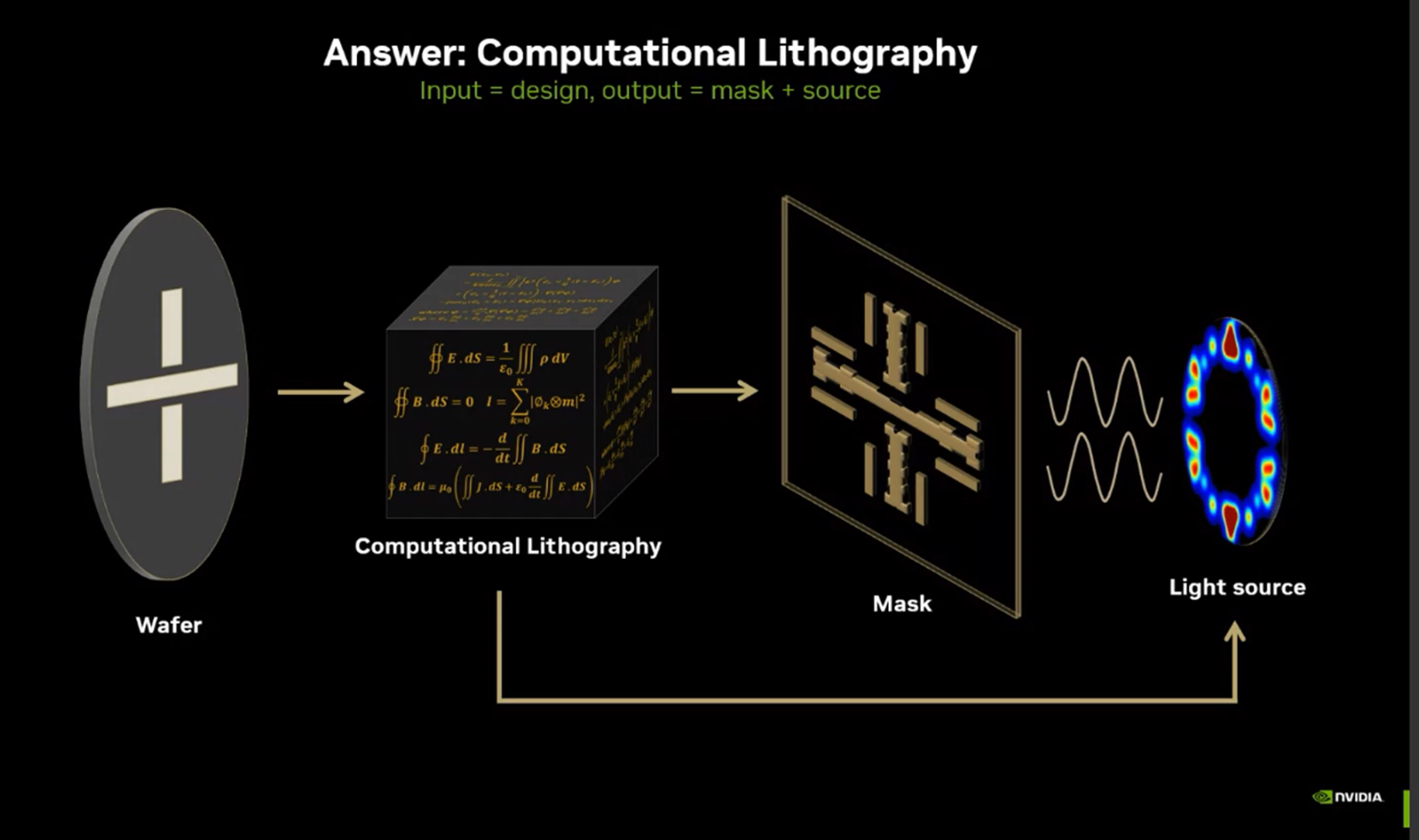
    Computational lithography is a specialized field in the semiconductor manufacturing domain. It is used during lithography when advanced algorithmic models optimize the patterning and masking process. It is done by deforming the patterns to compensate for the physical and chemical effects naturally occurring in a standard flow. It utilizes the concept of inverse lithography to do so.

    Result: Accurate production of the desired chip patterns on the wafer to fabricate the complex advanced node silicon.

    Achieving such a complex and exact process on the go demands compute speed. It means that the equipment must either be equipped with high-performance XPUs to deliver a modeling approach or be able to offload and on load. In practice, the remote and distributed processing approach is better suited.

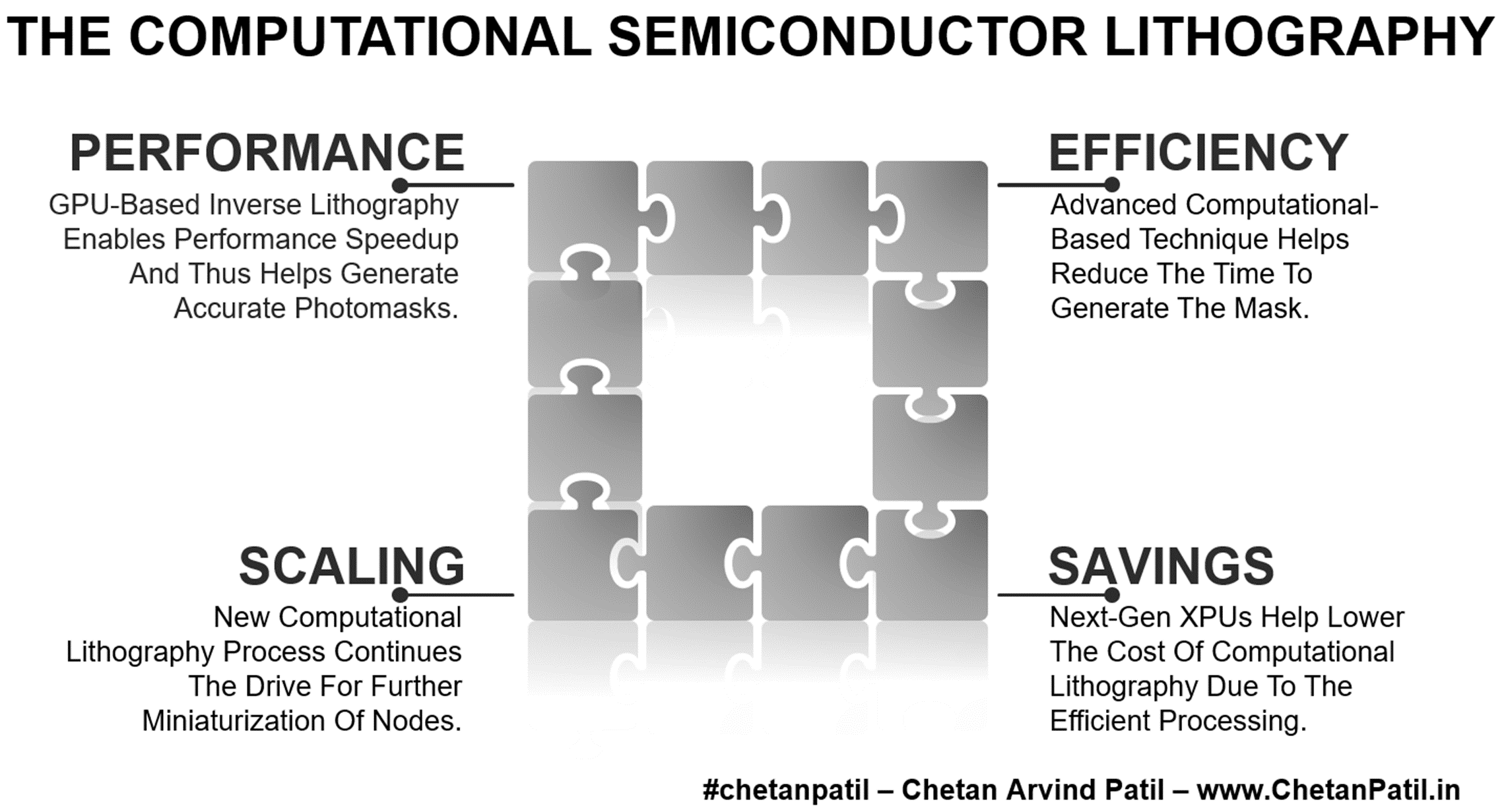
    Performance: GPU-based inverse lithography enables performance speedup and thus helps generate accurate photomasks.

    Efficiency: Advanced computational-based technique helps reduce the time to generate the mask.

    However, as the complexity of the technology node increases, it has become challenging to keep up with the processing requirements of lithography. Thus, better XPUs and also software support is required.


    Picture By Chetan Arvind Patil

    To tackle this bottleneck, NVIDIA, Synopsis, TSMC, and ASML have collaborated to leverage the software libraries on the GPU architectures. It will help drive silicon scaling and enable their end users to reduce costs and accelerate technology advancements. It leverages GPU-based inverse lithography.

    Below is a simplified flow of what this collaboration will speed up further. Details around the litho library (cuLitho) were presented by Vivek K Singh, Vice President, Advanced Technology Group, NVIDIA, early this year.


    Image Source: NVIDIA
    Image Source: NVIDIA
    Image Source: NVIDIA
    Image Source: NVIDIA

    It is a significant step in the right direction when there is a proper set of collaborators: Covering GPU, EDA, Technology-Node, and Semiconductor Equipment experts.

    Today, the compute workloads that achieve computational lithography are the most complex and extensive computational activity ever executed during semiconductor production.

    Savings: Using next-gen XPUs help lower the cost of computational lithography due to the efficient processing.

    Scaling: New computational lithography process continues the drive for further miniaturization of nodes.

    With the latest advancements in GPU technology and the collaborative approach, computational lithography performance will skyrocket.

    Eventually, semiconductor manufacturers will now achieve unprecedented speed and accuracy for all the lithography requirements. Such an improvement will also help drive better die-level manufacturing accuracy, improved yield, and the ability to continue to scale into the Angstrom era.