The semiconductor industry is constantly evolving, and one of the most promising new technologies is the semiconductor processor-in-memory (PIM). PIM is a new approach to computing that integrates processing units directly into memory chips. It can significantly improve performance and efficiency, especially for applications that require large amounts of data to be processed quickly.
There are several technical opportunities and challenges associated with PIM. One of the most significant opportunities is the potential to improve performance. PIM can reduce the time it takes to move data between memory and processing units, leading to substantial speedups for specific applications and can help to improve energy efficiency by reducing the number of transistors to be switched on.
Key Trends In The PIM market:
Increasing Demand For AI, ML, And Data Analytics Applications: The increasing demand for learning-driven applications is driving the growth of the PIM market. These applications require large amounts of data to be processed quickly, and PIM is the perfect solution to achieve this goal.
Development Of New PIM Technologies: New PIM technologies, such as 3D PIM and hybrid PIM, are expected to boost the market’s growth. 3D PIM is a type of PIM that integrates processing units in three dimensions. Hybrid PIM is a type of PIM that combines IMC and NMC.
Growing Adoption Of PIM In The Automotive And Healthcare Industries: The growing adoption of PIM in the automotive and healthcare industries will drive the market’s growth. In the automotive sector, PIM solutions can improve the performance of self-driving cars. In the healthcare industry, PIM devices can also improve the diagnosis and treatment of diseases.
High Cost Of PIM Chips: The high cost of PIM chips is a significant challenge for the market. However, as it happens, the cost of PIM chips is expected to decrease as the technology matures.
However, there are also some challenges associated with PIM. One challenge is that designing and manufacturing PIM chips can be difficult. Integrating processing units and memory cells on a single chip is a complex process that raises yield concerns. Additionally, PIM chips can be more expensive than traditional memory chips.
Despite the challenges, PIM has the potential to revolutionize the semiconductor industry. PIM can make it possible to create new types of applications that were not possible before, and it can also improve the performance and efficiency of existing applications. As PIM technology develops, it will likely move the computing industry forward faster than planned.
PIM also has several potential business opportunities for semiconductor companies. One of the most significant is the faster-than-ever-before analysis of data, thus reducing the overall time taken by different sets of learning-based applications. These applications are increasing and will continue to grow.
However, to achieve these goals semiconductor companies must invest heavily in research and development to bring PIM chips to market. Semiconductor companies must develop new business models to sell PIM chips. PIM chips are not a commodity product and will get sold to specific customers who need the performance and efficiency benefits that PIM can offer.
PIM will have a significant impact on the semiconductor industry in the years to come. PIM chips can improve the performance and efficiency of various applications and can get used in new applications that were not possible before. PIM can potentially create new markets for semiconductor chips. Additionally, PIM can help semiconductor companies to capture a share of the growing demand for artificial intelligence, machine learning, and data analytics.
Overall, PIM is a promising new technology that has the potential to revolutionize the semiconductor industry. It will also help create new markets for semiconductor chips and help semiconductor companies capture a share of the growing demand for artificial intelligence, machine learning, and data analytics.
In the world of computing, memory is a vital piece of silicon that can either make or break the computer system. It is nearly impossible to perform any computing task without the help of computer memory.
Memory is also the major reason why today we have large data storage centers and high-speed computers. There is no denying that software plays an important role in speeding up the application. However, the balance of software with the right hardware configuration is also a crucial part of making an efficient system.
The portable computers are a perfect example of how important semiconductor memory is. A decade ago, it was unimaginable to have GB of RAM and storage. The advanced and continuous innovation has brought down the memory cost significantly. This has enabled smartphone manufacturers with computing resources that have only improved the processing capabilities. As the world becomes more hyper-connected, the role played by semiconductor memory is only going to be more vital than ever.
In the last few years, there has been a shake-up in the semiconductor memory business where the number of top players providing memory products is shrinking year on year. In the long run, this might have major consequences due to greater dependency on specific players. Still, from the technical front, the semiconductor memory development will keep playing a supportive role in providing processing support on the go.
The role played by semiconductor memory has only increased over the last few years, mainly due to the proliferation of advanced data computing.
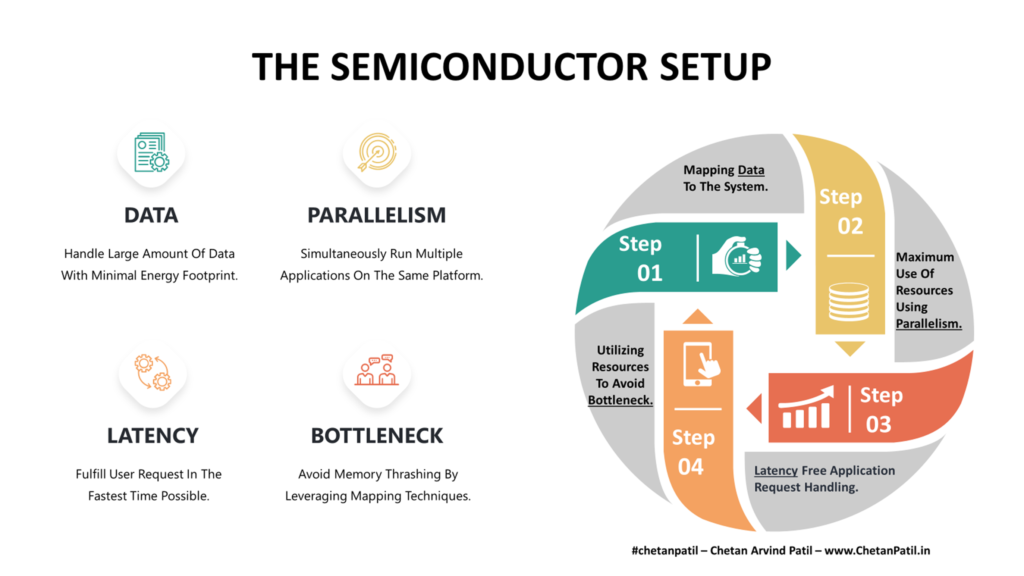
Data: Modern computer applications are rich both in terms of user interface and user requirements. The consumer today expects the request to be handled in the shortest time possible and that too without impacting the battery life or consuming more power. Whether it is a data center or a portable device like a smartphone, memory is playing a key role in handling the data request efficiently. While the major task is also done on the operating system and application side, the memory itself is also leveraging device-level techniques to minimize the footprint.
Parallelism: Another important role played by semiconductor memory is enabling parallelism. Hyper-threading has been around for decades. The decreasing cost and improving cache/storage have enabled better parallelism. In the long run, the total energy saved by minimizing the number of operations has only helped (due to larger memory) the overall performance and also the user experience.
Latency: In any given computer system, there are different blocks and the data travels through all these internal blocks before the request can be processing correctly. This often leads to latency and impacts user experience. To ensure there is no delay in processing the data request, computer architects have been using memory as a way to optimize data processing. This has lead to different innovative XPUs that allow memory usage in a manner that reduces the latency a lot.
Bottleneck: Avoiding bottleneck is another important reason why memory is one of the biggest pillars of an efficient XPU. The bottleneck can occur when multiple applications are racing to get the data processed. In such scenarios, it becomes important to cache the information closer to the processing units, and this often requires either a large amount of second or third level of computer memory or an efficient algorithm that can handle both the task efficiently without adding a bottleneck. It so often happens that the computer runs out of memory and has to scarifies one of the two requests. This is why it has become important to leverage semiconductor techniques to hold more data closer to the core processing unit, and this role is played by semiconductor memory.
Irrespective of the purpose for which the computer system is being used, in the long run, semiconductor memory plays a key role in ensuring the user experience is never compromised. This is also the major reason why the world will keep innovating futuristic semiconductor-driven memory solutions.
The world is racing towards digitization and the foundation of this race was laid long back with the invention of modern hardware and software systems. This journey towards an automated and digitally compliant world will not be possible without the help of memory units that is designed and manufactured by the semiconductor industry.
This is why the semiconductor memory solutions will keep playing a vital role in tomorrow’s applications and solutions used by the different semiconductor industries.
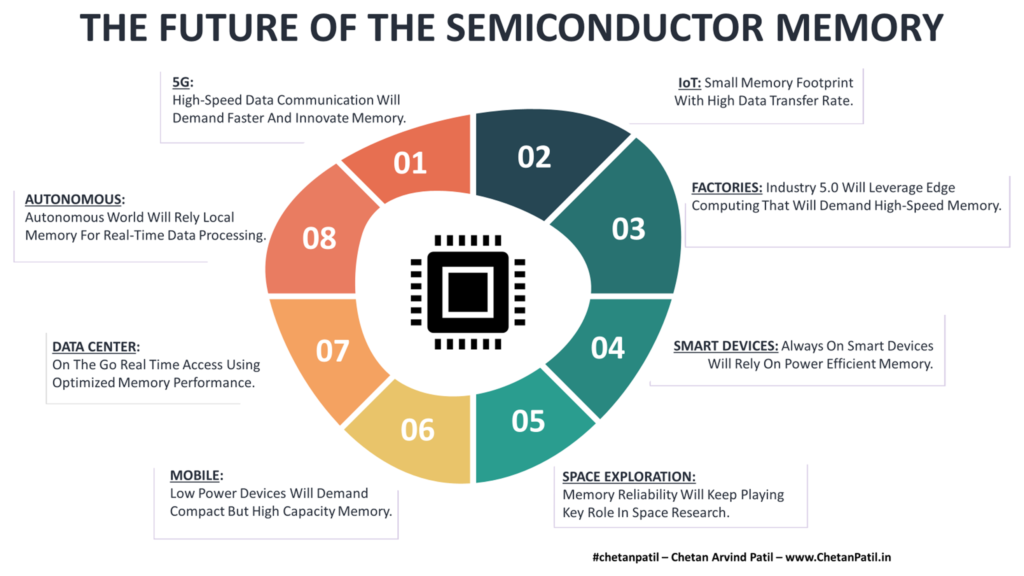
5G: Next-gen wireless communication technology, 5G, is more data-driven solutions than its predecessor. This will lead to the deployment of different types of applications that will be data-hungry. To cater to all such requests, nearby memory stations will be required that can fulfill the request with the help of caching or any other secure communication solutions. 5G will also push data storage activity and this will eventually require more efficient and high-speed memory solutions.
IoT: Internet-of-Things has been around for almost a decade. Even a laptop connected to the wireless internet can be called an IoT device. However, the 5G driven by Android and low-cost consumer electronic products, will speed up the use cases of smart and tiny devices. This will drive the need to optimize memory performance, which will also minimize energy consumption.
Factories: From automotive to aerospace, the factories are becoming more autonomous and smarter. This is not new and has been the case in major parts of the world for few years. The smarter factory concept is going to demand more robust and secure memory that is hack-proof. This is another area where semiconductor merry solutions will play a critical role.
Smart Devices: Smart devices are not just about smart cameras or drones. Any given device that is capable of delivering smarter solutions while not consuming more power than its predecessor has the right to be called a smart device. While applications and software also play a key role, the memory requirement for such devices is also going to have a major impact on making future smart devices even more efficient.
Mobile: Mobile is not about smartphones, it is more about any device that enables mobility. It can be a cell phone, laptop, car, or even drone. All these devices eventually require a high-speed and highly reliable memory system that can work without any issues for years. Another reason why semiconductor memory is important in the long run.
Data Center: Catering to data requests remotely also requires data centers that can hold a large amount of data. This task is impossible without the storage requirement and it often means investing in racks that can hold a large amount of semiconductor memory.
Space Exploration: Launching satellites and sending rovers to different planets also requires different semiconductor solutions. One of the key pieces is memory due to lag in real-time communication. This requires the remote satellite/rover to store data locally till the data delivery confirmation from the space station is received. Such critical missions demand the most reliable memory solution possible and this is going to keep pushing the semiconductor industry towards innovative memory requirements.
Autonomous: Autonomous world is exploding. Whether it is traffic management, inventory optimization, or maintaining a large warehouse, all the places are getting heavily automated. This requires algorithms to run on the machine at the edge. This demands a good combination of processing capabilities along with memory management. This is another area where semiconductor memory will play a supportive role by allowing over-the-air updates and software optimization.
There is not a single area where semiconductor memory is not playing a key role. Where ever there is a smart system running software, there is also a memory that is acting as a catalyst.
With the invention of new capacitor technology and the continuous development of new memory nodes, the semiconductor industry will see transformative memory products and solutions for the next few decades.