Category: POLICY

  • The Case For Asian Semiconductor Corridor

    Image Generated Using DALL-E


    What Is A Semiconductor Corridor

    A Semiconductor Corridor refers to a strategic network of regions and countries collaborating closely to enhance and optimize the semiconductor supply chain.

    This corridor involves interconnected semiconductor manufacturing hubs, research, development, and logistics to create a more resilient and efficient semiconductor production ecosystem.

    Key Components Of A Semiconductor Corridor:

    By leveraging advanced manufacturing, fostering research and development, ensuring efficient supply chain integration, developing a skilled talent pool, investing in infrastructure, and implementing supportive policies, any given Semiconductor Corridor is a strategic move that aims to revolutionize the industry and secure its future for the long term.

    The critical components of a Semiconductor Corridor collectively create a robust framework for advancing the global semiconductor industry. Thus, by Harnessing the specialized capabilities of different regions, such a corridor enhances technological innovation and supply chain resilience and drives economic growth and workforce development.

    ComponentDescription
    Manufacturing HubsRegions within the corridor that specialize in semiconductor fabrication, assembly, testing, and packaging. These hubs leverage advanced manufacturing technologies to produce various types of semiconductor devices
    Research And Development CentersInstitutions and facilities dedicated to the research and development of new semiconductor technologies. It includes work on advanced materials, chip designs, and innovative manufacturing processes
    Supply Chain IntegrationA streamlined and well-coordinated supply chain that ensures the efficient flow of raw materials, components, and finished products. This integration reduces delays, lowers costs, and mitigates risks associated with supply chain disruptions
    Talent PoolA corridor that fosters the development of skilled professionals in semiconductor technology through education, training, and workforce development programs
    Investment and InfrastructureSignificant investments in infrastructure, including state-of-the-art manufacturing facilities, research labs, and transportation networks, to support the semiconductor industry
    Regulatory And Policy SupportGovernment policies and regulations that encourage investment, innovation, and collaboration within the semiconductor sector. This includes tax incentives, research grants, and trade agreements


    Picture By Chetan Arvind Patil

    The Rationale For An Asian Semiconductor Corridor:

    The concept of an Asian Semiconductor Corridor has emerged as a strategic response to these challenges. By leveraging the unique strengths and capabilities of Asian countries, this corridor can create a robust and integrated ecosystem that can drive innovation, enhance supply chain resilience, and foster economic growth.

    The COVID-19 pandemic highlighted significant vulnerabilities in the semiconductor supply chain, demonstrating the need for a more resilient and diversified manufacturing base. An integrated corridor across Asia can mitigate these risks by ensuring a steady and reliable supply of semiconductors. 

    Moreover, Asia is home to some of the world’s leading semiconductor companies. The corridor can accelerate technological innovation in advanced chip design, fabrication, and packaging technologies by fostering collaboration among these entities.

    Key Players In The Asian Semiconductor Corridor:

    The success of the Asian Semiconductor Corridor hinges on the collaboration and contributions of key players within the region. Each country brings unique strengths and capabilities that enhance the corridor’s overall effectiveness and resilience. 

    Taiwan, South Korea, China, Japan, Singapore, Malaysia, Vietnam, and India each play critical roles, from advanced manufacturing and cutting-edge research to cost-effective assembly and strategic policy support.

    Understanding the distinct contributions of these countries provides insight into how the Asian Semiconductor Corridor can revolutionize the global semiconductor industry.

    CountryRole and Contribution
    TaiwanAs the world’s leading semiconductor manufacturer, Taiwan, with TSMC at its helm, plays a crucial role. Its expertise in advanced node fabrication is indispensable to the corridor
    South KoreaWith giants like Samsung and SK Hynix, South Korea contributes significantly in memory chips and logic devices, making it a vital player
    ChinaDespite facing trade restrictions, China continues to invest heavily in its semiconductor capabilities, with SMIC leading the charge
    JapanRenowned for its materials and equipment, Japan’s contribution is critical in providing the necessary tools and technologies for semiconductor manufacturing
    SingaporeA strategic hub for semiconductor manufacturing, Singapore’s established infrastructure and skilled workforce are key assets
    MalaysiaThe country’s well-established semiconductor infrastructure and industry experience make it a crucial player in this phase of the semiconductor supply chain
    VietnamSimilar to Malaysia, Vietnam offers cost-effective solutions for assembly and testing
    IndiaWith its growing focus on semiconductor design and plans to establish new fabs, India is an important player in the corridor

    In summary, the key players within the Asian Semiconductor Corridor form a synergistic network that drives innovation, efficiency, and growth in the semiconductor industry. By leveraging the diverse expertise and resources of Taiwan, South Korea, China, Japan, Singapore, Malaysia, Vietnam, and India, the corridor is well-positioned to address current challenges and future demands.

    This collaborative effort strengthens the regional semiconductor ecosystem and enhances the global supply chain’s resilience and stability. As the corridor continues to develop, the combined strengths of these key players will be instrumental in shaping the future of semiconductor technology.

    Take Away:

    Establishing an Asian Semiconductor Corridor can bring a strategic initiative to harness the collective strengths of various Asian countries in the semiconductor industry. As global demand for semiconductors continues to rise, driven by technological advancements and increased digitalization, the need for a resilient and efficient supply chain has never been more critical. The Asian Semiconductor Corridor offers a comprehensive solution to address these challenges, fostering collaboration, innovation, and economic growth across the region.

    In summary, the Asian Semiconductor Corridor can be a transformative initiative that promises to reshape the semiconductor landscape. It highlights the power of regional cooperation in driving technological advancements, ensuring supply chain resilience, and fostering economic growth. As the semiconductor industry continues to evolve, the corridor stands as a testament to the participating nations’ strategic foresight and collaborative spirit, paving the way for a brighter and more innovative future.



  • The Global Shift In Semiconductor Ecosystem

    The Global Shift In Semiconductor Ecosystem

    Photo by Maxence Pira on Unsplash


    The semiconductor ecosystem comprises distributed end-to-end semiconductor processes. These processes cover a different aspects of silicon development. It ranges from the market requirement, then moves to design, validation and if all goes as planned, then eventually mass manufacturing.

    However, these steps are not guaranteed to be performed by a specific location or region. It is where the semiconductor ecosystem comes into the picture.

    Global: Semiconductor Industry Is Adopting To The Changing Global Scenarios.

    Shift: Different Types Of Government Policies Are Shifting The Semiconductor Industry Process.

    In semiconductors, product development is dependent on different parts of the world. Given the recent shift in investment, planning, policies, and talent, this ecosystem is going through a tectonic shift that will have positive and negative consequences on future semiconductor technologies.

    On the positive side, such a shift is bringing better equilibrium in terms of investment, and also technological development is getting more distributed.


    Picture By Chetan Arvind Patil

    On the negative side, it has created technology-driven conflicts between different regions. Eventually, a middle way will have to be carved, where both the new and existing will grow and contribute to the semiconductor industry.

    Based on past, current, and future scenarios, the semiconductor industry will always be global. As such, any shift should not let a specific region dominate the end-to-end semiconductor processes.

    Conflict: Conflicts Between Different Regions Is Creating A Tectonic Shift In Semiconductor Business.

    Ecosystem: All The Geo Changes Are Leading To A New Type Of Semiconductor Ecosystem.

    A connected, dependent, global and decentralized approach is the primary reason the semiconductor industry will keep growing at a double-digit. Changing such an ecosystem is not an easy process. It is also about time different countries work together to enable next-gen solutions for ever demanding and ever-growing semiconductor market.

    The next few years will bring a lot of conflicts for the semiconductor industry and will challenge the traditional notion of how distributed and region dependent the semiconductor ecosystem is. Eventually, the semiconductor industry will have to balance by focusing on the next-gen advancement, which will have to be driven by the distributed semiconductor ecosystem, and no one region should dominate.


  • The Post Act Plan For Semiconductor Manufacturing

    The Post Act Plan For Semiconductor Manufacturing

    Photo by Brett Jordan on Unsplash


    The government of several countries has realized the need to establish a semiconductor ecosystem that can cater to computing needs for decades to come without relying on external factors. In doing so, several new policies and acts are getting approved with the sole purpose that the semiconductor companies will drive the development of an in-country semiconductor ecosystem.

    When it comes to the semiconductor ecosystem, it might never be possible to be 100% resilient and independent. However, it is possible to be 100% resilient and independent in specific parts of the semiconductor product development process.

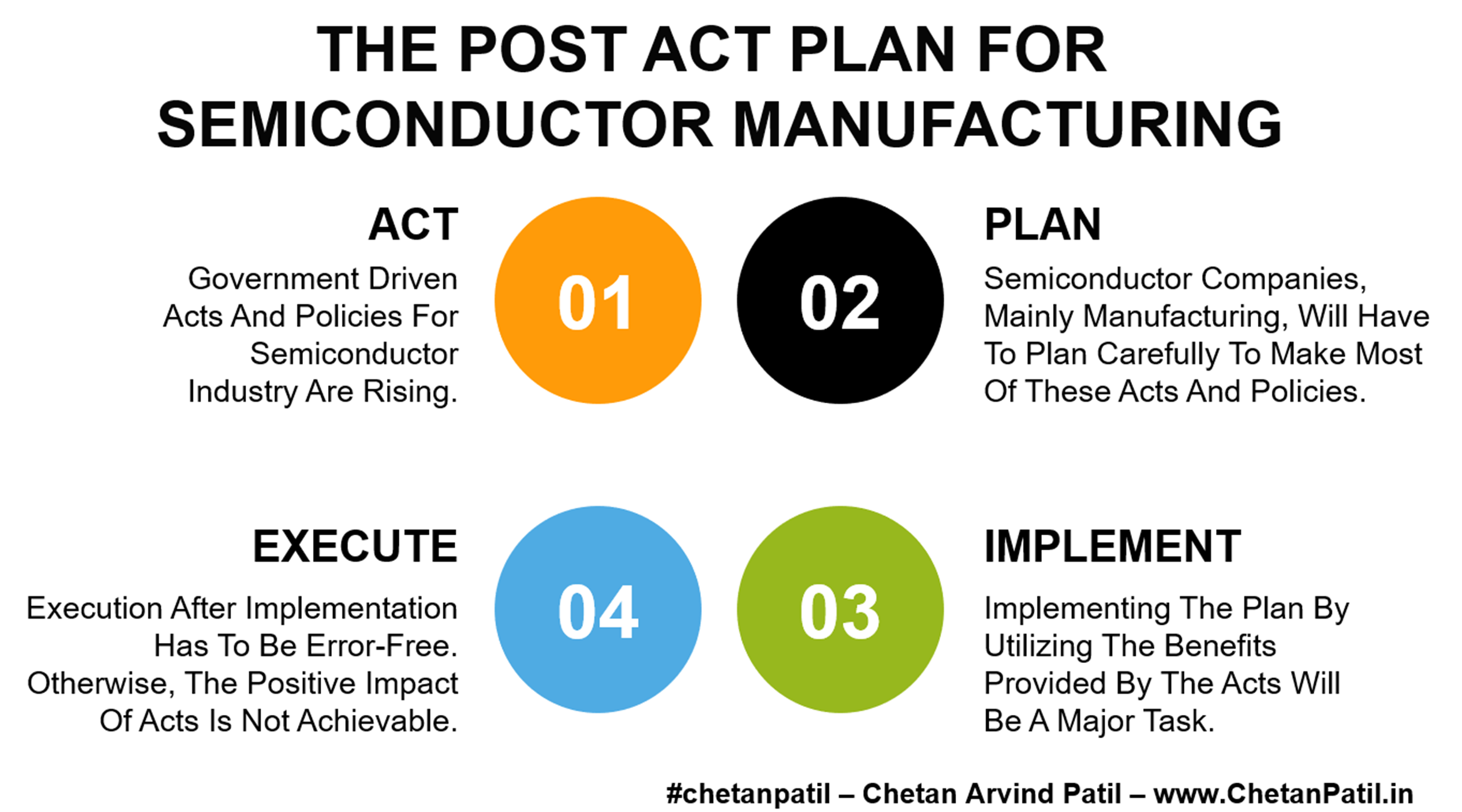
    Act: Government Driven Acts And Policies For Semiconductor Industry Are Rising.

    Plan: Semiconductor Companies, Mainly Manufacturing, Will Have To Plan Carefully To Make Most Of These Acts And Policies.

    While governments can drive different semiconductor industry-focused acts and policies, the crucial part is the process followed by the semiconductor industry after the government has approved new policies. And, to enable a positive impact demands an error-free plan, and certainly something achievable, from semiconductor companies.

    It should not happen that semiconductor companies are coming up with massive plans of expansion to leverage the incentives, and the execution parts lag. Such scenarios, if occurred, can end up creating a negative impact and might severely push the industry backward.


    Picture By Chetan Arvind Patil

    To leverage new acts, semiconductor companies should focus on the core strength to efficiently utilize benefits. There are several ways to do so:

    Expansion of design and manufacturing.

    Focus on mergers and acquisitions.

    Increase academia-industry collaboration.

    New joint ventures.

    And several other businesses and technology-driven decisions.

    All these approaches are not risk averse. It requires due diligence in the implementation and execution part. Doing so in the semiconductor business is more critical due to the long implementation time and high investment with slower than expected returns.

    Implement: Implementing The Plan By Utilizing The Benefits Provided By The Acts Will Be A Major Task.

    Execute: Execution After Implementation Has To Be Error-Free. Otherwise, The Positive Impact Of Acts Is Not Achievable.

    With new acts getting approved by different governments, there will be a sudden push for expansion. It is where companies will have to be very careful of over/under committing. The goal should be to ensure these acts are to power the next-gen solutions without any delay and cancellation.

    Governments slowly but surely are doing their part by providing the right impetus to enable the expansion of the in-country semiconductor ecosystem. Now it is on the semiconductor industry (mainly core and large companies) to focus on efficient use of the process to ensure continuous development of the semiconductor ecosystem.


  • The Impact Of Incentivizing Semiconductor Manufacturing

    The Impact Of Incentivizing Semiconductor Manufacturing

    Photo by Testalize.me on Unsplash


    Moore’s second law, or Rock’s law, states that the cost of a semiconductor manufacturing plant doubles every four years. It is in line with the increase in transistor density, which demands high-tech and advanced solutions which directly contribute to the cost of semiconductor manufacturing plant setup.

    As more countries around the globe gear up to attract new semiconductor manufacturing capacity, the investment component becomes the more crucial one and much more than the semiconductor technology itself. High investment involves risks, and to de-risk any future unknown issues, government support is often required. It is where incentives come into the picture and help push private players into building new FABs and OSATs.

    How much it costs to build a FAB/OSAT:

    MIN-FAB: ~$1 Billion+

    MEGA-FAB: ~$4 Billion+

    GIGA-FAB: ~$12 Billion+

    OSAT: ~$100 Million+

    Semiconductor technology and also semiconductor equipment decide the investment of next-gen semiconductor manufacturing plants. These two components together can increase the cost of a new facility significantly. High investment is also the primary reason to opt for the semiconductor technology that drives a faster break-even point.

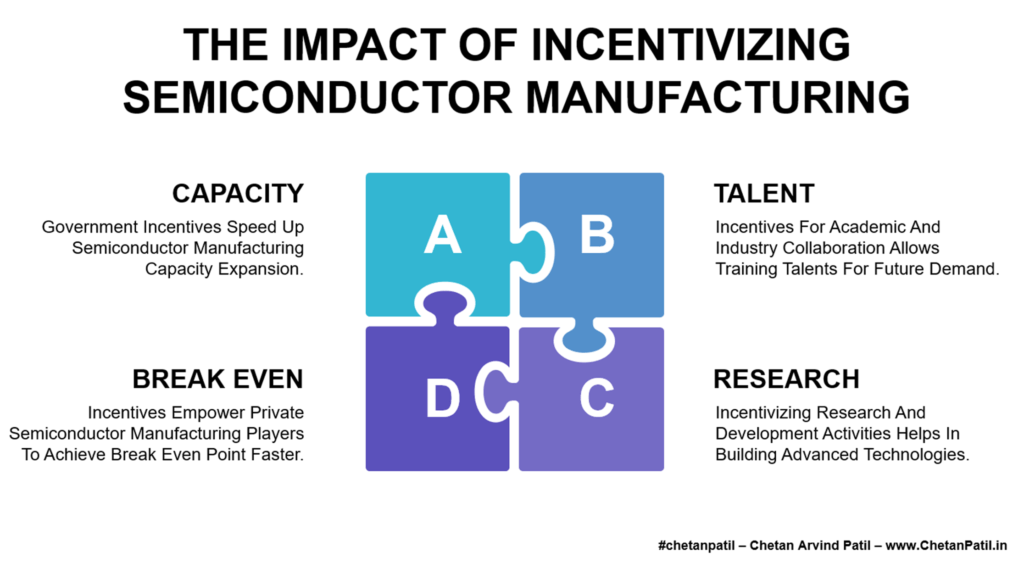
    Capacity: Incentives at the central/federal and state-level helps the building of new (and/or upgrading old) semiconductor manufacturing. Private players can take advantage of the tax or other related benefits/incentives to drive other semiconductor manufacturing-related activities like expanding existing facilities to drive future demand or hiring more human resources.

    Talent: Incentivizing semiconductor manufacturing empowers private players to hire more talents. In the long term, it also creates more job opportunities. Governments who provide an extensive incentive to universities for semiconductor research/education also encourage the training of high-tech talent. Countries like US and regions like Europe are two such examples apart from several Asian countries.

    The race to set up new capacity at new/existing semiconductor ecosystem is heating up. The factor that attracts investment in a semiconductor manufacturing plant is the incentive. Over the last decade, governments of countries that have heavily incentivized semiconductor manufacturing have seen an exponential increase in semiconductor manufacturing capacity. Taiwan, South Korea, Japan, and China are a few such examples.

    As more new semiconductor manufacturing regions come around the globe, governments must keep heavily incentivizing to drive next-gen semiconductor manufacturing infrastructure.


    Picture By Chetan Arvind Patil

    One of the most important long-term benefits of incentivizing semiconductor manufacturing is the long-term capacity building for the in-country requirement. Heavily depending on a high-tech solution like semiconductor is going to be a risk in the future.

    By incentivizing semiconductor manufacturing, private players can foster the growth of building a semiconductor ecosystem. Doing so can make any given country self-reliant concerning the semiconductor supply chain.

    Research: Incentives enable private players and universities to foster a research and development environment as companies/universities can divert the saved cost towards building the future advanced semiconductor logic to equipment.

    Break Even: Incentives also reduce the CapEx, which helps in achieving the break even point faster. It also reduces the liability and mitigates the business-related risk.

    The growing demand for semiconductor solutions in different day-to-day products is driving the need for new capacity. The only way to balance this capacity demand is by providing long-term incentives. To make the semiconductor FAB/OSAT a reality, a long-term strategic plan that balances the technical and business aspect is also required. It requires a handshake between the government and the private players.

    Governments with attractive incentives will win the battle of building a new semiconductor manufacturing capacity. Doing so will also empower countries to take control of in-county semiconductor demand.