Category: PRODUCT

  • The Productization Cycle Time In Semiconductor Development

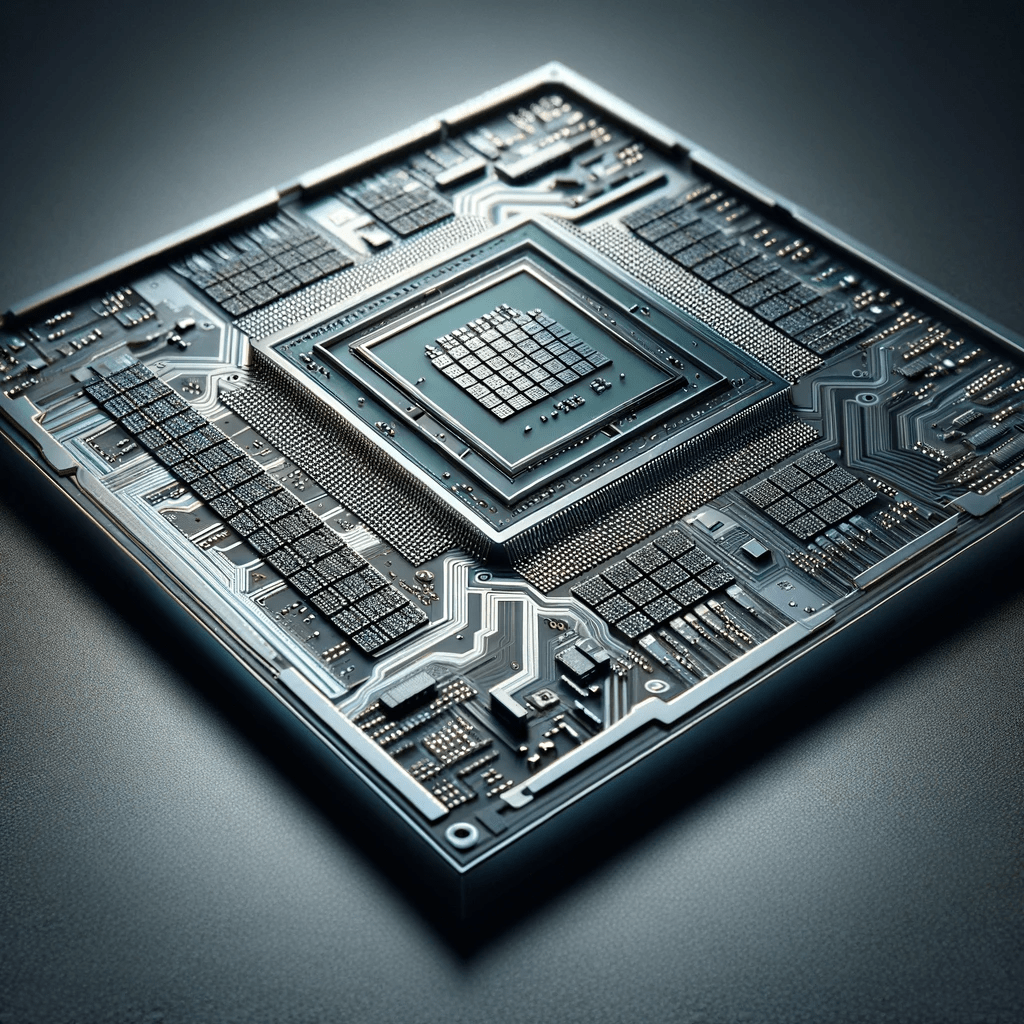
    Image Generated Using 4o


    What Is Semiconductor Productization Cycle Time?

    Semiconductor productization cycle time refers to the total duration required to transform a completed chip design into a fully qualified, production-ready product. It begins after the design is taped out and ends when the product is released to high-volume manufacturing with acceptable yield, quality, and system-level reliability. This period involves intensive cross-functional collaboration across silicon engineering, packaging, test development, validation, reliability, and supply chain.

    The cycle is not a single step but a structured series of technical handoffs, optimizations, and problem-solving phases. Each contributes to overall time-to-market and has a direct impact on cost, quality, and revenue generation.

    The key components of the productization cycle include:

    • Tapeout to first silicon readiness
    • Initial bring up and functional debug
    • ATE test program development and correlation
    • Package and assembly qualification
    • Reliability and standards-based qualification testing
    • Yield analysis and production ramp
    • Customer validation and system integration feedback

    Depending on the complexity of the product and the target market, this cycle can range from six months to over a year. Shortening the cycle without compromising quality is often a strategic priority, especially in competitive or regulated markets.

    In the long-term, managing this time effectively is what differentiates strong product execution from delayed or over-budget programs.


    Typical Timeline Of The Productization Cycle

    The productization cycle consists of several tightly coupled stages. Each stage has its own objectives, deliverables, and potential bottlenecks. While exact timelines vary depending on product complexity, market segment, and technology node, the typical range for a complete cycle is six to twelve months.

    The timeline below outlines each primary phase, its expected duration, and the core activities associated with it.

    StageEstimated DurationKey Activities
    First Silicon Readiness4 to 6 weeksTapeout to wafer delivery, packaging for evaluation
    Silicon Bringup2 to 6 weeksBasic functionality, register access, debug loops
    Test Program Development8 to 12 weeksATE pattern creation, DFT validation, test coverage
    Package Assembly4 to 6 weeksSubstrate readiness, thermal and form factor checks
    Reliability Qualification6 to 12 weeksHTOL, HAST, Temp Cycle, ESD, latch-up tests
    Yield Ramp and Optimization8 to 16 weeksProcess tuning, guardband validation, corner lots
    Customer Validation4 to 8 weeksApplication-level tests, system integration

    In many cases, some stages run in parallel to save time. For example, reliability testing and test program optimization may proceed concurrently after bringup. However, any failure in these parallel flows can lead to rework, which resets the clock for the affected stage.

    Thus, efficient productization requires not only strong technical execution but also program-level coordination to ensure each stage feeds smoothly into the next. Such a structure becomes even more critical when managing tape-outs across multiple products or process nodes.


    What Drives Productization Delays

    Delays in the productization cycle are common due to the technical complexity and cross-functional nature of semiconductor development. Common causes of delay include:

    • Incomplete Pre-Silicon Validation: Simulation fails to capture real-world corner cases that emerge only during bring-up
    • DFT and ATE Mismatch: Poor alignment between design-for-test features and test platform implementation slows test development
    • Packaging Issues: Packages may face late-stage problems with thermal, mechanical, or signal integrity
    • Qualification Failures: Reliability tests, such as HTOL or HAST, can fail, requiring debugging and retesting cycles
    • Yield Instability: Low or inconsistent yield across corners demands additional tuning and analysis
    • System-Level Gaps: Customer-side failures frequently result in late changes to silicon or test programs

    Even with detailed planning, issues often emerge from immature designs, process variability, and misaligned engineering handoffs.


    How Cycle Time Impacts Cost

    The productization cycle time has a direct impact on development costs. Each added week increases engineering effort, lab usage, and the need for additional silicon or packaging builds.

    These costs rise rapidly, especially for complex System-on-Chip (SoC) designs or high-reliability products. These longer cycles also stretch budgets and delay production, reducing the time available to recover investment.

    Delays also create opportunity costs. Missing key market windows or customer ramps can result in lost sales opportunities, lower selling prices, or even canceled projects.

    Underutilized equipment and late delivery in regulated markets may also trigger penalties. Managing cycle time effectively is essential for both technical execution and business success.


    Strategies To Optimize Productization Time

    Reducing productization cycle time requires more than just faster execution. It requires a structured, cross-functional approach that addresses bottlenecks, enhances handoff efficiency, and anticipates familiar sources of delay. Leading semiconductor companies treat productization as a tightly managed engineering flow, where technical readiness is synchronized with program planning and customer engagement. By front-loading risk and parallelizing key activities, teams can compress timelines without sacrificing quality or reliability.

    Below are the strategies to optimize productization time include:

    StrategyDescription
    Early Test DevelopmentBegin ATE pattern development and validation before first silicon using virtual test setups and simulations.
    First-Time-Right Design CultureEmphasize high-quality closure throughout the design cycle using linting, static checks, and sign-off tools to reduce post-silicon issues.
    Cross-Functional OwnershipAssign dedicated ownership early in the cycle to coordinate activities across design, test, validation, packaging, and customer engagement.
    Parallel Qualification and DebugRun reliability testing and test debug in parallel with early silicon to minimize serial dependencies.
    Unified Pre and Post-Silicon FlowAlign pre-silicon simulation environments with production test platforms to improve correlation and reduce transition time.
    Strong Data InfrastructureUse analytics tools for yield, failure analysis, and traceability to support faster debugging and feedback.
    Supplier and Customer IntegrationEngage OSATs, substrate vendors, and customers early to align requirements, timelines, and failure response plans.

    When these strategies are executed with discipline and data-driven feedback loops, teams can reduce cycle time significantly while improving first-pass success rates.

    Eventually, the result is not only faster product release but also greater cost control and more substantial customer confidence.

  • The Semiconductor Product Is More Than Just Silicon

    Image Generated Using 4o


    Silicon Alone Is Not The Product

    Silicon is the centerpiece of semiconductor innovation, but a bare die is not a product. What comes out of a foundry is an ultra-thin, unprotected sliver of silicon that cannot survive real-world application environments. It lacks mechanical durability, electrical connectivity, and environmental protection. No system designer can solder a raw die onto a board or expose it to industrial use conditions without risking catastrophic failure. The die may contain billions of transistors, but it is inaccessible and incomplete without packaging and interface layers.

    The core reasons why silicon is not a finished product:

    • It has no standard interface: external signals cannot connect directly to on-die metal pads
    • It lacks mechanical protection: dies are prone to cracks, delamination, and ESD damage
    • It cannot be mounted: without packaging, there is no board-level attach mechanism
    • It is unvalidated: operation under real voltage, temperature, and timing corners remains unknown
    • It is unqualified: the die has not passed JEDEC, AEC-Q, or industry-required reliability screening

    More importantly, silicon alone does not deliver functionality. Modern chips require configuration, calibration, and system-level interaction before performing as intended. A die sitting in a tray does not regulate power, process data, or handle sensor input. It must be connected to the rest of the system through physical packaging, embedded firmware, and electrical integration. Without this infrastructure, it cannot support its intended use case, let alone pass reliability or performance qualification for commercial deployment.

    Ultimately, productization is the bridge between die-level innovation and the end application. Without it, silicon remains a prototype, not a deliverable. The success of a semiconductor product lies not just in its design but in its transformation into a manufacturable, testable, and deployable solution.


    Engineering Beyond Silicon

    Once the die is fabricated, a deeper engineering phase begins, determining whether the silicon can become a reliable, shippable product. This phase involves translating the raw electrical design into a complete physical and functional unit. It is not enough for the die to meet spec in simulation. It must meet spec in the real world, in every corner case, and under every stress condition. This requires a systematic collaboration between packaging engineers, test engineers, validation teams, and firmware developers.

    ComponentRole In Productization
    Package DesignDetermines IO routing, power integrity, and thermal dissipation
    Test Program DevelopmentDefines coverage, test limits, and pass/fail criteria for each silicon lot
    Validation InfrastructureEnsures functionality across PVT (Process, Voltage, Temperature) conditions
    Qualification PlanningMaps out JEDEC, AEC, or custom reliability tests over production lots
    Firmware And CalibrationBrings up the chip, configures subsystems, and ensures device consistency

    Yield, Cost, And Time

    Even if a chip functions correctly. The success as a product depends on three tightly linked constraints: yield, cost, and time.

    High-performance silicon that yields poorly or takes too long to qualify often becomes commercially unviable. Yield losses can occur at multiple stages, such as wafer fabrication, packaging, final test, and system-level integration.

    For example, fab defects, package delamination, or test escapes can all degrade the number of good units. At the same time, some failures only emerge under real-world operating conditions like voltage droop or thermal cycling.

    A product that yields at 70 percent must absorb that loss into cost, and even modest increases in test time can significantly impact margins at high volumes. Time is equally critical delays in validation or qualification can miss market windows, resulting in lost design wins.

    Many chips fail not because they lack functionality but because they cannot meet volume, cost, or launch deadlines. Managing yield, price, and time in semiconductor productization is not optional, it is fundamental to delivering a viable product.


    Thinking In Terms Of The Whole Product

    A successful semiconductor product is more than a functional die, it results from coordinated engineering across design, packaging, testing, validation, and firmware. Teams that treat tape out as the finish line often face downstream failures that could have been avoided with system-level foresight.

    For instance, an SoC with impressive PPA may fail thermal targets due to poor package planning or require silicon respin because debug visibility was not designed. The product mindset starts at architecture, where tradeoffs are made for spec achievement, robustness, yield, and deployment efficiency.

    This approach demands that design decisions anticipate real-world constraints: ATE test time limits, handler thermal profiles, firmware bring-up timelines, and qualification windows. It also requires validation environments that reflect actual system use, not just block-level correctness.

    Teams considering the whole product build an observability plan for field failures and close the loop between lab data and production metrics. They succeed by designing high-performing silicon and delivering repeatable, validated, and field-ready semiconductor solutions.


  • The Critical Importance Of Semiconductor Product Development Skills

    Image Generated Using DALL-E


    What Is Semiconductor Product Development?

    Semiconductor product development is the intricate process of transforming innovative semiconductor designs into fully functional, market-ready products. It bridges the gap between conceptual ideas and real-world applications by integrating critical disciplines such as design, testing, validation, manufacturing, and packaging.

    This multifaceted process requires precision, meticulous planning, and seamless coordination across diverse teams, including silicon design, manufacturing, and beyond. Each stage is vital, as even minor errors can result in significant delays, increased costs, or product failures.

    More than just technical execution, semiconductor product development drives technological progress. It is the foundation for advancements in consumer electronics, artificial intelligence, autonomous vehicles, and renewable energy.


    Why Develop Skills For Semiconductor Product Development?

    The importance of semiconductor product development skills cannot be overstated, as they are essential for driving innovation, meeting market and customer needs, ensuring reliability, achieving cost efficiency, maintaining future relevance, and aligning with market projections.

    Product development skills empower professionals to anticipate and fulfill customer requirements, ensuring alignment with market needs and application-specific challenges. In aerospace, healthcare, and automotive industries, where reliability is paramount, these skills help ensure semiconductor products meet stringent quality and performance standards, fostering customer trust.

    Additionally, efficient product development reduces time-to-market and production costs, enabling companies to stay competitive by optimizing yield and minimizing resource wastage. The dynamic nature of the semiconductor industry necessitates continuous skill development to remain relevant and address emerging trends such as AI-driven optimization, quantum computing, and sustainable manufacturing practices.

    With the industry projected to grow significantly in the coming years, a strong skill set allows professionals to contribute effectively to product strategies, meeting current and future market needs.


    Talent Demand

    The demand for skilled professionals in semiconductor product development has reached unprecedented levels, fueled by the growing reliance on semiconductors across industries and the rapid pace of technological innovation.

    Despite the industry’s growth, a significant skill gap persists. Many companies face challenges in finding industry-ready professionals capable of managing the intricate processes involved in semiconductor product development, from design to manufacturing.

    The complexity of modern semiconductor products requires expertise across several key areas, including:

    • Product Design and Validation: Ensuring chips meet functional and performance requirements
    • Yield Improvement and Reliability Engineering: Enhancing production efficiency and product dependability
    • Advanced Packaging Techniques: Innovations like chiplet integration and 3D stacking which push the boundaries of performance and miniaturization

    Talent demand is also surging in semiconductor hubs such as the U.S., Taiwan, South Korea, and India. These regions are home to leading global companies and a rising wave of startups, creating abundant career opportunities and making them epicenters for semiconductor innovation. This confluence of market growth, specialized demand, and regional activity underscores the urgent need for skilled professionals to shape the future of semiconductor technology.


    Product Development And Market Correlation

    As these advancements unfold, the demand for professionals with expertise in testing, quality assurance, and yield improvement will rise. Companies will increasingly seek individuals with technical and interdisciplinary skills to navigate this evolving landscape. The rewards are immense for those who invest in developing these competencies, ranging from lucrative career and growth opportunities.

    In conclusion, semiconductor product development skills are the foundation of semiconductor product innovation. They ensure reliability, cost efficiency, and the creation of groundbreaking products. As the industry grows and evolves further, mastering these skills is not just an advantage but a necessity for thriving in this competitive and dynamic field.


  • The Implications Of AI Chatbots On Semiconductor Product Development

    Image Generated Using DALL-E


    AI Chatbot And Semiconductor Product Development

    Semiconductor product development will continue at the forefront of technological innovation, driving advancements in countless industries. As the demand for smaller, faster, and more efficient devices grows, the complexity of designing and manufacturing semiconductors will also escalate.

    Traditional methods, though foundational, are likely to need more support under the increasing pressure for rapid prototyping, reduced time-to-market, and uncompromising product reliability. This challenge calls for transformative solutions, bridging the gap between innovation and efficiency.

    AI chatbots, with their advanced natural language processing (NLP) and machine learning (ML) capabilities, promise to be the game-changers the industry needs. These intelligent tools will not only address these growing challenges but will also uncover new opportunities.

    Let us take a brief view about the status and implication of AI Chatbots from semiconductor product development point of view.

    Key Roles of AI Chatbots In Semiconductor Product Development

    AI chatbots will transform semiconductor product development by addressing some of its most pressing challenges. One of their key roles will be accelerating design cycles and assisting engineers with tasks like schematic development, layout optimization, and simulation analysis. By integrating seamlessly with Electronic Design Automation (EDA) tools, chatbots will provide real-time feedback, highlight potential issues, and suggest improvements.

    It will reduce errors and significantly shorten the time required to iterate on complex designs. Additionally, AI chatbots will enhance team collaboration by acting as centralized communication hubs, streamlining project updates, task assignments, and data sharing, ensuring alignment and efficiency throughout the development process.

    RoleDescriptionExample
    Accelerating Design CyclesAssists in schematic development, layout optimization, and simulation by suggesting improvements.Debugging circuit designs or recommending layout optimizations integrated with EDA tools.
    Streamlining CollaborationActs as a communication hub to enhance teamwork across design, testing, and manufacturing teams.Summarizing project updates, tracking progress, and resolving scheduling conflicts.
    Enhancing Data AnalysisProcesses and summarizes data from testing and validation to highlight key metrics.Identifying anomalies in test data and providing actionable insights to engineers.
    Supporting Knowledge ManagementStores and retrieves technical knowledge to ensure continuity and reduce onboarding time.Helping new employees access critical design documentation and troubleshooting guides easily.
    Enabling Real-Time Problem SolvingAnalyzes manufacturing data in real time and recommends corrective actions to maintain quality.Alerting engineers to process deviations and suggesting solutions to minimize downtime.

    Another critical role of AI chatbots will be managing and interpreting the vast amounts of data generated during semiconductor testing and validation. They will excel at analyzing test results, identifying anomalies, and summarizing key performance metrics, enabling faster troubleshooting and decision-making.

    Moreover, chatbots will play a pivotal part in knowledge management by storing and retrieving critical information, reducing the onboarding time for new employees, and ensuring that valuable expertise is retained within the organization. By enabling real-time problem-solving and process monitoring, AI chatbots will enhance productivity and improve semiconductor product’s overall quality and reliability.

    Examples Of Semiconductor Focused AI Chatbots

    The GitHub repository Awesome-LLM4EDA compiles resources on the application of Large Language Models (LLMs) in Electronic Design Automation (EDA). Among these resources, several AI chatbots are highlighted for their roles in semiconductor product development. Below is a table summarizing these chatbots:

    ChatbotDescription
    ChipNeMo: Domain-Adapted LLMs for Chip DesignA chatbot that leverages domain-adapted LLMs to assist in various aspects of chip design, providing tailored support and insights specific to semiconductor development.
    New Interaction Paradigm for Complex EDA Software Leveraging GPTIntroduces a novel interaction paradigm utilizing GPT models to enhance user engagement with complex EDA software, simplifying workflows and improving efficiency.
    From English to PCSEL: LLM Helps Design and Optimize Photonic Crystal Surface Emitting LasersUtilizes LLMs to translate natural language specifications into designs for photonic crystal surface-emitting lasers, streamlining the design process and reducing the need for extensive manual coding.
    RapidGPT: Your Ultimate HDL Pair-DesignerActs as a pair-designer for Hardware Description Language (HDL), assisting engineers in code generation, debugging, and optimization, thereby accelerating the development cycle.
    EDA Corpus: A Large Language Model Dataset for Enhanced Interaction with OpenROADProvides a comprehensive dataset designed to train LLMs for improved interaction with the OpenROAD EDA tool, facilitating more intuitive and effective user experiences.

    These chatbots exemplify the integration of AI into semiconductor product development, offering innovative solutions to enhance design efficiency, collaboration, and overall productivity.

    Market Outlook For AI Chatbot For Semiconductor

    The market for AI chatbots in semiconductor product development is poised for significant growth as the industry increasingly integrates AI into its workflows. While the exact figures for AI chatbot adoption specifically in semiconductor development are still in the development stage, the broader AI in semiconductor market is projected to grow substantially, with estimates exceeding $100 billion by 2030, driven by advancements in AI and machine learning technologies.

    One of the most marketing arguments for integrating AI chatbots into semiconductor workflows is the significant cost and efficiency gains they offer. Chatbots excel at automating repetitive and time-consuming tasks, such as debugging, data analysis, and report generation, which can otherwise consume valuable engineering hours.

    In summary, the market for AI chatbots in semiconductor product development is at an inflection point, offering immense opportunities for growth and innovation. Early adopters will benefit from enhanced productivity, reduced costs, and faster time-to-market, making this an area to watch closely in the coming years.


  • The Skills Needed To Improve The Yield And Test Time Of A Semiconductor Product

    Image Generated Using DALL-E


    In the fast-paced world of semiconductor product development, two metrics stand out as pivotal to the success and efficiency of manufacturing: yield and test time.

    Yield, the percentage of functional chips in a production batch, directly influences the cost-effectiveness and viability of semiconductor products. Simultaneously, test time, the duration spent verifying the functionality and reliability of these chips, plays a crucial role in determining the throughput and overall efficiency of the production process.

    Thus, it is essential to understand the intricacies of yield and test time in semiconductor manufacturing, exploring their significance, challenges, and the vital skills required to optimize these critical factors.

    Yield In Semiconductor Product Development:

    Yield refers to the proportion of functional chips produced from a batch in semiconductor manufacturing. It’s a critical factor in determining the cost-effectiveness of the manufacturing process because higher yields mean more functional chips per batch, reducing the cost per chip.

    The complex semiconductor manufacturing process, involving steps like oxidation, coating, lithography, and etching, poses significant yield challenges. Each wafer undergoes hundreds of high-precision processes over three to six months and must pass stringent quality tests.

    Yield analysis has evolved from a simple comparison of good and bad units to a more sophisticated approach involving data science. This deeper analysis helps in understanding and mitigating a range of factors that contribute to yield issues.

    Test Time In Semiconductor Product Development:

    Test time in semiconductor manufacturing refers to the duration spent testing the chips for functionality and reliability. Reducing test time is essential for decreasing running costs and improving manufacturing throughput.

    Key strategies to reduce test time include eliminating redundant tests, reordering tests to screen out significant failures early, and sample testing or removing “always passing” tests. This approach requires a deep understanding of device behavior.

    Virtual testing methodologies can significantly reduce the overall product development time for semiconductors. It allows for earlier detection of potential issues and streamlines the development process.​


    Picture By Chetan Arvind Patil

    Skills Needed To Improve Yield And Test Time:

    Deep Technical Knowledge: Understanding the intricate details of semiconductor manufacturing processes and the behavior of devices is essential. This knowledge enables engineers to identify and address yield issues effectively and to streamline testing processes.

    Data Analysis And Yield Modeling: Data science and analytics skills are crucial for yield analysis. Engineers must use yield modeling tools to identify design and process-related issues.

    Design For Testability (DFT) Expertise: Engineers should have expertise in designing chips with testability in mind. It involves creating more straightforward test and diagnose designs, thus improving yield and reducing test time.

    Process Optimization: Skills in process optimization, removing redundant steps in manufacturing and testing, are vital. It includes reengineering test flows and optimizing test programs.

    Familiarity With Virtual Testing Tools: Knowledge of virtual testing methodologies and tools can help reduce product development time and early issue detection.

    Adaptability To Technological Advances: As semiconductor technology evolves, staying updated with the latest methodologies and tools is crucial for continuous yield and test time improvement.

    Collaborative Skills: Working effectively with cross-functional teams, including design, manufacturing, and quality assurance, is essential for holistic improvements in yield and test time.

    In conclusion, mastering the aspects of yield and test time is indispensable in the realm of semiconductor manufacturing. The journey from understanding the complexities of these factors to effectively implementing strategies for improvement requires a blend of technical acumen, analytical prowess, and innovative thinking.

    Professionals in the field must continually evolve, embracing new methodologies and technologies to stay ahead in this dynamic industry. The enhancement of yield and test time bolsters production efficiency and serves as a cornerstone for the business success and technological advancement of semiconductor products.


  • The Semiconductor Puzzle To Build End Products

    The Semiconductor Puzzle To Build End Products

    Photo by Oleg Gospodarec on Unsplash


    There are thousands of different types of semiconductor chips in the market. Year after year, the number is only increasing. Thus, creating a large pool of options to choose from while also enabling customers with different feature sets.

    Ideally, this should be positive news for companies using semiconductor chips to build end products. However, such an increase in options is also creating a situation where it is slowly becoming difficult to narrow down the specific types of chips one should use to build the end products for the mass market.

    Application: Application Requirement Are Key To Building The Right End Product Using Semiconductor Chips.

    Feature: Listing Down Features Is A Better Approach To Narrow On Specific Semiconductor Chips To Use.

    Take an example of an integrated circuit with logic devices. At any given point, there are close to 90,000 different options. The same is the case with power management integrated circuits, where the number grows to 300,000. Searching for the correct semiconductor chips from a large set of options (that too, two of the several other semiconductor segments) is nothing less than finding a needle in a haystack.

    Is there a way to solve this problem and thus enable faster decision-making? In reality, there is no better approach to tackle such a problem. Nevertheless, companies can opt for a step-by-step approach to narrow down specific types of chips that will help build the envisioned end products, and this requires immense focus on the selection process.


    Picture By Chetan Arvind Patil

    There are sets of processes that can help in faster decisions on selecting silicon chips. However, the fundamental approach should always include a detailed analysis of the target application, as it allows companies to focus on specific types of chips to narrow on.

    As a next step, based on the list narrowed as per the application type, the focus should shift to the features. If the same chip can provide different features per application type, it should be preferred rather than opting for several chips.

    Search: Searching Through Thousands Of Different Types Of Options Is A Time And Cost-Intensive Process.

    Product: Building A Product With Semiconductor Chips Is All About Finding The Right Set Of Different Types Of Chips.

    Finding a perfect match of features based on the target application solves more than half of the puzzle to build next-gen end products. In the future, such a process will be far easier when AI-enabled software tools drive efficient searches to help system engineers come to a decision faster than ever.

    As the semiconductor industry marches ahead of trillion devices, the chip selection process for the end product will become more vital than ever. It will also define the flow for manufacturing future next-gen silicon-driven end products.


  • The Semiconductor Enabling Technology

    Photo by John Jemison on Unsplash


    Developing new consumer and enterprise technology requires a new type of semiconductor technology, ranging from design, raw materials, equipment, packaging, fabrication, manufacturing, and many more segments of semiconductors.

    These technologies developed are called semiconductor enabling technology. Enabling technology brings a new type of semiconductor solution. These solutions push new products with features that are more efficient than ever.

    Few examples of enabling technology:

    xFETs

    Silicon Interposers

    Next-Gen xUV Equipment

    Advanced Automated Tools

    High-Speed Memory Interfaces

    New Semiconductor Packaging Solution

    And The List Goes On.

    Semiconductor enabling technologies are not easier to develop and do require thorough research and development. Even then, the probability of bringing a new enabling technology is low. Thus, as the first step, semiconductor companies should find the pressing issues in the existing solutions and then chart out a detailed plan to ensure the solution is error-free and has gone through a thorough validation plan.

    Research: Semiconductor Research And Development Is Key To Enabling New Technologies.

    Development: New Semiconductor Technology Demands Long-Term Investment.

    As with several high-tech industries, the cost to research and develop a semiconductor product is very high. Therefore, it makes the process of developing new solutions crucial and fragile. It also means investing in resources for the long term along with a backup plan in case of failure.


    Picture By Chetan Arvind Patil

    Knowledge building is key to finding if there is a fit for the new semiconductor-enabling technology. It focuses on ensuring the processes or new solutions developed will not only provide new features but will also fit in the semiconductor roadmap to bring the much-needed benefits.

    Building knowledge is about capturing the correct information by empowering the right resources. And doing so requires experienced talents who can figure out the possibilities of new semiconductor enabling technology and how it will best fit the requirements of future products.

    Knowledge: Building Knowledge Of New Semiconductor Solutions Requires Time And Resources.

    Implementation: Knowledge Coupled With Market Fit Is Must Before Implementing The Enabling Solutions.

    An example is an interposer. It not only found the perfect fit, but the solution pushed the semiconductor packaging industry towards a new era.

    As the semiconductor industry moves forward, more semiconductor solutions will reach different types of technical and business walls, and to overcome them, more futuristic semiconductor-enabling technologies will play a key role, and now is the right time to develop such solutions.


  • The Productization Phase Of Semiconductor

    The Productization Phase Of Semiconductor

    Photo by Glen Carrie on Unsplash


    New silicon-powered products should have advanced features. These features also have to differentiate from the existing ones. Otherwise, the probability of success in the market will be very low. On the opposite side, the new semiconductor technology development is slowing down due to the need to find solutions that meet More-Than-Moore requirements. All of this is also delaying new features at the die level. However, the semiconductor industry still has to bring new products.

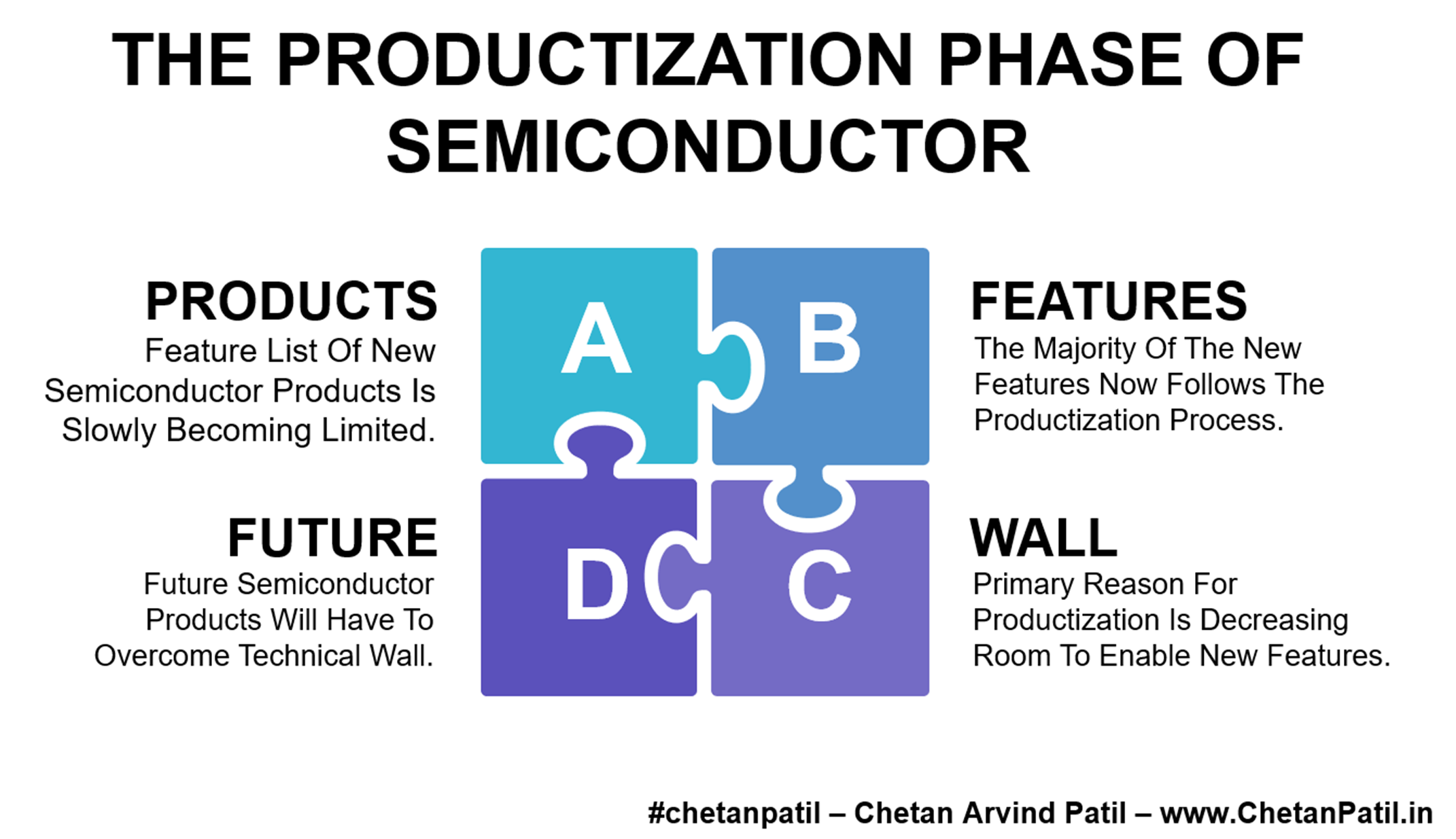
    Products: Feature List Of New Semiconductor Products Is Slowly Becoming Limited.

    Features: The Majority Of The New Features Now Follows The Productization Process.

    To tackle the dilemma of new features vs the ability to use new technology nodes, a productization path is being taken. Using productization, semiconductor companies can make use of existing and proven technology nodes to drive new features. Even though the design and manufacturing process is not able to use the latest technology node or assembly processes, the end goal of providing new types of products is still achieved.

    What Is Productization: A Process Of Turning An Existing Technology Into An Repeatable Effort To Enable New Products.

    Productization is not always positive news as it hinders the ability to provide more features in the new products. Take the example of XPUs. The rate of launching new XPUs is faster than the ability to enable new semiconductor technology at the die level that makes up the XPUs. On another side, there is a need to keep enabling the computing industry with new types of XPUs.

    To balance these two scenarios, XPU-focused companies take the middle path and keep providing new types of XPUs by leveraging the block level optimization while building new semiconductor technologies that can, later on, provide a needed larger push towards a new era of XPUs.


    Picture By Chetan Arvind Patil

    In many cases, productization can also be taken as a negative scenario. However, it is another business process using which new products get launched to meet the end goal of enabling new products in the market. A similar productization process has been used by different industries including automotive, consumer electronics, and several others.

    When it comes to the semiconductor industry, the fundamental reason to make use of productization is to overcome the technology wall which has hindered the ability to enable next-gen features. While the design processes are still able to make use of old semiconductor technology to enable new efficient products, however, the road to keep doing so is sooner or later going to end.

    Wall: Primary Reason For Productization Is Decreasing Room To Enable New Features.

    Future: Future Semiconductor Products Will Have To Overcome Technical Wall.

    With the rate at which the semiconductor use case is speeding up, productization can help cater to several use cases which do not demand or need the latest semiconductor technology. However, there will come a point where these types of use cases will also need the new silicon-level technology.

    In summary, as part of a long-term strategy, the semiconductor industry will have to cut down the time to enable next-gen semiconductor solutions (mainly nodes, FETs, and lithography solutions). Otherwise, even the productization process will not be able to help in the long term.


  • The Impact Of Semiconductor Chiplets On Design And Manufacturing

    The Impact Of Semiconductor Chiplets On Design And Manufacturing

    Photo by Thomas Jensen on Unsplash


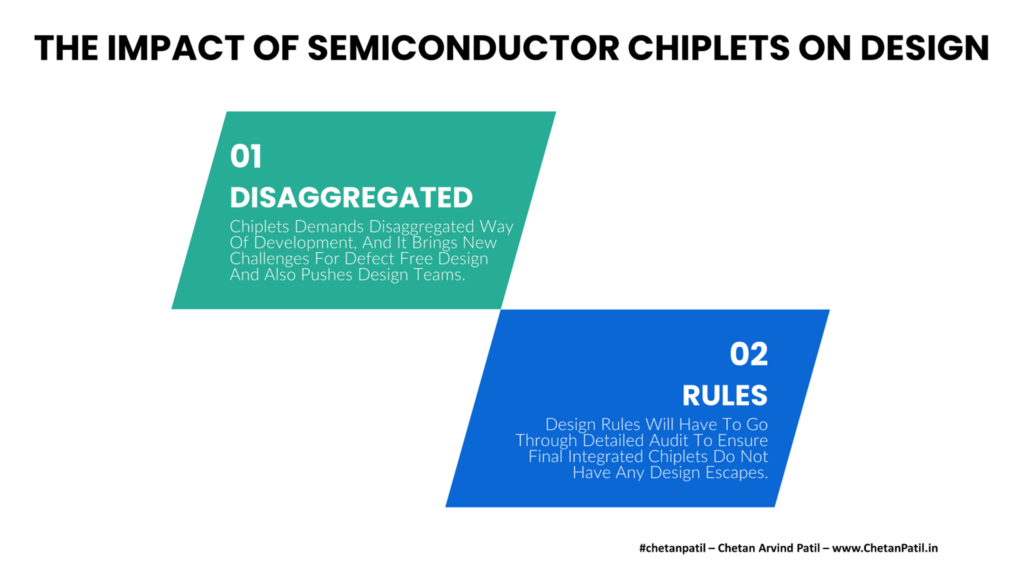
    THE IMPACT OF SEMICONDUCTOR CHIPLETS ON DESIGN

    The process of developing chiplets based silicon chips (mainly XPUs) demands new semiconductor design and manufacturing methods. These methods are not drastically different than what the semiconductor industry developed in the last few decades. Still, the product development steps have to adopt to ensure chiplets are a success in the long run.

    These changes impact both the semiconductor design and manufacturing stages. Thus, both the design and manufacturing companies need to take a fresh look at how to approach chiplets inspired products so that all such products still meet industry standards without compromising on the quality,

    Disaggregated: Chiplets demand N number of chiplet to get designed individually, and during the post-manufacturing stage, this N chiplet needs to work together as a single system. It requires designers to simulate the chip at the die/chiplet level and then at the chiplets (as a single system) level. It is not a new process, but when it comes to complex chiplets inspired products (XPUs based on chiplets), there is a high risk of design escape.

    Rules: At the individual die or chiplet level, design rules today are more robust than ever. Couple this with the designer’s experience, and the error rate goes to near-zero. However, chiplets will work if the integrated chiplet will. It makes the application of design rules at the chiplets level critical, and that too without any design rule escape. Simulation and verification certainly try to reduce such issues. In reality, there will be lessons learned when it comes to design rules escape at the chiplets level.

    When it comes to semiconductor design, the fundamental approach that chiplets changes are the disaggregated way of designing the same chip that otherwise would have been a single design file. Another impact is the design rules that ensure there is never an escape, but that also requires a fresh outlook for chiplets way of designing.

    Semiconductor design so far has been more about single-die design. With chiplets, the level of design complexity increases tenfold. However, the complexity and the impact of chiplets are not only limited to the semiconductor design. Semiconductor manufacturing also has to go through process-level changes to ensure that the manufacturing aspect of the chiplets does not become a show stopper in the long run.


    Picture By Chetan Arvind Patil

    Picture By Chetan Arvind Patil

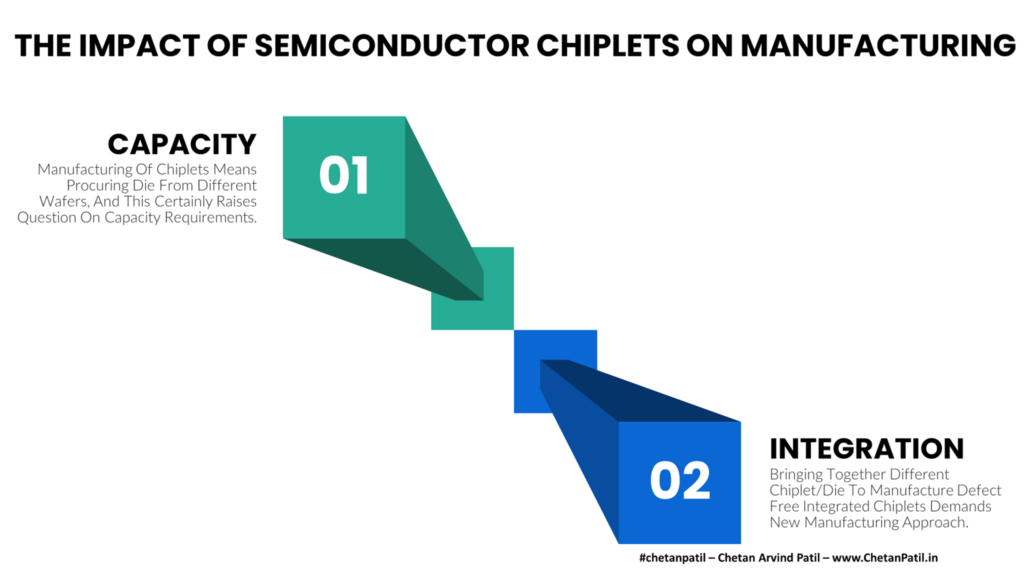
    THE IMPACT OF SEMICONDUCTOR CHIPLETS ON MANUFACTURING

    The impact of chiplets is also applicable to the semiconductor manufacturing aspect of semiconductor product development. The primary reason is again the disaggregated way of designing. In the end, chiplets are an integrated system, and making it work at the semiconductor manufacturing stage is more complex than it seems.

    The two critical impacts of chiplets on semiconductor manufacturing are capacity handling and managing integration (assembly mostly). These two impacts also mean a new outlook towards supply chain management.

    Capacity: Fabricating, assembling, and testing N number of chiplet to form a single chiplets does demand a new approach towards manufacturing capacity planning. The planners have to track and trace each and every chiplet that will become part of the chiplets. This may not have a very drastic impact on the capacity, but from the supply chain point of view, chiplets certainly bring a new level of complexity (and opportunity). Given the final part of the manufacturing occurs at the back end side (assembly/testing), error-free planning and traceability are required to capture any kind of manufacturing escapes.

    Integration: Integrating several chiplet to create a single chiplets is not an easy task. On top, to ensure the manufactured chiplets meets industry standards, the semiconductor manufacturing companies have to create a new set of process that drives the fabrication and assembling of chiplets based products. As more semiconductor design companies opt for the chiplets process, the need for a new integrated manufacturing system will increase, and this demands semiconductor manufacturing companies to be ready ahead of time.

    The race to provide solutions beyond Moore’s law demands new approaches. Chiplets is one such technology and requires a fresh outlook towards semiconductor design and manufacturing. As more semiconductor companies opt for chiplets and similar heterogeneous packaging solutions, the need to adapt the semiconductor design and manufacturing aspect will change.

    In the end, chiplets will push the semiconductor industry towards a new era, and hopefully, the long-term impact is nothing but all positive.


  • The Requirements And Challenges Of Semiconductor Product Development

    The Requirements And Challenges Of Semiconductor Product Development

    Photo by Brian Kostiuk on Unsplash


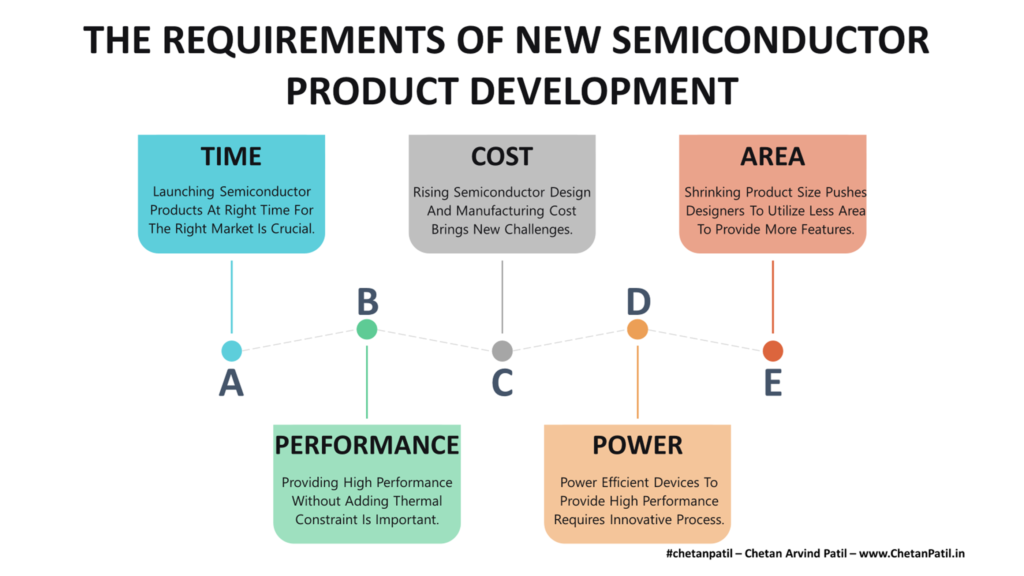
    THE REQUIREMENTS OF NEW SEMICONDUCTOR PRODUCT DEVELOPMENT

    The semiconductor industry is driving on top of the products that different companies introduce. These semiconductor products have to go through complex product development procedures to fulfill strict technical and business requirements. That makes the planning and strategy aspect of development vital.

    Technology (devices and package side) progress in the semiconductor industry has powered designers and manufacturers with resources to develop highly complex semiconductor products. These technological advancements have enabled much smaller and portable semiconductor-powered products than ever before.

    More options and features on semiconductor design and manufacturing are a bonus for both companies and their customers. However, the wide range of the device to transistor-level characteristics also means that the requirements to drive new semiconductor product development are getting stricter and thus leaves no room for error.

    Time: Semiconductor products have to go through a different process and validation steps, and this makes the planning of the design and the manufacturing phase a crucial step. Any slip or delay can give competitors an advantage. On top of that, the fast rate at which the different and new semiconductor-powered solutions (smartphones to automotive) are getting launched also puts pressure to ensure that any new semiconductor products are developed at the right time to meet the market/customer requirements.

    Cost: The cost of semiconductor manufacturing is increasing, mainly due to the progress in technology nodes, package technology, and also new automated equipment. Thus, selecting the right combination of semiconductor technology is a crucial step, as it directly affects the cost of manufacturing.

    Area: The shrinking device size (and also new vertical package technologies) means new semiconductor products can power new features in a small chip area. However, doing so demands a mechanism to ensure no design or manufacturing rules get violated. On top of this, the smaller size also means less space to provide more new advanced features. As the technology-node and package technology have made progress, the semiconductor products are also getting designed with the smallest footprints possible.

    Performance: The world is moving at a faster rate than ever. The wireless connected solutions to high-speed computers are all demanding fast processing. Enabling the high-performance (faster decision-making) feature in semiconductor solutions is a vital requirement. While not all silicon products get designed for faster processing, there are several application areas where a quick decision (airbag deployment)) is still the most basic requirement.

    Power: Apart from performance and area, managing power consumption is another de-facto criteria for several semiconductor products. The requirement of power management varies based on the application of the semiconductor product. In the long run, it becomes a very challenging task to managing power without having the room to provide an area for thermal management.

    Balancing all of the above requirements of a new semiconductor product is not an easy task. It requires resources to drive the vision of developing a semiconductor product that can take over the market. That is why today, there are companies (mainly in the XPU segment) that are taking new paths (chiplets, heterogeneous, wafer-scale engine, etc.) to develop new semiconductor products for their end customers.

    As the barrier of entry in the semiconductor industry (from the design point of view – FAB-LESS) has lowered, the competition of developing products loaded with new features has grown too. This has put a lot of pressure on companies to design new techniques that can provide critical features (response time, battery life, heating, etc.) to make their products stand out in the market.


    Picture By Chetan Arvind Patil

    Picture By Chetan Arvind Patil

    THE CHALLENGES OF NEW SEMICONDUCTOR PRODUCT DEVELOPMENT

    The majority of semiconductor products are designed and manufactured by considering the cost and time requirement. These two vital requirements also bring new challenges to the design and the manufacturing houses.

    Ensuring the products meet all the customer requirements has made the development of new semiconductors a challenging process. These challenges are faced by every semiconductor product, irrespective of the company developing it.

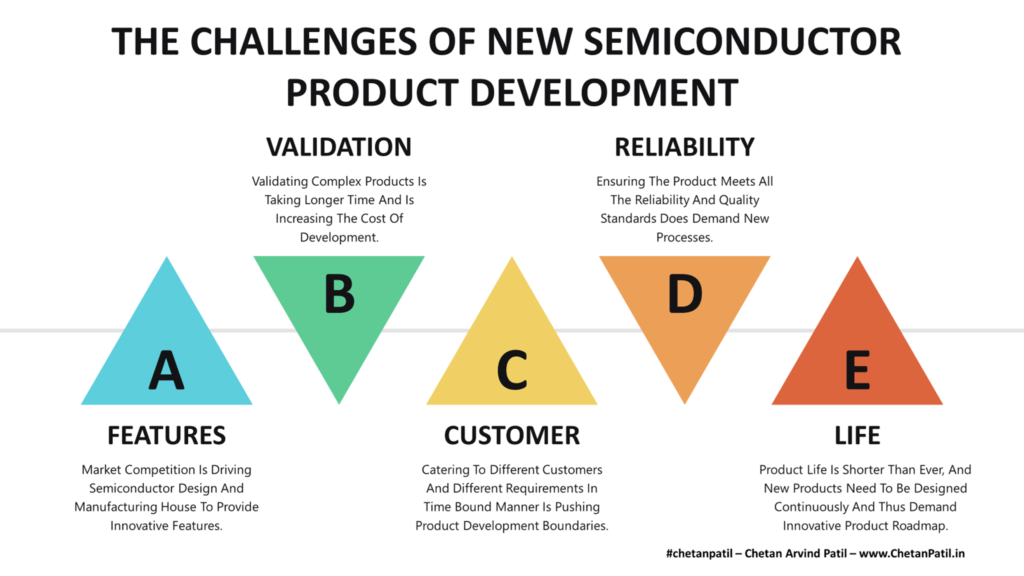
    Features: The number of FAB-LESS companies in the semiconductor industry has grown over the last few decades, and has increased the level of competition in the semiconductor new product market. It also means that every other product is equipped with new innovative features like new manufacturing methodology (chiplets) to utilizing new-age devices (MBCFET). The urge to provide new features to differentiate semiconductor products in the market is a challenging task, and it will keep getting more challenging due to the push towards newer semiconductor devices and also manufacturing processes (nodes).

    Validation: Ensuring the new product meets all the requirements and specification is vital. Thus depending upon the application area, the validation standards change too. The longer the validation process takes, the higher the cost associated with it and makes the semiconductor post-silicon efforts in a complex activity wherein both time and cost are to be managed.

    Customer: In the end, semiconductor products will be used by different customers. Understanding and catering to the different customers (and their market) is an important building block of a successful product. The most crucial challenge is to ensure that the product can be developed in the shortest timeline while also providing the rich set of features that the market is pushing semiconductor companies to provide.

    Reliability: New reliability standards are getting proposed to drive higher quality. The major reason for doing so is to meet the new requirements due to ever-advancing silicon/transistor level solutions that require detailed reliability checks to ensure the product does not fail in the field. While this brings cost and time challenges, the efforts required to enable new processes are an added challenge.

    Life: New features coupled with changing market demand are shortening the life of semiconductor products. The short market life of semiconductor products means continuous new product launches. This is the primary reason why every year there is a new generation of XPUs that are being launched with new design and manufacturing solutions. The growing market and competition will further drive down the semiconductor product life from decades to years.

    The standards and set process used by the semiconductor industry allow them to overcome the majority of the above challenges. The high-end equipment to design rules to process recipes has already empowered semiconductor houses to develop the first time right semiconductor product. The future challenges are more towards balancing the advancing technology with the cost, resources, and time in hand. Companies that will not be able to balance all these will face tough competition in the semiconductor market.

    In the next few upcoming years, several new (5G/6G, electric cars, etc.) opportunities will come up for the semiconductor industry. All new challenges will drive the semiconductor industry toward new semiconductor product solutions that cater to different requirements while ensuring the product meets the customer’s expectations.