Category: ROADMAP

  • The Need To Integrate Semiconductor Die And Package Roadmap

    The Need To Integrate Semiconductor Die And Package Roadmap

    Photo by Vishnu Mohanan on Unsplash


    Several semiconductor industry-wide roadmaps are planned and released by semiconductor companies and also different technical semiconductor groups. These semiconductor roadmaps are vital in providing glimpses of future semiconductor technologies and how they will shape silicon products.

    Out of all the semiconductor roadmaps, the two most critical are the die roadmap and the package roadmap. These two roadmaps are drafted by separate technological groups apart from different roadmaps from semiconductor companies. There is no question that these roadmaps provide a way to design and manufacture next-gen silicon products to transform industries relying on semiconductors.

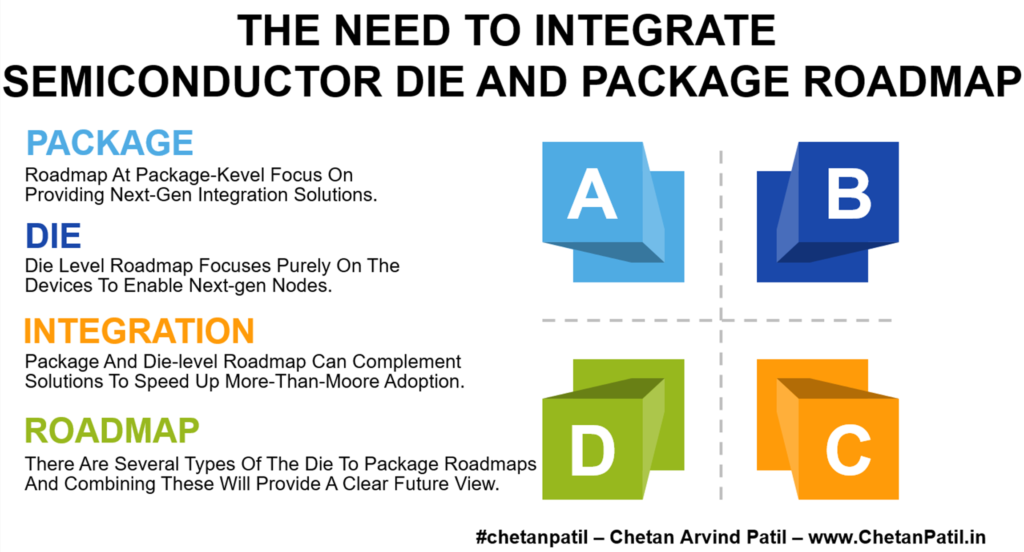
    Package: Roadmap at package-level focus on providing next-gen integration solutions.

    Die: Die level roadmap focuses purely on the devices to enable next-gen nodes.

    However, today, the semiconductor industry is at the cross-section where the die and package solutions complement each other. In doing so, these two semiconductor technologies are pushing the semiconductor industry to adopt More-Than-Moore solutions. This intersection of technology and business goals should be the primary reason the semiconductor industry should find an integrated roadmap to provide a clear view of die and package solutions that can come together to provide more advanced solutions than ever.

    Combining die and package-level roadmaps will also allow faster development of support systems. One example is chiplets, which need universal standards to combine die and package-level components to provide robust, economical, and industry-friendly More-Than-Moore solutions.

    Picture By Chetan Arvind Patil

    There is no denying that individual die and package-level roadmaps have sections that focus on solutions to provide a common technological platform. Even then, when it comes to implementation, several bottlenecks are present in the design to manufacturing stages. These bottlenecks range from technical (standards, yield, material, etc.) to business issues (cost, capacity, etc.). An integrated roadmap with a focus on how the industry can overcome these challenges is needed.

    An integrated roadmap can also provide a clear view to enable flawless integration of next-gen die and packages to drive faster adoption towards the More-Than-Moore era.

    Integration: Package and die-level roadmap can complement solutions to speed up More-Than-Moore adoption.

    Roadmap: There are several types of the die to package roadmaps and combining these will provide a clear future view.

    Advancement in die and package-level solutions will continue for decades. Also, the need to stack dies and packages to provide integrated solutions for the architectures like chiplets and flexible electronics will continue to rise.

    Thus, for the angstrom era and the long-term innovation in the semiconductor industry, faster adoption of integrated design and manufacturing approaches for the die and package scaling will be crucial. Achieving this goal will require continuous work on an integrated die and package roadmap.

  • The Semiconductor Journey Ahead

    The Semiconductor Journey Ahead

    Photo by Emma Francis on Unsplash


    The semiconductor industry is going through one of the most exciting phases. Worldwide the demand for semiconductor-powered products is increasing and driving very high silicon demand that the semiconductor industry has never seen before. It has also re-ignited the debate to build more semiconductor design and manufacturing capacity, which in the long run is going to empower the semiconductor businesses and will increase the market reach.

    The spike in semiconductor demand also means that the industry will touch the trillion-dollar market. The path the semiconductor industry took to reach half of it has taken several decades, and in a very short time, it is set to grow by 50%. It showcases how the last few years have fueled the demand, and there is no denying that it will stay like this for years to come.

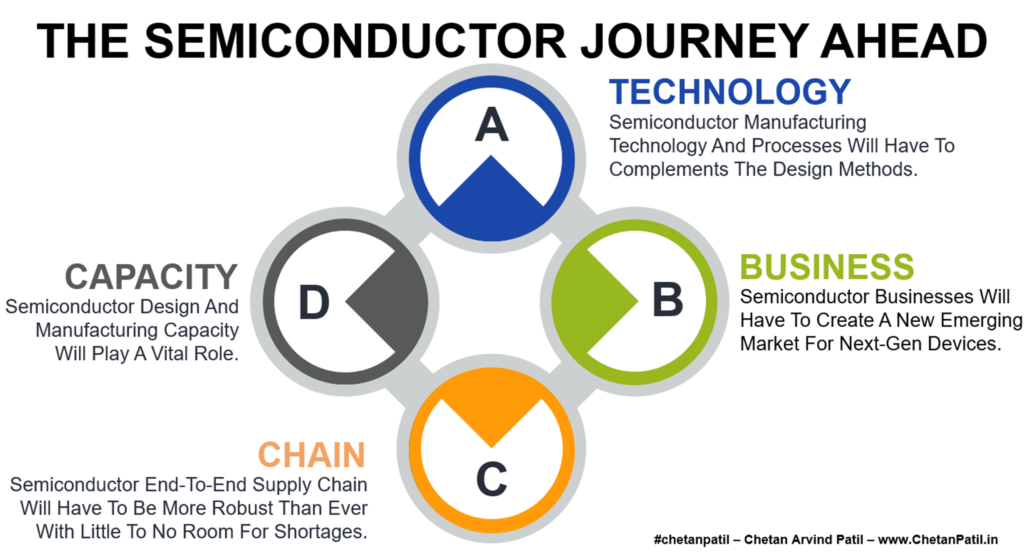
    Technology: The semiconductor manufacturing process will have to complement the design methodologies by enabling high-yielding error and defect-free processes.

    Business: Apart from the expansion of the existing market, semiconductor businesses will have to create a new emerging market for next-gen devices.

    However, achieving such a high target is not an easy task. It requires thorough planning from the industry level to the semiconductor business level. On top, this involves focusing on different aspects ranging from technological solutions to capacity building.

    In this regard, semiconductor design and manufacturing houses have been working hand in hand to come up with new technology-driven solutions and are also focusing on the capital required to enable new advanced solutions. The majority of the planning is still on paper and the next few years are crucial and will showcase whether the semiconductor industry will be able to expand its design and manufacturing capabilities to march toward the trillion-dollar market.


    Picture By Chetan Arvind Patil

    Apart from focusing on technology and business, semiconductor companies will require supply-level strategies to enable next-gen solutions. It means focusing on bringing more resiliency to the supply chain apart from building capacity for the semiconductor shortage-free world. Both demand in-depth planning for decades, if not years.

    The semiconductor shortage has sparked the debate to make resiliency to the supply chain and semiconductor capacity. Investments to address these two challenges have already been in the execution phase. However, there is also a risk if the demand goes down and the supply exceeds the requirement. The cost of not acting towards resolving the supply chain and capacity issues is far more than predicting the future.

    Chain: Semiconductor end-to-end supply chain will have to be more robust than ever with little to no room for shortages.

    Capacity: Semiconductor design and manufacturing capacity both are going to play a vital role in creating growth driven journey.

    Eventually, there is no magical process to enable the semiconductor industry to achieve high numbers by the end of the cade. it will all depend on how the market grows for the next decade and whether the plan the semiconductor business is executing will eventually help the semiconductor industry or not.