Category: SUPPLY-CHAIN

  • The U.S. Semiconductor Supply Chain – Now And The Future

    Image Generated Using 4o


    United States Semiconductor Industry

    The United States semiconductor industry has been foundational in shaping the modern digital world. From the invention of the integrated circuit to the articulation of Moore’s Law, the U.S. was instrumental in pioneering the core technologies that underpin global electronics today.

    However, as we enter 2025, the landscape has shifted. While the U.S. continues to lead in critical upstream segments, including chip design, electronic design automation (EDA), and semiconductor manufacturing equipment, much of its physical fabrication and packaging capability has migrated overseas over the course of last four decades. The result is a complex mix of strength in innovation and dependency in production.

    To understand the current position and emerging trajectory of the U.S. semiconductor supply chain, it is thus essential to examine it across four interdependent domains:

    1. Manufacturing And Packaging Capabilities
    2. Upstream Leadership: Equipment, EDA, And IP
    3. Policy, Industrial Strategy, And The CHIPS Act
    4. The Road Ahead: Building A Resilient And Competitive Future

    Each domain highlights not only the past’s legacy and limitations but also the strategic imperatives shaping the next chapter of U.S. semiconductor leadership.


    Manufacturing And Packaging Capabilities

    Over 80 percent of global semiconductor packaging is now carried out in Asia by Outsourced Semiconductor Assembly and Test (OSAT) providers. Although there are OSATs that are headquartered in the United States, most of its packaging (manufacturing plants) operations are based in Asian countries.

    Historically, the United States pioneered packaging technologies, from dual in-line packages to early wire bond methods. However, by the late 1990s, these labor-intensive processes had largely been offshored. Today, chips are designed in the U.S., and at the same time the fabrication is overseas and only returned as completed parts ready for system integration.

    This structural dependency is becoming more critical as the packaging itself transitions from a cost center to a performance enabler. The emergence of advanced packaging, such as 2.5D interposers, chiplet-based architectures, and three-dimensional stacking, redefines the backend’s role in overall system performance. These technologies address interconnect bottlenecks and enable heterogeneous integration that is no longer achievable by scaling transistors alone.

    Companies in the US are now leading efforts to push packaging beyond traditional boundaries. While few companies have build some domestic capability in this space, it does not yet match the high-volume, highly integrated ecosystems that many have developed in Asia.

    As chiplet-based designs become standard and system performance increasingly hinges on packaging innovation, this capability gap poses a strategic risk. Closing it will require capital investment and a coordinated build-out of ecosystem partners, precision tooling, and workforce expertise to support volume-scale, advanced backend manufacturing within the United States.


    Upstream Leadership: Equipment, EDA, And IP

    While the United States has experienced a gradual decline in its semiconductor manufacturing share, it continues to hold strategic leverage through its dominance in upstream segments of the supply chain. This includes leadership in semiconductor manufacturing equipment (SME), electronic design automation (EDA), and reusable intellectual property (IP), all of which are essential to the global semiconductor ecosystem.

    U.S. companies account for approximately 40 to 45 percent of the global SME market. Several US based key industry leaders are central in enabling deposition, etch, and metrology at the most advanced technology nodes. In addition to complete toolsets, U.S. component suppliers are deeply integrated into the global lithography ecosystem.

    The United States holds an even stronger position in the domain of EDA. U.S. companies collectively control nearly 90 percent of the global EDA software market. These tools are indispensable for chip design, logic verification, physical implementation, and yield optimization. No advanced integrated circuit can proceed to manufacturing without undergoing design validation and signoff using U.S.-origin software.

    This leadership extends further into the realm of silicon IP. From interface controllers and high-speed physical layer blocks to complete processor cores, U.S. companies provide a substantial portion of the reusable design building blocks used across the industry. These IP blocks are embedded in mobile systems-on-chip, data center processors, AI accelerators, and edge devices. This dominance in soft IP has created a form of control that, while less visible than fabrication or packaging, is deeply embedded in global product development.


    Policy, Industrial Strategy, And The CHIPS Act

    The sharp decline in the United States’ share of global semiconductor manufacturing, from 37 percent in 1990 to approximately 12 percent over decades, reflects more than just market trends. It highlights a long-standing policy imbalance, as several key Asian countries have consistently supported their domestic semiconductor sectors through targeted subsidies, infrastructure development, and coordinated industrial strategy.

    In contrast, the United States relied heavily on market forces, allowing manufacturing capacity and supply chain depth to shift overseas. The CHIPS and Science Act passed in 2022, marked a major policy correction by providing 52.7 billion dollars in federal incentives to stimulate new fabrication capacity, establish research centers, and support electronic design automation, materials development, and workforce training.

    Initial momentum has been significant, with more than 200 billion dollars in private investment already announced, including major fabrication projects several key platers in this space. Yet funding alone will not address the structural barriers that remain. The industry faces a pressing shortage of skilled workers, with projections indicating a need for over 100,000 additional professionals by 2030 across research, engineering, technical, and operational roles.

    At the same time, critical dependencies in materials, substrates, and packaging services persist, leaving even CHIPS-supported fabs reliant on imports. Delays due to permitting and construction constraints have also emerged. The CHIPS Act provides a vital foundation, but sustained execution, workforce development, and domestic supply chain expansion will be essential for long-term impact.


    The Road Ahead: Building A Resilient And Competitive Future

    As the U.S. semiconductor sector works to regain manufacturing depth, the path forward is not about replicating the past. It is about reshaping the future around new technological, economic, and geopolitical realities. Success will hinge on executing a focused strategy across four foundational areas:

    Strategic PillarDescriptionWhy It Matters
    Regional ResilienceShift from globalization dependence to a balanced ecosystem with strong domestic and allied regional capacity.Ensures continuity during global shocks and reduces single-point vulnerabilities.
    Technology LeadershipLead in post-Moore’s Law domains like chiplets, heterogeneous integration, and advanced packaging.Maintains U.S. leadership at the frontier of innovation where performance scaling now depends on integration.
    Supply Chain ReinforcementDevelop or secure access to critical inputs such as ultra-pure chemicals, substrates, OSAT capacity, and photomasks.Supports reliable fab operations and prevents bottlenecks in scaling domestic manufacturing.
    Workforce And EducationInvest in STEM education, technician training, and skilled immigration pipelines.Addresses the industry’s core labor bottleneck and ensures long-term innovation capacity.

    Rebuilding the U.S. semiconductor supply chain will require decades of coordinated investment and planning across policy, private enterprise, and education. By focusing on these four pillars, the U.S. has an opportunity not only to restore capability but also to redefine strategic, scalable, and resilient semiconductor leadership.



  • The Time Critical Semiconductor Supply

    Photo by CHUTTERSNAP on Unsplash


    The semiconductor supply chain ensures that the fabricated, assembled, and the tested product reaches customers on time. Achieving this goal requires eliminating all the bottlenecks that might impact the supply process.

    The standard process to mitigate bottlenecks is to capture the end-to-end supply chain requirements and then proactively fill the gaps. However, the better approach is to capture the supply time and ensure there are no time gaps.

    Inventory Time: How Long The Existing Supply Will Last.

    Reload Time: How Long Before The Supply Can Be Restored.

    In semiconductor supply, there are two ways to look at time: Inventory Time and Reload Time. The former provides a view of how long the inventory will last and later provides details about how much time it will take to replenish the stock.

    Eventually, the goal is to ensure there is never a shortage in the supply process. Nevertheless, it is not always the case, and the supply process is not bound to be smooth. More so when the semiconductor manufacturing process is cost and time sensitive, and there is no easy way to speed up the process.


    Picture By Chetan Arvind Patil

    Managing the Inventory Time and Reload Time has a positive impact on the semiconductor supply process. First of all, it eliminates hurdles and ensures the timely delivery of products. Second, it brings equilibrium in the demand and supply process, thus guaranteeing that customers never run out of the parts.

    As the semiconductor industry grows and the number of active products reach the trillion mark, the timely execution of an error-free supply process will play a huge part. It will require human resources to collaborate extensively to meet all the customer requirements on time.

    Impact: Proactively Eliminate Supply Chain Bottlenecks.

    Equilibrium: Ensuring The Right Amount Of Inventory, All The Time.

    The supply data management tools will also have to evolve and provide a better sneak by driving predictability. Thus, making the supply system more adaptive than reactive.

    In the end, the goal of the semiconductor supply chain is to meet the market demand. As the customer base expands, the challenge will be to ensure the market always has the right product delivered at the right time.


  • The Blocks Of Semiconductor Supply Chain

    The Blocks Of Semiconductor Supply Chain

    Photo by Barrett Ward on Unsplash


    THE BUILDING BLOCKS OF SEMICONDUCTOR SUPPLY CHAIN

    Supply Chain Management (SCM) is part of every manufacturing industry. It enables the movement and management of finished goods and all those components that drive the development of the final product.

    As the world became more connected, real-time information allowed SCM to be more efficient than ever. However, the years 2020 and 2021 have brought massive challenges to the SCM. Irrespective of the manufacturing industry, SCM teams across different companies have to fight against the unpredictable trend of the market, and companies (and SCM teams) are now struggling to find avenues to tackle the fluctuating supply and demand in the market. The same challenges and stories also apply to the semiconductor industry. The long manufacturing cycle time has thrown all SCM methodologies and rules out of the window.

    Like other industries, the semiconductor supply chain is also dependent on many blocks. Thus, the semiconductor supply chain also needs a synchronized approach to make materials and resources available so that semiconductor manufacturing can fulfill customer demand without delay.

    To achieve this goal, some of the basic building blocks of the semiconductor supply chain need to work in synchronization. Any delay or bottleneck in any of these basic blocks severely impacts the end customer.

    Raw Materials: The manufacturing of semiconductor products is dependent on the availability of raw materials like chemicals, semiconducting materials (silicon, germanium, gallium arsenide, etc.), substrate, and many other different types of resources. Without procuring these basic materials, the semiconductor product supply chain will not move forward. The semiconductor shortage is not only because of the capacity constraints but is also due to the impact pandemic had on raw material providers. As long as the industry providing raw materials to the semiconductor industry does not face supply chain challenges, the semiconductor supply chain keeps moving forward. If not, then the impact on these critical blocks often leads to a long semiconductor manufacturing cycle time.

    Design: Raw materials are critical from the manufacturing point of view. But before a semiconductor product goes for manufacturing, the design stage needs to be completed. Delays in product design also affect the manufacturing plan and thus directly impact the supply chain. The semiconductor supply chain keeps moving forward with the help of older products. However, the changing landscape and the rush to introduce new solutions means that new semiconductor products should continuously feed into semiconductor manufacturing to keep the semiconductor supply chain active. All this makes semiconductor product design the most vital building block of the semiconductor supply chain.

    Manufacturing: Semiconductor manufacturing is another vital process that semiconductor supply chain management runs on. In reality, this is true for any manufacturing industry, not just semiconductors. The pressure on the semiconductor supply chain today is majorly due to the bottleneck in semiconductor manufacturing. All-time high lead time is stopping the supply chain from providing the customers with the required product in the proper time frame. Supply chain teams often rely on inventory to tackle such scenarios, but the cycle time and lack of pre-planning have taken this option away from several companies. On top of all this, new semiconductor products are getting introduced continuously and entering the manufacturing cycle, which is also not helping semiconductor supply chain management. All this clearly shows why manufacturing is another building block of the semiconductor supply chain.

    Logistics: The movement of goods (whether raw or finished) is one of the most critical processes to drive a flawless semiconductor supply chain. Semiconductor companies worldwide rely on major logistics players to ensure that different parts, products, and materials get delivered on time. Logistics delays also have a direct impact on the supply chain. Thus far, during the capacity constraint, the semiconductor industry has managed the logistics very well compared to a few of the other building blocks of the semiconductor supply chain.

    Inventory: Keeping products in hand for future demand is the base concept of efficient supply chain management. Semiconductor companies often hold either assembled products or fabricated wafers for future requirements. However, this means predicting the future demand without knowing what will and what will not work. Thus making inventory management is another building block of the semiconductor supply chain.

    It is vital to understand why the last two years have been challenging for the semiconductor supply chain. Maybe the answer lies in the methodologies, approaches, and tools that enable the semiconductor supply chain. It might be that older techniques did not work as planned. This course correction is required.

    Given the vast amount of data and on-the-go information, the semiconductor supply chain should have adopted future trends faster and accurately. However, it seems like, in reality, the techniques are not getting utilized along with the resources, solutions, and tools that are available. It is time to revisit few blocks of the semiconductor supply chain and adapt these to create future building blocks that can contain the future semiconductor shortages.


    Picture By Chetan Arvind Patil

    Picture By Chetan Arvind Patil

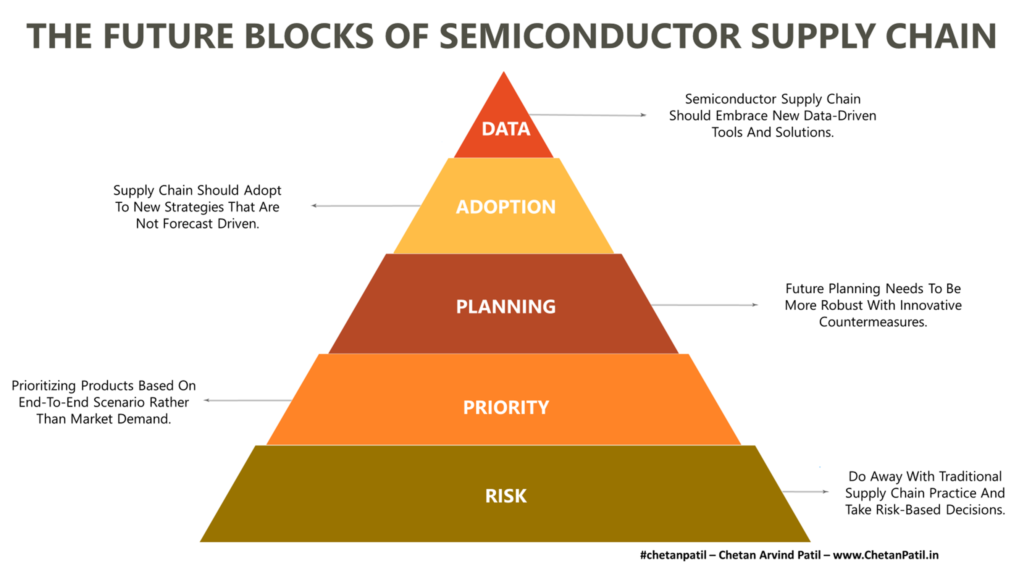
    THE FUTURE BLOCKS OF SEMICONDUCTOR SUPPLY CHAIN

    In the 1960s, the SCM followed a fragmented methodology and thus required coordinating with different teams to merge the information (forecast, sourcing, logistic, etc.) before implementing decisions. By the 1990s, the fragmented approach became consolidated, and SCM became more centralized. Now, teams could take decisions faster than ever. However, in the 2020s, when the world is more connected than ever, all the information in hand could not predict the market trend. The impact of all this is capacity to supply chain constraint. Today is the time to understand the bottlenecks and prepare future semiconductor supply chain countermeasures that can take into account the abrupt cycle nature of the market.

    To tackle future semiconductor supply chain challenges, the following critical blocks should be re-visited to capture the improvements required along with the way these resources are utilized to make future projections.

    Data: Understanding the market demand is very important. Semiconductor supply chain teams have resources that can allow them to gauge the market swing. These resources provide information to make a better decision on how to manage inventory, manufacturing orders, and supply. However, looking at the pandemic scenario, the semiconductor teams focused on the supply chain have not taken full advantage of the resources in hand. The future decision should be based on new advanced tools that can provide information outside of the industry (like predicting pandemics) and/or developing dedicated talents capable of using data to predict future market changes that can severely affect the semiconductor supply chain. Supply chain management should move more towards data drive management.

    Adoption: Just In Time (JIT) is a widely used methodology in manufacturing. However, the semiconductor supply chain needs to move beyond the traditional concepts. This demands changes in the supply chain working with the help of a detailed understanding of both technical and non-technical (like weather, outbreak, etc.) information that can affect the semiconductor supply chain.

    Planning: Semiconductor supply chain planning should utilize more data points than simply relying on forecast or market intelligence. The roadmap to manage the supply of semiconductor products in the market should also consider data points from different forward and backward supply chain-dependent industries. This could be from understanding the raw material supply chain to the end customer supply chain. Merging several output supply chains can provide a better outlook as to whether the planning is in line with the market reality or not.

    Priority: In the end, decisions taken by the semiconductor supply chain teams are all about how to balance and prioritize product manufacturing. This also means some products will have more supply than others, and any incorrect priority decision will lead to supply constraints. Prioritizing products is not an easy task, and that is why semiconductor supply chain teams need to find new ways to balance the inventory of different types of products.

    Risk: Eventually, semiconductor supply chain management is a risky business. If the market demand is lower than the expected supply (which means the products are at the manufacturing stage), then it can lead to losses. On another side, if the product supply is not meeting the market demand, then the opportunity to gain on the high demand is lost. It is vital to take risks but based on new strategies and concepts that are more robust than the older production and supply systems.

    The semiconductor supply chain teams can take these blocks and re-invent them to their potential. In the long run, the end customer also needs to backtrace and understand how the semiconductor supply chain drives them and also affects them.

    As the semiconductor world moves forward, the semiconductor supply chain management across different industries (not just semiconductors) will also evolve, and supply management teams will have to capture the impact of worldwide supply chains (semiconductors impacting automotive) and how individual industries should master 360-Degree views for long-term benefits.