Category: TECHNOLOGY

  • The Semiconductor Value Flow

    The Semiconductor Value Flow

    Photo by Skye Studios on Unsplash


    Industries and companies worldwide are focused on creating value, without which it is not possible to survive the customer-driven market. The semiconductor industry is no different and has consistently added value over the last four decades.

    The value created by the semiconductor industry has enabled different other connected industries. It is evident based on the fact that semiconductor-focused solutions have become critical pillars for businesses that need innovative semiconductor-powered products.

    Value Flow: Solutions and products that take the semiconductor and other connected industries forward.

    To generate value consistently requires executing flawless strategy, which the semiconductor industry (mainly companies focused on product development) has carried out for decades. This value generation ranges from technology node, equipment, process development, package technology, raw material improvement, etc. There have been examples where such plans have failed, but the number of successful value creation-focused is considerably high.

    Segment: Creating segments that add value to the industry is the first step toward developing vital semiconductor value flow.

    Planning: Planning focuses on ensuring the development of segments leads to high-value creation, which demands consistent innovation.

    Creating value that drives the industry forward demands long terms focus and planning. It starts with focusing on segments that can add value. It can be new equipment, FABs to OSATs capacity building, new semiconductor devices, and several other sub semiconductor chain-focused segments. Along with a clear segment definition, robust planning is a must-have.


    Picture By Chetan Arvind Patil

    Creating segments and planning a long-term roadmap is a must-have for value flow. The other two parts of value flow creation are investment and learning.

    The investment focuses on building the capital and human resource to drive the segments that will bring the needed value to the semiconductor industry. And learning focuses on course correction required to ensure the value flow of new or existing domains does not go off track.

    Investment: Focuses on enabling required resources and teams that can constantly innovate the value flow.

    Learning: Capturing errors and failures to make necessary course correction is vital to creating a robust value flow.

    Value flow has become an integral part of the semiconductor industry. Mainly due to the growing dependency on semiconductor products. Such a dependency demands highly focused value flow management. If not done correctly, it can often lead to situations similar to semiconductor shortages.

    The semiconductor industry is bound to grow in the coming decades. It is valid both from market size and numerous products that will get manufactured. Value flow needs to be more robust to achieve these goals, and the semiconductor industry thus will have to keep finding new avenues to make the new and existing value flow more resilient and innovative.


  • The Need To Open Source Semiconductors

    The Need To Open Source Semiconductors

    Photo by Shahadat Rahman on Unsplash


    Semiconductor end-to-end product development is a highly complex process. The majority of these processes are also proprietary. Developing a proprietary process is vital as it allows companies to bring innovation and never-seen-before products and solutions, which in the long term drive market position and revenue. However, opening up certain parts of the process is also vital for knowledge building.

    In the software industry, there have been numerous open source solutions. Doing so has only benefitted the software industry, which has enabled the development of new software-driven ideas. On top, it has powered a collaborative environment that drives knowledge building.

    In comparison, the semiconductor industry is far behind. Open hardware has been around, but it has not helped the semiconductor industry. The main reason is the focus on assembling rather than the design of semiconductors or the building blocks that make up the semiconductor chips.

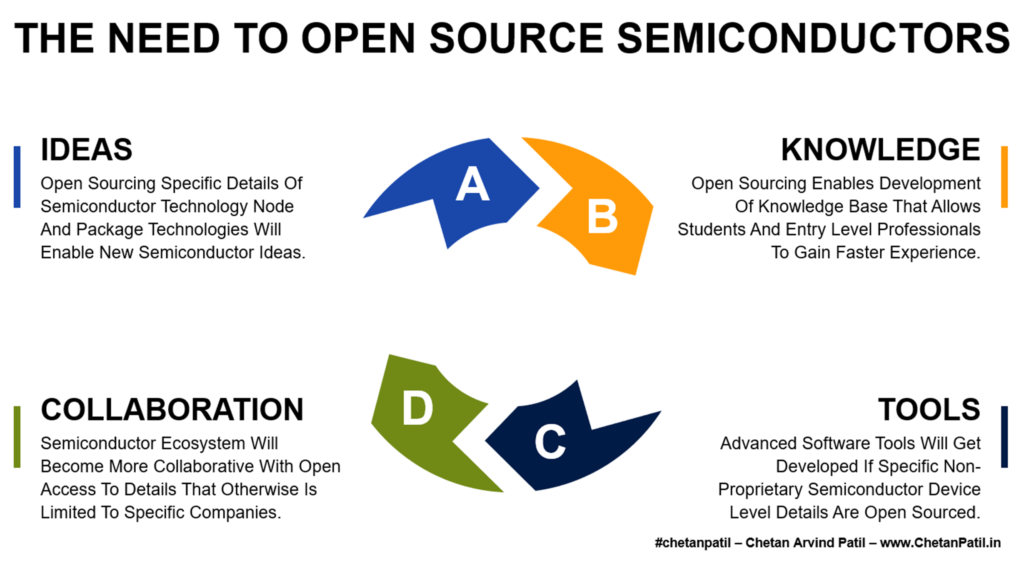
    Ideas: Open sourcing certain aspects of semiconductor design and manufacturing will drive the development of new ideas.

    Knowledge: Students and academia will get a lot from open-source (FET level) semiconductor-focused information that can enable new research activities.

    The benefits of open sourcing specific information are many. It allows anyone to learn and build from scratch. In this direction, semiconductor-driven companies have opened up Process Design Kit (PDK), a step in the right direction. PDKs allow individuals to take a deep look into the transistor-driven systems. If there are areas of improvement (power, performance, thermal, and so on), then a new PDK can be released (open sourced). It can then create a chain reaction of process developments. Long-term benefits will be the knowledge and idea-sharing that such continuous improvement will drive.

    Open-sourcing PDK is a welcome move. However, several other information and details can be shared (without impacting internal research). So that anyone with a focus on semiconductors can turn the open source into new solutions for the semiconductor industry.


    Picture By Chetan Arvind Patil

    Open-sourcing in the software industry has shown long-term benefits. It ranges from releasing new software tools to programming languages. In many cases, it has also led to even launching companies.

    However, open-source does come with a certain level of risk, whereby the companies have to balance what can and cannot be shared. This problem quadruples in the semiconductor industry as the time and capital required to develop new solutions are high, and not possible to open-source all the information.

    The semiconductor industry thus has to find a middle ground by at least open sourcing some of the old technologies which do not see much industry-wide development. Doing so will allow students and entry-level positions to develop skills by leveraging the open-sourced details of the technology node or the package technologies.

    Tools: Developing tools for silicon development is a complex process. Open-sourcing some libraries on the process and package size can go a long way in enabling open-source tool development.

    Collaboration: Open source has always enabled a collaborative approach that allows the development of ideas and processes. A similar impact is possible in the semiconductor industry.

    Open-source collaboration can also enable the development of next-gen FET devices. So far, there have been no attempts to collaborate (via an open-source model) on FET devices. Doing so might enable the industry with ideas that can provide a way forward toward the More-Then-Moore era.

    While the industry is gearing up for increasing semiconductor design and manufacturing (worldwide), the focus should also be on how to bring in more collaboration-driven innovation. The standardization approach has also helped but to a certain extent.

    In the long-term, the focus should also be on open-sourcing specifics of each of the end-to-end semiconductor design and manufacturing. It will not only go a long way in attracting new talents but also can bring several innovative ideas.


  • The Process Of Building Semiconductor Ecosystem

    The Process Of Building Semiconductor Ecosystem

    Photo by Shubham Dhage on Unsplash


    The end-to-end semiconductor design and manufacturing are dependent on the ecosystem. It is evident from the regions that have become a pillar of the semiconductor industry. These regions have grown steadily for decades while creating business and employment opportunities.

    Developing a semiconductor ecosystem is not an easy process. It demands time, resources, and capital, which are not easy to come by together. Existing semiconductor ecosystems have been around for more than two to three decades and thus have become a benchmark for the upcoming semiconductor regions.

    New regions that want to attract semiconductor businesses should focus on creating a semiconductor ecosystem. Doing so requires following a set process to bring together different building blocks of the semiconductor industry. These fundamental blocks create a platform that allows semiconductor-focused businesses to thrive for decades to come.

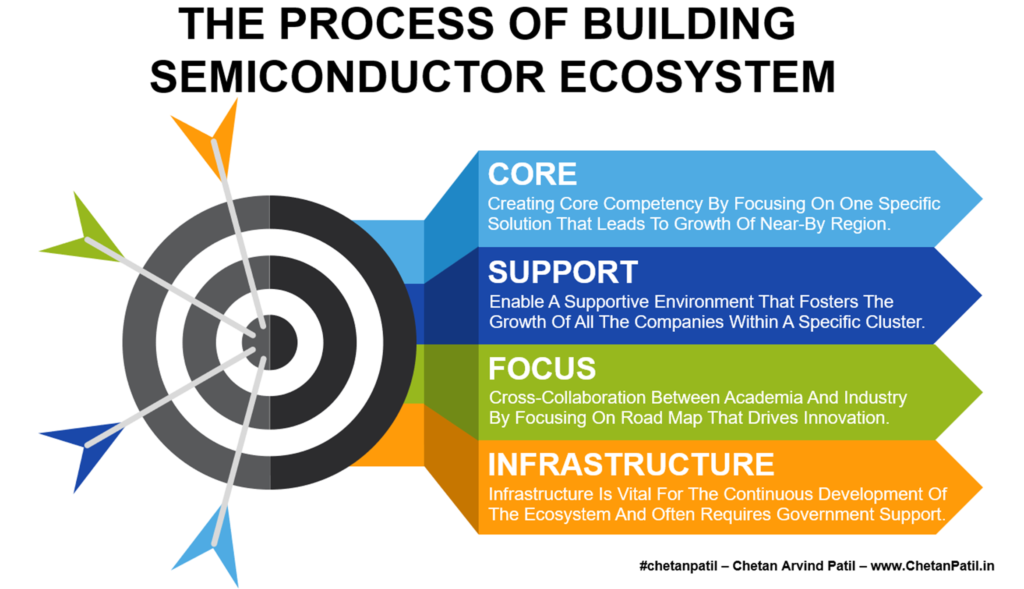
    Core: Focus on developing the region for one specific type of semiconductor business. For example, focusing on semiconductor design or manufacturing is far better than focusing on both.

    Support: Apart from developing core competency, also build a supportive environment that supports and helps the growth of different semiconductor businesses.

    The semiconductor ecosystem development starts with the core focus. Focus on one solution rather than focusing on all the segments of semiconductors. It is how some of the semiconductor ecosystems in Taiwan (manufacturing), the EU (equipment), Japan (material and equipment), China (assembly), and the USA (design) started and are now (or already have) becoming ecosystem with multi-segment semiconductor business.


    Picture By Chetan Arvind Patil

    The continuous growth of the semiconductor ecosystem demands a supportive environment. Companies within a semiconductor ecosystem should thus focus on cross-collaboration. Such an approach allows the development of a new type of semiconductor technology.

    Focus: Long-term focus is required by enabling collaborative culture that allows the flow of innovative ideas.

    Infrastructure: Basic infrastructure developed by public bodies goes a long way in making a robust semiconductor ecosystem.

    Public bodies also play a vital role in creating a semiconductor ecosystem. It ranges from providing adequate infrastructure to laying out policies to make it easy to do business. Education infrastructure is also critical for the free flow of talent that eventually drives the semiconductor ecosystem forward. There are already several examples whereby the proximity of a university powered the overall growth of the semiconductor business.

    As the race to attract semiconductor businesses to set up the design to manufacturing houses speeds up, the case to create a semiconductor ecosystem will grow and might be a de-facto way of developing regions.


  • The Ever-Increasing Share Of Semiconductor In Automotive

    The Ever-Increasing Share Of Semiconductor In Automotive

    Photo by Chris Liverani on Unsplash


    Automotive has always been an integral part of day-to-day life. Worldwide, billions of people drive vehicles, and the goal is the same: reaching the next destination safely and on time. Achieving this goal is only possible due to the different features and components that come together to enable an end product that can zoom safely.

    A lot of effort goes behind the scenes to meet customer demand and automotive safety requirements. Any given vehicle demands thousands of tiny parts procured (or manufactured) from different vendors. Eventually, all these components need to work synchronously to provide the safest ride possible.

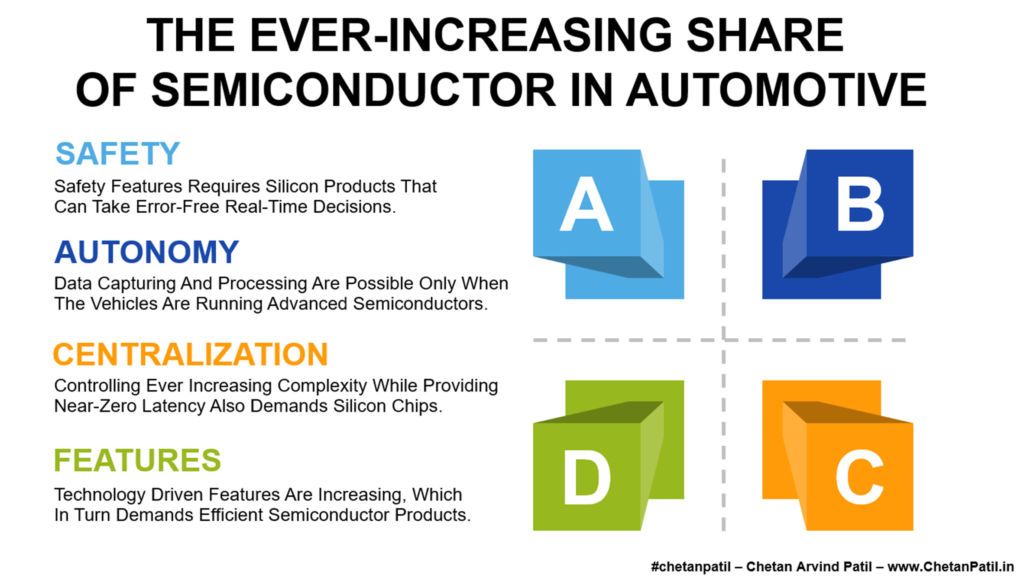
    Safety: Silicon products enable real-time decision-making, a must-have feature for maintaining the standard of automotive safety.

    Autonomy: Autonomy focuses on assisting safe rides, and it requires error-free silicon products that can work in any conditions.

    In this line, one of the vital part, whose share in automotive products have increased steadily year on year, is a semiconductor. Semiconductors are part of every vehicle out on the road. These tiny devices (packaged as silicon chips) enable different features.

    In the last decade alone, the number of semiconductor products in modern vehicles has increased by 10x. Such a drastic increase in demand is majorly due to new features apart from the need to make every ride a safe and enjoyable one. It is also evident from the growing demand for automotive-focused semiconductor solutions, which will increase further with the adoption of more alternate-fuel solutions that will increase the share of semiconductors in next-gen vehicles.


    Picture By Chetan Arvind Patil

    One of the drastic changes in the automotive industry is the centralization approach. CAN-based solutions were already available for decades. However, the availability of more reliable XPU based solutions has pushed the centralization towards a new era and is transforming automotive into a computer on the wheels. Thus, opening up the market for companies that never focused on automotive segments.

    It also implies that the thermodynamics of automotive products is changing and slowly becoming semi-dynamics. In the semi-dynamics world, the decision is driven by silicon products while also working alongside the traditional thermodynamic system. Such reliance will grow further, already has, with alternate-fuel, hybrid, and electric approaches.

    Centralization: Automotive products are getting loaded with high-performance computer chips, which are more centralized than ever before.

    Features: New features require new silicon products that focus on improving customer experience by enabling highly reliable products.

    Even though automotive semiconductor demand is increasing, it will not be easy for emerging companies to make the most of the growing market. The reason is the safety, quality, and reliability standards that automotive products demand. It is not only time-sensitive but also capital intensive. Still, there are promising upcoming automotive semiconductor-focused emerging companies making the mark in the market. However, such companies will face stiff competition from the existing established players.

    The next decade will be an exciting one for automotive semiconductor companies. The focus will be on highly dynamic, safe, and reliable semiconductor-driven products that will enable a new ear of transforming mobility.


  • The Semiconductor Over Capacity Risk

    The Semiconductor Over Capacity Risk

    Photo by Taylor Hammersla on Unsplash


    Semiconductor capacity has been the most talked-about topic due to the semiconductor shortage. Companies and countries are upgrading or building semiconductor manufacturing to cater to ever-increasing demand. However, simply increasing the semiconductor capacity is not the answer and often comes with several techniques to business challenges.

    The technical challenge involves deciding on the technology-node and package technology to focus on, which is not an easy decision and requires an end-to-end view of how the market will evolve and which technology will be crucial. Yield and throughput also play a role. On top of all this, the technology (lithography as an example) equipment required should work as expected. More so when the new capacity focuses on advanced semiconductor solutions.

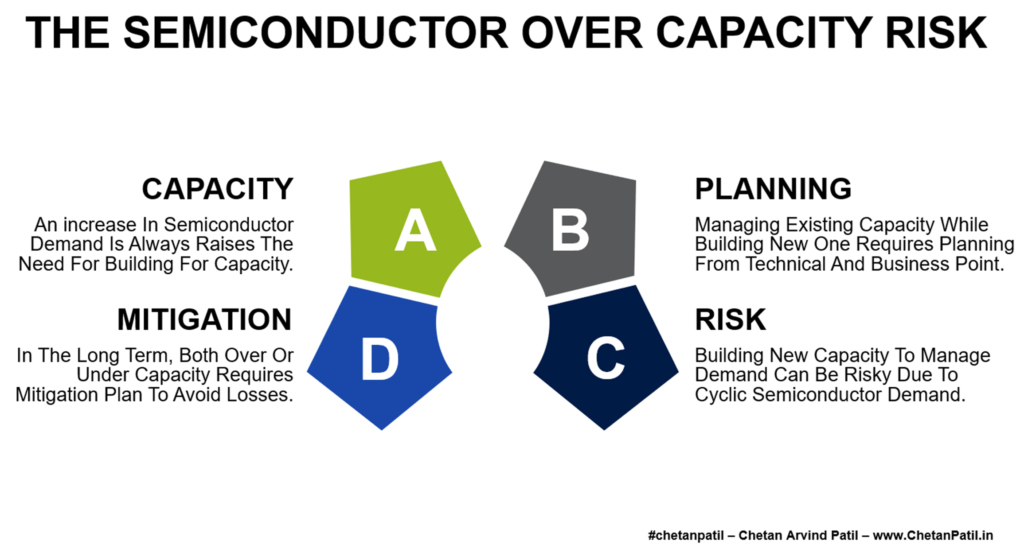
    Capacity: Building new semiconductor manufacturing capacity is not always the answer to capacity constraints. It can solve the problem in the short term. As a robust strategy, a more predictive, not reactive approach is suitable.

    Planning: Near-accurate prediction of how the industry will evolve is required. It enables accurate planning of how and when to build new capacity apart from when to upgrade the existing one.

    From the business perspective, the challenge is justifying the capital expenditure against the return on investment. In semiconductor manufacturing, 100% utilization is key to achieving a faster break-even point, and at the same time, it is not always possible to achieve such throughput. It is where government incentives come into the picture and act as a catalyst to drive the positive margin gain year on year.

    Even after overcoming the technical and business challenges, there is always the risk of building new capacity, which is driven by how the market demand evolves in years to come and how it will impact the manufacturing business in the long term.


    Picture By Chetan Arvind Patil

    Historically, the semiconductor business has always followed a cyclic nature, whereby the supply and demand are adjusted. This adjustment then triggers a round of discussion on expanding manufacturing capacity. By the time capacity comes up, the market demand may go down, and this can cause lower than expected orders for specific semiconductor silicon, which can derail the ROI plans of the given semiconductor manufacturing facility.

    Tackling such unknown scenarios is not straightforward. Thus, it is vital to have a full-proof risk mitigation plan. An ideal risk mitigation plan focuses on what-if scenarios and adapts to how the market changes. The manufacturing facility adapts to the requirement while maintaining the path towards break-even. It can demand continuous capital and is a must-have to run a successful semiconductor manufacturing facility.

    Risk: Expanding capacity without planning is a risk-driven approach. There needs to be a risk management strategy to mitigate any unknown event that can impact the planning of capacity building or upgrading.

    Mitigation: Mitigation strategy for capital-intensive semiconductor manufacturing is a big challenge. An adaptive approach that focuses on the market scenarios is a must-have.

    On paper, such planning is good but equally hard to implement. The reason is the inability to adapt semiconductor manufacturing planning without adding the time factor, which is needed to change the future course of any production facility.

    As new semiconductor FABs and OSATs come up, the question industry should ask is whether it is preparing itself for an over-capacity scenario and what is the mitigation plan when the market swings.


  • The Semiconductor Hurdles For Inspection

    The Semiconductor Hurdles For Inspection

    Photo by L N on Unsplash


    Semiconductor products often fail, and finding the root cause thus becomes a critical process. More so, when the product is already in production.

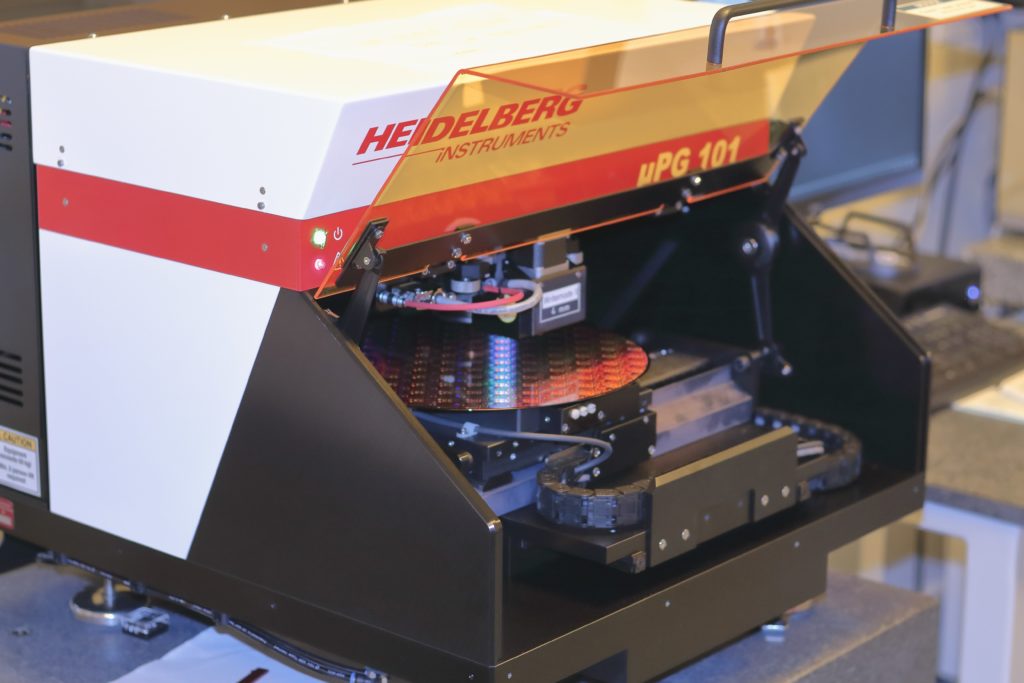
    Failure and root cause analysis are vital steps towards finding issues with the semiconductor product. Doing so requires an inspection process that allows engineers to look inside the chip.

    Several advanced equipment and technologies (SEM and beyond) can provide an in-depth view of what is happening inside the chip. The hurdles thus are not the availability of technology required to drive failure analysis. The real challenge is the complexity (silicon level) that the advanced design and manufacturing brings to enable failure analysis.

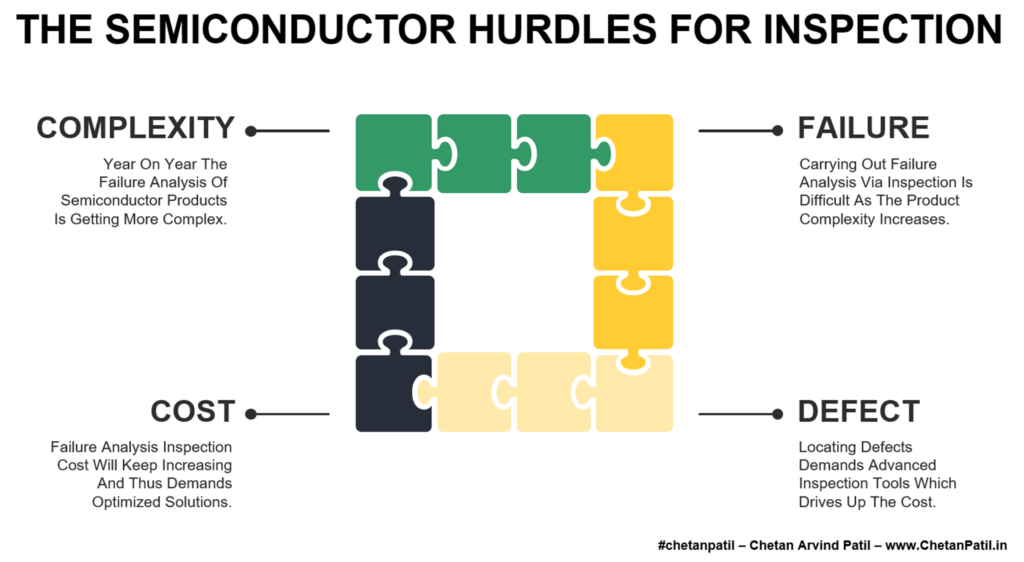
    Complexity: Growing transistor count increases the die level complexity, which brings difficulties to perform failure analysis without investing more than the required time, resources, and capital.

    Failure: During failure analysis (in the majority of the cases), it becomes difficult to narrow down the root cause for highly complex (3nm and lower) products. Advanced equipment does help, but not without investing a lot of time and cost.

    Overcoming different inspection hurdles is a vital step towards a fast resolution of why the product failed. At the same time, the growing design complexity of semiconductor products (coupled with different package technologies) is leading to constant upgrades of labs that enable such analysis and leading to the high cost of finding the defects in the product.


    Picture By Chetan Arvind Patil

    The fundamental process when carrying out failure analysis is the localization of defects. Doing so requires semiconductor products to run through several inspection steps, and it often requires looking at every layer. Biasing process helps, but it requires skilled engineers with years of experience to handle the inspection tools to find areas of concern within a given chip.

    Defect: Year on year, the localization of defects during the failure analysis is getting costlier and time-consuming. All of this leads to constant upgrades of equipment apart from the training of engineers.

    Cost: The cost of inspection to capture the failures is increasing due to the need to constantly upgrade labs apart from the time required to find defects in the highly complex products with advanced technology nodes. Solutions like do SEM are helpful but are also high on cost.

    Today’s advanced semiconductor product utilizing the latest technology node often comes equipped with billions of devices. Inspecting such devices is certainly not an easy task. More so, when the goal is to quickly root cause silicon-level issues.

    The importance of inspection as part of a semiconductor product (in case of failures) will only grow with the growing number of transistor counts. It is thus vital to focus on optimizing the process to perform failure analysis so that the operating cost is reasonable while also bringing skilled engineers who can efficiently carry out inspection-driven failure analysis.


  • The Cross Collaboration And Standardization Across Semiconductor Industry

    The Cross Collaboration And Standardization Across Semiconductor Industry

    Photo by Nick Fewings on Unsplash


    There are several parts to semiconductor product development, and without cross-industry collaboration and standardization, it is impossible to move forward (next-gen solutions).

    Collaboration and standardization have triggered several innovative solutions that have only taken the semiconductor industry forward. These strategic approaches come in different forms. Some are between two or more semiconductor-focused companies, many driven by consortiums of several companies (semiconductor and non-semiconductor). Irrespective of the approach, the focus is to bring new semiconductor technologies.

    Collaboration Benefits: It fosters the environment where one or more companies can share the knowledge to enable next-gen devices that can create future markets while expanding the current one. Examples of such collaboration are many. Collaboration between XPU developers and non-XPU developers is one. The reason one relies on the other and has to follow a collaborative approach to ensure the end products (desktops, laptops, smartphones, etc.) work flawlessly.

    Standardization Benefits: One of the impacts of standardization is that it allows product development knowledge sharing irrespective of the resources and capital any given company has. An example of this can be all USB or Wi-Fi-driven silicon solutions as it follows a standard protocol and empowers companies to build on top of it. Recently announced Universal Chiplet Interconnected Express is also one such example.

    The two positive impacts of collaboration and standardization are knowledge sharing and learning. Given how high-tech the semiconductor industry is, the knowledge transfer and learning approach enables a thriving business and expands the reach of semiconductor products.

    Knowledge: Sharing technical knowledge that helps the industry move forward is only possible via active collaboration.

    Learning: Capturing learnings based on old solutions allows the development of new solutions for the emerging market, which also requires standardization and continuous collaboration.

    The semiconductor industry-wide standards from the past decades have already shown the world several innovative solutions. Majority of which came out of active collaboration. It is also true that no given semiconductor company can thrive without active cross-industry partnerships. More so when the devices today require multiple and different types of solutions.

    In the end, the goal of collaboration and standardization in the semiconductor industry is to drive a new age of innovation, something the global semiconductor ecosystem has done very well for the last four to five decades.


    Picture By Chetan Arvind Patil

    Apart from the technical benefits, the two other vital impacts of collaboration and standardization are the expansion of business via existing or near markets along with the ability to launch next-gen devices. It is evident from the fact that today’s smart devices that were only possible due to the active collaboration of different types of semiconductor companies.

    Several of these strategic collaborations are proprietary. Which is also required to ensure the different businesses can create a niche market for themselves. On another side, there have been several open collaborations. All of which have moved the industry forward and have allowed design and manufacturing companies to come up with solutions to power next-gen solutions.

    Business: Different types of semiconductor businesses benefit from standardization as it creates a level playing field on the top of which companies can develop new solutions.

    Next-Gen: Emerging solutions (chiplets and photonics as an example) are only possible via industry-wide standardization. Otherwise, the speed of adoption will be slow.

    Active collaboration is also key to bringing new solutions forward. Semiconductor lithography solution is one such example. It has been able to leap forward only due to the long-term strategic planning and focus. Some of which have also been with academia.

    As the need to push for More-Then-Moore solutions grows further, the importance of semiconductor collaboration and standardization will grow too and make the semiconductor ecosystem more advanced than ever before.


  • The Growing Reliance Of Semiconductor Industry On Software

    The Growing Reliance Of Semiconductor Industry On Software

    Photo by ThisisEngineering RAEng on Unsplash


    Software is the backbone of several industries, including semiconductor. Several (maybe all) semiconductor activities cannot work without a software solution and are valid for several key stages like design, manufacturing, supply chain, and many more.

    This growing reliance on several stages is the primary reason it has become vital to utilize the best solution for all the stages of semiconductor product development. Doing so enables defect-free and error-free solutions for the end customers.

    The advancement in software tools has allowed the semiconductor industry to lower the time to market. As more advanced semiconductor technologies get deployed, the importance of developing faster and more accurate software will grow further and increase the reliance of the semiconductor industry on software solutions.

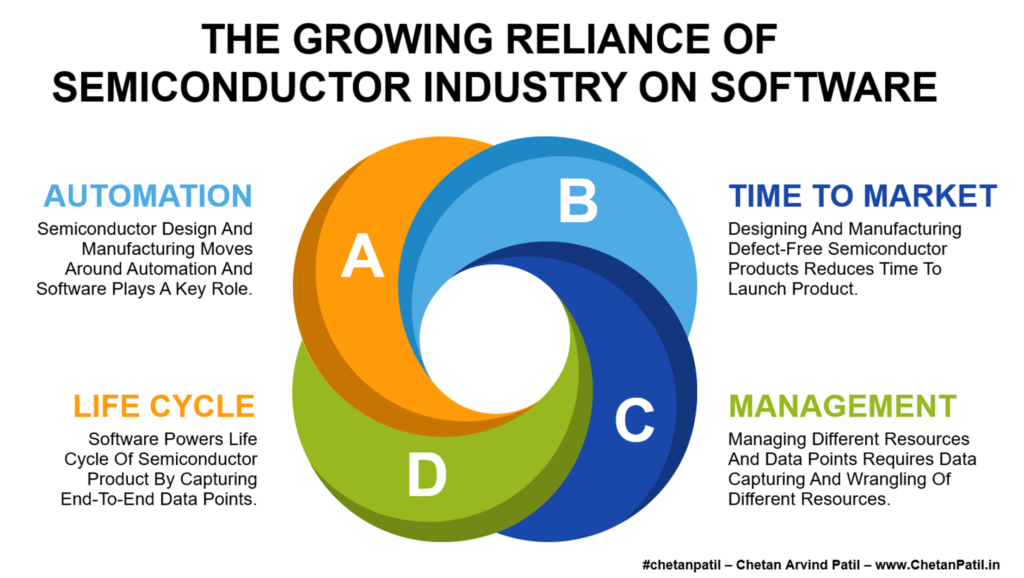
    Automation: Automated software solutions plays a critical role in capturing defects and errors during design or manufacturing stages.

    Time To Market: Software speeds the process of developing and launching semiconductor products. The reason is the ability to simulate and capture all the errors before products go to the customer.

    One key feature of the software is automation. It speeds up designing and also ensures defects get captured ahead of time. On another side, the software is powering the designing process of highly complex products without human interference.

    In the long run, such solutions may or may not work. However, raises questions of how much more software solutions can do (concerning design and manufacturing) and how it will impact the semiconductor industry.


    Picture By Chetan Arvind Patil

    Apart from semiconductor product development (design and manufacturing), the software also plays a vital role in semiconductor information management. It includes capturing and storing all the required data for a very long time.

    Software solutions around information and data management have been around for decades. However, the growing data complexity and the need to capture/process the data faster is leading bottleneck’s in the software solutions themselves. It has raised the demand for a new generation of software solutions to pull the information faster than ever.

    Management: Information management is a part of semiconductor product development and demands easy-to-use software solutions.

    Life Cycle: Managing product information demands long-term software-powered data storage and retrieval.

    As the need to reduce the time to market grows, the demand for software-driven automation will grow more. Semiconductor-focused software automation has been in place for several years. However, the market needs to enable new types of silicon products for the emerging market is demands novel ways to design and manufacture.

    All these requirements will further grow the reliance of the semiconductor industry on software and thus presents an opportunity to innovate software solutions to meet growing semiconductor industry demand.


  • The Semiconductor Chain Impact

    The Semiconductor Chain Impact

    Photo by Alina Grubnyak on Unsplash


    There is not a single industry that does not rely on strategic partnerships. The semiconductor industry is no different, and semiconductor companies have to rely on a strategic partnership to achieve the goal of a successful product launch.

    The semiconductor industry has several different segments. While the two major segments are design and manufacturing, several other critical segments are needed to empower the design to manufacturing solutions. These solutions originate from companies located in different countries, and the solutions developed powers billions of tiny silicon devices.

    It will not be wrong to say that the semiconductor industry is one of the most distributed. A single semiconductor chip with billions of transistors takes more than ten to twenty different companies to work together. In many cases, companies are global. In such scenarios, any disruption on one location or shortage (in the case of manufacturing) can impact the end-to-end supply chain.

    Connected: Semiconductor industry is one of the most connected industries out in the market, and different companies have to work together to get the product launched.

    Dependent: Semiconductor companies are dependent on each other, and this is also the primary reason why not a single region or country fully dominates in the semiconductor chain. It is always global collaboration that leads to innovative silicon chips.

    While countries without a stronghold on semiconductor design and manufacturing are focused on building in-country capabilities, the reality is that it not only requires several years (or decades) but is also impossible to create an end-to-end in-country semiconductor ecosystem. There will always be areas (not one, two, but several) for which every country will have to rely on others. It is where the technology-focused long-term partnership is required, without which it is impossible to keep the semiconductor chain intact.


    The semiconductor industry is a global one. Any given semiconductor company is strategically involved with different semiconductor and non-semiconductor companies. Imagine disrupting this global connected and dependent semiconductor ecosystem and how it will impact day-to-day product development activities.

    Over the last four decades, different regions across the globe have made their mark on specific solutions required by semiconductor-focused companies. Some regions are good at design, some at semiconductor manufacturing, a few at semiconductor equipment, and many on raw materials (including bare wafers). Eventually, all of the regions are powering each other.

    Global: Semiconductor product development always follows a global approach and the primary reason is the resource and solution dependency.

    Decentral: Decentralization is a key part of the semiconductor industry. Different regions have to work together, without which product development will halt.

    This connected, dependent, global and decentralized approach is the primary reason why the semiconductor industry is growing double-digit year on year. This approach is never going to change, and this is why different countries need to work together to enable next-gen solutions for ever demanding and ever growing semiconductor market.


  • The Consolidation Of Semiconductor Segments

    The Consolidation Of Semiconductor Segments

    Photo by Justin Luebke on Unsplash


    The semiconductor industry is going through a wave of consolidation. It is not the first time the semiconductor industry is marching through such a wave. However, everyone time it does, it often has positive and negative impacts.

    The reduction in the number of companies for a given semiconductor segment is one critical impact apart from the emergence of new players that try to create a new market that opened up due to the consolidation.

    Top Players: Companies that have been in the semiconductor business for a long time either create new business to continue their presence in the market or get acquired (due to market volatility) by other companies, thus leading to consolidation of top players.

    Small Players: When top players merge, there is a gap created in the market that opens up the opportunity for emerging players to focus and make the most of it. It is valid for solutions the old players are yet to find a stronghold on (RISC-V).

    The ongoing semiconductor consolidation is across the design and manufacturing space. In the past, it was either design or manufacturing. It leads to a ripple effect across the semiconductor domains (memory to logic to nodes to packaging solution providers), which can go either (in terms of market demand) way for the semiconductor industry.

    Design: Semiconductor companies that primarily focused on one solution (enterprise or consumer) are now entering new areas (wireless and automotive). It requires building teams from scratch or by merger and acquisition. Thus, creating a wave of consolidation.

    Manufacturing: In semiconductor manufacturing, companies are entering a new arena to capture technologies that have not been their stronghold. The reason for such push is the need to enter a new market that does require some form of in-house manufacturing capacity.

    Eventually, consolidation might be a piece of good news and can push the semiconductor technology ahead at a faster pace. However, there are downsides when consolidations are not successful, mainly because it leads to the loss of time and investment.


    Picture By Chetan Arvind Patil

    The impact of consolidation within the semiconductor (from a design and manufacturing point of view) industry can be positive and negative.

    The negative impact is when the number of players (companies) is reducing and thus creating less competition. It can also hinder the progress of new solutions. On another side, the positive impact can be the opportunities for emerging companies. They can create a market by leveraging the consolidation wave. One such example is utilizing RISC-V to create a new niche market to compete against x86/ARM (which is consolidating).

    Market: Strong wave of consolidation reduces the number of top players, and it can have a negative impact due to the decreasing number of options for consumers and enterprises.

    Opportunity: Semiconductor consolidation can also open up the market for emerging players, who can potentially grab new opportunities (and create a new market) due to the void created by the mergers and acquisitions.

    The semiconductor consolidation wave thus has both positive and negative sides. It can shrink the segment by reducing the number of players, and on another side, it can open up opportunities for emerging players. In the long run, the semiconductor consolidation (in a majority of the scenario) pushes the industry forward.