Category: TECHNOLOGY

  • The Employment Channels Driven By Semiconductor

    The Employment Channels Driven By Semiconductor

    Photo by Clem Onojeghuo on Unsplash


    The key factors to gauge the impact of any industry are by capturing: economic activity and employment generation. These two factors also apply to the semiconductor industry and are evident from year-on-year impact and growth.

    The economic impact is dependent on job creation. Thus, it is critical to understand what type (channels) of jobs the semiconductor industry creates.

    Economic Impact: Close $7 Trillion global economic contribution by the semiconductor industry, and primary factor is growing increase of semiconductors in day to day products.

    Employment Impact: In the US alone, the employment impact is close to 2 million, not accounting for several other semiconductor-dependent industries.

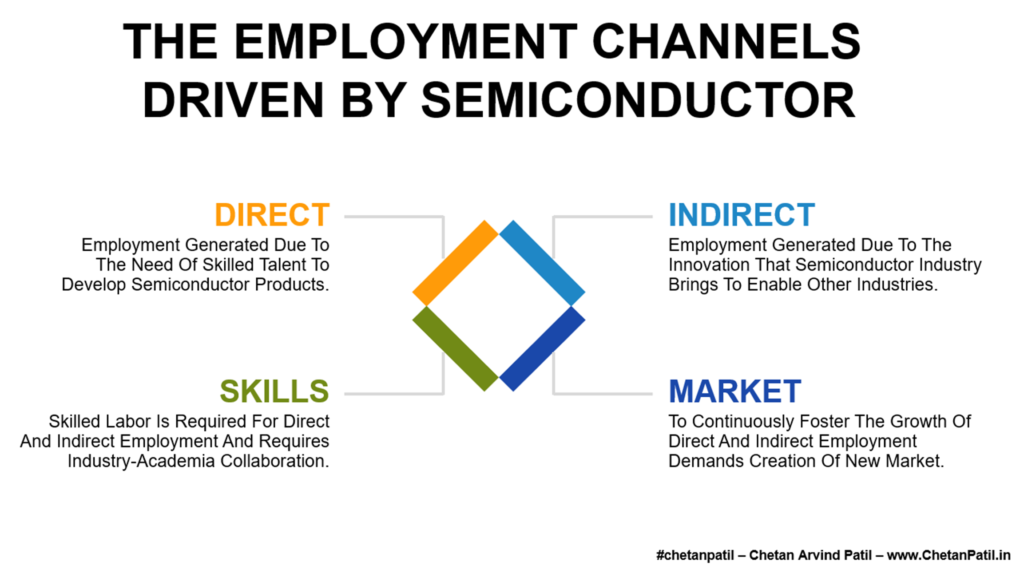
    Direct and indirect employment generation are the two primary ways the semiconductor industry drives employment. Direct employment is focused on skills that semiconductor companies need. On another side, indirect employment is by semiconductor-connected industries.

    Direct: Skilled jobs that require the design and development of semiconductor products.

    Indirect: Skilled jobs that the semiconductor industry empowers indirectly.

    The direct employment channel demands core skills that bring new semiconductor innovation to the market, which drives the indirect channel. The indirect employment channel works two ways. First, the semiconductor products enable indirect employment. On another side, the semiconductor industry is also dependent on it. The primary reason is the end customer products that indirect employment develops, and any negative impact on indirect channels can directly affect the semiconductor industry.


    Picture By Chetan Arvind Patil

    Growth of direct and indirect employment channels is possible if the market is loaded with skilled labor apart from the continuous expansion of the existing market apart from the creation of emerging markets.

    To continuously provide skilled talent, any industry should focus on academic collaboration. In the semiconductor industry, the gap between the industry requirements and the academic curriculum is widening and thus demands a fresh outlook towards the industry-academia collaboration.

    Skills: Talents with skills for direct employment for the semiconductor industry, which then drives products to help create indirect employment channels. Thus, creating a connected employment ecosystem.

    Market: New products that enable new markets are vital for the long-term growth of job creation.

    The semiconductor industry, like any other, is heavily engaged in innovative solutions that are becoming the backbone of the digital economy. Thus, it will be vital to create an ecosystem that generates skilled talent to drive the growth of all the industries connected to the semiconductor directly or indirectly.


  • The Semiconductor Powered Formula 1

    The Semiconductor Powered Formula 1

    Photo by gustavo Campos on Unsplash


    73rd Formula One World Championship has started. Ten teams and twenty drivers will compete for the next ten months by running high-speed cars across twenty-two different types of racing circuits located in several parts of the world.

    The team with consistent results, flawless drivers, skilled mechanics, and a powerful electromechanical system will eventually win the championship. While the racing teams are focused on getting to the chequered flag first, a lot of activity and effort goes behind to make the complex car system work without error.

    Out of all the components, semiconductor also plays a crucial role. Formula One calendar also provides a platform for different automotive semiconductor companies to test new concepts on a speed track, where average speed ranges from 180-200 mph.

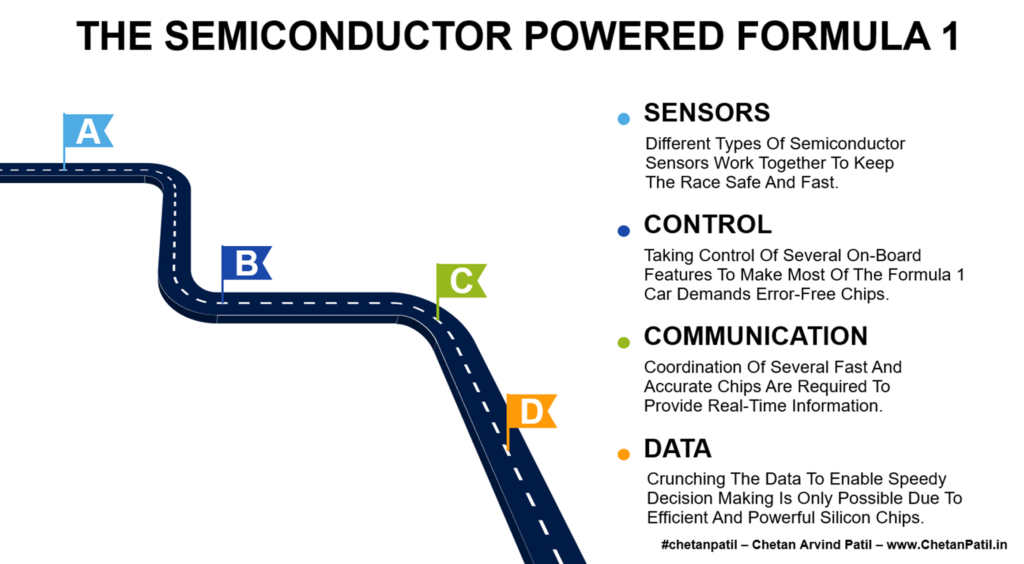
    Sensors: Silicon sensors play a vital role by capturing data around the car during the run time, which is a crucial part of the Formula One process. 

    Control: Formula One steering wheel consists o more than 30 buttons, all connected to a small handheld platform. Several tiny silicon chips ensure this communication is forwarded accurately to the car and the team.

    Different semiconductor chips enable fast and accurate decision-making. It is a crucial part of the race-winning strategy. Processing data and presenting it to the racing team is also a differentiating factor between winning and losing the race.

    Today, a Formula One car has more than 100 different types of simple to complex chips. Formula E (electric version of Formula One) has much more due to the electric power management system. It shows how semiconductor contributes to a Formula One championship.


    Picture By Chetan Arvind Patil

    Radio communication and data analysis is a big part of the Formula One championship. Both of them rely on silicon chips that can provide near-zero latency systems.

    Apart from utilizing existing solutions, semiconductor companies also have strategic partnerships (and sponsorship) with Formula One teams. It allows them to experiment with new solutions on a track and car that stresses the system to its limit.

    Communication: Real-time communication from the car, driver, and team allows faster decision-making. Doing so requires an error-free and near-zero latency silicon-driven system.

    Data: Crunching the data about how the car is moving, who is ahead and behind, how the engine performance is and whether the tires are in good shape is a big part of Formula One racing, and teams that make a quick decision using it eventually wins the race and the championship.

    Such a solution goes through several testing before the start of the championship and is eventually made into the final car if the testing results are promising. A centralized computer system to monitor car activity is one such example.

    The technology behind the Formula One car will keep evolving. It will also keep presenting opportunities for automotive companies to test ideas in an environment that can push the system to its limit. As the world moves towards a more chip-driven approach, Formula One itself presents as big technology and investment-driven platform to try out the best ideas.


  • The Growing Focus On Semiconductor Fabrication

    The Growing Focus On Semiconductor Fabrication

    Photo by Vishnu Mohanan on Unsplash


    Since the semiconductor shortage started, private semiconductor players and public bodies have focused on semiconductor manufacturing. The primary reason impact semiconductor shortage had on all other industries that heavily rely on semiconductor solutions.

    One of the positive impacts of semiconductor shortage (which ideally should be called a semiconductor opportunity) is the conversation around how to mitigate such shortage scenarios in the future. The best approach is increasing the semiconductor manufacturing capacity, but it also comes with several resources and investment constraints.

    Private: Focusing on market-driven technology requirements and upgrading/building semiconductor fabrication capacity.

    Public: Focused on creating an ecosystem for private players to either expand existing in-country semiconductor fabrication networks or create a new one from scratch.

    It is more valid for semiconductor fabrication. It takes two to three years to build any new facility. After that few more years to break even. All while semiconductor technologies keep changing and the cost increases year on year. On another side, post-fabrication semiconductor manufacturing (OSAT to ATMP) is still (compared to semiconductor fabrication) on the lower (but not easy to build) side when it comes to cost and resource planning.

    To mitigate any possible future semiconductor shortages, the private players and public bodies are taking different approaches, with the solve goal of mitigating future potential semiconductor shortages. Whichever path private and public players opt, the end impact is positive only. More so, when everything in day-to-day life is getting semiconductor driven.

    Semiconductor capacity building leads to several types of positive impacts. Removing dependency and catering to in-country demand are a couple of such examples.

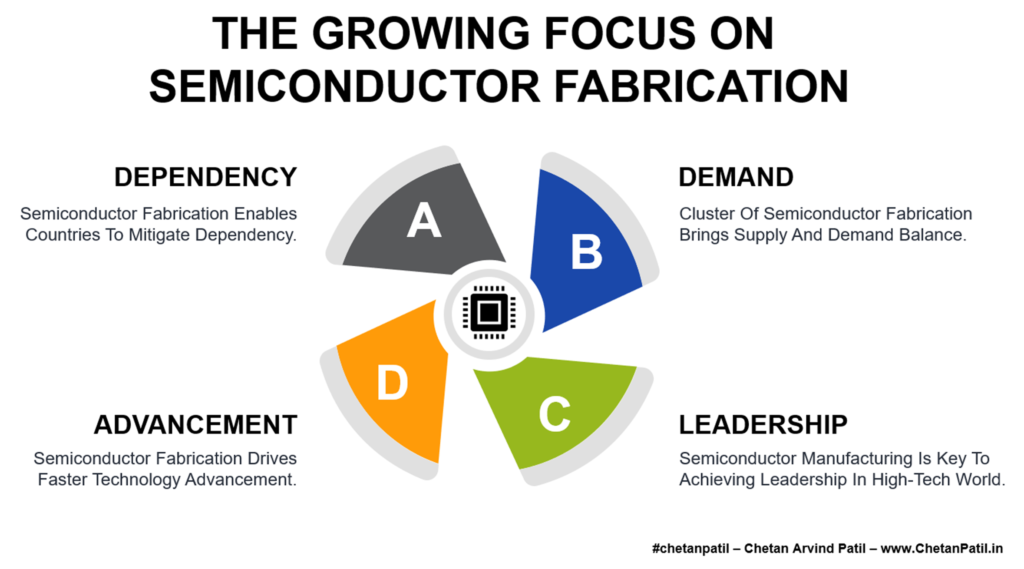
    Dependency: Building semiconductor fabrication capacity allows countries to become more independent. In the long run, it also encourages homegrown products for in-country demand.

    Demand: A cluster of semiconductor fabrication has the potential to bring balance to any future supply and demand cycle.

    Dependency is all about ensuring the private players and governments are focused on creating semiconductor goods that make them independent in the long run. It is a vital process as several national critical infrastructures today require semiconductors. Thus fabricating these products in-house/in-country has is more important than ever.

    Building the semiconductor fabrication capacity also restores supply and demand balance. Thus, reducing the overall cycle time. However, doing so demands time and continuous investment.


    Picture By Chetan Arvind Patil

    Apart from dependency and demand, the two other factors that push private players and public bodies to focus on semiconductor fabrication are leadership and advancement.

    Leadership is about competition within the industry and also among the different governments. The hyper-connected and technology-enabled world has changed the definition of the superpower. It is why the governments are competing with each other and are coming up with industry-friendly policies.

    Today, this solution is semiconductors and is the only factor that governments want to bring as much new fabrication capacity investment possible. More so, when semiconductors become the backbone of the digital world, which is not going to be an ever-growing environment.

    Leadership: Semiconductor manufacturing is slowly becoming a deciding factor for who will become the next superpower.

    Advancement: Focusing on semiconductor manufacturing empowers the development of inventions and solutions.

    A country with an expanding semiconductor fabrication ecosystem will also create an ecosystem of talented and skilled resources. Over the years, as the semiconductor fabrication ecosystem grows, it ends up driving the invention and development of next-gen semiconductor technologies. It is evident from the existing established semiconductor ecosystem.

    The race to bring more investment into semiconductor fabrication will not end soon. It thus presents a unique opportunity for governments to focus on a long-term plan. A plan that not only incentivizes private players but also builds an end-to-end semiconductor ecosystem that will thrive for decades to come.


  • The Emerging Semiconductor Devices

    The Emerging Semiconductor Devices

    Photo by Chris Ried on Unsplash


    The shrinking size of semiconductor nodes has led to better performance, which is beneficial from a features point of view, but not from the cost point of view. The cost to design and manufacture highly complex chips (to provide better performance) is increasing year on year. It is thus pushing the semiconductor industry towards solutions that enable new features but are also not high (long term) on cost.

    To balance the cost with features, semiconductor researchers (academia and industry) have focused on solutions that are not high on investment and at the same time provide a way towards the More-Then-Moore era.

    The one approach that researchers have taken is to focus on the silicon devices and then invent improved versions that provide balanced (power, performance, thermal, and voltage) characteristics. One example is photonic devices, which enable high-speed communication and are getting adopted for advanced silicon chips.

    Neuromorphic Devices: Lately, neuromorphic chips have been the focus of the computing industry. It has given rise to the IP that enables pre-configured devices with more adaptive features than ever before. Such devices are suitable for real-time applications where algorithms demand faster computation.

    Flexible Devices: Flexible electronics is another approach that the semiconductor industry is adopting. The flexible devices present an opportunity to stack silicon (mainly packages) uniquely. So far, flexible devices are limited to the board-level solution and follow a hybrid approach. However, soon unique material properties will drive flexibility architecture level.

    There has been an increase in the adoption of devices that scale vertically instead of horizontally. However, in the long term, such a solution will hit the node wall, and thus the semiconductor industry will have to adopt a non-scaling approach.

    To tackle such scenarios, devices like neuromorphic and flexible present an excellent opportunity as these devices can enable advanced adaptive features coupled with the flexibility to adopt different form factors, which can benefit different types of computing silicon chips and solutions.


    Picture By Chetan Arvind Patil

    There are several known reasons why the scaling approach is not going to work beyond a certain point, and the two most critical reasons are the cost and device operating budget. The cost factor is associated with the manufacturing aspect of the semiconductor, while the device operating budget is all about creating technical criteria that fit the performance and power requirements of the given application/solutions.

    Even the most advanced devices will hit the node wall where scaling will not be a cost-effective feature. The efforts and investment required to bring next-gen (FET-inspired) devices may not provide long-term sustainable solutions. Hence, the semiconductor industry needs to mass-produce complementary solutions that are scaling avert and can co-exist along with the standard devices.

    Carbon Devices: Carbon Nanotube FETs (CNFETs) have been in the works for a very long time. After decades of research and development, the industry has started adopting CNFETs. However, they still suffer from a power handling and have yet to be mass manufactured.

    Photonics Devices: Photonics is vital for optical communication and also for interconnects. There are already several companies that have provided a way forward for the mass adoption of photonic devices, and several new silicon-powered devices are already showcasing the potential of photonic-based solutions.

    Investment and the resources required to enable emerging devices are very high. It is why public bodies and governments will have to provide the much-needed runway for academia and industry. It will ensure the long-term foundation for the research and development of the futuristic device.

    The next decade is going to bring new emerging devices that will not only provide advanced features but will also drive the semiconductor industry towards a new era. The vital part will be to enable faster adoption and manufacturing.


  • The Building Blocks Of Semiconductor Driven Heterogeneous Integration

    The Building Blocks Of Semiconductor Driven Heterogeneous Integration

    Photo by Nenad Grujic on Unsplash


    Heterogeneous Integration (HI) has become one of the most focused topics in the last decade. From academia to industry, everyone is publishing and launching innovative solutions to scale transistors per area out of the die. HI is also one of the paths (that soon) all of the semiconductors companies will have to follow for high-impact and core systems like XPUs.

    For every new technology, there are basic blocks that are required to ensure the new technology is adopted speedily. The list of blocks can be endless and varies from technology to technology. The same is valid for new semiconductor technology, and the challenges become tenfold due to the time, cost, and resources required to make an idea work error-free.

    HI also requires several new and old building blocks to come together. Few of these blocks have been in use for decades (in the semiconductor industry), can be directly applied to HI. On another side, some blocks must get adopted for the HI.

    A couple of examples of such blocks are interconnected and standards.

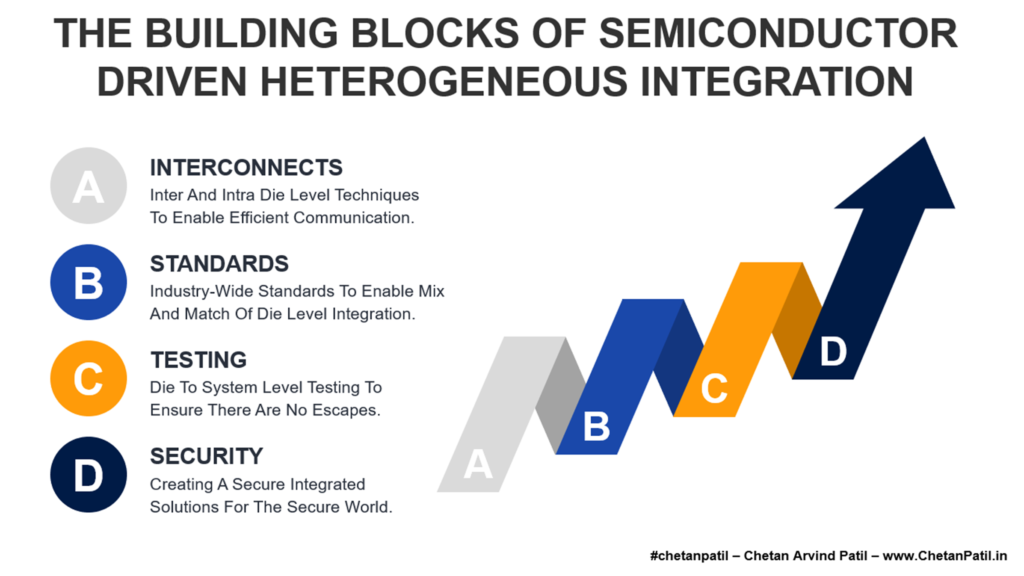
    Interconnects: Interconnects are vital in driving the data transfer rate, and that too without adding any bottlenecks. For HI, electrical interconnects can introduce bottlenecks and thus demand new solutions. Optical and Optical-Electrical are two approaches that HI systems are increasingly adopting to solve bottlenecks. In HI, die-to-die interconnect also becomes crucial apart from silicon/die-only interconnect. A perfect combination of die-level and die-to-die interconnect is vital for HI solutions. 

    Standards: In HI, the die can come from a different vendor (due to IP) or the same vendor. However, to drive efficient integration, die-to-die level standardization is required. One such example of standards is Advanced Interface Bus (AIB). As more companies come up with HI solutions, it will be crucial for all to come together and move forward with HI-focused industry standards.

    Apart from interconnects and standards, the other two critical building blocks vital for HI: testing and security. In the end, to make a HI solution defect-free, the building blocks required will evolve, but it is good to make a few blocks of HI robust. Importantly, to increase the adoption rate.


    Picture By Chetan Arvind Patil

    Testing and security are other major building blocks of the HI world. These two together ensure the end HI-inspired semiconductor product meets the strict requirement of the industry. Without proper testing, there can be escapes that can lead to failures in the field, and similarly, without security, the product can be compromised.

    Testing: Testing ensures all the parts and sub-blocks within a die work as expected. For HI, this process changes a bit as the testing now needs to occur at a multi-die level. The testing world will still follow the individual die-to-die testing plan, but it is equally vital to ensure the multi-die (something like chiplets) work as it should. It certainly requires new methods, equipment, and skills.

    Security: Like monolithic chips, HI-driven chip development also demands secure solutions. During HI, it becomes more about ensuring no counterfeiting, which may occur with multiple moving parts. Thus, it requires a secure supply chain for a secured HI world.

    HI provides a long-term incentive for the semiconductor industry by ensuring the next-gen solutions will not be defined by the technology-node. Instead, chip development will get ranked based on how they leverage different die level techniques to bring an integrated way to design and fabricate future chips.

    One of the challenges for the HI solutions is the cost and time to manufacture. Taking the die level solutions and manufacturing it into multiple dies and then integrating is costly and requires capacity, and both are very difficult to balance.

    Irrespective of where the semiconductor industry heads, the chip development process will become more HI, and it will open up new opportunities for the semiconductor design and manufacturing world.


  • The Impact Of Testing In Semiconductor Manufacturing

    The Impact Of Testing In Semiconductor Manufacturing

    Photo by ShareGrid on Unsplash


    Semiconductor testing is one of the most critical steps in ensuring that the product meets all the required specifications and quality standards. Thus semiconductor testing has also become a major driving factor for defect-free products.

    Every chip manufactured has to go through testing processes to ensure the data collected is in line with the expected range. This step ensures the product shipped is fault-free. It requires understanding the product’s internal architecture (by non-designers) before creating testing rules to validate every block within the design.

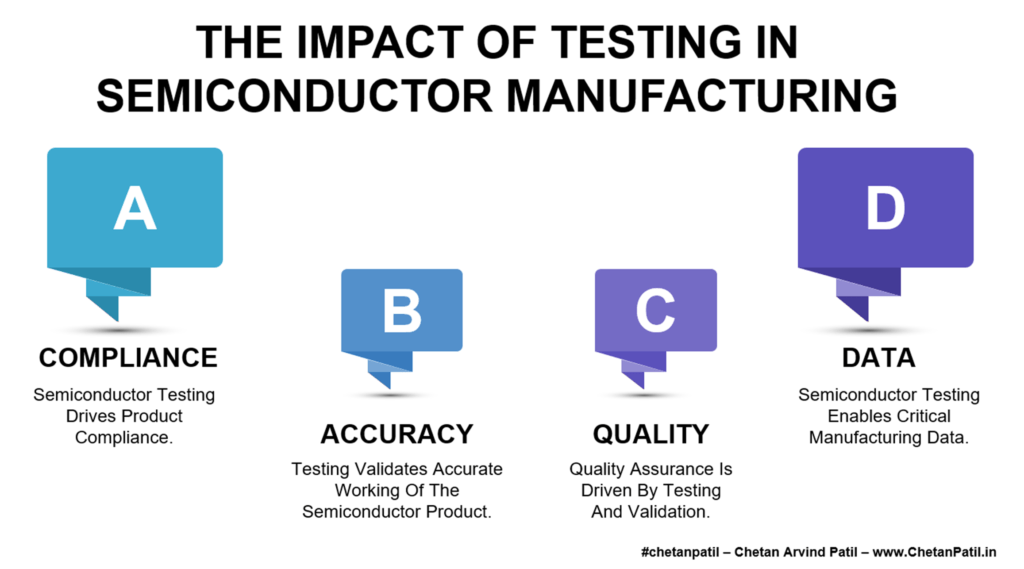
    Compliance: Semiconductor product testing plays a vital role in ensuring the product manufactured meets the compliance targets as per the specification and thus requires testing for the worst to best technical scenarios.

    Accuracy: Semiconductor manufacturing needs to be accurate, and any deviation can impact the production line. Semiconductor testing during the fabrication and post-fabrication stage can reveal whether the product functions accurately or not. It can also provide insights to correct the issues before the product is shipped out.

    Semiconductor testing is also heavily reliant on design techniques. The primary reason is the hooks (non-technical terminology) required to ensure the paths are available to correct test the device. It is where the design for the test strategy comes in to picture.

    As the complexity inside a chip increases, the importance and impact of semiconductor testing will increase too. It also directly impacts semiconductor manufacturing as the goal is always to enable high yield, which is possible only if the testing can reveal the good and the bad parts. It also means thoroughly implementing a full proof and error-free testing process.


    Picture By Chetan Arvind Patil

    In semiconductor manufacturing, there are several stages where testing is needed to collect data.

    The most critical stage is during the fabrication, and testing can reveal if the product is following the correct fabrication process. Any deviation can have a catastrophic effect on the rest of the manufacturing stage. Another critical stage where testing plays a crucial role is the validation stage. This stage can disclose underlying architecture that is not working as expected.

    Quality: Customers are always looking for a product that meets all the quality standards and requirements. Semiconductor testing plays a vital role in ensuring high-quality products. It does so by disclosing any known and unknown issues with the product.

    Data: Only way to know whether a semiconductor product works as expected is by looking at the data, and it is possible only by enabling high volume semiconductor testing.

    Today, one of the hurdles the semiconductor industry faces is the CapEx and resources required for semiconductor testing. An area where the majority of the semiconductor companies find it hard to balance the requirements with the CapEx, and something which will be the primary focus in the years to come. Mainly due to the next era of technology node and package technology.

    Semiconductor testing and the data that comes with it will become more critical for semiconductor manufacturing during the angstrom era. Hence, it will be crucial for the semiconductor equipment and testing teams to innovate solutions that can ensure the complex and advanced products do not lead to escapes. All this while also balancing the time and cost of semiconductor testing.


  • The Horizontal And Vertical Semiconductor Integration

    The Horizontal And Vertical Semiconductor Integration

    Photo by Denys Nevozhai on Unsplash


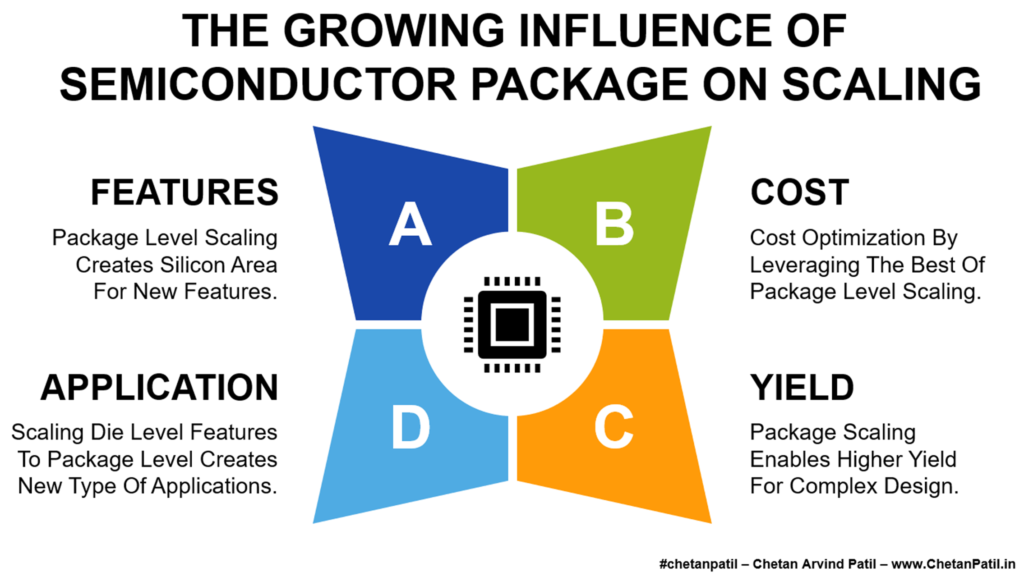
    Advanced semiconductor package technologies have always played a crucial role in transistor scaling. It is also the primary reason these two scaling methods complement each other to enable customers (and industry) with innovative solutions.

    Die and package level innovation have always provided the industry with solutions (chiplets, heterogeneous integration, big.LITTLE, etc.) that took the semiconductor design and manufacturing to a new level. Today, this synchronized work of die level-scaling with package innovation has taken the semiconductor industry towards a sub-1nm technology node.

    Historically, the semiconductor industry has always focused on transistor scaling from two points of view:

    Die: Shrinking the devices while not compromising on the power delivery.

    Package: Package level scaling (SiP as an example) solution is used to tackle transistor scaling bottlenecks.

    Similar to the die level integration, package level scaling can occur in two ways: Horizontal and Vertical. These two types have thus far played a crucial role in enabling customers with the desired form factors, and the importance will grow only.

    The fundamental reason for the semiconductor industry to utilize horizontal and vertical integration is mainly due to the need to accommodate the new (driven by the market) requirements. Example: Chiplets methodology utilizes vertical integration at the die level and expands it further by moving dies across horizontal layers. Thus, bringing the best of the two worlds: die and package.

    As the semiconductor industry moves forward with more advanced solutions, the need for package-level integration (similar to chiplets) will increase further.


    Picture By Chetan Arvind Patil

    In semiconductor manufacturing, package integration is often (in some cases testing occurs after packaging) the last step, but the crucial one. As the demand for better (and efficient) thermal and power insulation techniques increases, the need for advanced package-to-die level integration will rise.

    Horizontal Integration: At the package level, horizontal integration provides a layer to all die by creating a common pathway for data and other communication.

    Vertical Integration: Allows multiple die (2.5D/3D) to get stacked vertically and drives communication via a industry standard bus interface.

    Opting for horizontal and vertical package integration is driven by the target solution. A device (silicon) utilizing the chiplet method is bound to have horizontal integration (with die-level vertical integration), while a standalone XPU might only rely on vertical integration.

    Advanced packaging techniques are crucial for the next era of semiconductor-driven computing. Hence, the development of next-gen packages will require efforts from everyone: FAB-LESS, FAB, IDM, and OSAT. It is also what the More-Than-Moore era demands.

    As the research and development of next-gen FETs continue, it will be essential to consider the package technologies that can provide an edge in semiconductor design and manufacturing.


  • The Front And Back End For New Era Of Semiconductor

    The Front And Back End For New Era Of Semiconductor

    Photo by Stefan Kunze on Unsplash


    The semiconductor industry is entering a new era where all high-tech solutions will demand new and advanced semiconductor product-driven solutions. These solutions range from wireless to automotive. In this massive market (upward of $2 Trillion), there will be a need to re-invent different segments within the semiconductor ecosystem.

    The products and solutions that will drive a new era of semiconductors will require new (many are already in the market) semiconductor technologies that can provide an edge to different customers. From a technical point of view, this means a perfect combination of an efficient semiconductor design (new FETs) with defect-free semiconductor manufacturing (new Nodes and Packages).

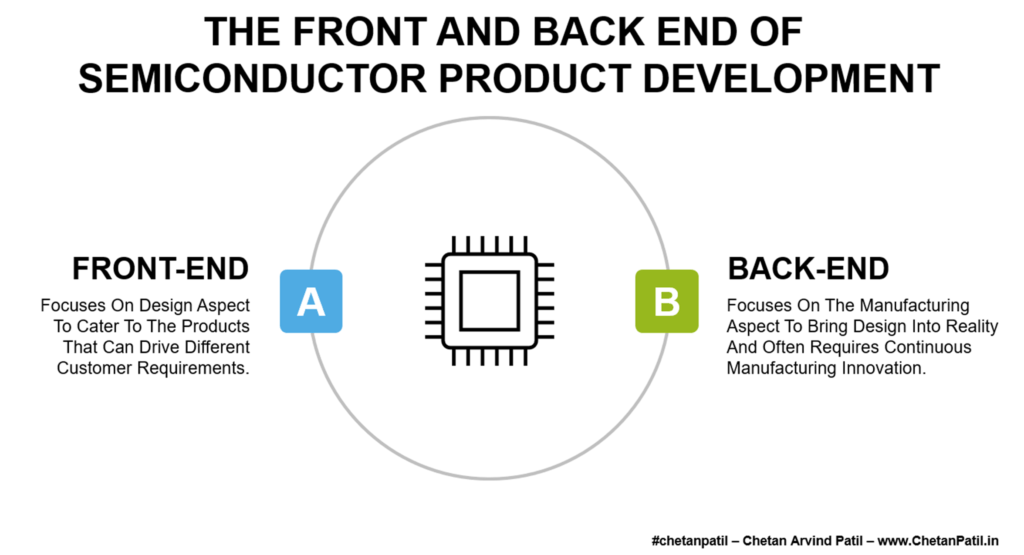
    Semiconductor design is the front-end of semiconductor product development, while semiconductor manufacturing is the back-end. These two parts play a crucial role in bringing new solutions to the market.

    Front-End: Focuses on design aspect to cater to the products that can drive different customer requirements. It ranges from creating powerful to efficient semiconductor products that enable different types of semiconductor-driven markets like automotive, smartphone, communication, etc.

    The major bottlenecks in the front-end development is the research required to bring the solution into reality, and not all efforts eventually get implemented. It also means a long time and investment is needed to push the front-end innovation.


    Picture By Chetan Arvind Patil

    Semiconductor technologies that drive the back-end part (manufacturing) get inspired by front-end innovation. However, there are still several back-end technologies that drive front-end innovation. It is valid mainly for lithography and packages development activities.

    Back-End: Focuses on the manufacturing aspect to bring design into reality and often requires continuous push for innovative manufacturing solutions that range from equipment, nodes, packages to materials.

    In the end, semiconductor innovation is greatly dependent on the perfect combination of front-end technologies with back-end capabilities. From matured to advanced/new semiconductor technologies, all have been successful due to the features provided by both the front-end and back-end features.

    As the semiconductor industry embraces the demand for existing and emerging markets, the importance of creating technical infrastructure for front and back end solutions will grow too. It is why emerging semiconductor destinations need to focus on research and development activities. As it will not only bring new semiconductor solutions into the market but will also train future talents.

    Countries that can strike this perfect balance will surely lead the front and back end of semiconductor product development.


  • The Semiconductor Manufacturing Innovation And Way Forward

    The Semiconductor Manufacturing Innovation And Way Forward

    Photo by Testalize.me on Unsplash


    Semiconductor manufacturing cost is increasing year on year. The reasons are the high cost to develop new semiconductor manufacturing processes, which often requires constant up-gradation of facilities.

    As semiconductor manufacturers expand to new regions, the most critical piece will be the push for innovation. The semiconductor technologies used in the semiconductor product development process have to be defect-free, which demands innovative solutions. It is the primary reason semiconductor companies keep coming up with new technology node processes apart from package technologies.

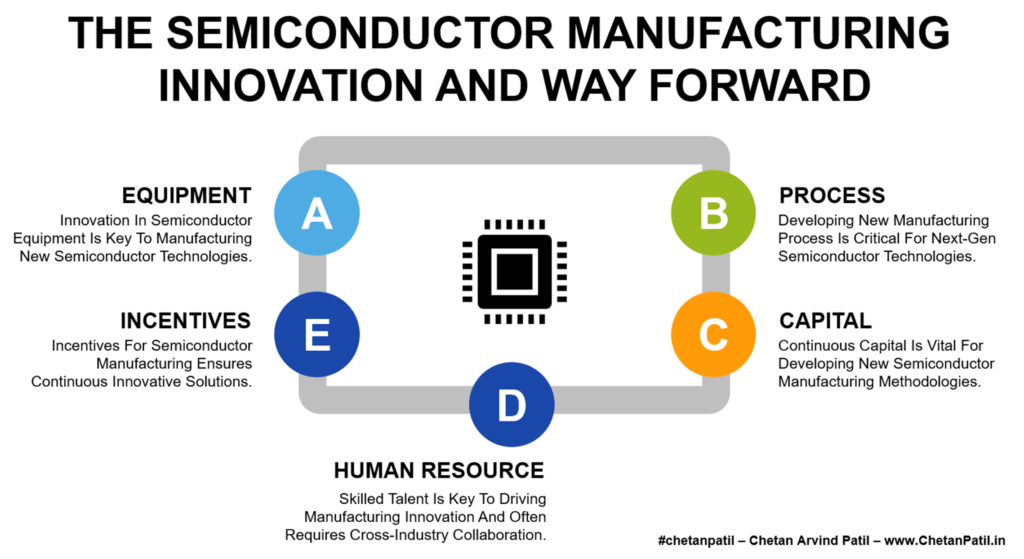
    Equipment: Semiconductor equipment is the backbone for semiconductor manufacturing. Different xUV solutions are required to drive next-gen technology nodes and thus require continuous innovation via research and development activities.

    Process: Developing processes that can provide the customer with options to power next-gen solution is the need of the hour. These processes can belong to the same technology node or a new technology node/process. Developing, validating, testing, and releasing these processes is crucial for semiconductor manufacturing innovation.

    Capital: The semiconductor manufacturing houses need to focus on the customer requirement apart from the future market demand. Both of which require continuous investment. Thus, making new processes development a very capital-intensive task.

    The major hurdles in enabling continuous innovating semiconductors are the cost and time. Cost is critical, mainly because the investment does not generate ROI until the technology is fully developed. The time directly impacts the costs. The longer the research is, the higher the time and thus the cost.

    Apart from product development, semiconductor manufacturers also have to balance the research and development activities. Not doing both together will make today’s solution irrelevant in the future. And, without the next-gen in-house developed solution available for future use, the long-term impact might not be good.


    Picture By Chetan Arvind Patil

    Apart from the technical details, several business aspects need to be considered for long-term innovation in semiconductor manufacturing.

    One such critical business part is the human resource required to bring innovative ideas into reality. Unless and until the focus is on correctly training the talent to bring the innovation forward, there is no way semiconductor manufacturing will be ready for the semiconductor industry’s requirement for the next century. Doing so often requires collaborating with the universities to train the students to enable human resources for its future requirement.

    Human Resource: Talents with a wide range of skills sets are required for enabling future innovation. It often requires both academia and industry to come together and drive a curriculum that can bring more skilled talent to the semiconductor manufacturing industry.

    Incentives: Semiconductor manufacturing itself is a high capital-oriented industry. Semiconductor manufacturers thus do require support from government bodies that can help them balance the product development capital versus the capital needed for research.

    Another critical business aspect for continuous innovation in semiconductor manufacturing is the incentive part. It comes directly from the state and/or central/federal bodies. A long-term incentive can empower semiconductor manufacturers with the ability to come up with innovations, and at the same time can lower the burden to invest in existing setups and facilities.

    Semiconductor manufacturing is critical from the design and also the manufacturing point of view. A manufacturing house cannot survive without a continuous push for next-gen semiconductor technologies. Doing so also requires support from public bodies, which is also a differentiating factor between the new regions that will grow as the next big destination for end-to-end semiconductor solutions.

    The next few years will be crucial for semiconductor manufacturing due to the rush towards providing More-Than-Moore manufacturing solutions. The semiconductor manufacturing companies that have invested in such solutions long back will eventually win the race.


  • The Semiconductor Logic Impact

    The Semiconductor Logic Impact

    Photo by CHUTTERSNAP on Unsplash


    Logic devices (FETs) are the building blocks of semiconductor products. Today’s silicon chip can easily have billions of these logic devices. It is also in line with Moore’s law, and today’s semiconductor technology allows the possibility of packing more logic devices without impacting the total silicon area.

    Semiconductor equipment and other semiconductor technologies have also played a key role in achieving the goal of fabricating innovative logic devices. Apart from this, both academia and industry have consistently provided novel ways to design logic devices for the future requirements of semiconductor products.

    The impact of these logic devices on the overall semiconductor product-driven system is high and ranges from the technical to the business aspect. It is the primary reason the semiconductor design and manufacturing houses are always coming up with techniques to improve the efficiency of logic devices.

    Performance: Logic devices directly impact the performance of the overall semiconductor products. The reason is the faster turn on/off time. To power performance-oriented silicon chips, underlying logic devices need to have the required characteristics that enable high performance. It is also the primary reason the industry is adopting next-gen FET devices.

    Power: Several systems that do not require high-performing logic devices. Instead, they need a device that can work over different power profiles. It is usually the requirement of low-power semiconductor products. It is also where logic devices need to have smaller power footprints come into the picture and have been around for decades.

    Area: The need to pack more logic devices will keep increasing due to the demand for faster processing. It is where logic devices play a crucial part and often have to evolve (technical features at the gate level) to cater to the next-gen processing demand while having minimal impact on the silicon area.

    As the semiconductor industry moves towards the era where silicon chips might easily have trillions of logic devices, the need for next-gen logic devices that have minimal impact on the cost and time will grow too.


    Picture By Chetan Arvind Patil

    Logic devices also drive the business aspect of semiconductor products. It is in the form of products that get launched and what type of new features these products will have.

    Product: New semiconductor products need to be at par with the predecessor products. It is only possible if the underlying semiconductor technology evolves as per the changing requirements. It requires advanced logic devices.

    Customer: Consumer-friendly products require a good balance of internal architecture capabilities. It often ranges from response time to battery life. These two features are driven by the building blocks of the semiconductor products i.e. logic devices.

    More than the semiconductor design, semiconductor manufacturing needs to invest more time and money to enable new logic devices. The majority of the investment eventually provides the next-gen solutions to the semiconductor industry at large. FinFET is one such example, which originated due to the cross-industry and academia efforts.

    As the need to pack more transistors without affecting the time, area, and cost increases, the investment towards the research and development activities of the logic devices will have to increase too.

    In the end, the semiconductor design and manufacturing companies will keep innovating to prepare themselves for the decades to come, and academia will also play a crucial role in promoting next-gen logic devices.