Category: TECHNOLOGY

  • The Requirements And Challenges Of Semiconductor Product Development

    The Requirements And Challenges Of Semiconductor Product Development

    Photo by Brian Kostiuk on Unsplash


    THE REQUIREMENTS OF NEW SEMICONDUCTOR PRODUCT DEVELOPMENT

    The semiconductor industry is driving on top of the products that different companies introduce. These semiconductor products have to go through complex product development procedures to fulfill strict technical and business requirements. That makes the planning and strategy aspect of development vital.

    Technology (devices and package side) progress in the semiconductor industry has powered designers and manufacturers with resources to develop highly complex semiconductor products. These technological advancements have enabled much smaller and portable semiconductor-powered products than ever before.

    More options and features on semiconductor design and manufacturing are a bonus for both companies and their customers. However, the wide range of the device to transistor-level characteristics also means that the requirements to drive new semiconductor product development are getting stricter and thus leaves no room for error.

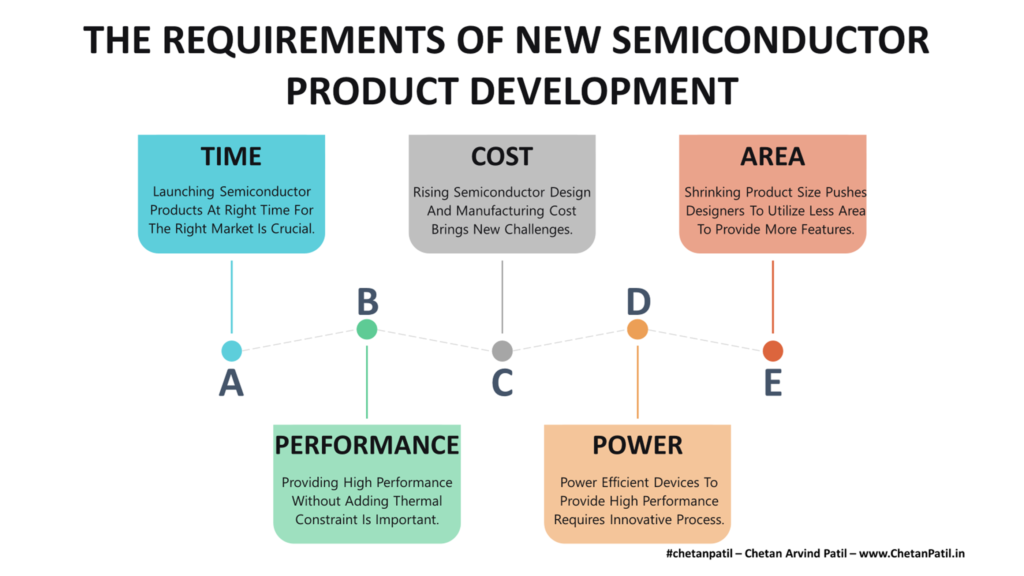
    Time: Semiconductor products have to go through a different process and validation steps, and this makes the planning of the design and the manufacturing phase a crucial step. Any slip or delay can give competitors an advantage. On top of that, the fast rate at which the different and new semiconductor-powered solutions (smartphones to automotive) are getting launched also puts pressure to ensure that any new semiconductor products are developed at the right time to meet the market/customer requirements.

    Cost: The cost of semiconductor manufacturing is increasing, mainly due to the progress in technology nodes, package technology, and also new automated equipment. Thus, selecting the right combination of semiconductor technology is a crucial step, as it directly affects the cost of manufacturing.

    Area: The shrinking device size (and also new vertical package technologies) means new semiconductor products can power new features in a small chip area. However, doing so demands a mechanism to ensure no design or manufacturing rules get violated. On top of this, the smaller size also means less space to provide more new advanced features. As the technology-node and package technology have made progress, the semiconductor products are also getting designed with the smallest footprints possible.

    Performance: The world is moving at a faster rate than ever. The wireless connected solutions to high-speed computers are all demanding fast processing. Enabling the high-performance (faster decision-making) feature in semiconductor solutions is a vital requirement. While not all silicon products get designed for faster processing, there are several application areas where a quick decision (airbag deployment)) is still the most basic requirement.

    Power: Apart from performance and area, managing power consumption is another de-facto criteria for several semiconductor products. The requirement of power management varies based on the application of the semiconductor product. In the long run, it becomes a very challenging task to managing power without having the room to provide an area for thermal management.

    Balancing all of the above requirements of a new semiconductor product is not an easy task. It requires resources to drive the vision of developing a semiconductor product that can take over the market. That is why today, there are companies (mainly in the XPU segment) that are taking new paths (chiplets, heterogeneous, wafer-scale engine, etc.) to develop new semiconductor products for their end customers.

    As the barrier of entry in the semiconductor industry (from the design point of view – FAB-LESS) has lowered, the competition of developing products loaded with new features has grown too. This has put a lot of pressure on companies to design new techniques that can provide critical features (response time, battery life, heating, etc.) to make their products stand out in the market.


    Picture By Chetan Arvind Patil

    Picture By Chetan Arvind Patil

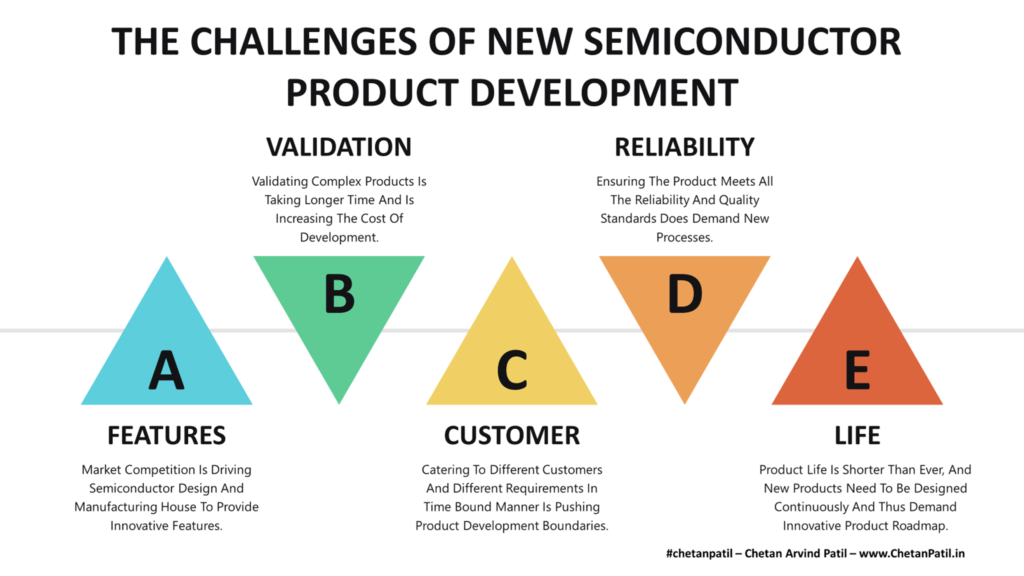
    THE CHALLENGES OF NEW SEMICONDUCTOR PRODUCT DEVELOPMENT

    The majority of semiconductor products are designed and manufactured by considering the cost and time requirement. These two vital requirements also bring new challenges to the design and the manufacturing houses.

    Ensuring the products meet all the customer requirements has made the development of new semiconductors a challenging process. These challenges are faced by every semiconductor product, irrespective of the company developing it.

    Features: The number of FAB-LESS companies in the semiconductor industry has grown over the last few decades, and has increased the level of competition in the semiconductor new product market. It also means that every other product is equipped with new innovative features like new manufacturing methodology (chiplets) to utilizing new-age devices (MBCFET). The urge to provide new features to differentiate semiconductor products in the market is a challenging task, and it will keep getting more challenging due to the push towards newer semiconductor devices and also manufacturing processes (nodes).

    Validation: Ensuring the new product meets all the requirements and specification is vital. Thus depending upon the application area, the validation standards change too. The longer the validation process takes, the higher the cost associated with it and makes the semiconductor post-silicon efforts in a complex activity wherein both time and cost are to be managed.

    Customer: In the end, semiconductor products will be used by different customers. Understanding and catering to the different customers (and their market) is an important building block of a successful product. The most crucial challenge is to ensure that the product can be developed in the shortest timeline while also providing the rich set of features that the market is pushing semiconductor companies to provide.

    Reliability: New reliability standards are getting proposed to drive higher quality. The major reason for doing so is to meet the new requirements due to ever-advancing silicon/transistor level solutions that require detailed reliability checks to ensure the product does not fail in the field. While this brings cost and time challenges, the efforts required to enable new processes are an added challenge.

    Life: New features coupled with changing market demand are shortening the life of semiconductor products. The short market life of semiconductor products means continuous new product launches. This is the primary reason why every year there is a new generation of XPUs that are being launched with new design and manufacturing solutions. The growing market and competition will further drive down the semiconductor product life from decades to years.

    The standards and set process used by the semiconductor industry allow them to overcome the majority of the above challenges. The high-end equipment to design rules to process recipes has already empowered semiconductor houses to develop the first time right semiconductor product. The future challenges are more towards balancing the advancing technology with the cost, resources, and time in hand. Companies that will not be able to balance all these will face tough competition in the semiconductor market.

    In the next few upcoming years, several new (5G/6G, electric cars, etc.) opportunities will come up for the semiconductor industry. All new challenges will drive the semiconductor industry toward new semiconductor product solutions that cater to different requirements while ensuring the product meets the customer’s expectations.


  • The Automated World Of Semiconductor Manufacturing

    The Automated World Of Semiconductor Manufacturing

    Photo by L N on Unsplash


    THE REASONS FOR SEMICONDUCTOR MANUFACTURING AUTOMATION

    Automation is part of all advanced manufacturing industries. As the computing world has progressed, the high-tech software-hardware interaction now allows manufacturers all over the world to make the most of automation techniques to accurately run their production line.

    Semiconductor manufacturing is one such industry, which has taken advantage of automation for a long time and during this course has deployed several automated techniques to minimize errors. Given the time, cost, and resources required to manufacture semiconductor products, it is inevitable that automation is required to develop semiconductors.

    There are several ways in which automation is deployed to manufacture error-free semiconductor products. This ranges from utilizing software to keep track of different production activities to highly advance equipment that finishes the task with a click of a button. All these automated processes have taken a very long time to perfect and semiconductor manufacturing on itself has also invented many techniques to ensure there are no gaps in their manufacturing process.

    Apart from utilizing automation to ensure that the semiconductor production line is up and running 24×7, there are several other key factors that drive the need for automation in the semiconductor industry.

    Defect: The semiconductor fabrication process goes through several process steps, and with shrinking transistor size, the complexity to fabricate advanced products is increasing. Automation plays a critical role in the fabrication of defect-free products. Defect-free production demands utilizing advanced equipment which can capture optical images to alert the engineering team about unexpected features. Software (loaded with different algorithms) and hardware (equipment loaded with high-end image sensors) are keys to driving defect-free wafer fabrication. The same applies to testing and assembly.

    Data: Semiconductor data is crucial in ensuring that the product is meeting its required specifications. Capturing semiconductor data is half the job done. Post-processing and analysis are vital steps, which demand utilizing either automated data analysis solutions or tools that engineers can use to efficiently screen the data. In the end, data analysis is automation (capturing, storing, visualizing, etc.) driven and can efficiently allow the elimination of bad parts from the production line.

    Testing: Testing of semiconductor products can take place at several key stages. All these stages often require different types of equipment to test and collect the semiconductor data. Such activities are automated so that the equipment can interact with the silicon wafers or assembled products without human interference. This is one of the major reasons why automated test equipment has become a critical part of post-silicon activities.

    Variation: Analyzing optical data of every semiconductor data is crucial. High-speed devices are utilized to capture images that can find anomalies with the fabricated product. There are also dedicated automated tools that can look inside the devices to find any variation in the fabrication process that can cause the product to fail. Capturing such or any other process-related information and analyzing it in the shortest time possible is crucial in ensuring the end product meets the customer requirements.

    Throughput: Ultimately, the goal of semiconductor manufacturing is to ensure that the semiconductor production line is 100% occupied day in and day out. That is only possible if there are tools, equipment, and data processing systems that can take decisions without delay, which requires investing in equipment apart from the software solutions that enable high throughput. As the back-end activities (fabricating, testing, or assembling) are becoming costlier, fully utilizing semiconductor manufacturing capacity is the need of the hour, which eventually drives the revenue.

    As the world moves towards newer semiconductor manufacturing capacity, the need for automation will only grow, which presents a unique opportunity for both the software and equipment vendors to deploy new solutions.

    The automation market for semiconductor manufacturing will keep growing along with the growth in the semiconductor market and the need for new semiconductor fabrication, testing, and assembling facilities. In the next few years, several semiconductor manufacturing houses are also going to upgrade their facilities. All these presents new opportunities to drive automation within the semiconductor manufacturing industry.


    Picture By Chetan Arvind Patil

    Picture By Chetan Arvind Patil

    THE ROADMAP OF NEXT-GEN SEMICONDUCTOR MANUFACTURING AUTOMATION

    Semiconductor manufacturing utilizes the most advanced manufacturing processes in the world. The technology required to drive these processes needs to be automated and flawless and is the primary reason why semiconductor manufacturing has embraced automation since its inception.

    Over the last few decades, these basic to advanced automated (handling material, moving material, fabricating, testing and assembly, etc.) have seen a lot of improvements and have played a key role in minimizing the Defective Parts Per Million (DPPM).

    The increasing share of the semiconductor market (mainly in critical areas like aerospace, automotive, wireless communication, etc.) will increase the rate of semiconductor fabrication, testing, and assembly. This is the primary reason why the semiconductor industry’s new benchmark for defectivity rate is Defective Parts Per Billion (DPPB), to ensure that the manufacturing process leads to a minimum to zero waste.

    Achieving such a goal is not an easy task and requires bringing different solutions to drive next-gen semiconductor manufacturing automation. There are several advanced techniques that can be deployed to ensure the DPPB is lower than ever, and utilizing automation is key, but it also demands a new approach towards semiconductor manufacturing automation.

    Adoption: As the newer devices and semiconductor processes get deployed, semiconductor manufacturing houses will have to adopt new techniques that can adopt a new data-driven approach to drive the development of next-gen devices. It can be from learning the behavior of the device at every process step to how the testing/validation phase affects the semiconductor product based on the fabrication technology and assembly process used.

    Inspection: As the semiconductor world moves towards 2nm technology-node and beyond, the importance of visually analyzing the devices during every stage of the manufacturing process will be crucial. Doing so requires a highly sophisticated and high-speed instrument that can capture the internal details on the go apart from simultaneously processing the information in a user-friendly manner. While such techniques are already available in the majority of the high-end semiconductor manufacturing facilities, the need to handle a new type of device will mean upgrading the majority of the equipment and software solutions to meet next-gen requirements.

    Equipment: Semiconductor manufacturing equipment is already highly automated and can perform tasks with minimal human interference. However, all the equipment still requires human support (issues with the process steps to fabrication mistakes) apart from regular maintenance. Shortly semiconductor equipment (lithography to etch) will need to get equipped with features that can capture deviation in the process step and thus alerting the production line before more bad parts get fabricated in the subsequent process.

    Comparison: Data capturing and analysis are already part of semiconductor manufacturing. The critical step the semiconductor manufacturing process needs to march towards is a faster and accurate comparison of new, old and relevant data. It can ensure that the semiconductor product getting fabricated does not have any characteristics that were in any other product/data that caused failure in the field. Such techniques can take the automated analysis in semiconductor manufacturing to the next level and thus can lower the failure rate.

    Human: Semiconductor manufacturing is already highly advanced, and as more new facilities come up around the globe, new automated techniques will get deployed. It can range from analytics tools to data-driven equipment. In the end, whichever way the semiconductor manufacturing automation goes, the talent (human resource) required to drive these solutions will be the key. To enable a new level of automation, semiconductor manufacturing will require highly trained human resources that can utilize advanced solutions to drive the automated world of semiconductor manufacturing.

    In the next five years, the worldwide semiconductor manufacturing capacity will increase by 10-20%. All these new (and upgrading older facilities) will require techniques to achieve the lower defectivity and failure rate. It will be possible with the help of automation techniques that can remove the error before they appear. These solutions are already present but will have to get adopted for future devices, technology-node, and assembly processes.

    The semiconductor manufacturing automation presents a new opportunity to both established and emerging companies providing automation solutions, and all these new solutions will improve the throughput of worldwide installed capacity.


  • The Blocks Of Semiconductor Supply Chain

    The Blocks Of Semiconductor Supply Chain

    Photo by Barrett Ward on Unsplash


    THE BUILDING BLOCKS OF SEMICONDUCTOR SUPPLY CHAIN

    Supply Chain Management (SCM) is part of every manufacturing industry. It enables the movement and management of finished goods and all those components that drive the development of the final product.

    As the world became more connected, real-time information allowed SCM to be more efficient than ever. However, the years 2020 and 2021 have brought massive challenges to the SCM. Irrespective of the manufacturing industry, SCM teams across different companies have to fight against the unpredictable trend of the market, and companies (and SCM teams) are now struggling to find avenues to tackle the fluctuating supply and demand in the market. The same challenges and stories also apply to the semiconductor industry. The long manufacturing cycle time has thrown all SCM methodologies and rules out of the window.

    Like other industries, the semiconductor supply chain is also dependent on many blocks. Thus, the semiconductor supply chain also needs a synchronized approach to make materials and resources available so that semiconductor manufacturing can fulfill customer demand without delay.

    To achieve this goal, some of the basic building blocks of the semiconductor supply chain need to work in synchronization. Any delay or bottleneck in any of these basic blocks severely impacts the end customer.

    Raw Materials: The manufacturing of semiconductor products is dependent on the availability of raw materials like chemicals, semiconducting materials (silicon, germanium, gallium arsenide, etc.), substrate, and many other different types of resources. Without procuring these basic materials, the semiconductor product supply chain will not move forward. The semiconductor shortage is not only because of the capacity constraints but is also due to the impact pandemic had on raw material providers. As long as the industry providing raw materials to the semiconductor industry does not face supply chain challenges, the semiconductor supply chain keeps moving forward. If not, then the impact on these critical blocks often leads to a long semiconductor manufacturing cycle time.

    Design: Raw materials are critical from the manufacturing point of view. But before a semiconductor product goes for manufacturing, the design stage needs to be completed. Delays in product design also affect the manufacturing plan and thus directly impact the supply chain. The semiconductor supply chain keeps moving forward with the help of older products. However, the changing landscape and the rush to introduce new solutions means that new semiconductor products should continuously feed into semiconductor manufacturing to keep the semiconductor supply chain active. All this makes semiconductor product design the most vital building block of the semiconductor supply chain.

    Manufacturing: Semiconductor manufacturing is another vital process that semiconductor supply chain management runs on. In reality, this is true for any manufacturing industry, not just semiconductors. The pressure on the semiconductor supply chain today is majorly due to the bottleneck in semiconductor manufacturing. All-time high lead time is stopping the supply chain from providing the customers with the required product in the proper time frame. Supply chain teams often rely on inventory to tackle such scenarios, but the cycle time and lack of pre-planning have taken this option away from several companies. On top of all this, new semiconductor products are getting introduced continuously and entering the manufacturing cycle, which is also not helping semiconductor supply chain management. All this clearly shows why manufacturing is another building block of the semiconductor supply chain.

    Logistics: The movement of goods (whether raw or finished) is one of the most critical processes to drive a flawless semiconductor supply chain. Semiconductor companies worldwide rely on major logistics players to ensure that different parts, products, and materials get delivered on time. Logistics delays also have a direct impact on the supply chain. Thus far, during the capacity constraint, the semiconductor industry has managed the logistics very well compared to a few of the other building blocks of the semiconductor supply chain.

    Inventory: Keeping products in hand for future demand is the base concept of efficient supply chain management. Semiconductor companies often hold either assembled products or fabricated wafers for future requirements. However, this means predicting the future demand without knowing what will and what will not work. Thus making inventory management is another building block of the semiconductor supply chain.

    It is vital to understand why the last two years have been challenging for the semiconductor supply chain. Maybe the answer lies in the methodologies, approaches, and tools that enable the semiconductor supply chain. It might be that older techniques did not work as planned. This course correction is required.

    Given the vast amount of data and on-the-go information, the semiconductor supply chain should have adopted future trends faster and accurately. However, it seems like, in reality, the techniques are not getting utilized along with the resources, solutions, and tools that are available. It is time to revisit few blocks of the semiconductor supply chain and adapt these to create future building blocks that can contain the future semiconductor shortages.


    Picture By Chetan Arvind Patil

    Picture By Chetan Arvind Patil

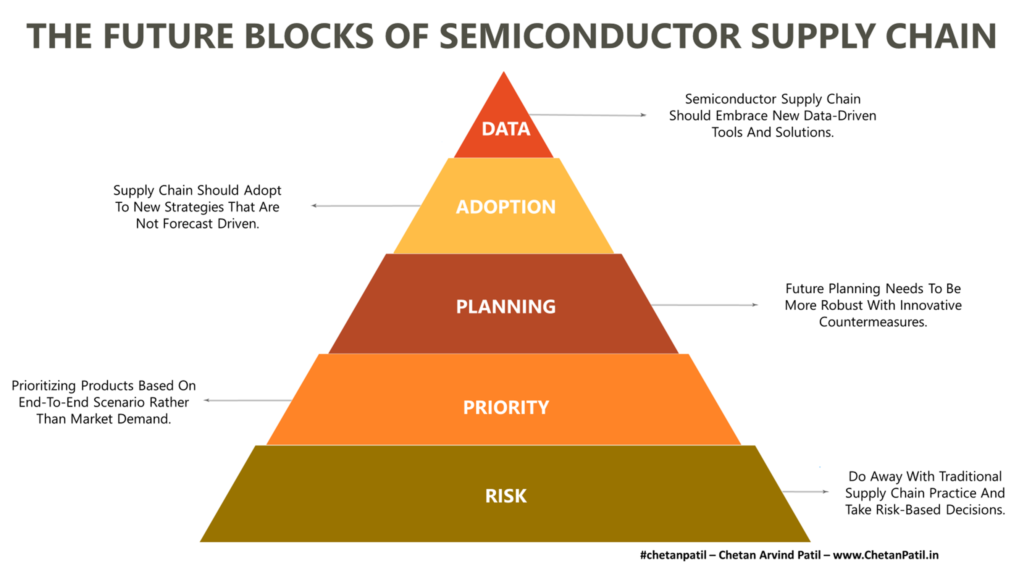
    THE FUTURE BLOCKS OF SEMICONDUCTOR SUPPLY CHAIN

    In the 1960s, the SCM followed a fragmented methodology and thus required coordinating with different teams to merge the information (forecast, sourcing, logistic, etc.) before implementing decisions. By the 1990s, the fragmented approach became consolidated, and SCM became more centralized. Now, teams could take decisions faster than ever. However, in the 2020s, when the world is more connected than ever, all the information in hand could not predict the market trend. The impact of all this is capacity to supply chain constraint. Today is the time to understand the bottlenecks and prepare future semiconductor supply chain countermeasures that can take into account the abrupt cycle nature of the market.

    To tackle future semiconductor supply chain challenges, the following critical blocks should be re-visited to capture the improvements required along with the way these resources are utilized to make future projections.

    Data: Understanding the market demand is very important. Semiconductor supply chain teams have resources that can allow them to gauge the market swing. These resources provide information to make a better decision on how to manage inventory, manufacturing orders, and supply. However, looking at the pandemic scenario, the semiconductor teams focused on the supply chain have not taken full advantage of the resources in hand. The future decision should be based on new advanced tools that can provide information outside of the industry (like predicting pandemics) and/or developing dedicated talents capable of using data to predict future market changes that can severely affect the semiconductor supply chain. Supply chain management should move more towards data drive management.

    Adoption: Just In Time (JIT) is a widely used methodology in manufacturing. However, the semiconductor supply chain needs to move beyond the traditional concepts. This demands changes in the supply chain working with the help of a detailed understanding of both technical and non-technical (like weather, outbreak, etc.) information that can affect the semiconductor supply chain.

    Planning: Semiconductor supply chain planning should utilize more data points than simply relying on forecast or market intelligence. The roadmap to manage the supply of semiconductor products in the market should also consider data points from different forward and backward supply chain-dependent industries. This could be from understanding the raw material supply chain to the end customer supply chain. Merging several output supply chains can provide a better outlook as to whether the planning is in line with the market reality or not.

    Priority: In the end, decisions taken by the semiconductor supply chain teams are all about how to balance and prioritize product manufacturing. This also means some products will have more supply than others, and any incorrect priority decision will lead to supply constraints. Prioritizing products is not an easy task, and that is why semiconductor supply chain teams need to find new ways to balance the inventory of different types of products.

    Risk: Eventually, semiconductor supply chain management is a risky business. If the market demand is lower than the expected supply (which means the products are at the manufacturing stage), then it can lead to losses. On another side, if the product supply is not meeting the market demand, then the opportunity to gain on the high demand is lost. It is vital to take risks but based on new strategies and concepts that are more robust than the older production and supply systems.

    The semiconductor supply chain teams can take these blocks and re-invent them to their potential. In the long run, the end customer also needs to backtrace and understand how the semiconductor supply chain drives them and also affects them.

    As the semiconductor world moves forward, the semiconductor supply chain management across different industries (not just semiconductors) will also evolve, and supply management teams will have to capture the impact of worldwide supply chains (semiconductors impacting automotive) and how individual industries should master 360-Degree views for long-term benefits.


  • The Implications Of Semiconductor FAT Outsourcing

    The Implications Of Semiconductor FAT Outsourcing

    Photo by Yogesh Phuyal on Unsplash


    THE IMPACT OF SEMICONDUCTOR FAT OUTSOURCING

    The process of developing a semiconductor product requires several business and technical components to work together. Depending upon the business model of the semiconductor company, these development activities (mainly design and manufacturing) can be insourced or outsourced.

    The technical aspects of semiconductor product development are often insourced and developed in-house. Doing so requires investing in teams to drive research and development activities. The outcome of these efforts is patents and intellectual property, which in turn allows the development of more advanced products and thus provides an edge over other semiconductor companies. However, the manufacturing part of the semiconductor can be executed in two ways: in-house or outsourced, and the final decision is based on the business requirements and planning.

    The business component of semiconductor product development mainly decides on how to develop the product after the design stage: semiconductor manufacturing. In the last few decades, semiconductor manufacturing has become more outsourced than insourced, and the major driving factor for this is cost optimization apart from resource balance.

    The outsourcing model in semiconductor manufacturing is applied to three specific domains:

    Fabrication: Pure-Play FABs are hired to fabricate wafers.

    Assembly: Vendors who provide different types of silicon packaging services.

    Test: Semiconductor houses that are capable of providing resources to test wafers and packaged products.

    FAT – Fabrication, Assembly, And Test – outsourcing has increased mainly due to FAB-LESS growth. However, as the number of companies without in-house semiconductor manufacturing grows, the dependence on external vendors increases too. Over the years, the process and business model of semiconductor FAT outsourcing have to lead to both pros and cons.

    Time: Every semiconductor design company wants to see their product go through semiconductor FAT in the shortest time possible. In reality, it is dependent on the vendor who is hired for the semiconductor FAT. If there is no capacity or resource constraint then the manufacturing time is fast, otherwise, the manufacturing process can take a lot of time, which is what is happening during the semiconductor shortage.

    Reliance: As the semiconductor FAT outsourcing business grows, the reliance on external vendors is increasing year on year. This makes planning an important part of the semiconductor product development as any slip on the vendor side can hurt the design houses and their business. In case of any hiccups and difficulties, it is not easy to switch the outsourced vendor overnight, and this process makes it critical to capture and plan for countermeasures.

    Cost: Not investing in internal manufacturing capacity can certainly reduce the CapEx and allows semiconductor companies to focus on building next-gen products. In the long run, semiconductor FAT outsourcing can provide several cost benefits. However, care should be taken for scenarios when external resources run out of capacity due to demand, and it turns starts increasing the cost of outsourcing.

    Features: In the end, all semiconductor design houses are providing features. These features are in form of packaged products but internally several sub-features are driving the system. Some critical features are dependent on the outsourcing vendors who are capable of fabricating as per the requirement (technology-node for example) and then can also package parts as per package technology. This also means that majority of the design features are also driven by well equipped the semiconductor FAT providers are.

    Resource: One of the most positive impacts of semiconductor FAT outsourcing is resource allocation. By focusing on design and then letting external vendors manufacture, enables semiconductor companies to focus on future roadmap while external vendors bring today’s product to reality.

    Semiconductor FAT outsourcing is not new and has been around for decades. The future of semiconductor outsourcing looks bright mainly due to the growing market and it will certainly make semiconductor design (mainly FAT less) houses more dependent on FAT outsourcing than ever, but the semiconductor shortage and impact it had on the industry is going to make certain specific changes in the future of semiconductor FAT outsourcing.


    THE FUTURE OF SEMICONDUCTOR FAT OUTSOURCING

    Recent development in the semiconductor industry is now questioning the worldwide semiconductor manufacturing capacity. From the technology point of view, it is difficult to build capacity overnight and this makes the manufacturing process far more critical than few other stages in the product development phase.

    Semiconductor dependent end-companies/customers (and even governments) have realized the role played by the semiconductor manufacturing process. On top of that, the companies and governments are also realizing that it takes time, effort, and a large amount of investment to build a basic semiconductor manufacturing infrastructure.

    All these new learnings are certainly pushing the future of semiconductor FAT outsourcing. In the long term, all the push might bring more market for the semiconductor outsourcing business.

    Diverse: Today, there are specific regions that are dominating the semiconductor FAT outsourcing business. The experience gained out of the semiconductor shortages is pointing to the fact that there is a need for a far more diverse manufacturing supply chain. Whether this is by building more capacity or by upgrading existing ones, the end result will be more diverse (spread across different countries) than it is today.

    Balance: Hiring external vendors for FAT is inevitable in many cases. Care must be taken by ensuring that there is no growing dependence on external vendors. This means the semiconductor companies should always have some percentage of internal capacity, but that requires CapEx, resources, and planning. In the end, it is not a good strategy to rely on external vendors for all semiconductor manufacturing needs and that is why it is becoming critical to balance internal manufacturing with external.

    Consolidation: There are different types of semiconductor FAT outsourcing options. Some are giant vendors who hold more than 40% of the market and then several smaller vendors also play a crucial role. As the semiconductor industry comes out of the semiconductor shortage issues, there will be more activity of manufacturing consolidation wherein smaller vendors will merge to bring investment for new capacity. This consolidation might also be driven by semiconductor companies (design-focused) acquiring manufacturing assets.

    Joint Ventures: Joint Ventures (JV) is another future roadmap that semiconductor FAT outsourcing will follow. This might see different FAB and OSAT opting for JVs with design houses. The probability of JVs happening at a very high rate is low, but this is certainly going to be the case for companies looking to enter the semiconductor manufacturing arena.

    Catch-Up: Semiconductor FAT outsourcing capacity crunch is going to drive new capacity along with up-gradation of existing ones. However, the majority of this new capacity might also come from regions and countries which never had any experience in the FAT outsourcing business. Governments worldwide are providing incentives to set up new FAB and OSAT capacity, and this will allow respective countries to catch up with the other FAT markets/regions.

    Ultimately the semiconductor manufacturing is going to be driven heavily by the FAT outsourcing model, and there is no harm in it. It is upon the semiconductor FAT less companies to understand their market and then accordingly invest either in the internal manufacturing capacity or the external ones.

    In the end, the semiconductor FAT outsourcing is going to keep rising as the semiconductor market grows.


  • The Overlapping Business Model Of Semiconductor Pure-Play FAB And OSAT

    The Overlapping Business Model Of Semiconductor Pure-Play FAB And OSAT

    Photo by Firdouss Ross on Unsplash


    THE REASONS FOR THE OVERLAPPING OF SEMICONDUCTOR PURE-PLAY FAB AND OSAT BUSINESS

    Semiconductor manufacturing is heavily dependent on external vendors. This is more true for semiconductor companies that do not have any internal manufacturing capability and have to rely heavily on outsourcing.

    This has made Pure-Play FAB and OSAT the two major driving forces of semiconductor manufacturing. It is widely known that FAB-LESS (and OSAT-LESS) semiconductor companies have contributed heavily in driving the external Pure-Play FAB and OSAT business.

    There are few widely know accepted business model that defines the semiconductor design and manufacturing:

    FAB-LESS: Semiconductor companies that only focus on semiconductor design and rely on external Pure-Play FAB and OSAT for semiconductor manufacturing.

    IDM: Semiconductor companies that focus on both semiconductor design and manufacturing and have the internal capacity to execute both and also take help of external capacity when required.

    Pure-Play FAB: Semiconductor companies that invest mainly in semiconductor fabrication capacity. Cater to both FAB-LESS and IDM.

    OSAT: Outsourced semiconductor assembly and test business that caters to any semiconductor companies without internal assembly and testing capacity.

    The above definitions were applicable in the 1980s and 1990s, and to some extent till the 2000s. However, as the reliance on the semiconductor industry has grown, so has the application of the above business models. This is at least true for Pure-Play FABs and OSATs because of the following reasons:

    Opportunity: Both Pure-Play FABs (more than OSATs) and OSATs are seeing the growing importance of providing extensive services than only specific ones. This is pushing them towards each other’s market. Some of the big Pure-Play FABs already have internal assembly and testing facilities and are already capturing OSAT business. Few Pure-Play FABs are also forming JVs with external houses to provide OSAT services like an umbrella business. This is putting pressure on OSATs and slowly they have also started exploring opportunities beyond OSAT business itself.

    Services: In the end, both Pure-Play FABs and OSATs are providing services to their customers. The more and the better services they can provide the larger market they can capture. Increasing portfolio and moving beyond dedicated services is another reason why Pure-Play FABs and OSATs are entering each other’s business market.

    Technologies: Top Pure-Play FABs are already known for providing 2.5D/3D packaging expertise. This is mainly due to More-Than-Moore solutions the semiconductor world is looking forward to. This is naturally allowing Pure-Play FABs to increase back-end business, and thus putting pressure on OSAT to innovate its back-end solutions or provide Pure-Play FAB services to even out the market.

    Resources: Both Pure-Play FABs and OSATs can drive new technological solutions from inception to production. The major factors are the internal resources (equipment, labs, facilities, etc.) and also a talented pool of researchers who can execute the new solutions on the go. This is another major reason why Pure-Play FABs and OSATs are looking at each other’s market and slowly rolling out new services.

    New Model: The high cost to develop large FAB and OSAT to only provide one set of services is raising the question as to whether there is an opportunity to extend the same facility to drive new services. This eventually means providing overlapping services and thus enabling a new semiconductor business model.

    Pure-Play FAB business started with the focus of providing big giant factories that can take design files and bring them to reality in form of silicon wafers. However, semiconductor fabrication is only one part (important though) of the semiconductor product development. Pre-fabrication and post-fabrication activities are also critical and Pure-Play FABs are realizing the importance of it, and to fill this gap, in the last few years Pure-Play FABs have started investing in assembly and testing services (design is not far behind). While this makes them essentially an Integrated Device Manufacturer (IDM), however, the percentage of assembly and testing services that Pure-Play FABs provides is still comparatively less but certainly on the rise.

    OSAT business on other hand has primarily focused on assembly and testing, and it has allowed them to build high-class facilities that can test and package the product as per the customer requirements. However, as Pure-Play FABs start getting into the assembly and testing services, the OSAT business is changing itself to extend services beyond assembly and testing. Top OSATs are looking to invest in smaller FABs that can allow them to capture the fabrication market, and some OSATs have already created subsidiaries that focus on the design aspect of semiconductor product development. Thus also colluding with the FAB-LESS business model.

    The overlapping of Pure-Play FAB and OSAT business is raising questions as to whether there even exists a specific semiconductor business model, and what are the long-term implications.


    Picture By Chetan Arvind Patil

    Picture By Chetan Arvind Patil

    THE IMPLICATION OF MERGING SEMICONDUCTOR PURE-PLAY FAB AND OSAT BUSINESS

    Semiconductor manufacturing companies expanding their business to provide more services is certainly a welcome move, but the implications of doing so can be both positive and negative. More so when Pure-Play FABs and OSATs extend their services and start capturing each other’s market.

    For semiconductor customers (mainly FAB-LESS) having more options to outsource semiconductor manufacturing will be positive news only. However, only a handful of Pure-Play FAB is capable of capturing OSAT business, and this will certainly raise the level of dependence on big manufacturing giants which might not have positive implications in the long run.

    This is why it is important to understand what are the major implications when Pure-Play FABs starts getting into the OSAT market and vice verse:

    Competition: Overlapping of Pure-Play FABs and OSATs will increase the competition to provide semiconductor fabrication, testing, and assembly services. For customers hiring Pure-Play FAB and OSAT, it is a win-win situation and so will it be for the semiconductor industry at large as there will be more capacity and also options for outsourcing to semiconductor fabrication and back end services.

    Dependence: If more semiconductor companies start providing fabrication to the assembly under one roof, then it will slowly make FAB-LESS more dependent (than today) on specific solutions providers. The major reason is due to the notion of keeping all semiconductor manufacturing under one location/flow so that the cycle time reduces. Hiring two different vendors brings more complexity than hiring a single vendor which can perform all the semiconductor manufacturing services at the same location.

    Cost: If all the semiconductor manufacturing (fabrication, testing, and assembly) services are provided by a single entity, then it can allow semiconductor design companies to lower the cost by negotiating the terms. It might also be the case that the cost of development goes up due to new facilities requiring the full cycle of qualification before it can be used to fabrication, test, and assembly the silicon products.

    Capacity: If Pure-Play FABs and OSATs ramp up their efforts to enter the new semiconductor manufacturing business, then it will bring new capacity for the semiconductor industry. In the long run, this can have a more positive impact and can certainly mitigate future semiconductor shortages.

    Emerging Solutions: Extending business to provide new services often leads to innovation. This can very well happen if OSATs start exploring the fabrication business and drive newer technological solutions that are not only limited to technology nodes but are also about new semiconductor manufacturing methodologies. The same can be true for Pure-Play FABs.

    The overlapping of Pure-Play FABs and OSATs is inevitable. One of the strategies that Pure-Play FABs and OSATs can deploy is to invest in smaller OSATs and FABs respectively. This can remove the risk of investing a large sum of money on upgrading existing facilities and can also bring life to smaller OSATs/FABs which are on the verge of closure.

    In the end, if OSAT and Pure-Play FABs keeping increasing their foothold into each other’s arena, apart from trying hands on the semiconductor design (dominated by FAB-LESS and IDMs), then does that mean all OSAT and Pure-Play FABs will turn into IDMs and eventually there will be no dedicated OSAT and Pure-Pay FABs? Only time can answer this question.


  • The Semiconductor Recipe For Automotive Industry

    The Semiconductor Recipe For Automotive Industry

    Photo by Lenny Kuhne on Unsplash


    THE IMPACT OF SEMICONDUCTOR SHORTAGE ON AUTOMOTIVE INDUSTRY

    Automotive is one of the several industries that heavily rely on semiconductor products to provide different features. These features range from infotainment to sensors to wireless communication. Over the last few decades, the need to drive such advanced features has increased the share of semiconductor products in automotive manufacturing.

    Due to the heavy dependence on automotive semiconductor products, the automotive industry has also been impacted because of the semiconductor shortage. The non-availability of the automotive semiconductor product has certainly brought several challenges for the automakers (and OEMs) and worldwide automakers are now struggling to keep their production line up and running.

    In the end, automakers also have to rely on OEMs to provide the sub-systems that their production line uses. The delay is more because the OEMs are not able to procure the silicon chips (from OSATs and FABs) required to provide the end systems that automakers use to assemble different vehicles. Eventually, the impact is felt on the end product (vehicles) and this is why the focus has shifted more on automakers than the OEMs.

    Below are the major impacts of the automotive semiconductor shortages on the automotive industry:

    Delay: Semiconductor capacity crunch has lead to a shortage of critical automotive semiconductor products. Automakers are not able to ship or sell vehicles without these vital silicon chips. This has lead to a backlog of orders and slowly causing leading to the halt of several automotive production lines. Given how strict the quality and reliability requirements of automotive semiconductors are, it is difficult to switch the FABs and OSATs where the capacity might be available. All this is impacting automakers with severe delay in providing the last piece of silicon automakers need.

    Revenue: Automaker’s OEM vendors are not able to procure the required number of silicon chips to design automotive systems that are needed by different vehicles. This has caused a supply chain gap and has impacted the revenue (slow production line) of the majority of the automakers even though the demand is high.

    Human Resource: Due to the slow or halted production lines, the automotive manufacturers are taking tough decisions to lower the loss caused by the semiconductor shortage. One such decision is layoffs and unfortunately, it is leading to job losses.

    Planning: Automakers worldwide launch new models and trims every year. Due to the semiconductor shortage, automakers are not able to plan out their future product launches. This is severally impacting their long-term planning and more so when it comes to launching alternate-fuel technologies to drive next-gen vehicles.

    Cost: As it happens in any other industry, the slow production has to lead to a supply crunch and this is leading to a rise in the cost of vehicles. On top of this, the cost to develop new products and solutions has also gone up mainly due to the impact on timeline and schedule caused by the semiconductor shortage.

    The severe impact of the automotive semiconductor shortage has prompted the automotive industry to take a serious look at the importance and share of semiconductors in automotive manufacturing.

    As the world moves towards alternate-fuel technologies to drive next-gen automotive products, the share of automotive electronics (developed by the semiconductor industry) will keep increasing. This implies that any semiconductor shortage in the future will also keep impacting the automotive industry.

    The corrective actions (based on semiconductor shortage) will take years of planning and investment, and it is about time that the automakers (more than the OEMs) start preparing themselves for future implications today.


    Picture By Chetan Arvind Patil

    Picture By Chetan Arvind Patil

    THE RECIPE TO MERGE SEMICONDUCTOR INTO AUTOMOTIVE MANUFACTURING

    Every industry that has been impacted by the semiconductor shortage has started preparing backup plans for the future. This is mainly true for the OEMs who could not procure the semiconductor chips required to develop their system so that their customers can use and ship the end product out of the manufacturing facilities.

    When any other manufacturing industry is compared with automotive manufacturing, the major difference that stands out is the amount of investment and big plants that are required to keep assembling the new vehicles. On a positive note, the experience of handling large manufacturing facilities provides the automotive industry an edge mainly due to the vast experience in building complex machines. If planned well, there is no question that the automotive industry can easily adapt and embrace non-automotive (semiconductor) manufacturing facilities.

    Automotive manufacturing is indeed heavily dependent on OEMs. More so for systems that are built using semiconductor chips and end up getting plugged during the automotive assembly process. This dependence has grown with the growing importance of semiconductor products that are required to build a more advanced automotive solution than its predecessors.

    Semiconductor Design -> FAB -> OSAT -> OEM -> Automotive Manufacturing

    For automotive manufacturing, if there is one important question that comes out of the semiconductor shortage saga, then it is about how to mitigate future semiconductor shortages. To answer this question, several automotive manufacturers have already started preparing plans to make themselves self-sufficient for future semiconductor needs. In reality, it will take a lot of time and effort, but such push by the automotive industry is inevitable.

    Irrespective of the path taken by different automakers, the below recipe can be used to understand how to merge semiconductor manufacturing into the automotive manufacturing process:

    Cluster: Setting up semiconductor manufacturing (mainly FABs and OSATs) is a big investment. It requires years of planning and then billions of dollars to execute and thereafter millions to keep the facilities active. It is a risk that few key players have taken. What the automotive industry should focus on is a cluster-based approach wherein different automakers pool money and resources to create a network of automotive-focused FAB and OSAT facilities. This can be a multi-tier JV that can drive the manufacturing of critical automotive semiconductor products. These cluster facilities can also balance out the semiconductor manufacturing capacity worldwide.

    In-House Capacity: Apart from the cluster semiconductor manufacturing approach, automakers can also find avenues to build semiconductor manufacturing capacity in-house. This is certainly not easy to execute and there are only a handful of automakers that will have the kind of investment required to drive FABs and OSATs. But this is certainly the way to go because the importance of semiconductors in providing new technology features will keep increasing.

    Team: Irrespective of whether the automotive manufacturers end up building their semiconductor manufacturing facilities or not, there should be a push to create a network (within and outside) of semiconductor teams that can provide insights into the design and manufacturing of next-gen semiconductor products. This can help automakers understand which target features can be optimized using a different set of available semiconductor features. This can also be a way to make automakers self-sufficient when it comes to the automotive semiconductor.

    Acquisition: Automakers should start acquiring emerging companies that provide automotive semiconductor solutions. They can do so by focusing on critical automotive features like LIDAR, RADAR, CMOS cameras, sensor-based tech, and even centralized XPUs for future autonomous vehicles. In the end, these strategic acquisitions will help automotive companies drive in-house semiconductor design operations, which can slowly kickstart the need to move towards the manufacturing aspect of semiconductors, which can also be executed by acquiring small FABs and OSATs.

    Investment: Even if automakers are not able to acquire semiconductor-focused emerging companies, they should start investing in semiconductor companies that can add value to their portfolio. This investment can be equally distributed towards both the design and the manufacturing aspects of the semiconductor.

    When the world comes out of the semiconductor shortage (which can take anywhere from months to years), there are certainly going to be new players entering the semiconductor industry to take control of the different aspects of the semiconductor supply chain that affected their business.

    One such industry will be automotive, and there is certainly going to be a push by automakers to make themselves self-sufficient to ensure that any future semiconductor shortage does not impact their production line.

    The recipe to merge semiconductor manufacturing (and even design) with automotive manufacturing is readily available and the only missing links are the actions by the automakers.


  • The Need To Focus On Outsourced Semiconductor Assembly and Test

    The Need To Focus On Outsourced Semiconductor Assembly and Test

    Photo by Devin Spell on Unsplash


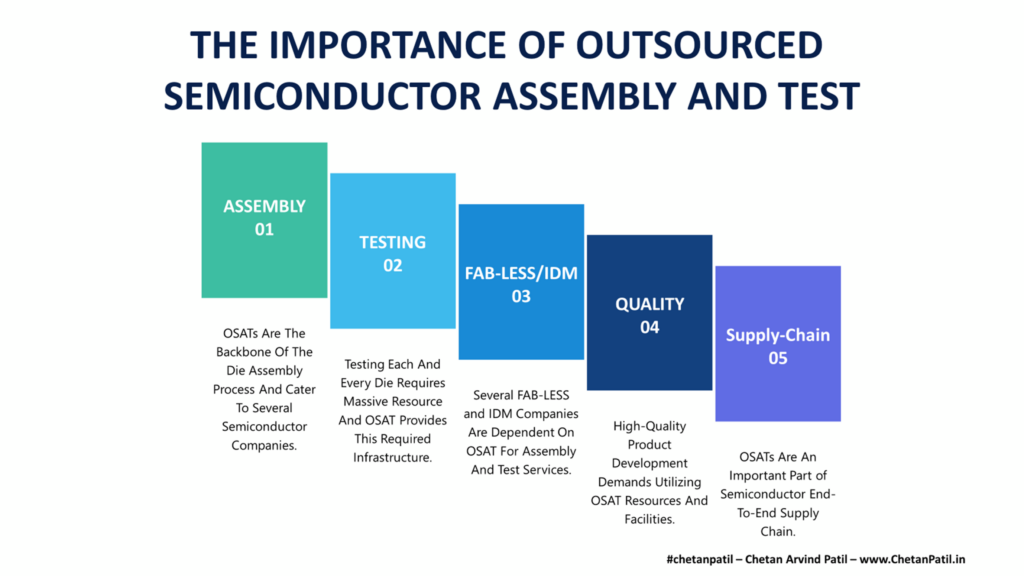
    THE IMPORTANCE OF OUTSOURCED SEMICONDUCTOR ASSEMBLY AND TEST

    Outsourcing is one of the several ways to optimize in-house business activities, and that is why the majority of the industry heavily takes advantage of outsourcing. In the long run, hiring an external vendor to outsource part of the product development process not only brings operational efficiency but also provides an avenue to optimize internal resources.

    The semiconductor industry is also heavily driven by outsourcing. More than the design, the manufacturing aspect of the semiconductor product development relies on services provided by external vendors. The two major examples of semiconductor outsourcing are FABs (Pure-Play Foundries) and OSATs.

    Pure-Play Foundries: Provides services that transform the design files into real silicon wafers.

    OSATs: Takes the silicon wafers fabricated and puts them through the testing process before assembling.

    The semiconductor shortage has shown the world the importance of semiconductor FABs. This is the primary reason why all over the world countries are coming up with attractive incentives to invite the Pure-Play Foundries to set up new FABs. However, from the semiconductor manufacturing point of view, semiconductor FABs provide only 50% of the services that are necessary to turn a product design into reality. The rest of the 50% is dependent on the OSATs – Outsourced Semiconductor Assembly and Test.

    Test and packaging (also referred to as assembly) is a major part of semiconductor manufacturing, and these two are the services that OSATs provide. OSATs invest heavily in equipment and processes that enable testing of different types of wafers/parts apart from providing high-tech research-driven packaging solutions. The cost associated with running the testing and packaging process is the major reason why the majority of semiconductor companies are relying on outsourcing.

    In doing so, over the last four decades several OSATs have come up all over the world. However, their growing importance is also the major reason why the semiconductor industry should also focus on OSATs when talking about building new manufacturing capacity and not just focus on semiconductor FABs that only provide half of the semiconductor product development process.

    Several factors have made OSATs the backbone of the semiconductor industry. The semiconductor supply chain will be inefficient without OSAT houses because of the following importance:

    Assembly: Any piece of semiconductor die has to get packaged into an assembled product that can be soldered onto the target application platform. This is where OSATs come into play as their first area of focus is to drive assembly (by providing different package technology) services. OSATs invest heavily in research and development activities to provide different types of assembly options, and over the last few years, semiconductor design houses have also relied on OSAT to drive their assembly requirement.

    Testing: Testing and assembly go hand in hand, and that is why OSATs by default provide testing services. These services require high-end equipment so that any type of wafer can be tested with minimal human interference. In many cases, testing is also carried out on the packaged parts and is a de-facto way to screen bad parts out of the assembly line.

    FAB-LESS/IDM: In the semiconductor industry, not all companies have in-house manufacturing facilities. This is more applicable for FAB-LESS and some IDMs. These two types of companies thus leverage external FABs and OSATs to cater to their need for fabricating, testing, and assembly. This is another reason why OSATs have grown in importance as several FAB-LESS/IDM are dependent on them.

    Quality: Several years of industrial experience have enabled OSATs to provide high-quality services that drive defect-free testing and assembly solutions. In the long run, OSATs ensure that the product being tested and assembled follows a robust recipe that allows them to remove any low-quality part out of the production line thus improving the quality of their customer’s product.

    Supply-Chain: The end-to-end semiconductor flow requires several stakeholders to come together. This is where companies providing different services come into the picture. The design and fabrication houses are a major part of the supply chain. However, the testing and assembly requirement makes the semiconductor supply chain incomplete without OSATs. The outsourcing facilities provided by OSATs make them the last critical step in the semiconductor supply chain.

    Even though there are several OSAT vendors in the market, only a few players are well known and have also expanded their business and reach over the last few decades. While this is certainly good news for the semiconductor growth, but slowly it is presenting a challenge similar to the semiconductor FABs, where a handful of players are driving the semiconductor back-end business. The same scenario is applicable in the OSAT arena, where few companies are increasing their market share and making the semiconductor supply chain dependent on them.

    In the long run, this can prove out to be a costly scenario and that is why the semiconductor industry needs diverse players to provide semiconductor FABs and OSATs services. Today is the right time to do so as countries are looking to attract new manufacturing houses to set up shops and new players can leverage these incentives to create a niche market for themselves.


    Picture By Chetan Arvind Patil

    Picture By Chetan Arvind Patil

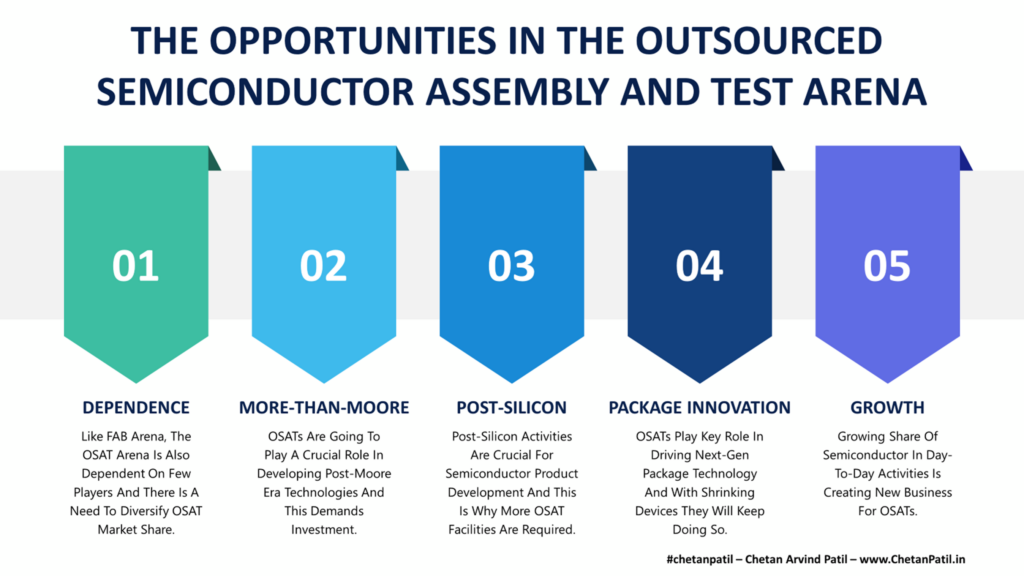
    THE OPPORTUNITIES IN THE OUTSOURCED SEMICONDUCTOR ASSEMBLY AND TEST ARENA

    The OSAT market share shows a similar story as the semiconductor FAB. There are three to four players in the OSAT arena that are dominating the market for several years, and year-on-year this gap is increasing when compared to other smaller OSAT players.

    There is certainly nothing wrong if the big OSAT players are getting bigger. The problem arises when there is a spike in demand and the top players are not able to accommodate all the requests, which eventually leads to higher processing (test and assembly) time. In situations like these, the need for larger diversified OSAT capacity is felt.

    The sudden rise in semiconductor demand has not only affected the semiconductor FABs but has certainly also affected OSATs. In some sense, this presents an opportunity for emerging OSATs, semiconductor investors, and also countries/governments to focus on OSAT business if the cost of developing new FABs is too high/risky.

    OSATs can be an excellent vehicle for emerging semiconductor manufacturing regions as they require less investment compared to semiconductor FABs and on other hand, the revenue is attractive too. Focusing on OSAT capacity improvement can also drive growth in semiconductor manufacturing for countries that haven’t had the fortune of housing semiconductor FABs so far.

    The opportunities presented by the OSAT business arena are many and are a good mix of business and technical dependency:

    Dependence: When it comes to optimizing semiconductor operational activities, hiring OSATs to perform semiconductor testing and packaging is the most important decision. The growing dependence on OSAT has lead to the expansion of some of the top players and this is making FAB-LESS to IDMs dependent on few top OSAT houses. To balance this out (similar to what the semiconductor FAB market also needs) there is an opportunity for new emerging OSAT to provide more capacity to the semiconductor industry and this might ensure that there is no dependence on few select players.

    More-Than-Moore: As the world move beyond 1nm, the research around technologies that can drive solution beyond Moore’s law is also critical. OSATs have an important part to play, and the major reason is due to the different types of package technologies that can help drive next-gen semiconductor solutions like chiplets and heterogeneous integration.

    Post-Silicon: More than 50% of the semiconductor product development activities occur during the post-silicon stage. From FABs to OSATs to ATMPs to Distributers, all play a critical role in bringing the design to life. As part of the post-silicon process, OSATs have increased their importance over the last decade. The complexity brought by the new chip design is also pushing OSATs to upgrade their facilities to handle the probing of new types of chips. This presents an opportunity not only to the OSAT market but also to the equipment and tool manufacturers.

    Package Innovation: Innovative package solutions will be a continuous development process. FAB-LESS and other types of semiconductor design houses can come up with new packaging solutions, but they will always require an OSAT vendor to execute and bring the new package technology to reality. The major reason is the lack of internal or in-house assembly and testing facilities (which often require millions of dollars), and relying on OSAT is the best way to optimize the cost while driving new package innovations.

    Growth: The increasing share of semiconductors in day-to-day solutions is putting a lot of pressure on semiconductor manufacturing. This is the major reason why for the next few years or even decades, the semiconductor market will keep growing. The heavy dependence on OSAT services makes them a perfect venture to be in, and also makes them a great candidate for countries looking to ignite semiconductor manufacturing clusters within their borders.

    The importance of OSAT is well known in the semiconductor industry. They provide critical services by building larger facilities that can drive the last important piece of semiconductor manufacturing. This is why countries looking to attract semiconductor manufacturing houses should focus on OSATs and then build the semiconductor manufacturing infrastructure up to the FABs.

    Ultimately, as the importance of manufacturing aspect of the semiconductor product development grows, the importance of both the FABs and OSATs will grow too.


  • The Evolving Semiconductor Wafer Size

    The Evolving Semiconductor Wafer Size

    Photo by Maxence Pira on Unsplash


    THE IMPACT OF WAFER SIZE ON SEMICONDUCTOR INDUSTRY

    The semiconductor industry is built on the platform laid by silicon wafers that form the base of fabricating different types of advanced semiconductor products. The silicon wafers have gone through an incremental change in size/diameter over the last half-century. The growing need for advanced semiconductor products is now raising another round of discussion to move beyond wafer size in use today, mainly as a factor to improve the production rate of new semiconductor FABs and OSATs.

    The semiconductor manufacturing facilities around the globe are categorized based on the wafer size they can handle. The majority of the FABs and OSATs today are focused on 200 mm (7.9/8 inch) wafers with a few focusing on 300 mm (11.8/12 inch). On other hand, only small FABs and OSATs cater to 150 mm (5.9/6 inch) wafers.

    Wafer size plays a crucial role in deciding how the FABs and OSATs are built. The major reason is the equipment and tools that are required vary based on the wafer size and with the increase in wafer size the cost of setting up new FABs and OSATs increases too. This is why selecting the right wafer size a crucial.

    Eventually, the choice of wafer size is more investment and strategically driven rather than technical. The reason for this is the impact of any change in wafer size on the full end-to-end semiconductor flow.

    Wafer Size: Larger wafer size certainly provides more die per unit area. The extra area to fabricate more die eventually allows FABs and OSATs to fabricate and test/assemble more dies in a given time. This pushes the rate at which new products can be fabricated/assembled and to some extent increasing wafer size can also have a positive impact on the supply chain.

    Die Per Wafer: Wafer size clearly defines how many die per wafer there will be. This allows the semiconductor design houses to gauge how much cost savings will be there. In the end, a smaller wafer for a high demanding product will lead to more wafer orders compared to a relatively larger size wafer. This balancing act is the major reason why companies often have to spend more time analyzing the pros and costs of selecting wafers from the business perspective.

    Cost: Wafer size certainly dominates the cost of developing a semiconductor product. Apart from the cost of the wafer itself, there are FAB and OSAT costs that also need to be considered. Using a 200 mm (7.9/8 inch) wafer will certainly have a lower cost of fabricating and assembling semiconductor chips compared to a 300 mm (11.8/12 inch) wafer. In the end, it is all about creating the margin by selecting the right wafer size.

    Yield: Historically, as the wafer size has increased the yield has come down. A product fabricated on a 300 mm (11.8/12 inch) wafer will have a lower yield compared to the same product on a 200 mm (7.9/8 inch) wafer. In the end, the final yield will be comparable, but the loss of yield as the wafer increases is mainly due to the time required to perfect the semiconductor process, which improves as more products use the same wafer size as the learnings can be captured and applied to improve overall product yield. Wafer handling also plays a crucial role in deciding the final yield and as the wafer size increases, it becomes difficult to lower the number of process steps due to a large number of die per given area.

    Process: Wafer size is so crucial that semiconductor manufacturing facilities have to play a very long game and decide upfront the wafer size they will support over the next 5 to 10 years. The major factor is the cost associated with the process that is required to set up based on any upgrade in wafer size. To play safe, the majority of the semiconductor facilities have zeroed on to 200 mm (7.9/8 inch) wafer as they allow the balance of both the technical and business aspect. However, the need for 300 mm (11.8/12 inch) is putting pressure on FABs and OSATs to go for upgrades.

    The above points clearly show the impact wafer size has on a different aspect of the semiconductor process. From cost to yield, there are several things to consider when the time comes to decide on which wafer size will be used to produce the next-gen product.

    In the end, the decision is taken by the semiconductor houses who design and own the chip as the manufacturing facilities are only providing services.


    Picture By Chetan Arvind Patil

    Picture By Chetan Arvind Patil

    THE STEPS TOWARDS NEW WAFER SIZE FOR SEMICONDUCTOR INDUSTRY

    The current saga of semiconductor shortage is also raising the question of going a setup further and reigniting the discussion of going for the largest wafer size (300 mm (11.8/12 inch)) in production today.

    This means pushing all the to-be-designed FABs/OSATs capacity to opt for 300 mm (11.8/12 inch) or even 450 mm (17.7/18 inch), which has not been used for full fledge production so far. The major argument is to increase the capacity per FAB/OSAT by equipping them with the process to churn more die per unit area. This will certainly require huge investment and not many FAB/OSAT will be willing to opt for anything more than a 200 mm (7.9/8 inch) wafer.

    However, the semiconductor industry should also take a look at the wafer size from the growing dependency on semiconductor products. The most efficient way to eliminate any future demand that leads to the shortage is not only to build more FABs/OSATs but to also equip these facilities for future needs.

    Even if the FABs/OSATs are initially designed and equipped with a 200 mm (7.9/8 inch) or 300 mm (11.8/12 inch) wafer, they should also start planning for 450 mm (17.7/18 inch) today. Following such a strategy will allow FABs/OSATs to be ready for the future demand that can certainly exceed the total capacity that will be available in the near term.

    There are robust steps required to drive the adoption of a much larger (mainly 450 mm (17.7/18 inch)) wafer size than that is produced today, and the below roadmap provides a holistic view of why different steps should be taken towards larger wafer size.

    Capacity: Today’s capacity is built on top of different wafer sizes and certainly it is not enough as per the semiconductor shortage. Building more FABs/OSATs will certainly provide higher capacity but not as much when the wafer size is increased. The semiconductor manufacturing houses need to take a long-term look at what is the loss of not upgrading to higher wafer size. It can start with 300 mm (11.8/12 inch) wafer FABs/OSATs and then move towards 450 mm (17.7/18 inch).

    Collaboration: Setting up FABs/OSATs that can handle larger wafer sizes is costly. The only way to mitigate this cost is to bring different manufacturers together and invest in cluster-based facilities that cater to different customers. This will certainly invite IP and other confidentially issues but without a collaborative approach, it is not possible to increase capacity that is focused on larger wafer (300 mm (11.8/12 inch) or 450 mm (17.7/18 inch)) size.

    FAB-LITE: Another approach towards handling wafer size can be to create a few niche semiconductor FABs and OSATs that only cater to future large wafer sizes. These can be facilities that are focused on 450 mm (17.7/18 inch) or 675 mm (26.6/27 inch) wafer FABs/OSATs. This strategy will make these new facilities the future R&D places that can drive the development of larger wafer size and as the technology progresses the lower cost of utilizing these larger wafer size will lead to mass production.

    Target Node: Larger wafer size can also be used for specific technology-nodes. This way the cost of production can also be balanced along with the investment required. The best suitable nodes can be older nodes that have a more robust process than the future new technology-nodes. This can certainly help drive the adoption of higher wafer size too.

    Efficiency: In the end, larger wafer sizes bring efficiency by shipping more parts in the same amount of time. The overall cost and investment will balance (as long as the production technology is affordable) out. This is another reason why the semiconductor industry should move towards a larger wafer size.

    The steps if taken strategically can re-ignite the discussion of bringing 450 mm (17.7/18 inch) wafer into production and can certainly create a niche network of FABs and OSATs that can ramp up the production by providing more die per area (not just wafer but also facility area).

    The semiconductor industry has to capture the cost of creating hundreds of FABs/OSATs versus a handful of high capacity FABs/OSATs that can handle much larger wafer sizes than today and thus providing a way to balance the cost and capacity for future demands.


  • The Semiconductor Chips For Data Centers

    The Semiconductor Chips For Data Centers

    Photo by Taylor Vick on Unsplash


    THE BUILDING BLOCKS OF SEMICONDUCTOR CHIPS FOR DATA CENTERS

    The connected world is leading to real-time information exchange, and this is why consumers to enterprises expect the request to be processed in the fastest time possible. The devices used to send such requests can only process and store a certain amount of data. Anything beyond a threshold requires the use of data centers, and that also means transferring/receiving data over the air.

    The computing industry has relied on data centers since mainframe days. However, the importance of data centers has mainly grown due to the connected systems. These data centers have to run 24×7 and also have to cater to numerous requests simultaneously.

    To ensure a quick and real-time response from data centers, three major systems have to work in synchronization:

    Software: If a smartphone user is sending the request, then the data needs to be encrypted in packets before sending it over the air to the remote location where the massive data centers are located. This means the software solutions, both on the client and the server-side, have to work in harmony. This is why software is the first major system required for accurate data center operation.

    Connection: The second major system is the network of wired and wireless systems that aid the transmission of data from the client to the server (data centers). If a robust connection is not available then data centers will be of no use.

    Hardware: The third and most critical piece is the silicon chip or hardware that makes up the data center. These tiny semiconductor chips end up catering to all the request that comes from different part of the world. To ensure the request is fulfilled in real-time, a smart silicon chip is also required that can handle the data-efficient without adding bottlenecks.

    The growing internet user base along with data-driven computing solutions has to lead to the high demand for data centers. To cater to all such growing services, different types of data centers are required. Some data centers are small in size (less number of servers) and some are giant. Data centers with more than 5000 servers are also called hyperscale data centers. In 2020, there were more than 500 hyperscale data centers running 24×7 and were catering to request coming from any part of the world.

    Data Centers Require Different Types Of Semiconductor Chips.

    To run these hyperscale data centers requires large facilities, but the key piece is still the tiny semiconductor chips that have to run all the time to handle different types of requests. Due to the growing focus on data centers, there is a need to change the way new semiconductor chips are being designed for data center usage.

    This is why all the semiconductor chip solutions that end up getting used in the data centers should be built around the following blocks:

    Processing: Semiconductor chips for data centers should be designed to process not only a large amount of data but also a new type of data. This requires designing semiconductor chips that can cater to the request in the shortest time possible, while also ensuring there are no errors during the processing.

    Security: Data centers receive different types of data processing requests and this data can have any information from credit card processing requests to personal information to login credentials. Semiconductor products by default have to focus on the security aspect when designing silicon solutions for data center usage.

    Workloads: Rapid software development has lead to different types of data. Data eventually lead to the formation of workloads that the computing system has to process. Given the rise of AI/ML/DL, there is a need to process the data elegantly. This requires doing away with traditional processing blocks and instead of adapting to more workload-centric architecture that can enable a high level of parallelism to train and infer information out of it.

    Adaptive: Smart world not only requires data capturing but also demands adaptive decisions. This often requires on-the-go training and modeling to ensure the user request is fulfilled intuitively. This is why there is a demand to drive AI drive architectures that can train data efficiently (eFPGA or NPU) and ensure any new (and never seen) request is handled without errors.

    Storage: Memory is one of the major building blocks of the computing world. The surge in the use of cloud storage is leading to new innovative storage systems that can provide more storage per dollar. This requires driving new semiconductor solutions so that data centers become powerful but at the same time are compact enough to not consume a large amount of energy.

    Efficiency: Data centers are considered to be one of the most power-hungry systems in the world. The year-on-year growth in hyperscale data centers is only going to increase the power consumption. To balance the processing need with the power consumption, semiconductor solutions have to consider the energy consumption per user request. By building an efficient semiconductor chip, the data centers can expand in number without impact the total power consumption.

    The above building blocks are not specific to XPUs for data centers only. These blocks are valid for another type of semiconductor chip that data centers require. This can be a networking solution (PCIe) or a new data transfer (HBM) interface. Eventually, the above points discussed are the major reasons why data centers require different types of semiconductor chips.


    Picture By Chetan Arvind Patil

    Picture By Chetan Arvind Patil

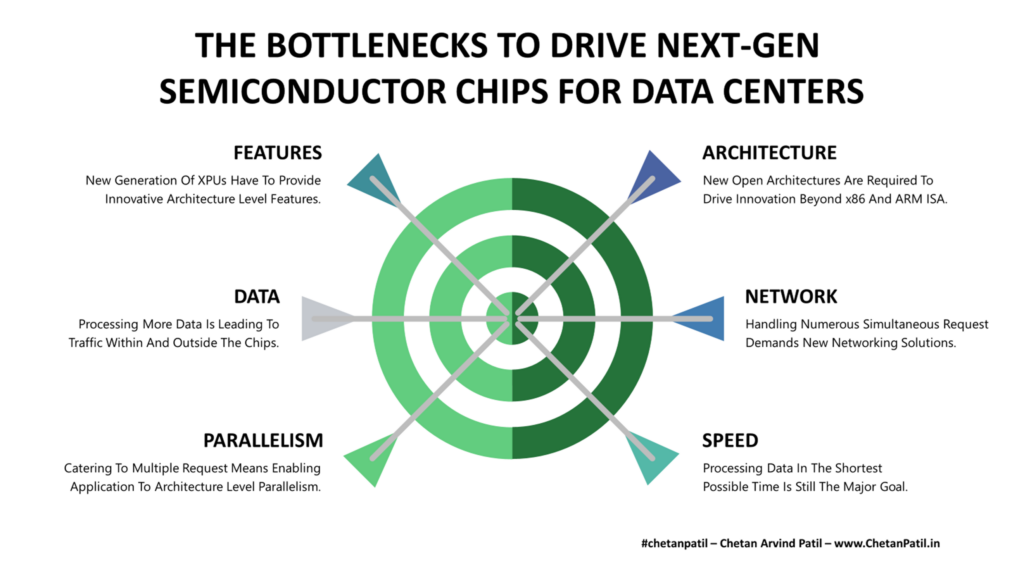
    THE BOTTLENECKS TO DRIVE NEXT-GEN SEMICONDUCTOR CHIPS FOR DATA CENTERS

    Designing and manufacturing semiconductor chips for any type of solution requires a thorough understanding of different issues and opportunities. The same strategy is applicable when coming up with semiconductor solutions for data centers. For data centers, the complexity is much more than consumer systems mainly due to the need to provide bottleneck-free semiconductor products that run all the time.

    Over the past few years, new data center-focused semiconductor companies have emerged and they have been providing different solutions. Fungible’s Data Processing Unit and Ampere’s ARM-powered XPU are a couple of such examples. However, in the end, the goal of all the semiconductor solutions is to focus on a set of features that ensures all the request is catered by the data centers in the real-time without adding any bottlenecks.

    When it comes to bottlenecks in the world of computing, the list is endless. These bottlenecks can originate either from software or hardware. Eventually, the software features have to be mapped onto the hardware so that both software and hardware can work in synchronization to drive next-gen solutions.

    The next-gen semiconductor chips need to focus on a few criteria’s to drive bottleneck free semiconductor powered data centers:

    Features: Traditional semiconductor chips for data centers were (and still are) purely focused on performance. As the world is increasingly adopting connected systems, there is growing demand to balance performance with efficiency. This requires a new set of features that can ensure that tomorrow’s data centers are more efficient than today’s. These features can range from using advanced transistor-level techniques to new packaging solutions.

    Data: The amount of data that hyperscale data centers have to crunch will keep increasing every year. The storage aspect of it will also grow along with it. This growth is leading to huge cooling systems and thus adds to total energy requirements. This challenge of managing data while lowering the impact on power consumption is pushing new solutions. More modular approaches are needed to drive next-gen semiconductor solutions.

    Parallelism: Any given chip of any type in a data center can receive any amount of request. To ensure there are no bottlenecks, intelligent parallelism techniques are required. Some of the parallelism techniques require software support but many often do require hardware features (cache, data pipeline, etc.) that can support parallelism. Networking and XPUs solutions often have to consider this problem while designing chips for data centers.

    Speed: While there is a growing concern of power consumption (by data centers) due to performance requirements, there is also demand to drive faster response out of data centers. This requires designing semiconductor chips for faster processing. Balancing the power, performance, and area aspect for data centers is becoming more difficult than ever. This is leading to more modular data centers but it is still going to demand semiconductor chips that can provide a high-speed solution without adding to the power requirement.

    Network: Data centers have to communicate with different systems that are located in remote areas, and such communication requires heavy usage of networking solutions. To drive communication efficiently, robust networking chips are required that can handle the data without any errors. This demands designing and manufacturing semiconductor solutions with reliability and error correction. In the long run, network chips are going to play a vital role and require the bottleneck-free design to drive new data centers.

    Architecture: Intel is considered the leader in XPU solutions for data centers. To design XPUs, Intel has been relying on its homegrown x86 architecture. In the last decade, the emerging workloads have changed a lot and that requires new XPU solutions. To provide newer solutions, emerging companies are focusing more on ARM and RISC-V to power their solutions. The major driving factor to use ARM or RISC-V is the ability to adapt and change the architecture to suit future requirements. Picking up the architecture is vital to avoid any kind of bottlenecks in the XPUs for next-gen data centers.

    In the last two years, the world has moved towards data center solutions mainly due to the remote feature required by different services. The growth in the number of smartphone and smart device users is also driving the need for new and efficient hyperscale data centers. To cater to the future demand of green hyperscale data centers, the existing and emerging semiconductor companies will keep coming up with a newer solution.

    In the long run, newer data-centric semiconductor solutions are only going to benefit the computing industry and the race to wind data centers has just begun.


  • The In-House Custom Semiconductor Chip Development

    The In-House Custom Semiconductor Chip Development

    Photo by Jason Leung on Unsplash


    THE REASONS TO DEVELOP CUSTOM SEMICONDUCTOR CHIP IN-HOUSE

    As technology is progressing and touching every aspect of day-to-day life, the dependence on semiconductor solutions is also growing. These solutions are often made by semiconductor companies and can power several things from sensors to a smartphone to cars to satellites to name a few.

    One of the most critical infrastructures that the semiconductor industry powers are data centers and portable computing systems. These two systems are interconnected as one cannot do without the other. Today, majority of the request a smartphone users sends ends up in one of the numerous data centers around the world. The data centers then quickly crunch the request and send it back to the requesting user. As the customer base and internet users grow, there is a surge in demand for power-efficient computing systems (both data centers and portable computing systems) by the software or data-driven companies/industry.

    Data-Driven Industry Is Getting Into Custom Semiconductor Chip Development

    The big software and data crunching companies are often dependent on specific semiconductor solution providers who have been powering their data centers and portable computing systems for decades. The silicon chip these semiconductor companies design often falls in the category of the general-purpose chip, so the same is used by different customers even though their requirements might differ. So far, general-purpose strategy has worked wonders. However, as the software industry explodes (due to data), the big giants are realizing the importance of powering their data centers (and in some cases portable computing systems too) by developing custom chips in-house.

    This change in landscape is mainly because the data crunching companies understand the need, purpose, and features that they require to drive bottleneck-free solutions for their customer. This can only be possible by starting chip development in-house so that software companies can deploy custom chip solutions across their data centers to drive services more efficiently. This is evident from the fact that YouTube has deployed its chip for video transcoding for faster processing of videos, and even Microsoft’s Pluton secure chip solution for its Windows platform.

    While providing better solutions is certainly the main goal of developing the custom chip, there are several other reasons too. All these reasons ensure the in-house chip development by non-semiconductor companies is a win-win idea or not.

    Cost: One of the major driving factors of developing chips in-house (at lead the designing part) is the cost. Having control over what chip needs to be designed and how to deploy it (as per the features) can potentially enrich user experience while bringing in savings. Savings are captured mainly in the form of usage when different computing systems within the company start utilizing the custom solutions. In many cases, the benefits can also be gauged based on how much power savings are achieved (data centers) compared to the traditional outsourced general-purpose solution.

    Time-To-Market: Another benefit of designing custom semiconductor chips is for companies whose end product is a smart solution. This can range from kitchen appliances to television to desktops and many more. Having the ability to design and create chips in-house can allow greater control over launching products and takes away the uncertainty that general-purpose solutions provide. This is very true for data centers that heavily rely on x86 architecture solutions to drive future data centers.

    Flexibility: Software changes very quickly and can demand new features out of the silicon chip. If there is no in-house development, then all these requests will eventually have to go out of the company in form of outsourcing. If there is a dedicated silicon development in-house team, then the software team can work in collaboration with the internal team (safeguarding IPs) to drive better hardware-software systems to power emerging solutions.

    Features: If a company is selling laptops and relies on an outside vendor for chip development, then it makes them vulnerable due to dependency. Incorporating chip development in-house can provide a way to balance the chip requirement that can drive better systems. This can also push outside vendors to bring new features and in the long term, the competition helps the industry at large.

    Applications: Developing in-house semiconductor chips can also provide avenues to expand the application area. This can be very true for smart device providers who often have to build systems based on what is available in the market. In-house chip development activities if planned well can allow companies to expand their portfolios by driving new end-products for their customers.

    Dependency: Companies that are into data centers are heavily dependent on different companies for silicon chips to power their systems. Many of these solutions are not specifically designed to cater to everyone procuring the company’s request. This makes the data center companies heavily reliant on external factors to driven in-house innovation which today certainly requires custom chips.

    All of the above reasons are the driving factor that is pushing several big software companies to drive in-house semiconductor chip development plan.

    It is also true that not all companies have the need or focus to create such custom solutions. But in the long run, as the dependency on the silicon chip grows, the risk associated with not developing an in-house semiconductor chip might be far greater than not planning for it.


    Picture By Chetan Arvind Patil

    Picture By Chetan Arvind Patil

    THE REQUIREMENTS TO DEVELOP CUSTOM SEMICONDUCTOR CHIP IN-HOUSE

    Developing semiconductor solutions is not an easy task. Even for big software giants, it has taken years of planning and execution to come to a stage where they can deploy custom in-house developed silicon solutions across data centers and portable computing systems. This is why it is important to understand the different requirements that are the driving factor in ensuring the in-house semiconductor chip is impactful and profitable at the same time.

    In-house silicon chip development requirements do take time to execute and often require tons of resources apart from the time it takes to perfect a semiconductor chip solution.

    Team: The most important criteria for developing a successful in-house chip is to ensure that there is a team with an excellent set of skills to execute custom chip development flawlessly. The team often has to be a combination of excellent design and manufacturing skills. This means hiring individuals who have been in the semiconductor industry for a long time and are capable of developing semiconductor solutions via long-term research and development. A dedicated manufacturing team is also critical to bring ideas to life.

    Acquisition: The team is one part of the development of in-house silicon chips. Another part is the ability to ensure that the company can acquire outside assets (IPs and patents) as and when required. This greatly pushes the in-house development activity in a positive direction and many cases reduce the efforts required to bring in-house silicon chip development to reality.

    Investment: Managing teams, labs, and other resources often require a massive amount of money. If a company without a semiconductor background is entering in-house chip development activity, then the company should ensure there is a large amount of investment available for a very long time. This is why it is important to ensure that over the long period of chip development process and research, the investment activity will pay off in the long run.

    Roadmap: In-house chip development also means having a clear strategy as to why the company should do it. Having teams and resources to tackle one specific feature without a plan is not a good strategy to invest time and money behind in-house chip development. Major emphasis should be on the long-term plan and how it will benefit the company. This often requires a clear roadmap is a must-have requirement.

    Balance: Not all semiconductor solutions require in-house development, and that is why it is very important to balance the focus in terms of what part of the silicon requirement should be outsourced and which is worth developing in-house. It is not possible for software or data-driven companies to become full-fledge semiconductor solution providers overnight and no single company (even core semiconductor) develops everything in-house. This is why a filtering mechanism of balancing the in-house and outsourcing is important.

    Bottlenecks: Major criteria of in-house development of silicon chip is also to remove any barrier in developing new products. The roadmap should allow bottleneck-free development of in-house semiconductor products as long they meet the company’s requirements.

    The reasons and requirements showcase how and when the non-semiconductor companies should get into the semiconductor design segment. In-house semiconductor development has already started long back and many of the companies (Google, Microsoft, and Amazon to name a few) have already enjoyed success around it. The major reason for doing so has been the greater control of designing features that in reality removes the issues the companies were facing.

    This trend of taking things in hand and designing solutions in-house is certainly going to continue, more so due to the semiconductor shortage and the impact it had on several industries.