Category: WIRELESS

  • The Drones Are Flying

    Photo by asoggetti on Unsplash


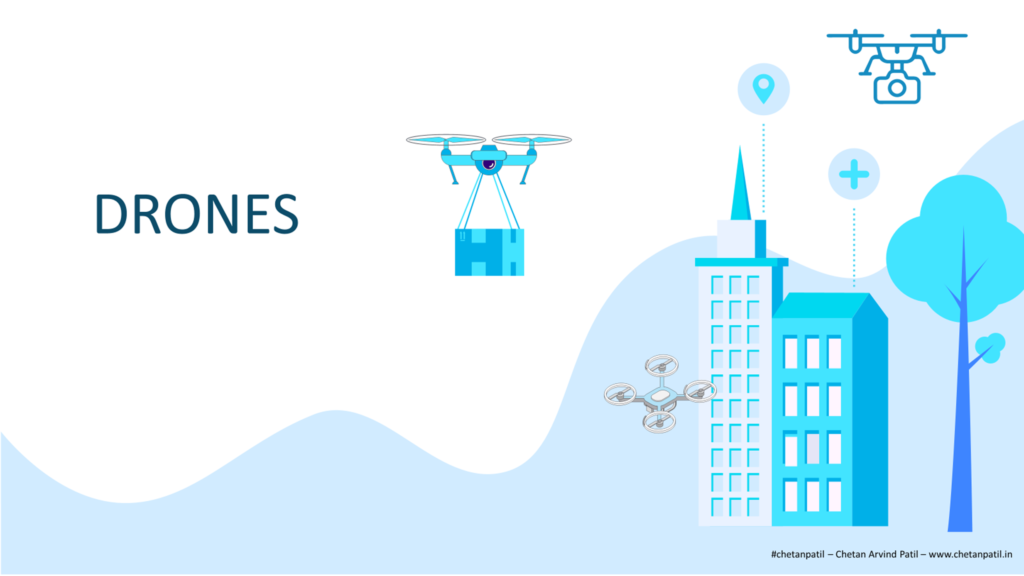
    DRONE

    Unmanned Aerial Vehicles (UAV) have been in use since 1849. Several countries around the world have invested in massive research and development activities to make use of UAV for surveillance activities by the armed forces. All the military-grade UAVs are distinctly complex and wide-body machines.

    In recent years, due to the development in the semiconductor process technology and the advancement in software development, the form factor of high-tech hardware and software solutions have been shrinking. Along with the improved connectivity and wireless communication technology, the UAVs are now also being used by civilians for personal and professional non-military activities.

    The civilian UAV are more popularly known as drone.
    Picture By Chetan Arvind Patil

    With the flying capability and ability to get controlled remotely, the drone can reach places easily where humans require heavy machinery to do so.

    The primary usage of the civilian drone has been for aerial photography and videography due to the high-resolution cameras that the drone can fly with. Lately, the application area has widened to agriculture, scientific research, and numerous other business segments.


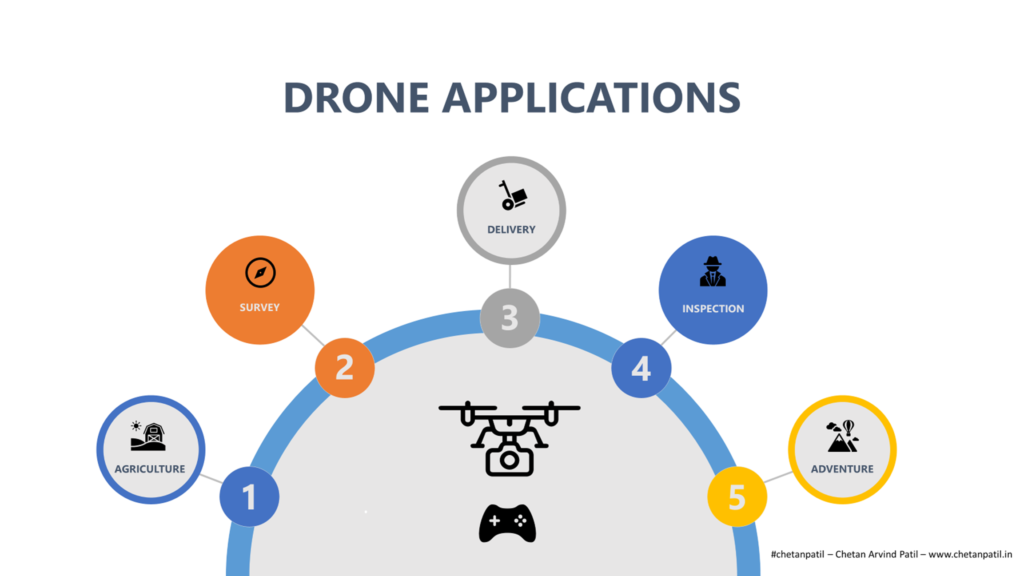
    DRONE APPLICATIONS

    There are different areas where the drone is useful. Mainly in the areas where deployment of the drone can lead to lower operating cost compared to the existing solutions.

    In Agriculture it is not only important to monitor the yield of the crops but also critical to understand the effect of the new agriculture technique. Going by the traditional approach of performing the acres of land inspection manually is not only time consuming but is a labor-intensive task too. This is where the drone come into the picture. The drone can either fly from nearby centers to monitor the farming or can reside near the field. In both the cases it can be controlled remotely. On top, farmers can also be trained to fly the drone.

    The drone can be programmed with the map of the agriculture land to automatically capture the aerial high-resolution pictures and videos. The data captured can then be uploaded to the cloud servers for further analysis. The farmers can then get the accurate feedback on the progress of their crops, along with live audio/video advice.

    Another important application area of the drone is to perform survey. Surveys can be to understand the structure of a high rise, finding any faults on long pipelines located in terrain land, checking on the high rise electric pole lines, and many other important areas where humans will require heavy instruments (high cost) to reach. The drone can also be very handy in surveying bridges and tunnels. Similar to the agriculture application, the data captured from the cameras can aid in understanding whether maintenance is required or not.
    Picture By Chetan Arvind Patil

    The drone are also being used for adventure activities like capturing videos during a movie stunt, aerial view of national parks and many other adventure activities. The high resolution cameras provide breathtaking view from a point of location that humans cannot read easily.

    The drone is already is use at police and firefighter departments across the world. The primary reason to use the drone by the police departments is to inspect suspicious areas. With the help of sensors and cameras, the drone can per-alert and provide details about whether it is safe enter the area or not. The firefighters are deploying water loaded drones to put off the fire in buildings or complex, where it is not safe for a human to reach. Civil engineering and the oil/gas industry are also increasingly deploying the drone to inspect infrastructures in order to predict maintenance.

    Lately, the most crucial use case of the drone being discussed a lot is the delivery of the packages within the city flying zone. Few of the companies have already got an operating license to do so on a pilot basis. If implemented at large scale across different cities, the cost and time benefits are humongous.

    The drone will also help in reducing the carbon footprint.


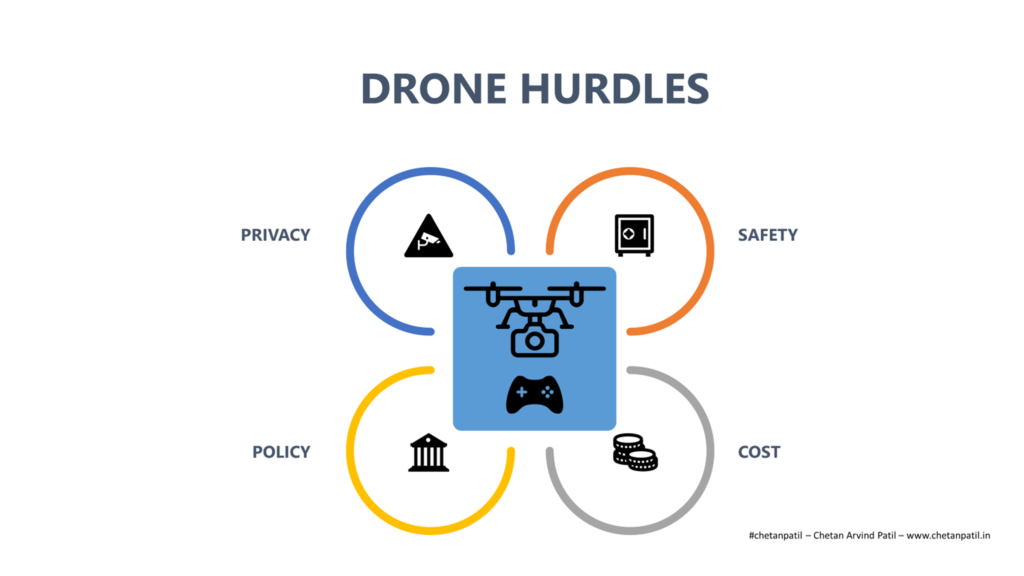
    DRONE HURDLES

    The drone have numerous use cases. Hardware companies are launching new drone concepts every month. At the same time the software companies are making it easier to fly the drone along with data capturing and processing.

    However, with opportunities come hurdles.

    Currently, the biggest battle around the drone is who can use it for the commercial purpose. Many countries are coming up with the state and national level policies on the drone commercial activities. The major (and important) requirement is going to be the basic training and license required to operate the drone. It will take a few more years before the drone policies are aligned between the businesses and governments.
    Picture By Chetan Arvind Patil

    The next big challenge is the privacy. Due to the ability to fly at high altitudes, the drone may capture aerial footage of the private locations. There are already the drone catcher technologies, however these require investment and capital which not everyone can afford. Hence, clear guidelines and laws need to be defined around the drone and the privacy breach.

    Safety is another hurdle. The autopilot has been in use for a long time but only for commercial flights flow by trained pilot. When it comes to the drone, the operator is not trained for hours. It is certainly possible to automate the drone flying, but there are still users who would like to control the drone flight. There is a possibility that the flight control can be lost, thus raising safety concerns.

    The drone are becoming cheaper year-on-year. Every year, new solutions and the software/hardware technologies in the drone is also making it costly. To break even the investment on the drone systems from the business and consumers point of view can be challenging task. A subscription based buying model can be helpful.


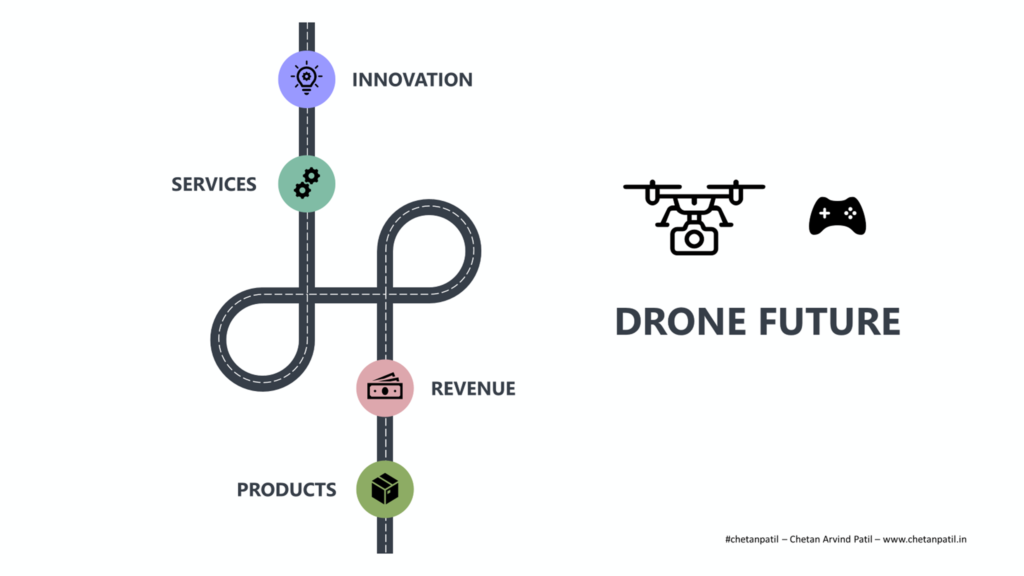
    DRONE FUTURE

    The drone segment is poised to become a $50 Billion market by 2025. The application areas are clearly defined. Many new use cases and promising innovation around the drone technology are being implemented by several companies and startups around the world.

    Ecommerce and logistics companies have already started to experiment with the drone delivery services. Drone enables faster delivery, are more carbon-friendly, and lower the shipping cost. The drone delivery system will be game changer for cities with heavy road traffic.
    Picture By Chetan Arvind Patil

    The drone will also drive innovation of smart hardware and software products. With the expanding market, new electronic sensor-based solutions will be developed along with smart software tools to make drone flying experience safer. All this will open new revenue sources for both the software and the hardware businesses.

    The time for the drone to take off has come.


  • The Hearables

    The Hearables

    Photo by Yogendra Singh on Unsplash


    THE HEARABLES

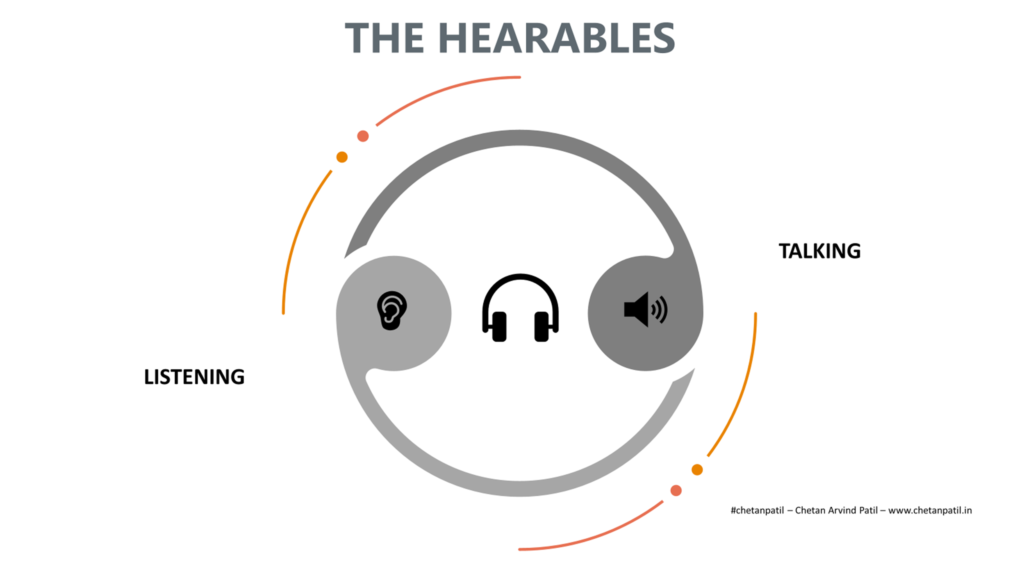
    The hearables are the smart technology-enabled over-the-ear or in-the-ear devices that are mainly used for music listening. The natural language assistant has equipped the hearables with the ability to talk. These smart assistant can interactively talk to the user using the inbuilt speakers, and then can also listen to the user with the help of the microphone. The hearables also have inbuilt features like ambient sound control and active noise cancellation.

    The majority of the hearables use Bluetooth for wireless connectivity, which allows voice control of the smart phone with the help of the virtual assistant. Though not everyone is comfortable talking to these virtual assistants in public, however with the increasing use, it is becoming a new normal.

    Picture By Chetan Arvind Patil

    Every major smartphone and audio company in the world has launched its own hearables. Technology companies are merging the best of the audio, hardware, and software to create new solutions around the hearables. Google is deploying artificial intelligence-enabled voice assistant, while Amazon is focused on enhancing online shopping and audiobook experience with the help of the hearables.

    There are already numerous applications of the hearables and it will be exciting to see what the consumers get to experience in coming years.


    THE HEARABLES APPLICATIONS

    The application of any technological solutions requires multiple functions to work in harmony. First and foremost is the underlying hardware technology, the second is the connectivity (mainly wireless), third is the software systems running on top of the hardware and fourth is the application ecosystem driven by the developer community.

    Starting from pre-internet to the post-internet ear, all the consumer-oriented solutions have relied on these four major points for success. Whether it is Windows powering the majority of the world personal computer or Android changing the landscape of the mobile industry. The same is also applicable for the hearables, except that majority of these underlying solutions (hardware, software, connectivity, and ecosystem) already existed beforehand. With the hearables, the companies have simply taken the existing software/hardware infrastructure and extended it to the hearables. So far, the outcome has become anything but positive.

    Entertainment has always been the default application of the hearables. The small form factor and features like active noise cancellation has surely taken the audio experience to the next level. The applications on the mobile devices can now connect to the hearables via Bluetooth, which provides an ability to control different features using the smart gestures.

    Picture By Chetan Arvind Patil

    Another major application of the hearables has been to swiftly interact with the voice assistant. The offloading of tasks after sending instructions via the hearables has made the smart devices more interactive. It can be used to retrieve important information like the weather forecast, nearby places, and many other useful data. All this has been possible due to the underlying smart hardware that can capture and process the natural voice.

    The hearables also offer audio privacy and enable one to interact with the party on the other side without compromising the confidential information exchange. There are still gaps, mainly from the speaker’s point of view and it will take a breakthrough technology to overcome some of the gaps.

    Cross reality by default requires a pair of devices to connect with ears. The hearables are the perfect candidate due to the smaller form factor. The hearables mixed with cross reality is going to provide new avenues on how to project information in the virtual world.

    In the coming decade, the application areas of the hearables will surely expand.


    THE HEARABLES OPPORTUNITY

    The smart features requires the smartest of hardware and software.

    The hearables might be marketed by a specific company, but a lot goes inside these little devices which requires effort from several design, development, and manufacturing companies. The software part is still being handled majorly by the vendors selling the hearables, but the application ecosystem opens up a lot of opportunities for the developers.

    Hardware companies, mainly semiconductors, will have a lot of opportunities to launch new low power and smaller electronic audio/voice chipNoise cancellation system will have to keep improving to consider the work from anywhere scenario, which also opens up new opportunity and revenue for the semiconductor companies. Context-awareness is another promising feature, for which the hearables will require smart sensors in order to adapt to the environment.

    Wired charging will be phased out of the market in the next decade, and the hearables will also have to adopt wireless charging system. Already different wireless charging solutions are available in the market, but fast wireless charging will be the key until the battery technology evolves. A portable battery bank cum carrying case for the hearables will be another area that companies can target.

    Picture By Chetan Arvind Patil

    Software innovation will also open up new opportunities. It is expected that going forward the hearables will be able to connect with the cellular towers, and when that happens the services will have to be provided mostly over the voice. This will require smart applications to make most of the hearables. For example, the banking application on the hearables can provide details about the bank balance or initiate transfer with voice commands. 

    Voice assistants are already in use, but local language support will be the key. Providing local language support will increase the reach of the hearables. Audio control is already part of the hearables. Extending it beyond just the master mobile device will open up new ways to interact with the world. For example, controlling car infotainment using the hearables.

    Hardware electronic chips can only cancel 70-80% of the noise. In order to achieve 100% noise cancellation, software adaptive features are required, which can capture and filter out the noise. Innovation around the software noise cancellation will also lower the cost of the hearables, as it will eliminate the need to have a dedicated hardware chip inside the hearables.

    The hearables have opened new opportunities for both the hardware and software domains. The domain is expected to grow more in coming years.


    THE HEARABLES FUTURE

    Over the next decade, the adoption of the smart devices will increase, mostly in the developing market. With Google becoming more of an AI service business, many local vendors from the developing market can take advantage of its solution to provide locally manufactured smart hearables.

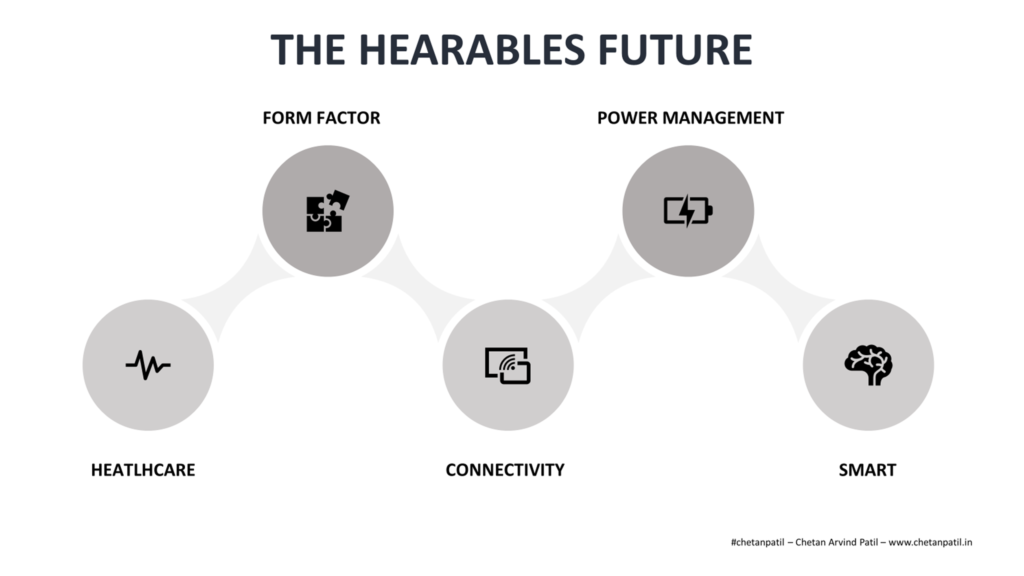
    It is inevitable that Android will also find its way on the hearables and it will make them a standalone device rather an add-on one. However, to make the hearables work as a standalone system, it will be critical to provide better power management. Dynamic task management can only drive efficiency to a certain extend and that is why the advanced battery technology is need of the hour.

    Picture By Chetan Arvind Patil

    The development of the hearables as a technology platform will demand different form factors. Advanced semiconductor process nodes along with flexible hybrid electronics will ensure that hearables become much smaller and flexible than they are now.

    Expansion of 5G small cell connectivity will ensure that the hearables can form a network that securely allows sharing of the information within a specific range. This will take the person-to-person voice communication to a new level and make the hearables smarter than ever.

    One of the major domains that every smart device eventually tries to target is healthcare. The hearables are yet to enter this market due to the limited use case. It will be exciting to see how the evolution of the hearables occurs over the next decade from healthcare point of view.

    The hearables have got lot of traction and have already captured the market faster than other smart devices. Next few years will be exciting as the innovation around the hearables grows.


  • V2X – Vehicle To Everything

    V2X – Vehicle To Everything

    Photo by chuttersnap on Unsplash

    Over the last half-century, vehicles have played an important role in everyone’s life. It has enabled point-to-point commute a faster and an efficient process. Whether one is traveling on a public bus or a private car, each of these vehicle types play a very crucial role in enabling ease of living.

    The last decade saw a drastic change in how the automotive industry manufactures vehicles. Vehicles of all forms are now much more fuel-efficient. Alternate fuel technologies are being used on a large scale. Features are provided that make vehicles safer and more aware. Enhanced digital experience by making most of the auto software tools built on top of the Android Auto and Apple CayPlay ecosystem.

    The next big change in vehicles is going to be on the data and communication technologies.

    On the data front, there are already many interesting hardware-based solutions that can capture the data generated by the vehicle. Then present it to the consumers and businesses to understand vehicle behavior and/or to track the vehicle usage. This is possible due to the standardization of the On-Board Diagnostics (OBD) and Controller Area Network (CAN). Data is also critical for the automotive industry to manufacture the products with zero defects.

    There are still many unexplored opportunities in the data domain due to the lack of continuous high speed internet access inside the vehicle. With 5G communication networks even vehicles can be equipped with the high speed internet. This will also allow many over the top service and will enable data driven innovation.

    The next decade is going to change how data is accessed within a vehicle due to the 5G expansion. Due to the different frequency bands 5G can run on, it makes it a perfect solution to enable real-time information access.

    While data and communication will play a major role in the automotive industry, it is also critical to understand the specifics of how this foundation will be laid.


    VEHICLE TO FUTURE

    The answer of how to make use of data and communication in automotive industry lies in the solutions provided under Vehicle To Everything (V2X).

    V2X holds big promises. All the sensors and the data points when combined ensure that vehicles are more secure and aware than ever.

    V2X already enables on the go real-time entertainment, but in the future with 5G and other network infrastructure, on-demand information and entertainment will go hand in hand.

    Picture By Chetan Arvind Patil

    The developments around V2X will provide second by second tracking of the logistics and will prealert any possible issues with traffic, vehicle, and any important information that may lead to shipment delays.

    V2X will also enable different levels of vehicle autonomy apart from securing pedestrians and bicyclists from colliding on vehicles. V2X will also increase the number of small cell networks by converting the vehicle itself as a cellular point of access.

    It is important to understand how V2X does so with the help of different technology domains within V2X.


    VEHICLE TO EVERYTHING

    Vehicle-To-Everything (V2X) is all about how vehicles are able to send the data out and get the data in with the help of advanced communication technologies. With 5G, there is going to be a rapid increase in V2X implementation. Every new vehicle in the market will then act as a data point, router, and network in itself.

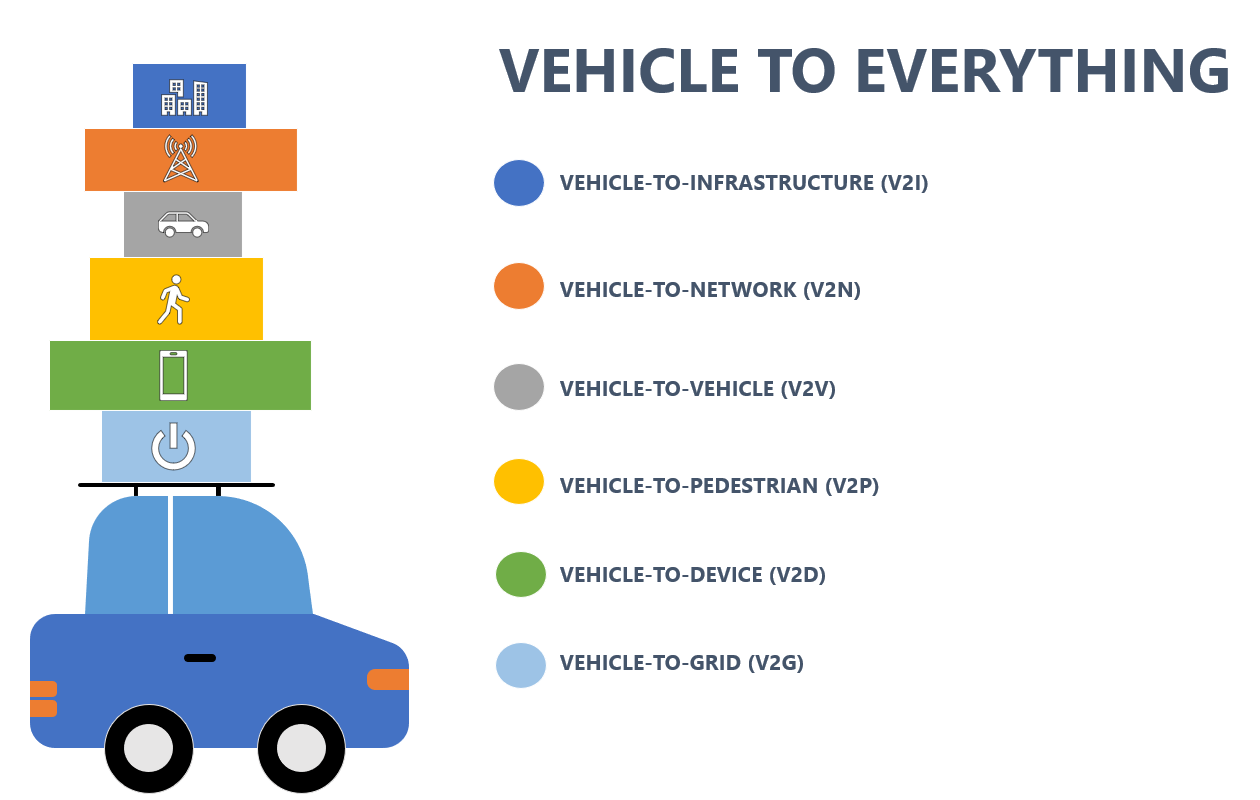
    The X in V2X stands for the different technology domain a vehicle has started being part of.

    Vehicle-To-Network (V2N) – V2N is the foundation of V2X. With the help of widely deployed communication network within and outside the vehicle, high speed data transfer can occur. The important use of V2N is voice and data communication for real-time navigation and entertainment apart from the critical emergency roadside assistance. Internet access using hotspots also comes under V2N.

    Any other V2X technology domain is fully dependent on V2N as without a communication network (specially wireless), none of the other V2X implementations can work.

    Vehicle-To-Infrastructure (V2I) – V2I is critical for level 5 automation where along with LIDAR and other self-driving sensors the data based approximation also is useful. This way vehicles can distinguish between road and obstacles much better than just a single data point coming from the use of vehicle’s own hardware. This is done so by feeding the vehicle with live view of surrounding by communicating directly with near by internet and data nodes. This continuous data feed helps in decision making. Apart from self-driving, V2I can also communicate with the traffic control network directly. Using this information vehicle can adjust/advice speed to ensure that the traffic block miles away does not get more congested.

    Vehicle-To-Vehicle (V2V) – V2V takes the help of V2N along with V2I to capture information from vehicles in close proximity. With V2V, Vehicles can communicate about traffic, speed, collision, and distance. All these data points will enable much safer driving compared to the past decade. A self-driving vehicle is heavily dependent on its sensors to capture, decode, and react to the real time situation. If the same self-driving vehicle gets accurate input that makes the driving safer, then it will also increase the adoption and take safety to the next level. This is where V2V is important and helps drive zero accident occurrence.

    Picture By Chetan Arvind Patil

    Vehicle-To-Pedestrian (V2P) – V2P takes the approach of ensuring that the vehicle is always able to detect and take action in case a pedestrian or bicyclist comes in the way. V2P relies on V2N and V2I data points and then combines it with its data to ensure that any critical scenario like a pedestrian or bicyclist coming in front of the vehicle, is handled without comprising on the safety of the pedestrian or bicyclist and even the passengers. Most of the systems in the vehicle today are already equipped with processing capability to alert the driver for different collision scenarios, but with V2P the data point will allow another layer of security and ensures 100% accurate collision alerts by considering 360 degree view .

    Vehicle-To-Device (V2D) – V2D is already in use in most of the vehicles out in the market. With the help of Bluetooth communication any device can connect with the vehicle and do many tasks from answering calls to playing music to logging data via OBD. The next step in V2D will be to allow smart devices to make use of small cell 5G networks that every vehicle will come equipped with. This will allow vehicles to act as hotspots. V2D will also enable advanced secure keyless vehicle entry along with remote startup, locking, and tracking.

    Vehicle-To-Grid (V2G) – V2G is all about electric vehicles plugging into the electric grids. These grids can be in a parking lot, home, or a roadside charging station. V2G allows real-time tracking of nearby grids that can be used to charge the vehicles. The same grids can also perform a diagnostic check to ensure that the safety of the vehicle is not compromised and the battery to internal electrical networks is intact. Performing such smart checks with V2G will provide more safety than mile based servicing currently followed by the manufacturers. The data points gathered with V2G every time an electric vehicle is charged then can be sent to the central servers to process and understand usage of energy along with other data insights.

    V2X provide unlimited opportunity not only to the automotive industry but also to the hardware and software businesses. The consumers are also going to see rapid increase in the feature list. It will be interesting to see how automotive industry provides V2X features without making it too costly for the consumers. Otherwise, wide adoption of V2X will not be possible.


    Bloomberg technology has an interesting video on 5G and the Future of Connected Vehicles showcasing the importance of having a universal data and communication standard to enable growth of V2X.


  • The Wireless Charging World

    The Wireless Charging World

    Photo by Lucian Alexe on Unsplash

    The major reason smart devices, mainly smartphones, are immensely useful is due to the portability they provide with the help of the battery management system. This allows consumers to make use of the device without direct supply for an extended period.

    Even though every new smart device is more efficient compared to the last concerning the power consumption and battery life, there are still gaps on the battery technology innovation side that have not kept up with the growing software and hardware demand.

    To tackle this critical gap, the industry is moving from wired to wireless charging solutions as it provides charging wire-free and aims to make it ubiquitous. The solution has gained traction in the smartphone domain where charging points are increasingly being switched to wireless hotspots than wired.

    By 2030, Wireless Charging Will Be $50 Billion Market

    The concept of wireless electricity is not new and has been in existence since 1900s. The major gap has been in adoption in the areas where there is need to have wireless charging solution to ensure consumers and businesses never run out of power.

    With the popularity of electric vehicles, it will be quite interesting to see what type of innovative solutions come out to provide hassle-free charging.


    WHY WIRELESS CHARGING

    With the growing demand to perform day to day activity on the go also means the power required to run the smart devices should be available any time. Most of the devices that reside at one location like smart cameras, smart sensors, and so on, can be hooked directly to the power outlet to draw electricity 24x7x365. This does not apply to the devices that have to be used remotely like smartphones, laptops, or an electric car.

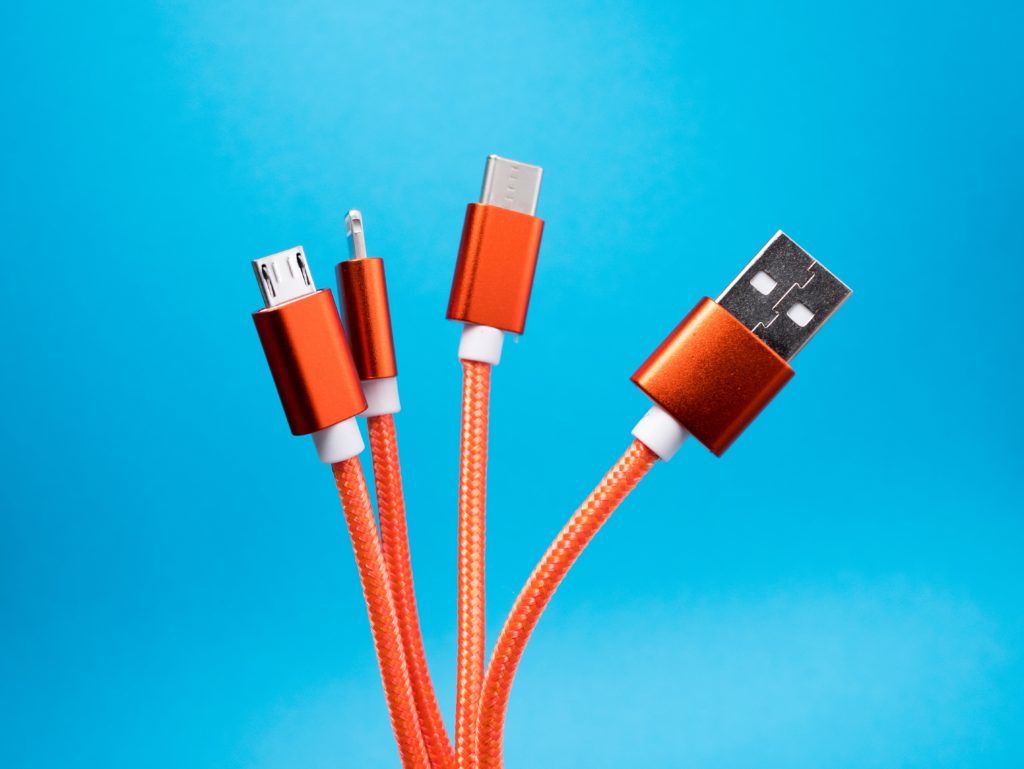
    Though these devices can get hooked to the power outlet, but do suffer from the fundamental issue of requiring a different set of adapter for each of the devices.

    How useful will it be if the source or the adapter is capable of adapting the current and voltage requirement of the device so that one adapter device fits all?

    Picture By Chetan Arvind Patil

    This will not only drastically decrease the need to have different types of charging points and devices, but will also make the system smart by providing always-on charging capability. This adds one more ease of use layer on top of what is currently provided by the smart devices concerning compute and connectivity.

    In the end, the demand to use smart portable devices and solutions will not go down. The form factor may change, but the need will always be there. It is about time that the way these smart devices get powered also becomes smart, and wireless charging is the way to do it.


    IMPACT OF WIRELESS CHARGING

    Imaging a scenario where you have four different types of smart devices to charge, with each using different power adapter, and on top of this, there is only one power outlet to use. What do you do? The simple answer is charge as per the priority of the device that needs to be active for a critical task. Is this a smart way to charge smart devices in a smart world?

    Wireless Charging Is Not About Smart Devices But About Smart World

    If the answer is no, then certainly the way to power these devices should change. This can be with the use of Quick Charge technology, but it requires that the device is equipped with a specific System on Chip (SoC).

    Another important factor is that charging in the future will not be limited to consumer electronic smart devices only. The definition is going to extend to automotive and all the connected systems that will go wireless.

    The impact of wireless charging is huge not only from the market demand point of view but also on how much good change and impact it will have on the usage.

    Wireless charging will extend the life of using the device and will ensure that the smart systems never run out of the power. These always-on systems will make use of a smart sleeping mechanism to provide savings to businesses, industries, and consumers.

    Picture By Chetan Arvind Patil

    Wireless charging will drive innovation by introducing solutions that are built on top of next-gen connectivity standard. The portability wireless charging will add will also ensure standardization by eliminating the need to have different types of adapters, cables, and power outlets.

    The opportunity and solutions around wireless charging are also going to drive faster adoption of an electric vehicle by providing more mileage without worrying about the stoppage to charge the car as roads and the nearby system itself can provide wireless charging solutions.

    The wireless charging system by default is COVID-19 compliant.


    WIRELESS CHARGING INNOVATION

    The innovation around wireless charging is going to be the key factor in faster adoption. There are already many interesting ideas that are out in the market that showcase the power of wireless charging.

    AiraPower’s FreePower technology shows how customized solution that provides multi-device wireless charging is going to change the day to day charging points at home, automotive, and business zones.

    Energous also showcases different possible ways wireless charging is going to be part of the daily life. It provides a unique approach to how the smart devices can draw energy wirelessly the moment the battery level goes down a specific threshold.

    Semiconductor companies have already started to provide solutions that can be deployed around the city to enable the charging of electric vehicles an enjoyable and more innovative. The current solution focuses on dedicated parking spots with wired cables that can be used by electric vehicles. Imagine parking the vehicle in a shopping mall and it charges using the wireless pads in the parking spot while one enjoys the shopping.

    All this leads to a true benefit when the electric vehicle cannot be refilled as fast as a fossil fuel-powered vehicle.

    These are a few of the many solutions out in the market. The next year or two more innovative and advanced approaches will show up with more smart devices starting to adopt wireless charging.


    FUTURE OF WIRELESS CHARGING

    It is important to understand the future of wireless charging. The current use cases are well defined, with more emphasis on smartphones than any other consumer electronics.

    Currently, the wireless solution is confined to specific locations like a couple of devices at home and in the workplace. Going forward, there are going to be three key areas which will see faster and exponential adoption this leading to the standardization of wireless charging solutions.

    These three domains are: automotive, home and work place.

    In automotive, the electric vehicles are going to adapt to the wireless charging more than any other solution. It will showcase the true potential of an inductive charging for high power devices like a motor car or a bus. China being one of the fastest-growing markets will lead the way in showcasing innovative approaches concerning wireless charging and electric vehicles.

    Picture By Chetan Arvind Patil

    For home, the solutions will move beyond smartphones to television and cooking appliances. The number of power outlets will decrease, and home buyers and renters will see how real estate will make use of wireless charging solutions to provide Over The Top (OTT) services. This may add cost to the buyers and renters, but will also see a balance by removing the need to have different types of power outlets and adapters.

    Workplace (including business and entertainment zones) will start adopting to the solutions whenever there is a gathering of employees or the number of visitors in a business zone is more than the number of power outlets. Such places will see more wireless charging stations that will not require cables and will only have pads that will act as charging points.


    This decade with advanced connectivity will demand always-on devices. This is going to push for the faster adoption of wireless charging. It will be interesting to see what other innovative use cases of wireless charging come up as adoption grows.


  • 5G And Wi-Fi 6 Will Transform Digital Life

    5G And Wi-Fi 6 Will Transform Digital Life

    Photo by Thimo Pedersen on Unsplash

    The next decade is going to be all about enhanced digital experience built on top of the most advanced wireless data communications technologies ever: 5G and Wi-Fi 6.

    These two wireless technologies are not only going to increases the data throughput but also provide much better connectivity experience with minimum power impact, thus making them suitable from home to industry-wide applications.

    5G has already started to take over the world and along with Wi-Fi 6 proliferation, the always-on connectivity is going to ease day to day information-enabled digital life.


    WHAT IS 5G

    5G is the next generation of voice and data communication solution that is capable of providing 20x more data speed compared to current 4G deployed all over the world. It does so by enabling low latency by deploying a wide array of networks that allows multiple users with multiple inputs and multiple output data transmission.

    5G is also capable of running at a different spectrum from below 1GHz to above 24GHz.


    WHAT IS Wi-Fi 6

    Wi-Fi 6 is the next IEEE 802.11ax standard designed for the future data, increasing nodes and security needs. It is going to provide much better seamless connectivity without getting affected by the number of active users. It can do so by providing high capacity via Orthogonal Frequency-Division Multiple Access (OFDMA) with minimal energy requirements.

    Poor connectivity and network interference at home and offices are going to be a thing of past with Wi-Fi 6. Wi-Fi 6 is capable of using both 2.4 and 5 GHz frequencies. With recently introduced Wi-Fi 6E which supports 6GHz may allow easy interoperability with 5G.

    One of the benefits of Wi-Fi 6 is its backward compatibility, which allows previous Wi-Fi generation devices to work with Wi-Fi 6 certified products. For better user experience, it is always good to have all the infrastructure upgraded with both transmitting and receiving systems capable of running Wi-Fi 6 protocol.


    5G vs Wi-Fi 6

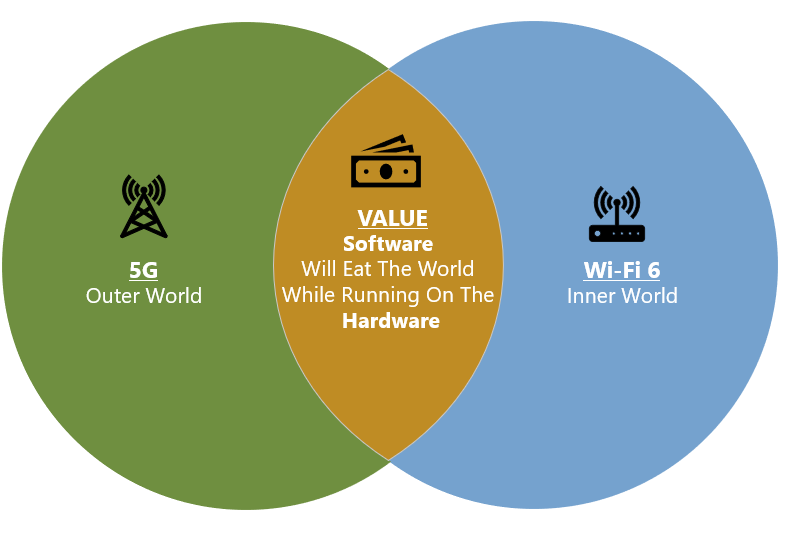
    It is often said that 5G and Wi-Fi 6 are supposed to compete for the same services. In reality, 5G is designed specifically to cater to the mobility needs, while Wi-Fi 6 for better location aware requirements.

    Picture By Chetan Arvind Patil

    5G will dominate on-the-go connectivity by providing faster data and voice speed. Wi-Fi 6 on other hand will cater to the smart solution (while taking the help from 5G) without worrying about the number of nodes, access points, and security.

    In the end, 5G and Wi-Fi 6 are going to work in harmony and create value for the next digital decade.


    5G IS FOR THE OUTER WORLD

    Every wireless technology has a perfect use case. Near-Field Communication is designed for secure transactions like paying via NFC enabled credit card or Mobile Wallet. Same is true for Bluetooth which is designed for short-range communication like connecting to streaming devices or car’s infotainment.

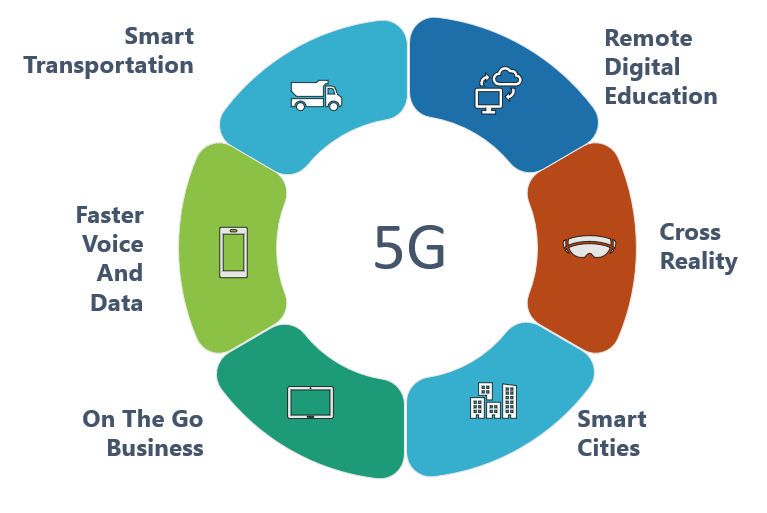
    Similarly, 5G has been designed and developed over the last decade with future demand in mind. It is going to be the de-facto wireless solution for anything that requires a remote connection. Whether it is the remotest place that requires high-speed data to enabling cross reality in places where it is difficult today. It will also ensure that digital education is accessible at affordable cost to anyone with 5G equipment and networks.

    Picture By Chetan Arvind Patil

    5G is going to benefit both consumers and businesses due to the real-time fastest possible access to the data. Smart cities around the world will provide public service on top of 5G networks from remote kiosks to online utility access and payment solutions.

    Over The Top (OTT) is a terminology that allows content to thrive, scale, and monetize on top of an existing technological solution. Not only 5G is going to enable software-driven OTT, but many hardware OTT are also going scale on top of 5G.

    All of this is going to enable the next trillion-dollar market with huge employment opportunities for every sector.


    Wi-Fi 6 FOR THE INNER WORLD

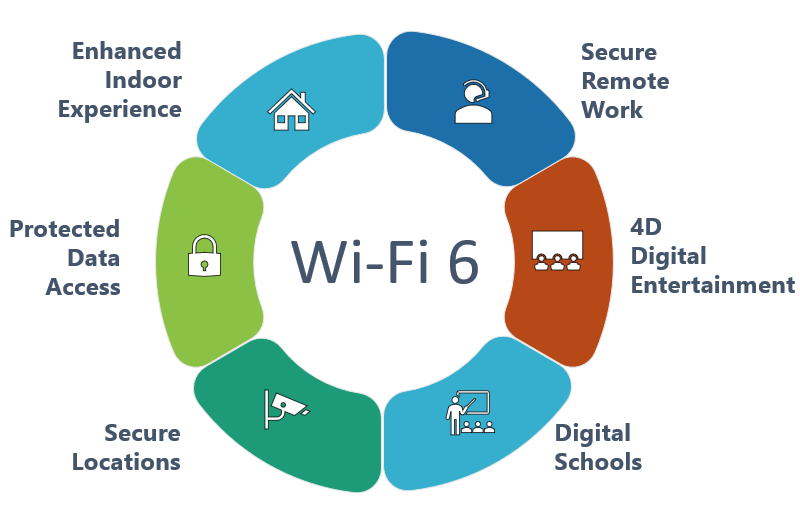
    While 5G is supposed to transform the outer world, Wi-Fi 6 is going to enhance the experience of indoor digital activity to the next level.

    There are fundamentally bigger differences between 5G and Wi-Fi 6. One of the simplest to understand is that 5G requires full infrastructure upgrade including smart devices like smartphones. On the other hand Wi-Fi 6 is about connecting to the access point with Wi-Fi 6 protocol enabled and thereby leveraging existing high-speed bandwidth network. This is why Wi-Fi 6 is more suitable for the inner world like home, public areas, offices, and schools as these are already equipped with high speed wired networks.

    Picture By Chetan Arvind Patil

    For Wi-Fi 6 too full upgrade of receiver and transmitter (Wi-Fi 6 certified) is preferred, however since it is backward compatible thus only one device (receive/transmitter) needs to be using Wi-Fi 6 certified. However, from technical point of view it still doesn’t mean full Wi-Fi 6 experience. With Wi-Fi 6, the routers will allow better performance irrespective of number of active IoT devices. WPA3 (security standard used by Wi-Fi 6) will also ensure the secure transaction are more hack-proof.

    Only time will tell if the routers itself will be used as hardware devices that will run more digital applications thus ushering new ways to provide OTT services. In any case, new era of home connectivity will enrich digital experience.


    HURDLES WITH OPPORTUNITIES

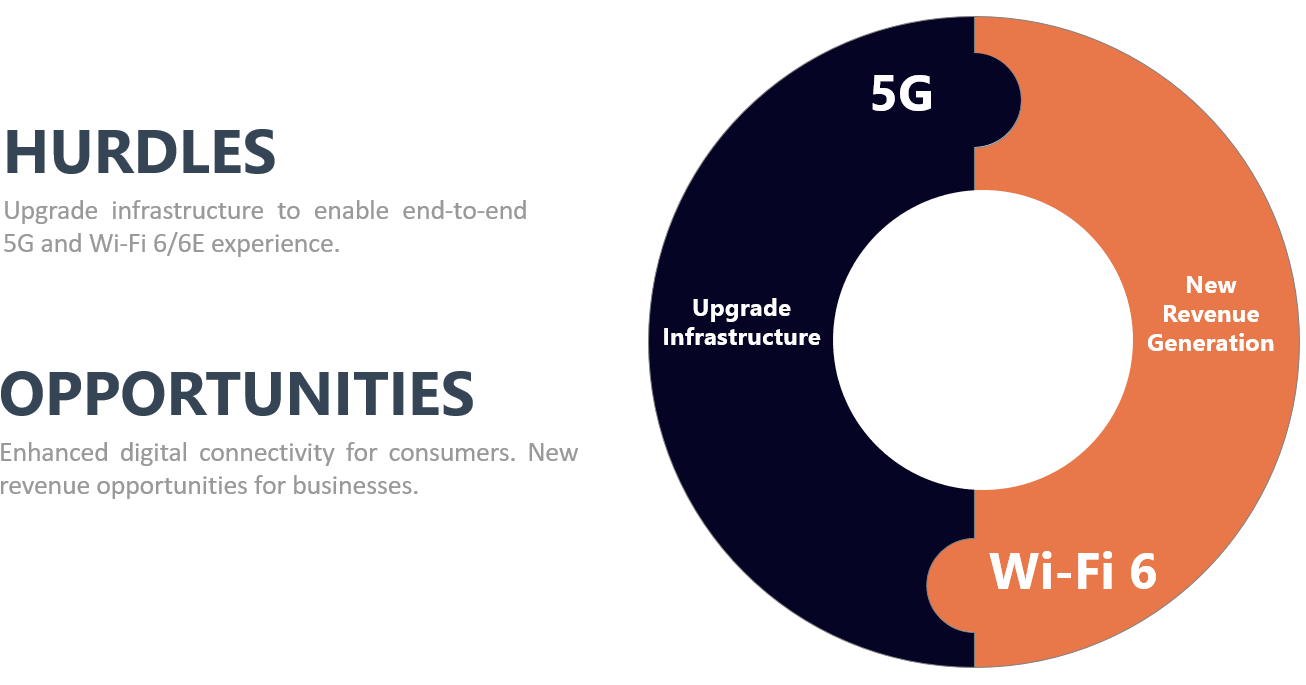
    The biggest hurdle for both 5G and Wi-Fi 6 is to ensure that not only new devices are capable of communicating using the two new protocol but the infrastructure required to deliver the true promises these two solutions hold is deployed massively across the globe. It will be critical to implement in India, where millions of users are still using 3G and older Wi-Fi certified devices.

    For 5G, the smart devices need to have electronic chips capable of encoding/decoding the packets that will be sent to and from the nearby cell towers. Telecom operators will have to invest and upgrade all of the networks to ensure 5G protocols can run smoothly on top of the existing 4G infrastructure. Given that some countries still have more than 350 million 2G users, it will take half a decade to move many of the current 3G/4G users to 5G.

    Wi-Fi is backward compatible, thus it only needs one of the two communicating devices to be running on the newer protocol. However, OEMs have started launching laptops, smartphones, and smart devices with Wi-Fi 6. Network equipment also have started to come Wi-Fi 6 certified. Similar to 5G, Wi-Fi 6 large scale adoption is also expected to take more than half a decade as many business that are going through the financial impact due to COVID-19 will be focusing more on revenue re-generation than upgrading existing infrastructure at large.

    Picture By Chetan Arvind Patil

    With hurdles come opportunities. Upgrading all the devices (or one of the nodes for Wi-Fi 6) that will access these protocols at different frequencies, also means tremendous revenue opportunity from OEMs to Distributors. It will also provide platform for the new markets to tap into the hardware manufacturing and assembly opportunities.

    Another possibility is merging 5G with Wi-Fi 6E (a step ahead of Wi-Fi 6), and that is going to ensure that the investment to implement these infrastructure today pays off in the long term when devices and nodes can easily switch between these two wireless frequency technology without upgrading.

    It may also drive innovation as both 5G and Wi-Fi 6E solutions can reside on the same System-On-Chip, thus allowing optimization on the designing and reducing manufacturing cost.


    DIGITAL TRANSFORMATION ROAD MAP

    As the world moves towards post-COVID-19 new normal, digital connectivity across the globe will be the priority. Governments will push for newer and better wireless connectivity to enable end-to-end digital transformation road map. 5G and Wi-Fi 6 are going to ensure that every digital offering is experience the new innovation.

    Picture By Chetan Arvind Patil

    The digital transformation road map will be a 360-degree view on how daily home to business to industry activity is going to be always-on data enabled. Whether it is accessing information at home, commuting to the office, shopping at local stores, running in the park, producing products in heavy industry, going for health check-ups to making cities smarter.

    All of this is going to drive change, thus allowing 5G And Wi-Fi 6 to transform digital life.


    PSA

    For the technical audience: