Blog

  • The Semiconductor Dual Edge Of Design And Manufacturing

    Image Generated Using DALL·E


    Semiconductor leadership comes from the lockstep of two strengths: brilliant design and reliable, high-scale manufacturing. Countries that have both move faster from intent to silicon, learn directly from yield and test data, and steer global computing roadmaps.

    Countries with only one side stay dependent, either on someone else’s fabs or on someone else’s product vision.

    Extend the lens: when design and manufacturing sit under one national roof or a tightly allied network, the feedback loop tightens. Real process windows, such as lithography limits, overlay budgets, CMP planarity, and defectivity signatures, flow back into design kits and libraries quickly. That shortens product development cycles, raises first pass yield, and keeps PPA targets honest. When design is far from fabs, models drift from reality, mask rounds multiply, and schedules slip.

    In all, semiconductor leadership comes from the lockstep of two strengths: brilliant design and reliable, high-scale manufacturing.

    Countries that combine both move faster from intent to silicon, learn directly from yield and test data, and steer global computing roadmaps. At the same time, those with only one side remain dependent on someone else’s fabs or someone else’s product vision.

    A nation strong in design but weak in manufacturing faces long debug loops, limited access to advanced process learning, and dependence on external cycle times. A nation strong in manufacturing but with a focus on design, the light industry depends on external product roadmaps, which slows learning and dampens yield improvements. The durable edge comes from building both and wiring them into one disciplined, high-bandwidth, technical feedback loop.

    Let us take a quick look at the design and manufacturing lens from country point of view.


    The Design

    A strong design base is the front-end engine that pulls the whole ecosystem into orbit. It creates constant demand for accurate PDKs, robust EDA flows, MPW shuttles, and advanced packaging partners, shrinking the idea-to-silicon cycle. As designs iterate with honest fab feedback, libraries and rules sharpen, startups form around reusable IP, and talent compounds.

    MechanismEcosystem Effect
    Dense design clusters drive MPW shuttles, local fab access, advanced packaging, and testJustifies new capacity; lowers prototype cost and time
    Continuous DTCO/DFM engagement with foundriesFaster PDK/rule-deck updates; higher first-pass yield
    Reusable IP and chiplet interfacesShared building blocks that accelerate startups and SMEs
    Co-located EDA/tool vendors and design servicesFaster support, training pipelines, and flow innovation
    University–industry, tape-out-oriented programsSteady talent supply aligned to manufacturable designs

    When design is strong, the country becomes a gravitational hub for tools, IP, packaging, and test. Correlation between models and silicon improves, respins drop, and success stories attract more capital and partners, compounding advantage across the ecosystem.


    The Manufacturing

    Manufacturing is the back-end anchor that turns intent into a reliable product and feeds complex data back to design. Modern fabs, advanced packaging lines, and high-coverage test cells generate defect maps and parametric trends that tighten rules, libraries, and package kits. This credibility attracts suppliers, builds skills at scale, and reduces the risk associated with ambitious roadmaps.

    MechanismEcosystem Wffect
    Inline metrology, SPC, and FDC data streamsRapid rule-deck, library, and corner updates for design
    Advanced packaging (2.5D/3D, HBM, hybrid bonding)Local package PDKs; chiplet-ready products and vendors
    High-throughput, high-coverage testProtected UPH; earlier detection of latent defects; cleaner ramps
    Equipment and materials supplier clusteringFaster service, spare access, and joint development programs
    Scaled technician and engineer trainingHigher uptime; faster yield learning across product mixes

    With strong manufacturing, ideas become wafers quickly, and learning cycles compress. Suppliers co-invest, workforce depth grows, and the feedback loop with design tightens, creating a durable, self-reinforcing national semiconductor advantage.


    A nation that relies solely on design or solely on manufacturing invites bottlenecks and dependency. The edge comes from building both and wiring them into a fast, disciplined feedback loop so that ideas become wafers, wafers become insight, and insight reshapes the next idea.

    When this loop is tight, correlation between models and silicon improves, mask reentries fall, first pass yield rises, and ramps stabilize sooner.


  • The Semiconductor Risk And Cost Of Deploying LLMs

    Image Generated Using DALL·E


    Large Language Models (LLMs) are rapidly reshaping industries, and semiconductors are no exception. From generating RTL code and optimizing verification scripts to guiding recipe tuning in fabs, these models promise efficiency and scale. Yet the adoption of LLMs comes with risks and costs that semiconductor leaders cannot ignore.

    The challenge lies not only in financial and energy investment but also in the trustworthiness, security, and long-term viability of integrating LLMs into sensitive design and manufacturing workflows.

    Let us explore in more detail.


    Energy And Infrastructure Burden

    The deployment of large language models (LLMs) in semiconductor design and manufacturing carries a hidden but formidable cost: energy. Unlike software tools of the past, modern AI requires enormous computational resources not just for training but also for inference, verification, and ongoing fine-tuning.

    For a sector already grappling with the massive electricity requirements of wafer fabrication, this additional burden compounds both operational and environmental pressures.

    MetricValue(s) / EstimateSource
    U.S. data center electricity use (2023)~176 TWh annuallyMarvell
    Projected U.S. data center demand by 20286.7–12% of total U.S. electricityReuters / DOE report
    Global data center demand by 2030~945 TWhIEA
    GPU node draw during training (8× H100)~8.4 kW under loadarXiv 2412.08602
    Inference cost per short GPT-4o query≈0.43 WharXiv 2505.09598
    Training GPT-3 energy≈1.29 GWhCACM

    At scale, the infrastructure to support LLMs demands specialized GPU clusters, advanced cooling systems, and data center expansions. Each watt consumed by AI models is ultimately a cost borne by semiconductor companies, whether directly in on-premises deployments or indirectly through cloud services.

    For leaders balancing fab energy efficiency targets with innovation needs, this creates a difficult trade-off: how much power should be diverted toward digital intelligence rather than physical manufacturing capacity?


    Financial And Opportunity Costs

    Deploying large language models in semiconductor workflows is not just a matter of compute cycles, it is a matter of capital allocation. The financial footprint includes infrastructure (GPU clusters, accelerators, cloud subscriptions), data pipelines, and the skilled personnel required for model training and fine-tuning. For semiconductor firms accustomed to billion-dollar fab projects and high non-recurring engineering (NRE) costs, this introduces a new category of spend that competes directly with traditional investments.

    The opportunity cost is just as pressing. Every dollar devoted to AI infrastructure is a dollar not invested in EUV tools, yield enhancement, or chiplet R&D. While LLMs promise productivity gains, the strategic question remains: are they the best use of scarce capital compared to advancing process technology or expanding wafer capacity?

    Semiconductor leaders must balance the lure of AI-driven acceleration against the tangible benefits of traditional engineering investments.
    For firms already facing skyrocketing fab and equipment costs, the addition of LLM-related spending intensifies capital pressure. Even if AI promises faster time-to-market, the financial risk of sunk costs in rapidly evolving AI infrastructure is real, today’s models and accelerators may be obsolete within two years.

    This creates a classic semiconductor dilemma: invest in transformative but volatile digital intelligence, or double down on the proven, capital-intensive path of lithography, yield engineering, and packaging. The wisest path may lie in hybrid strategies, small domain-specific LLM deployments tuned for semiconductor workflows, paired with careful capital prioritization for core manufacturing investments.


    Risks To Security And Intellectual Property

    For the semiconductor industry, intellectual property is the critical due to designs, RTL/netlists, process flows, and test data represent billions in sunk cost and future potential. Deploying large language models in design or manufacturing introduces new risks of leakage and misuse.

    Unlike traditional deterministic EDA tools, LLMs are probabilistic, data-hungry, and often cloud-hosted, which amplifies the chances of sensitive data escaping organizational boundaries. Threats range from external exploits like model inversion attacks to internal mishandling, such as engineers pasting proprietary code into AI assistants.

    These risks demand robust safeguards. Secure on-premises deployment, sandboxing, and strict access controls are essential, while domain-specific LLMs trained on sanitized datasets can help mitigate exposure.

    Yet even with precautions, the cost of compromise far exceeds the cost of deployment, a single leak could enable cloning, counterfeiting, or billions in lost market share. For semiconductor leaders, protecting IP is not optional; it is the deciding factor in whether LLM adoption becomes a strategic advantage or an existential liability.


    Accuracy, Verification, And Yield Trade-Offs

    Even with all the progress, large language models generate probabilistic outputs. While this creativity can accelerate design-space exploration, it also introduces a margin of error that semiconductor companies cannot afford to overlook.

    An extra semicolon in Verilog or a misplaced timing constraint can propagate downstream into silicon, leading to costly respins or yield loss. What looks like a small error in code generation can become a multimillion-dollar problem once wafers hit production.

    Risk AreaExample ImpactSource
    Syntax & logic errors in RTLVerilog/VHDL generated by LLMs often fails to compile or simulate correctlyarXiv 2405.07061
    False confidenceLLMs present flawed outputs as authoritative, increasing human trust riskarXiv 2509.08912
    Verification overheadTeams must re-run regressions and formal checks on AI-assisted designsSemiconductor Engineering
    Manufacturing recipe risksPoorly validated AI-generated etch or deposition recipes can reduce yieldarXiv 2505.16060
    System-level propagationSmall design errors can scale into functional failures post-fabricationIEEE TCAD

    The real challenge is that LLMs often present outputs with high confidence, even when incorrect. This shifts the burden back to verification engineers, who must re-validate LLM suggestions with rigorous simulation, formal methods, and regression testing.

    Instead of eliminating work, AI may simply reshuffle it, saving time in one step but adding effort in another. For fabs, unverified LLM-driven recipe suggestions can degrade wafer yield, reduce tool uptime, or increase defect density, eroding the efficiency gains that motivated deployment in the first place.


    In all, the semiconductor industry stands at a crossroads in its relationship with large language models.

    On one hand, LLMs hold an undeniable promise: faster design iteration, automated verification assistance, smarter recipe generation, and a more agile workforce. On the other hand, the risks, escalating energy demands, high financial and opportunity costs, exposure of critical IP, accuracy concerns, and rapid technology obsolescence, are too significant to ignore.

    The path forward is not wholesale adoption or outright rejection but disciplined integration. Companies that deploy LLMs selectively, with strong guardrails and domain-specific tailoring, will be able to capture meaningful gains without exposing themselves to catastrophic setbacks.

    Those who chase scale blindly risk turning productivity tools into liability multipliers. In an industry where the margin for error is measured in nanometers and billions of dollars, the winners will be those who treat LLMs not as shortcuts, but as carefully managed instruments in the larger semiconductor innovation toolkit.


  • The Semiconductor Data Theft Driving A Trillion-Dollar Risk

    Image Generated Using DALL·E


    Semiconductor And Theft

    The global semiconductor industry is under growing pressure, not only to innovate, but to protect what it builds long before a chip ever reaches the fab. As the design-to-manufacture lifecycle becomes increasingly cloud-based, collaborative, and globalized, a critical vulnerability has emerged: the theft of pre-silicon design data.

    This threat does not target hardware at rest or devices in the field. Instead, it targets the foundational design assets: RTL code, netlists, and layout files. It defines the behavior, structure, and physical manifestation of chips. These assets are being stolen through insider leaks, compromised EDA environments, and adversarial operations. The result is a growing ecosystem of unauthorized design reuse, counterfeit chip production, and compromised supply chains.

    The implications are severe. This is not just a technical concern or a matter of intellectual property (IP) rights, it is a trillion-dollar global risk affecting innovation pipelines, market leadership, and national security.


    The Threat Landscape

    The theft of semiconductor design data is not a hypothetical risk, it is a growing reality. As chip design workflows become more complex, distributed, and cloud-dependent, the number of ways in which sensitive files can be stolen has expanded significantly.

    Threat SourceDescriptionRisk to Design Data
    Compromised EDA Tools and Cloud EnvironmentsCloud-based electronic design automation (EDA) tools are widely used in modern workflows. Misconfigured access, insecure APIs, or shared environments can allow attackers to access design files.Unauthorized access to RTL, test benches, or GDSII files due to cloud mismanagement or vulnerabilities.
    Unauthorized IP Reuse by PartnersThird-party design vendors or service providers may retain or reuse IP without consent, especially in multi-client environments. Weak contracts and missing protections increase exposure.Loss of control over proprietary designs; IP may be reused or sold without permission.
    Adversarial State-Sponsored OperationsNation-states target semiconductor firms to steal design IP and accelerate domestic chip capabilities. Several public cases have linked these efforts to cyberespionage campaigns.Targeted theft of RTL, verification flows, and tapeout files through cyberattacks or compromised endpoints.
    Risk at the FoundryExternal foundries receive full GDSII files for fabrication. In low-trust environments, designs may be copied, retained, or used for unauthorized production.Fabrication of unauthorized chips, IP leakage, and loss of visibility once design leaves originator’s control.

    Pre-silicon design assets like RTL, netlists, and GDSII files pass through multiple hands across internal teams, external partners, and offshore facilities. Without strong protections, these files are exposed to theft at multiple points in the workflow.


    Economic And Strategic Impact

    The theft of semiconductor design data results in direct financial losses and long-term strategic setbacks for chipmakers, IP vendors, and national economies. When RTL, netlists, or layout files are stolen, the original developer loses both the cost of creation and the competitive advantage the design provides. Unlike other forms of cyber risk, the consequences here are irreversible. Once leaked, design IP can be used, cloned, or altered without detection or control.

    Estimates from industry and government reports indicate that intellectual property theft costs the U.S. economy up to $600 billion per year. A significant portion of this comes from high-tech sectors, including semiconductors. With global chip revenues projected to reach $1.1 trillion by 2030, even a 10 percent exposure to IP leakage, replication, or counterfeiting could mean more than $100 billion in annual losses. These losses include not only development costs but also future market position, licensing revenue, and ecosystem trust.

    Key Impact Areas:

    • Lost R&D Investment: High-value chip designs require years of engineering and investment. Once stolen, the original developer has no way to recover sunk costs.
    • Market Erosion: Stolen designs can be used to build similar or identical products, often sold at lower prices and without legitimate overhead, reducing profitability for the originator.
    • Counterfeit Integration: Stolen layouts can be used to produce unauthorized chips that enter the supply chain and end up in commercial or defense systems.
    • Supply Chain Risk: When stolen designs are used to produce unverified hardware, it becomes difficult to validate the origin and integrity of chips in critical systems.
    • Loss of Licensing Revenue: Third-party IP vendors lose control of their blocks, and future royalties become unenforceable when reuse happens through stolen design files.

    Governments investing in semiconductor R&D also face consequences. Stolen IP undermines public investments, distorts global market competition, and creates dependencies on compromised or cloned products. When this happens repeatedly, it shifts the balance of technological power toward adversaries, weakening both commercial leadership and national security readiness.

    Beyond direct monetary impact, the strategic risk is amplified when stolen IP is modified or weaponized. Malicious actors can insert logic changes, backdoors, or stealth functionality during or after cloning the design. Once deployed, compromised silicon becomes extremely difficult to detect through standard testing or field validation.


    Image Credit: ERAI

    Global Implications

    The theft of semiconductor design data is no longer a company-level problem. It has become a national and geopolitical issue that affects how countries compete, collaborate, and secure their digital infrastructure.

    As nations invest heavily in semiconductor self-reliance, particularly through policies like the U.S. CHIPS Act or the EU Chips Act, stolen design IP can negate those investments by giving adversaries access to equivalent capabilities without the associated R&D cost or time. This reduces the effectiveness of subsidies and weakens the strategic intent behind public funding programs.

    At the same time, countries that rely on foreign foundries, offshore design services, or cloud-hosted EDA platforms remain exposed. Pre-silicon IP often flows through international partners, third-party IP vendors, and subcontracted teams, many of which operate in jurisdictions with limited IP enforcement or are vulnerable to nation-state targeting.

    If compromised designs are used to manufacture chips, the resulting products may be integrated into defense systems, critical infrastructure, or export technologies. This creates a long-term dependency on supply chains that cannot be fully trusted, even when fabrication capacity appears secure.


    Path Forward

    Securing semiconductor design data requires a shift in how the industry treats pre-silicon IP. Rather than viewing RTL, netlists, and layout files as engineering artifacts, they must be recognized as high-value assets that demand the same level of protection as physical chips or firmware. Security needs to be built into design workflows from the beginning, not added later.

    This includes encrypting design files, limiting access through role-based controls, and ensuring that every handoff, whether to a cloud platform, verification partner, or foundry, is traceable and auditable.

    To reduce systemic risk, companies must adopt stronger controls across the design chain and align with emerging standards. Without widespread adoption, the risk of IP leakage, unauthorized reuse, and counterfeit production will persist. The next phase of semiconductor security must begin before manufacturing ever starts, and with a clear focus on protecting design data at every stage.


  • The Benefits Of Digital Twins For Semiconductor Product Development

    Image Generated Using DALL·E


    The semiconductor industry is at a turning point. For decades, progress followed a well-defined path: scale transistors, shrink nodes, and watch performance and efficiency improve.

    However, as I discussed in The Role of Simulation in Semiconductor Product Development, this formula alone is no longer sufficient. Physical and economic barriers are making each new node more expensive, more complex, and slower to deliver.

    In this environment, innovation cannot rely solely on lithography advances, it has to come from how we design, validate, and manufacture chips.

    This is where digital twins are emerging as a critical enabler. Unlike static simulations, digital twins are dynamic, data-driven models that replicate the behavior of physical components, equipment, and processes in real-time.

    They represent not just a tool, but a new way of thinking about product development, one that connects design, manufacturing, and reliability into a continuous loop of learning and improvement.


    Why Digital Twins

    At their core, digital twins aim to bridge the gap between the physical and the virtual. They allow engineers to build a living, breathing model of a chip, a process, or even an entire fab, one that evolves with real-time data and can be tested under countless scenarios. Unlike traditional simulations, which are static and limited to a specific design phase, digital twins continuously adapt, creating a feedback loop between design, manufacturing, and reliability.

    As I explored in The Semiconductor Smart Factory Basics, smart factories already rely on sensors and analytics to monitor performance and drive efficiency. Digital twins extend this idea further by enabling the virtual modeling of entire systems, optimizing recipes, validating workflows, and reducing risks before they reach the production floor. The value extends beyond the fab.

    In The Semiconductor Reliability Testing Essentials, I discussed how AI-driven modeling can anticipate failures long before physical tests are complete. Digital twins take this predictive approach to the next level, embedding reliability into the earliest stages of design and ensuring that potential weaknesses are addressed before chips even leave the drawing board.

    By reducing costly iterations, lowering the reliance on physical prototypes, and enabling continuous learning across the product lifecycle, digital twins are becoming not just a competitive advantage but a necessity in the post-Moore era.


    Digital Twins In Action

    The promise of digital twins becomes clear when we examine how they transform specific stages of semiconductor product development, design, reliability, and manufacturing.

    Smarter Design Cycles: Instead of relying on lengthy trial-and-error processes with physical prototypes, digital twins enable the validation of architectures and exploration of design trade-offs virtually. In The Role of Simulation in Semiconductor Product Development, I discussed how simulation already reduces risks and accelerates iteration. Digital twins extend this idea by creating dynamic models that update with real-world data, ensuring that the “virtual chip” always reflects the current state of development.

    Predictive Reliability: Reliability is one of the most expensive and time-consuming parts of the semiconductor lifecycle. As noted in The Semiconductor Reliability Testing Essentials, AI-driven prediction can reduce reliance on long burn-in tests. Digital twins add another layer by modeling how devices behave under stress, heat, or aging, allowing engineers to simulate years of use in hours. This helps identify weak points early and deliver more robust products.

    Yield and Process Optimization: Yield is the ultimate measure of success in manufacturing. In Data-Driven Approaches to Yield Prediction in Semiconductor Manufacturing, I highlighted how analytics can drive better yield outcomes. Digital twins take it a step further by simulating entire fab processes, testing different recipes, and identifying bottlenecks without risking live wafers. This leads directly to higher throughput, less scrap, and more predictable manufacturing outcomes.

    Continuous Learning: The most transformative aspect of digital twins is how they turn every stage of development into a feedback loop. Each test, each process tweak, and each reliability check feeds back into the virtual model, making it smarter over time.


    Bottlenecks To Overcome

    For all their promise, digital twins in semiconductors face significant hurdles. As I noted in The Semiconductor Data-Driven Decision Shift, traditional EDA tools were never designed for system-level interactions across chiplets, packaging, and fab processes.

    Scaling digital twins requires integrating data from design simulations, equipment sensors, and reliability testing into one unified model, a challenge compounded by siloed workflows and the sheer volume of data modern fabs generate. Without seamless interoperability, the value of the twin remains limited.

    Economic and practical constraints add another layer of complexity. Building high-fidelity digital models, validating them across various operating conditions, and maintaining their accuracy in real-time is a resource-intensive process.

    As noted in The Economics of Semiconductor Yield, profitability often hinges on razor-thin margins. For digital twins to scale, the industry must establish standards, reduce the costs of adoption, and prove clear ROI. Until then, many companies will hesitate to embrace this transformative approach despite its long-term potential fully.


    Ultimately the companies that master digital twins will not only reduce risks and accelerate product cycles but also redefine what progress looks like in the post-Moore era. Just as chiplets and AI are reshaping architectures, digital twins are reshaping development itself.


  • The Convergence Of Chiplets And AI In Semiconductor Design

    Image Generated Using 4o


    The semiconductor industry is at an inflection point. For decades, the trajectory of Moore’s Law provided a predictable path forward: smaller transistors, higher performance, and lower costs. But as I discussed in The More Than Moore Semiconductor Roadmap, shrinking nodes alone can no longer sustain the pace of progress. Physical and economic limits are forcing the industry to seek new strategies that redefine what advancement means in this post-Moore era.

    Two of the most important forces reshaping the landscape are chiplets and artificial intelligence.

    Chiplets provide modularity, efficiency, and flexibility in system design, while AI is driving entirely new computational demands and design paradigms. Each of these trends is powerful on its own, but their true potential emerges when considered together. The convergence of chiplets and AI is setting the foundation for how future semiconductors will be conceived, validated, and manufactured.


    Why Chiplets And AI

    Chiplets break down large monolithic SoCs into smaller, reusable building blocks that can be integrated within a package. This approach reduces reticle size constraints, improves yield, and allows system designers to mix different process nodes and IP blocks. As explained in The Rise of Semiconductor Ghiplets, modularity is not just about performance scaling but also about lowering costs and accelerating time to market.

    AI, on the other hand, is creating workloads that are unprecedented in size and complexity. Training neural networks with billions of parameters requires not just raw compute power, but also immense memory bandwidth, efficient data movement, and specialized accelerators.

    These demands are increasingly challenging to meet with monolithic designs. Chiplets solve this by allowing designers to integrate AI accelerators, memory dies, and I/O blocks within the same package, scaling systems in ways monolithic chips cannot.

    The relationship is symbiotic. AI workloads need chiplets for modular scalability, while chiplets need AI to push the development of advanced architectures, packaging, and simulation tools that can handle the complexity of integration.


    AI Needing New Chiplet Based Architecture

    The rapid scaling of AI models has exposed the limitations of traditional semiconductor design. As explored in The Hybrid AI and Semiconductor Nexus, AI is forcing the industry to rethink architectures around data movement, memory hierarchies, and workload-specific optimization. Monolithic SoCs struggle to deliver the balance of compute and bandwidth that AI requires.

    Chiplet-based architectures solve this by enabling heterogeneous integration. A single package can combine logic dies manufactured on cutting-edge nodes with memory chiplets on mature nodes and I/O dies optimized for high-speed connectivity. This modularity allows for greater flexibility in designing AI accelerators tailored to specific workloads, whether in data centers, edge devices, or mobile platforms.

    Industry standards like UCIe are accelerating this shift by providing open, vendor-neutral interconnects that make chiplet ecosystems interoperable. This means AI hardware development no longer needs to rely on closed, vertically integrated designs, but can instead draw from an ecosystem of interoperable components. Without chiplets, scaling AI hardware efficiently would be economically unsustainable.


    Bottleneck For AI And Chiplets To Grow Together

    Despite the promise, the convergence of chiplets and AI faces significant bottlenecks. Packaging complexity is one of the most pressing. High-speed die-to-die interconnects must be validated for signal integrity across process, voltage, and temperature corners. In 2.5D and 3D packages, thermal gradients create hotspots that impact performance and reliability. Mechanical stresses from advanced packaging compounds must also be modeled to avoid long-term failures. These are not trivial extensions of SoC verification, but entirely new domains of system-level engineering.

    Yield is another critical constraint. As I explained in The Economics of Semiconductor Yield, profitability in semiconductors depends heavily on how many functional dies come off a wafer. With chiplets, the probability of system-level failure increases since multiple dies must work together flawlessly. A defect in one chiplet can compromise an entire package, multiplying yield risks. This is why embedding yield optimization into the design process is so essential.

    Finally, simulation and validation remain major bottlenecks. As noted in The Role of Simulation in Semiconductor Product Development, traditional EDA flows were not designed to handle chiplet-level interactions. AI-driven simulation, as I explored in The Semiconductor Data Driven Decision Shift, offers a path forward. However, the industry is still in the early stages of building predictive, adaptive simulation environments capable of handling such complexity.


    The convergence of chiplets and AI is not a coincidence but a necessity. AI workloads demand architectures that can only be delivered through modular chiplet design. At the same time, chiplets require the intelligence and predictive power of AI-driven simulation to overcome integration and yield challenges.

    As I discussed in The Semiconductor Learning Path, success in the post-Moore era requires connecting design, manufacturing, and data into a unified roadmap. Chiplets and AI are two of the most critical pillars in this roadmap, and their convergence is redefining how the industry balances complexity, cost, and scalability.

    The companies that master this interplay will not only meet the demands of today’s AI workloads but also shape the semiconductor roadmaps of the next decade. The future of design is modular, data-driven, and inseparable from the intelligence that AI brings to every stage of the value chain.


  • The Rise Of AI Co-Creativity In Semiconductor Productization

    Image Generated Using 4o


    AI As A Creative Partner In Chip Design

    Chip design has always been a demanding discipline, requiring engineers to balance performance, power, and area across endless iterations. Traditionally, much of this work has been manual and time-consuming. With the rise of large language models, engineers now have intelligent collaborators at their side.

    Recent research demonstrates how these models can take natural language specifications, such as “design a 4-bit adder,” and generate corresponding Verilog code that is both syntactically correct and functionally accurate.

    Projects like VerilogEval and RTLLM highlight how LLMs can handle structured hardware description, while experiments such as ChipGPT allow engineers to ask why a module fails verification and receive context-aware debugging suggestions.

    These capabilities are not about replacing human designers, but about extending their reach. The engineer provides intent and creative direction, while AI manages repetitive exploration, expanding the possibilities of what can be achieved in each design cycle.


    Image Credit: OpenLLM-RTL

    Flexible Architectures For A Rapidly Evolving Landscape

    The impact of AI co-creativity extends beyond the design process into the way chips themselves are architected. Traditional fixed-function hardware often struggles to remain relevant as AI models evolve, since a design optimized for one generation of algorithms may quickly become outdated.

    AI-enabled frameworks such as AutoChip and HiVeGen are addressing this challenge by automatically generating modular and reconfigurable hardware. Instead of starting over for each new workload, AI adapts existing modules to meet new requirements.

    This makes it possible to create architectures that behave more like flexible platforms than static end products, evolving alongside the software they are built to support.

    Such adaptability reduces the risk of obsolescence, lowers redesign costs, and ensures that semiconductors keep pace with the rapid cycles of algorithmic change.


    Image Credit: CorrectBench

    Why AI Co-Creativity Matters

    The practical benefits of AI as a co-creator are felt across the entire productization cycle. Multi-agent systems such as AutoEDA demonstrate that large portions of the RTL-to-GDSII flow can be automated, with agents specializing in tasks like synthesis, placement, and verification before combining their results into a complete design.

    By mirroring the way human teams distribute responsibilities, these systems drastically shorten time-to-market. Designs that once took months to finalize can now be completed in weeks, allowing faster response to industry demands.

    Quality also improves when AI is embedded in the flow. Benchmarks such as CorrectBench illustrate that LLMs are capable of generating verification testbenches with high functional coverage, reducing the burden on engineers and improving design reliability. Similarly, AI-driven defect detection in layout generation helps identify issues early in the process, preventing costly downstream corrections.

    These capabilities enable engineers to concentrate on strategic architectural decisions and system-level innovation, knowing that AI can handle the lower-level repetitive work.


    Image Credit: EDAid

    An Expanding Ecosystem Of Co-Creativity

    The reach of AI is spreading across the semiconductor ecosystem. Conversational assistants like LLM-Aided allow engineers to interact with tools in natural language, reducing the steep learning curve often associated with complex design environments.

    Code and script generation tools, such as those explored in ChatEDA, EDAid, and IICPilot, produce automation scripts for synthesis and verification, eliminating the need for repetitive manual scripting.

    Multi-agent frameworks go further, creating distributed AI systems in which specialized agents collaborate to carry an entire design from high-level specification to implementation.

    These developments point toward an ecosystem where human engineers and AI systems are intertwined at every stage of productization. Instead of siloed and linear workflows, semiconductor development becomes a dynamic collaboration in which human creativity and machine intelligence reinforce one another.


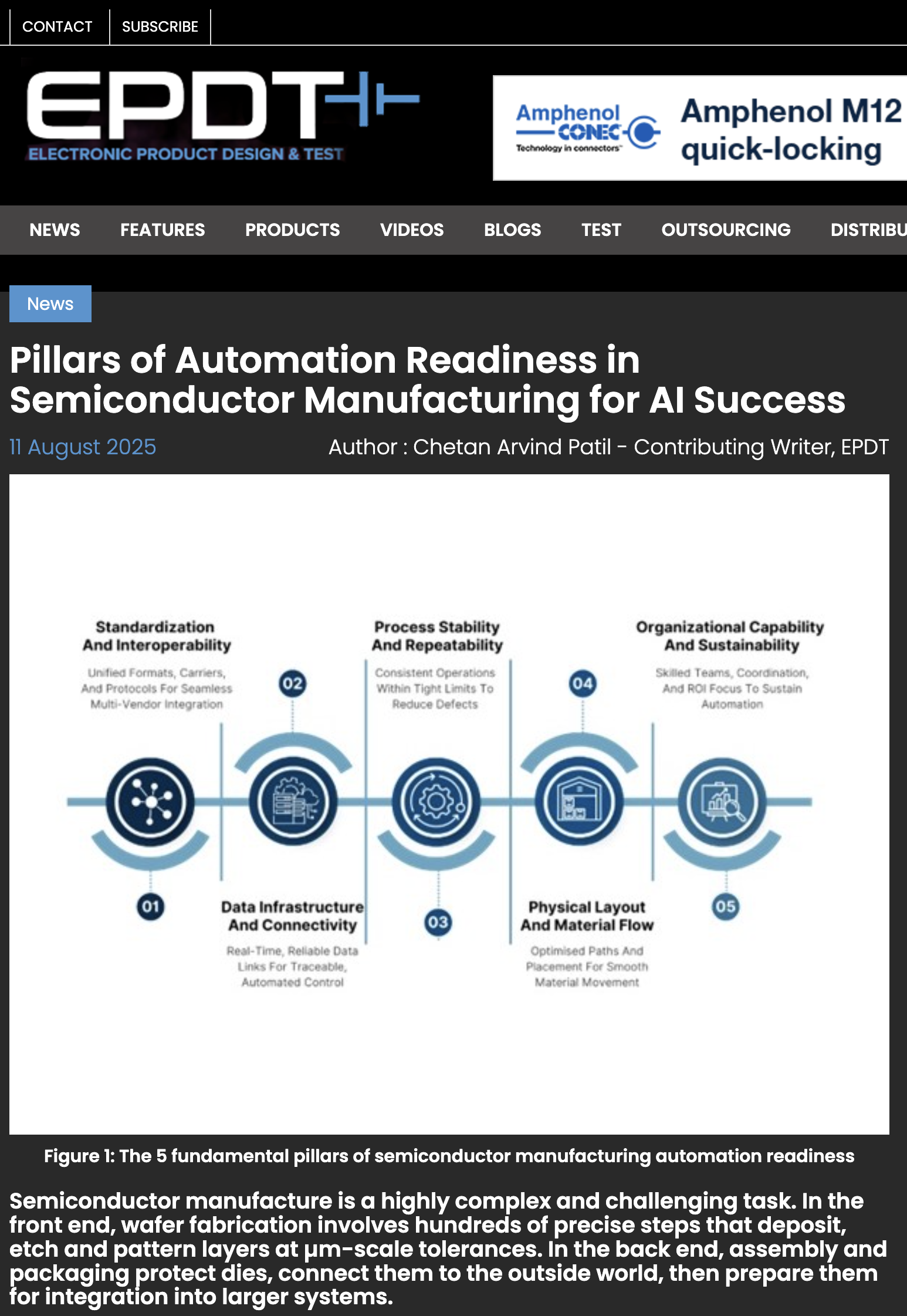
  • Pillars Of Automation Readiness In Semiconductor Manufacturing For AI Success

    Published By: Electronics Product Design And Test
    Date: August 2025
    Media Type: Online Media Website And Digital Magazine

  • The Post-Moore Semiconductor Computing Shift With Data And Yield At The Core

    Image Generated Using 4o


    The semiconductor industry is at a turning point. For decades, Moore’s Law offered a clear roadmap for progress: double the transistor count, boost performance, and drive costs down.

    That predictability is fading as both computing and semiconductor industry approaches physical and economic limits, forcing engineers, designers, and manufacturers to explore entirely new paths forward.

    In this new era, success depends on more than just clever design. It requires rethinking architectures around data movement, embedding intelligence into manufacturing, and building roadmaps that tightly connect design choices with yield outcomes.

    Let us explore how these shifts are reshaping the industry and setting the stage for the next generation of computing.


    Emergence Of Post-Moore Computing Paradigms

    For years, Moore’s Law, predicting the doubling of transistors every couple of years, was the North Star guiding performance improvements. It provided a clear sense of direction: keep shrinking transistors, pack more onto a chip, and performance will keep improving. But as semiconductor industry approach physical limits, that predictable march forward has slowed. Manufacturing costs are soaring, quantum effects are creeping in at the most minor scales, and simply making transistors smaller is no longer the whole answer.

    This turning point has given rise to what the industry calls More Than Moore approaches, strategies that rethink progress without relying solely on transistor scaling. Instead of building ever larger monolithic chips, engineers are turning to modular design, chiplets, multi-chip modules, and advanced packaging to push performance further. I explored this shift in The More Than Moore Semiconductor Roadmap, where I explained how mixing different chip types (SoC, MCM, SiP) can shrink board footprint, improve flexibility, and even enhance yield.

    Of course, adopting chiplets comes with its challenges. As I discussed in The Hurdles For Semiconductor Chiplets, issues like high-speed interconnect complexity, the need for standard interfaces, and the slower-than-hoped pace of adoption have slowed their mainstream rollout. Encouragingly, some of these barriers are beginning to be addressed through industry-wide collaboration.

    In Universal Chiplet Interconnect Express Will Speed Up Chiplet Adoption, I examined how open protocols like UCIe are laying the groundwork for interoperability between vendors, unlocking economies of scale that could make modular architectures the default choice in the years ahead.

    Ultimately, the value of these innovations extends beyond just sidestepping Moore’s Law. As I highlighted in The Semiconductor Value Of More Than Moore, these approaches allow the industry to build chips that are tuned for specific workloads, balancing cost, performance, and power in ways traditional scaling never could.

    In short, the post-Moore era is not about the end of progress, and it is about redefining what progress looks like, moving from chasing smaller transistors to engineering more intelligent systems.


    Data-Centric Architectures Redefining Chip Design

    As semiconductor industry shift away from Moore’s Law, another transformative trend is emerging: designing chips around data, not just arithmetic operations. In today’s landscape, raw compute is no longer the only king; what matters more is how quickly, efficiently, and intelligently data can be handled.

    Data-centric architectures treat data flow and handling as the heartbeat of the system.

    Rather than moving data through complex pipelines, these architectures embed processing where data lives, right in memory or near the sensors that generate it. This minimizes delays, slashes energy use, and magnifies performance.

    In my post The Semiconductor Data Driven Decision Shift, I explored how data collected from fabrication, including inline metrology, critical dimensions, and yield analytics, is transforming design loops. The hardware must now be agile enough to feed, respond to, and benefit from data streams in real time.

    Similarly, as covered in The Hybrid AI And Semiconductor Nexus, the convergence of AI and semiconductors is accelerating edge intelligence. When chips must support neural networks locally on mobile, IoT, or edge devices, the data-centric mindset demands memory hierarchies and compute structures that prioritize data movement over raw transistor counts.

    Looking ahead, semiconductor industry (alongside computing industry) will see architectures that tightly couple storage and compute, such as near memory or in-memory computing, to process data where it resides. This is not theoretical, and industries already experimenting with these paradigms are seeing significant gains in AI workloads, graph analytics, and streaming data operations.

    In essence, data-centric design reframes the challenge. Instead of asking “How many operations per second can an architecture perform?”, customer will now ask, “How smartly and swiftly can the silicon architecture handle data at scale?”


    Yield Optimization As A Critical Success Factor

    As semiconductor industry sharpen our focus on smarter, data-centric architectures, it becomes clear that progress is not just about innovative chip design, it is also about turning those designs into reality cost-effectively. That is where yield optimization comes in. It is the art and science of ensuring that as many chips as possible coming off the production line actually work, and do so reliably.

    High yield is not just a technical win, and it is a business one, too. In The Economics Of Semiconductor Yield, I explored how yield directly impacts cost per chip, profit margins, and competitiveness. When yield climbs, manufacturers can lower prices, reinvest in innovation, and stay agile in rapidly shifting markets.

    But yield is not something that magically appears. It must be managed. In The Semiconductor Smart Factory Basics, I examined how real-time data, such as wafer metrology and inline process metrics, can alert fabs to yield drifts early, allowing for proactive adjustments rather than costly reactive fixes.

    Understanding why yield issues arise is just as essential. As discussed in The Semiconductor Technical Approach To Defect Pattern Analysis For Yield Enhancement, analyzing defect patterns, whether they are random or systematic, lets engineers pinpoint root causes of failures and fine-tune processes.

    In short, yield optimization is the bridge from clever design to efficient production. When a chip’s architecture is data savvy but the fab process cannot reliably deliver functional units, everything falls apart. By embedding data-driven monitoring, agile control mechanisms, and targeted defect analysis into manufacturing, yield becomes the silent enabler of performance innovation.


    Bridging Data And Yield To Enable Strategies For Future-Ready Chipmaking

    From data-centric architectures to yield optimization, the next step is clear, and unite these forces within a single, forward-looking roadmap. Such a roadmap makes data and yield inseparable from the earliest design stages to high-volume manufacturing.

    In The Semiconductor Learning Path: Build Your Own Roadmap Into The Industry, I outlined how understanding the whole value chain from design to manufacturing enables data-driven decisions that directly influence yield.

    Disruptions like those in The Impact Of Semiconductor Equipment Shortage On Roadmap show why yield data and adaptive planning must be built in from the start. Real-time insights allow teams to adjust plans without losing competitiveness.

    At the ecosystem level, India’s Roadmap To Semiconductor Productisation shows how aligning design, manufacturing, and policy can create resilient industries. Technical alignment is just as important. In The Need To Integrate Semiconductor Die And Package Roadmap, I explained why die and package planning must merge to optimise yield and performance.

    Finally, the Semiconductor Foundry Roadmap Race illustrates how foundries are embedding yield and data feedback into their roadmaps, making them competitive assets rather than static plans.

    Bridging data and yield within a cohesive roadmap turns chipmaking into a dynamic, feedback-driven process, essential for strategies that are truly future post-Moore era.


    In summary, the Post-Moore era demands a different mindset. Progress is no longer a straight line of shrinking transistors, but a complex interplay of more innovative architectures, intelligent data handling, and disciplined manufacturing.

    By uniting these elements through thoughtful roadmaps, both the computing and the semiconductor industry can continue delivering breakthroughs that meet the demands of AI, edge computing, and emerging applications. The path ahead will be shaped by those who can integrate design ingenuity, data-driven insight, and yield mastery into one continuous cycle of innovation.


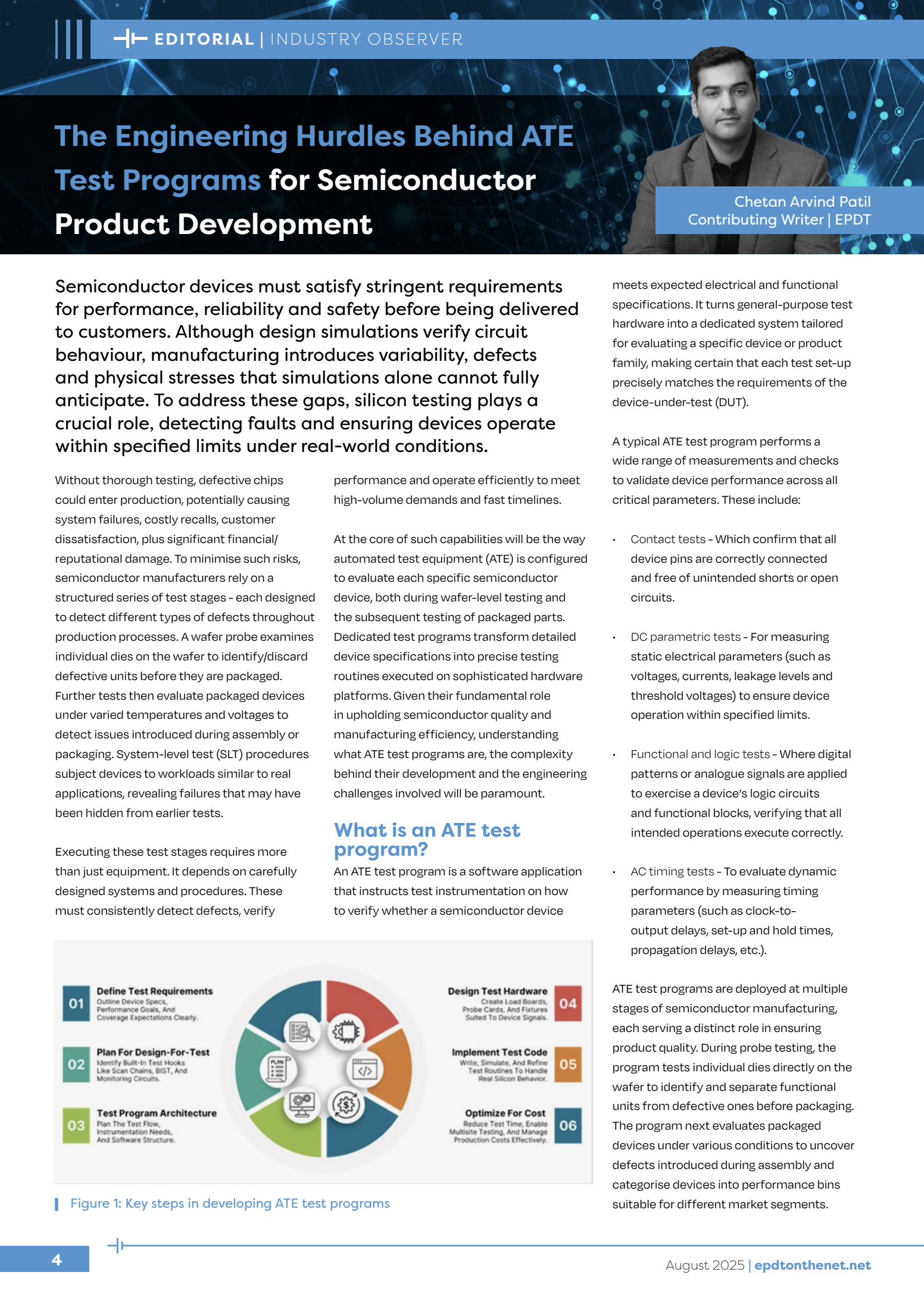
  • The Engineering Hurdles Behind ATE Test Programs For Semiconductor Product Development

    Published By: Electronics Product Design And Test
    Date: August 2025
    Media Type: Online Media Website And Digital Magazine

  • The Semiconductor Data Gravity Problem

    Image Generated Using 4o


    What Is Data Gravity And Why It Matters In Semiconductors

    The term “data gravity” originated in cloud computing to describe a simple but powerful phenomenon: as data accumulates in one location, it becomes harder to move, and instead, applications, services, and compute resources are pulled toward it.

    In the semiconductor industry, this concept is not just relevant, it is central to understanding many of the collaboration and efficiency challenges teams face today.

    Semiconductor development depends on highly distributed toolchains. Design engineers work with EDA tools on secure clusters, test engineers rely on ATE systems, yield analysts process gigabytes of parametric data, and customer telemetry feeds back into field diagnostics.

    Consider a few common examples:

    • RTL simulation datasets stored on isolated HPC systems, inaccessible to ML workflows hosted in the cloud
    • Wafer test logs are locked in proprietary ATE formats or local storage, limiting broader debug visibility
    • Yield reports are buried in fab-side data lakes, disconnected from upstream design teams, and are used for troubleshooting quality issues
    • Post-silicon debug results that never make it back to architecture teams due to latency, access control, or incompatible environments

    Yet all of this breaks down when data cannot move freely across domains or reach the people who need it most. The result is bottlenecks, blind spots, and duplicated effort.

    These are not rare cases. They are systemic patterns. As data grows in volume and value, it also becomes more challenging to move, more expensive to duplicate, and more fragmented across silos. That is the gravity at play. And it is reshaping how semiconductor teams operate.


    Where Does Data Gravity Arise In Semiconductor Workflows?

    To grasp the depth of the data gravity problem in semiconductors, we must examine where data is generated and how it becomes anchored to specific tools, infrastructure, or policies, making it increasingly difficult to access, share, or act upon.

    The table below summarizes this:

    StageData GeneratedTypical Storage LocationGravity Consequence
    Front-End DesignNetlists, simulation waveforms, coverage metricsEDA tool environments, NFS file sharesData stays close to local compute, limiting collaboration and reuse
    Back-End VerificationTiming reports, power grid checks, IR drop analysisOn-prem verification clustersData is fragmented across tools and vendors, slowing full-chip signoff
    Wafer TestShmoo plots, pass/fail maps, binning logsATE systems, test floor databasesDebug workflows become localized, isolating valuable test insights
    Yield and AnalyticsDefect trends, parametric distributions, WAT dataInternal data lakes, fab cloud platformsInsightful data often remains siloed from design or test ML pipelines
    Field OperationsRMA reports, in-system diagnosticsSecure internal servers or vaultsFeedback to design teams is delayed due to access and compliance gaps

    Data in semiconductor workflows is not inherently immovable, but once it becomes tied to specific infrastructure, proprietary formats, organizational policies, and bandwidth limitations, it starts to resist movement. This gravity effect builds over time, reducing efficiency, limiting visibility, and slowing responsiveness across teams.


    The Impact Of Data Gravity On Semiconductor Teams

    As semiconductor workflows become more data-intensive, teams across the product lifecycle are finding it increasingly difficult to move, access, and act on critical information. Design, test, yield, and field teams each generate large datasets, but the surrounding infrastructure is often rigid, siloed, and tightly tied to specific tools. This limits collaboration and slows feedback.

    For instance, test engineers may detect a recurring fail pattern at wafer sort, but the related data is too large or sensitive to share. As a result, design teams may not see the whole picture until much later. Similarly, AI models for yield or root cause analysis lose effectiveness when training data is scattered across disconnected systems.

    Engineers often spend more time locating and preparing data than analyzing it. Redundant storage, manual processes, and disconnected tools reduce productivity and delay time-to-market. Insights remain locked within silos, limiting organizational learning.

    In the end, teams are forced to adapt their workflows around where data lives. This reduces agility, slows decisions, and weakens the advantage that integrated data should provide.


    Overcoming Data Gravity In Semiconductor

    Escaping data gravity starts with rethinking how semiconductor teams design their workflows. Instead of moving large volumes of data through rigid pipelines, organizations should build architectures that enable computation and analysis to occur closer to where data is generated.

    Cloud-native, hybrid, and edge-aware systems can support local inference, real-time monitoring, or selective data sharing. Even when whole data movement is not feasible, streaming metadata or feature summaries can preserve value without adding network or compliance burdens.

    Broader access can also be achieved through federated data models and standardized interfaces. Many teams work in silos, not by preference, but because incompatible formats, access restrictions, or outdated tools block collaboration.

    Aligning on common data schemas, APIs, and secure access frameworks helps reduce duplication and connects teams across design, test, and field operations. Addressing data gravity is not just a technical fix.

    It is a strategic step toward faster, wiser, and more integrated semiconductor development.